Visine comfort
Ukraine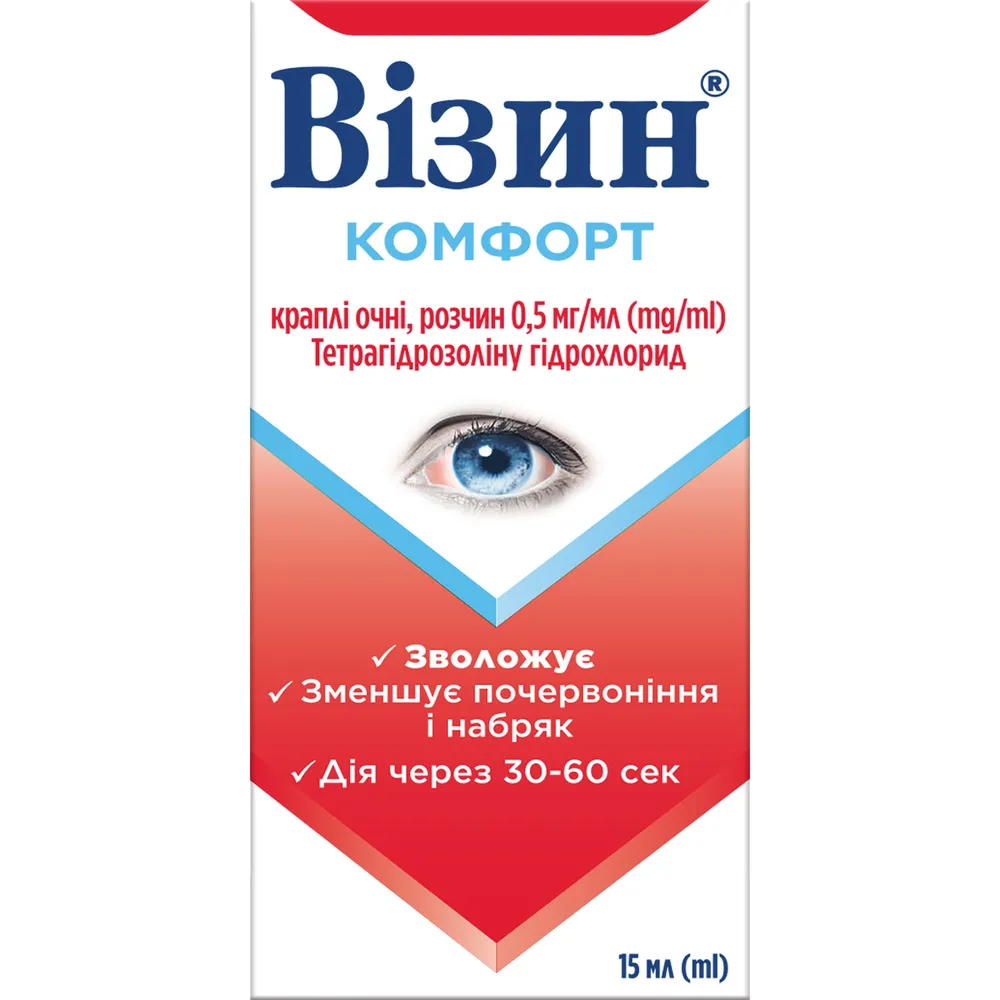
Table of Contents
INSTRUCTIONS FOR MEDICAL USE OF THE MEDICINAL PRODUCT VISION® COMFORT (VISINE® COMFORT)
Composition:
Active substance: tetrahydrozoline hydrochloride;
1 ml of solution contains tetrahydrozoline hydrochloride 0.5 mg;
Excipients: glycerin (99.5%); hypromellose 2910; macrogol 400; boric acid; sodium dihydrogen phosphate; sodium citrate; potassium chloride; magnesium chloride, hexahydrate; sodium lactate solution (50%); glycine; ascorbic acid; glucose, monohydrate; polyquaternium chloride (polyquaternium 42) (33% solution); purified water.
Pharmaceutical form. Eye drops, solution.
Main physicochemical properties: clear solution, colorless to slightly yellow.
Pharmacotherapeutic group.
Agents used in ophthalmology. Anti-edematous and anti-allergic agents. Sympathomimetics used as anti-edematous agents.
ATC code S01G A02.
Pharmacological properties.
Pharmacodynamics.
Mechanism of action
Tetrahydrozoline is a sympathomimetic agent belonging to the group of imidazoline decongestants. It directly stimulates alpha-adrenergic receptors of the sympathetic nervous system with minimal or no effect on beta-adrenergic receptors.
Pharmacodynamic effects
As a sympathomimetic amine, tetrahydrozoline has vasoconstrictive and decongestant properties. When applied topically to the conjunctival mucosa, the drug exerts a temporary vasoconstrictive effect on small blood vessels, thereby reducing vasodilation and conjunctival edema.
Clinical efficacy and safety
A double-blind, randomized, controlled study demonstrated symptom relief within 30–60 seconds after instillation of 0.05% tetrahydrozoline. Improvement lasted for 6 hours after administration; however, after 8 hours, the efficacy of tetrahydrozoline and placebo in reducing erythema was similar. Overall, the decongestant effect of tetrahydrozoline lasted from 6 to 8 hours.
A single-day, double-blind, randomized study involving 120 patients showed that 0.05% tetrahydrozoline in the form of ophthalmic drops reduces eye redness compared to baseline within 30 seconds after administration and improves ocular comfort for up to 12 hours when used as directed. A participant questionnaire assessing sensory benefits as secondary endpoints demonstrated significant improvement (p < 0.001) in the sensation of eye moisture compared to baseline at 60 seconds, 10 hours, and 12 hours after the first instillation of ophthalmic drops.
Pharmacokinetics.
Absorption
In a study involving 10 healthy volunteers, systemic absorption varied between individuals, with maximum serum concentrations ranging from 0.068 to 0.380 ng/mL.
When applied topically as directed, systemic absorption is not expected to be clinically significant. However, after topical application, especially in patients with damaged mucosa or epithelium, systemic absorption cannot be excluded.
Distribution
Data are lacking.
Metabolism
Data are lacking.
Excretion
In a study involving 10 healthy volunteers, after ophthalmic therapeutic use, tetrahydrozoline concentrations in serum and urine were detectable. The mean elimination half-life of tetrahydrozoline from serum was approximately 6 hours. Within 24 hours, all patients had detectable concentrations of tetrahydrozoline in urine.
Linearity/non-linearity
Data are lacking.
Preclinical safety data
Local toxicity
Application of a buffered (pH 5.5) solution of tetrahydrozoline (0.25% and 0.50%) twice daily for 5 consecutive days showed no eye irritation in rabbits.
Acute toxicity
Animal studies did not demonstrate specific sensitivity to tetrahydrozoline hydrochloride. The acute oral LD50 was 420 mg/kg in mice and 785 mg/kg in rats.
Chronic toxicity
No active substance-related toxicity was observed in rats after oral administration of 10 to 30 mg of tetrahydrozoline hydrochloride per kilogram of body weight over several weeks. In rhesus macaques, prolonged sedation and hypnotic state were observed after intravenous administration of 5 to 10 mg/kg body weight over 120 days and after oral administration of 5 to 50 mg/kg body weight over 32 weeks. However, when used as ophthalmic drops as directed, minimal systemic toxicity is expected.
Preclinical data on genotoxicity, carcinogenicity, or reproductive toxicity of tetrahydrozoline are lacking.
Clinical characteristics.
Indications.
Temporary relief of ocular hyperemia secondary to irritating effects of non-infectious factors such as smoke, dust, wind, chlorinated water, light, or due to allergic conjunctivitis.
Contraindications.
Hypersensitivity to the active substance or to any of the excipients.
Closed-angle glaucoma.
Children under 2 years of age.
Interaction with other medicinal products and other forms of interaction.
Concomitant use of monoamine oxidase inhibitors (MAO) of the tranylcypromine type or tricyclic antidepressants together with other medicinal products that have the potential to increase blood pressure (such as tetrahydrozoline hydrochloride) may potentiate their vasoconstrictor effects and elevate blood pressure. Therefore, such combinations should be avoided.
Prior to concomitant use with other ophthalmic medications, consultation with a physician is required.
Special precautions for use.
Vizin® Comfort should not be used in the presence of:
- severe cardiovascular disorders (e.g., ischemic heart disease, arterial hypertension, pheochromocytoma);
- prostate hyperplasia;
- metabolic disorders (e.g., hyperthyroidism, diabetes, porphyria);
- dry rhinitis;
- dry keratoconjunctivitis;
- glaucoma (detailed information is provided below).
Excessive or prolonged use of this medication (longer than 3–5 days) may lead to tachyphylaxis and result in increased eye redness (rebound hyperemia) or nasal mucosa congestion (medication-induced rhinitis); therefore, such use should be avoided.
This medicinal product may be used in children aged 2 to 6 years only after consultation with a physician.
Prolonged and excessive use of the medication should be avoided, especially in children. Use in children and administration of higher doses should be performed only under medical supervision.
Use in narrow-angle glaucoma is contraindicated. Use in other types of glaucoma should be performed under medical supervision.
Even the recommended doses for topical use should be administered with caution in patients with signs of hyperthyroidism, heart disease, high blood pressure, or diabetes mellitus.
Patients using Vizin® Comfort should be advised that eye irritation or redness may be symptoms of a serious eye condition, and they should be encouraged to consult an ophthalmologist.
Vizin® Comfort should be used only for mild eye irritation. If improvement is not observed within 48 hours of use, or if eye irritation or redness persists or worsens, use should be discontinued and medical advice sought.
Eye irritation or redness due to infection, presence of foreign bodies, or chemical injury to the cornea requires medical treatment. If eye pain, headache, vision loss, visual disturbances (e.g., floating "spots" or double vision), severe acute or unilateral eye redness, or photophobia occur, use should be discontinued immediately and medical attention sought without delay.
After using this medication, pupils may temporarily dilate.
In patients with existing eye disorders, contact lenses should generally not be used. If a patient wears contact lenses, they should be removed before instilling the medication and may be reinserted no sooner than 15 minutes after instillation.
The medication should not be used if the solution has changed color or become cloudy. Any unused medicinal product and waste material should be disposed of in accordance with local guidelines.
Use during pregnancy or breastfeeding.
Pregnancy
Adequate and well-controlled studies of tetrahydrozoline use in pregnant women have not been conducted. This medication should not be used during pregnancy unless, in the opinion of the physician, the potential benefit to the mother outweighs the possible risks to the fetus.
Breastfeeding
Adequate and well-controlled studies of tetrahydrozoline use in women who are breastfeeding have not been conducted. Data on the excretion of tetrahydrozoline or its metabolites in human breast milk are lacking. This medication should not be used during breastfeeding except when, in the opinion of the physician, the potential benefit to the mother outweighs the possible risks to the breastfed infant.
Fertility
Data are lacking.
Ability to affect reaction speed when driving or operating machinery.
Ophthalmic medications may cause temporary visual disturbances (blurred vision and mydriasis), which may impair the ability to drive or operate machinery. Patients should be advised to wait until visual disturbances have resolved before driving or operating machinery.
Method of Administration and Dosage
Dosage
Adults and children aged 6 years and older
Instill 1–2 drops of the solution into the affected eye(s) 2–3 times daily.
This medicinal product should be used for the shortest duration necessary to relieve symptoms. See section "Special Warnings and Precautions for Use" regarding rebound risk with prolonged use.
Children under 12 years of age should use the medication under adult supervision.
Children aged 2 to 6 years
This medication may be used in children aged 2 to 6 years only after consultation with a physician (see section "Special Warnings and Precautions for Use"). The recommended dose is 1 drop of solution into the affected eye(s) 2–3 times daily.
The medication is contraindicated in children under 2 years of age (see section "Contraindications").
Method of Administration
For ophthalmic use.
After removing the cap, invert the bottle and gently squeeze it so that one or two drops fall from the tip into the eye, without touching the eye. The bottle tip must not come into contact with any surfaces other than the cap to prevent contamination of the solution.
Children
The medication should be administered to children according to the dosage specified in the section "Method of Administration and Dosage." Vizin® Comfort is contraindicated in children under 2 years of age.
Overdose
Review of available safety data has not revealed adverse reactions related to overdose. Symptoms of overdose are unlikely following ophthalmic administration; however, if ingested, tetriazole may cause serious adverse effects.
Symptoms
The clinical picture of intoxication with imidazole derivatives may be unclear, as periods of stimulation and depression of the central nervous and cardiovascular systems may alternate.
Symptoms of central nervous system stimulation include anxiety, excitement, hallucinations, and seizures.
Symptoms of central nervous system depression include decreased body temperature, lethargy, drowsiness, and coma.
Additional symptoms may include miosis, mydriasis, sweating, fever, pallor, cyanosis, nausea, vomiting, tachycardia, bradycardia, cardiac arrhythmia, rapid heartbeat, cardiac arrest, arterial hypertension, shock-like hypotension, pulmonary edema, respiratory disturbances, salivation, and apnea. In children, overdose due to ingestion may particularly lead to predominant effects on the central nervous system, including convulsions, coma, bradycardia, apnea, and arterial hypertension, which may subsequently shift to hypotension.
A dose as low as 0.01 mg of tetriazoline hydrochloride per kilogram of body weight should be considered toxic.
Treatment
Administration of activated charcoal, gastric lavage, oxygen therapy, management of hyperthermia, and anticonvulsant therapy. Vasopressors are contraindicated in patients with hypotension.
If anticholinergic symptoms develop, an antidote such as physostigmine should be administered.
Adverse Reactions
Adverse reactions of the medicinal product identified during clinical trials of tetriolol 0.05% and during the post-marketing period are listed in the table below, classified by organ system classes.
The frequencies are presented according to the following conventional classifications: very common (≥ 1/10), common (≥ 1/100 to < 1/10), uncommon (≥ 1/1000 to < 1/100), rare (≥ 1/10,000 to < 1/1000), very rare (< 1/10,000), frequency not known (cannot be estimated from available data).
Adverse reactions of the medicinal product are listed by frequency category, taking into account:
- frequencies observed in adequately designed clinical or epidemiological studies, if such studies have been conducted, or
- if frequency cannot be calculated, it is labelled as "frequency not known".
| Organ system class |
Frequency |
Adverse drug reaction (preferred term) |
| Eye disorders |
Common |
Eye irritation (pain, stinging, burning), visual disturbance |
| Uncommon |
Mydriasis |
|
| Rare |
Epithelial keratinization (xerosis) of conjunctiva with lacrimal puncta occlusion and epiphora (excessive tearing) after prolonged use of tetrizoline |
|
| Frequency not known |
Increased lacrimation |
|
| General disorders and administration site conditions |
Common |
Reactive hyperemia, mucosal burn, dryness of mucous membranes |
| Frequency not known |
Application site reactions (including burning sensation in eyes and periorbital area, erythema, irritation, swelling, pain and pruritus) |
Undesirable effects associated with excipients
In some patients with significant corneal damage, very rare cases of corneal calcification have been reported with the use of eye drops containing phosphates.
Reporting of suspected adverse reactions
Reporting suspected adverse reactions after authorization of the medicinal product is important. It allows ongoing monitoring of the benefit-risk balance of the medicinal product. Medical and pharmaceutical personnel, as well as patients or their legal representatives, are encouraged to report all suspected adverse reactions and lack of efficacy through the Automated Pharmacovigilance Information System at the following link: https://aisf.dec.gov.ua/.
Shelf life.
36 months. After first opening of the container – 6 weeks.
Storage conditions.
Store at a temperature not exceeding 30 °C. Keep out of reach of children.
Packaging
15 ml of solution in a bottle with a dropper dispenser and child-resistant cap. One bottle with the instruction for medical use is packaged in a cardboard box.
Classification by availability.
Over-the-counter (without prescription).
Manufacturer.
Janssen Pharmaceutica NV.
Manufacturer's address and location.
Turnhoutseweg 30, Beerse, 2340, Belgium.
Marketing Authorization Holder.
McNeil Products Limited.
Address of the Marketing Authorization Holder.
50-100 Holmers Farm Way, High Wycombe, HP12 4EG, England.
Representative of the Marketing Authorization Holder.
LLC "Johnson & Johnson Ukraine"
Address of the representative of the Marketing Authorization Holder.
32/2 Ostrizkykh Knyaziv Street, Kyiv, 01010, Ukraine.
+38 (044) 498 0888
+38 (044) 498 7392