Visque
Ukraine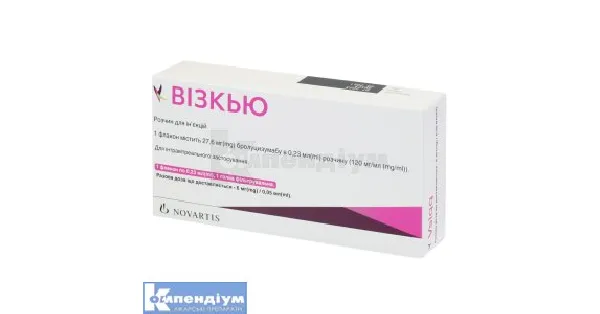
Table of Contents
INSTRUCTIONS FOR MEDICAL USE OF THE MEDICINAL PRODUCT VSIQQ
Composition:
Active substance: brolucizumab;
1 vial contains 27.6 mg of brolucizumab in 0.23 ml of solution (120 mg/ml)
(provides a deliverable amount sufficient for a single dose of 0.05 ml of solution containing 6 mg of brolucizumab);
Excipients: sodium citrate, sucrose, polysorbate 80, water for injections.
Pharmaceutical form. Solution for injection.
Main physicochemical properties: clear or slightly opalescent aqueous solution, colorless to pale brownish-yellow.
Pharmacotherapeutic group.
Agents used in eye vascular diseases. Anti-neovascularization agents. Brolucizumab. ATC code S01LA06.
Pharmacological Properties
Pharmacodynamics
Mechanism of Action
Brolucizumab is a single-chain Fv-(scFv) fragment of a humanized monoclonal antibody with a molecular mass of approximately 26 kDa.
Elevated signaling through the vascular endothelial growth factor A (VEGF-A) pathway is associated with pathological ocular angiogenesis and retinal edema. Brolucizumab binds with high affinity to VEGF-A isoforms (e.g., VEGF110, VEGF121, and VEGF165), thereby preventing VEGF-A from binding to its receptors VEGFR-1 and VEGFR-2. This results in inhibition of endothelial cell proliferation, leading to reduced pathological neovascularization and vascular permeability.
Pharmacodynamic Effects
Neovascular (exudative) age-related macular degeneration (AMD)
Anatomical parameters related to leakage of blood and fluid characteristic of choroidal neovascularization (CNV) were part of the disease activity assessments used to guide treatment decisions in the HAWK and HARRIER studies. Reductions in central subfield thickness (CST) and the presence of intraretinal/subretinal fluid (IRF/SRF) or fluid under the retinal pigment epithelium (sub-RPE) were observed in patients receiving brolucizumab as early as 4 weeks after initiation of treatment and were maintained up to weeks 48 and 96.
At week 16, the reduction in CST was statistically significant in the brolucizumab group compared to aflibercept in both studies (HAWK: -161 vs. -134 microns; HARRIER: -174 vs. -134 microns). This CST reduction remained statistically significant at week 48 compared to baseline (HAWK: -173 vs. -144 microns; HARRIER: -194 vs. -144 microns) and was sustained until the end of each study at week 96 (HAWK: -175 vs. -149 microns; HARRIER: -198 vs. -155 microns).
At week 16, the difference in the percentage of patients with IRF and/or SRF was statistically significant in the brolucizumab group compared to aflibercept in both studies (HAWK: 34% vs. 52%; HARRIER: 29% vs. 45%). This difference remained statistically significant at week 48 (HAWK: 31% vs. 45%; HARRIER: 26% vs. 44%) and was maintained until the end of each study at week 96 (HAWK: 24% vs. 37%; HARRIER: 24% vs. 39%).
At week 16, the difference in the percentage of patients with sub-RPE fluid was statistically significant in the brolucizumab group compared to aflibercept in both studies (HAWK: 19% vs. 27%; HARRIER: 16% vs. 24%). This difference remained statistically significant at week 48 (HAWK: 14% vs. 22%; HARRIER: 13% vs. 22%) and was sustained until the end of each study at week 96 (HAWK: 11% vs. 15%; HARRIER: 17% vs. 22%).
In these studies, a reduction in CNV lesion size was observed in patients receiving brolucizumab as early as week 12 and at weeks 48 and 96 after initiation of treatment.
Diabetic macular edema (DME)
In the KESTREL and KITE studies, relevant anatomical parameters were part of the disease activity assessments used to guide treatment decisions. Reductions in CST and the presence of IRF/SRF were observed in patients receiving Vabysmo (brolucizumab) as early as 4 weeks after initiation of treatment and were maintained up to week 52. These improvements were sustained through week 100.
Clinical Efficacy and Safety
Neovascular (exudative) age-related macular degeneration (AMD)
The safety and efficacy of brolucizumab were evaluated in two randomized, multicenter, double-masked, active-controlled Phase III studies (HAWK and HARRIER) in patients with neovascular (exudative) AMD. Overall, 1817 patients were enrolled across both studies over two years (1088 received Vabysmo and 729 received the comparator aflibercept). Patient age ranged from 50 to 97 years, with a mean age of 76 years.
In both studies, after the initial three monthly doses (weeks 0, 4, and 8), patients in the brolucizumab group received treatment every 12 weeks, with the option to adjust to every 8 weeks based on disease activity. Disease activity was assessed by the investigator during the first 12-week interval (at weeks 16 and 20 after randomization) and at each subsequent scheduled visit every 12 weeks. Injection frequency in patients with active disease (e.g., decline in visual acuity (VA), increase in CST, and/or presence of IRF/SRF or sub-RPE fluid) at any visit was shortened to an 8-week interval. The comparator drug aflibercept was administered every 8 weeks after the first three monthly doses.
Results
The primary efficacy endpoint in both studies was the change from baseline in best-corrected visual acuity (BCVA) at week 48, measured using the ETDRS (Early Treatment Diabetic Retinopathy Study) chart. The primary objective was to demonstrate non-inferiority of brolucizumab compared to aflibercept. In both studies, brolucizumab (administered every 12 weeks/8 weeks as needed) demonstrated non-inferior efficacy compared to aflibercept 2 mg (administered every 8 weeks). The improvement in visual acuity observed during the first year of the studies was maintained throughout the second year.
Detailed results from both studies are presented in Table 1.
Table 1
Visual acuity assessment results at weeks 48 and 96 in Phase III studies (HAWK and HARRIER)
| Effectiveness result |
Week |
HAWK |
HARRIER |
||||
| Medicinal product Vyzcye (n=360) |
Aflibercept 2 mg (n = 360) |
Difference (95 % CI) brolucizumab – aflibercept |
Medicinal product Vyzcye (n = 370) |
Aflibercept 2 mg (n = 369) |
Difference (95 % CI) brolucizumab – aflibercept |
||
| Mean change in BCVA from baseline (according to ETDRS visual acuity chart) |
48 |
6.6 (SE = 0.71) |
6.8 (SE = 0.71) |
-0.2 (-2.1; 1.8) P < 0.0001a) |
6.9 (SE = 0.61) |
7.6 (SE = 0.61) |
-0.7 (-2.4; 1.0) P < 0.0001a) |
| 36–48b) |
6.7 (SE = 0.68) |
6.7 (SE = 0.68) |
0.0 (-1.9; 1.9) P < 0.0001a) |
6.5 (SE = 0.58) |
7.7 (SE = 0.58) |
-1.2 (-2.8; 0.4) P = 0.0003a) |
|
| 96 |
5.9 (SE = 0.78) |
5.3 (SE = 0.78) |
0.5 (-1.6; 2.7) |
6.1 (SE = 0.73) |
6.6 (SE = 0.73) |
-0.4 (-2.5; 1.6) |
|
| % of patients achieving improvement in VA by at least 15 letters |
48 |
33.6 |
25.4 |
8.2 (2.2; 15.0) |
29.3 |
29.9 |
-0.6 (-7.1; 5.8) |
| 96 |
34.2 |
27.0 |
7.2 (1.4; 13.8) |
29.1 |
31.5 |
-2.4 (-8.8; 4.1) |
|
| % of patients with decreased VA (%) (loss of BCVA by > 15 letters) |
48 |
6.4 |
5.5 |
0.9 (-2.7; 4.3) |
3.8 |
4.8 |
-1.0 (-3.9; 2.2) |
| 96 |
8.1 |
7.4 |
0.7 (-3.6; 4.6) |
7.1 |
7.5 |
-0.4 (-3.8; 3.3) |
|
Missing data were imputed using the last observation carried forward (LOCF) method;
SE – standard error.
a) P-value refers to the confirmation of the non-inferiority hypothesis with a non-inferiority margin of 4 letters.
b) Primary secondary endpoint accounting for differences in the treatment period with brolucizumab and aflibercept.
Improvement in BCVA was achieved in 56% and 51% of patients receiving brolucizumab every 12 weeks at Week 48, and in 45% and 39% of patients at Week 96 in the HAWK and HARRIER studies, respectively. Among patients identified as eligible for achieving the 12-week interval during the first 12 weeks, 85% and 82% of patients remained on treatment every 12 weeks up to Week 48. Among patients receiving treatment every 12 weeks at Week 48, 82% and 75% continued treatment every 12 weeks up to Week 96.
Efficacy results across all subgroups (e.g., by age, sex, race, baseline BCVA, baseline CST, type of lesion, lesion size, fluid status) in each study were generally consistent with results in the overall populations.
Disease activity was assessed by changes in BCVA and/or anatomical parameters, including CST and/or presence of IRF/SRF, sub-RPE. Disease activity was evaluated throughout the study periods. Anatomical signs of disease activity decreased at Weeks 48 and 96 with brolucizumab treatment compared to aflibercept (see section "Pharmacodynamics").
The difference in the percentage of patients with disease activity at Week 16 was statistically significant in the brolucizumab group compared to aflibercept (24% vs. 35% in the HAWK study, p = 0.0013; 23% vs. 32% in the HARRIER study, p = 0.0021).
In both studies, brolucizumab demonstrated clinically meaningful improvement from baseline in the pre-specified secondary patient-reported treatment outcome endpoint, as measured by the National Eye Institute Visual Function Questionnaire (NEI VFQ-25). The magnitude of these changes was similar to that reported in published studies, corresponding to a 15-letter improvement in BCVA. Patients reported that treatment benefits were maintained throughout the second year of the studies.
No clinically meaningful differences between brolucizumab and aflibercept were observed from baseline to Week 48 in terms of improvement in the composite score and individual subscales of the NEI VFQ-25 (near vision, distance vision, social functioning, mental health, ocular pain, dependency, color vision, peripheral vision, communication difficulties, driving, and general vision).
The results of the HAWK and HARRIER studies, in which the first 3 doses (loading doses) of Vabysmo were administered every 4 weeks (monthly) followed by maintenance dosing every 12 or 8 weeks, were reproduced in a simulation study using a population pharmacokinetic/pharmacodynamic model, where the first 2 or 3 doses (loading doses) of Vabysmo were administered every 6 weeks followed by maintenance dosing every 12 or 8 weeks.
The "Treat-and-Extend" regimen for the maintenance phase was evaluated in the TALON study, a 64-week, randomized, double-masked, multicenter, phase IIIb study with two comparison groups, assessing the efficacy and safety of Vabysmo compared to aflibercept 2 mg in patients with neovascular (exudative) AMD.
A total of 737 patients were randomized in a 1:1 ratio to one of two treatment groups: brolucizumab 6 mg or aflibercept 2 mg. Patients in both groups received an injection of the assigned drug every 4 weeks for the first 3 injections, followed by one injection at 8 weeks. After that, dosing intervals were extended to 8, 12, or 16 weeks until Week 60 or 62.
The mean change in best-corrected visual acuity (BCVA) from baseline at Week 64 was +4.7 letters (ETDRS) with Vabysmo and +4.9 letters (ETDRS) with aflibercept 2 mg, respectively.
Treatment interval results at Week 64 are presented in Table 2.
Table 2
Last treatment interval without disease activity: proportion of patients at Week 64
| Study groups |
||
| Interval (weeks) |
Brolucizumab, 6 mg n = 366 |
Aflibercept, 2 mg n = 368 |
| 4 |
23.2 % |
41.8 % |
| 8 |
26.0 % |
22.0 % |
| 12 |
22.4 % |
23.9 % |
| 16 |
28.4 % |
12.2 % |
255 patients who completed the TALON study were enrolled in a 56-week single-arm open-label extension of the TALON study (TALON extension) and received brolocizumab treatment using a "Treat&Extend" regimen without a loading phase and with a maximum treatment interval of up to 20 weeks.
By week 56, over 50% of the 237 subjects who received at least 2 injections had a treatment interval of 16 weeks (24.9%) or 20 weeks (28.7%) and showed no disease activity, while visual acuity was maintained throughout the study period.
Diabetic Macular Edema (DME)
The efficacy and safety of Vyzure were evaluated in two randomized, multicenter, double-masked, active-controlled Phase III studies (KESTREL and KITE) involving patients with vision impairment due to diabetic macular edema. Overall, 926 patients participated in these studies over two years (558 patients received brolocizumab and 368 patients received aflibercept at a dose of 2 mg). Patient age ranged from 23 to 87 years, with a mean age of 63 years.
In both studies, after the first five doses (weeks 0, 6, 12, 18, and 24), patients received brolocizumab treatment every 12 weeks, with the possibility of adjusting the injection interval to 8 weeks based on the presence of disease activity. Disease activity was assessed by the physician during the first 12-week period (at weeks 32 and 36) and at each subsequent scheduled visit. Patients who showed signs of disease activity (e.g., decreased BCVA, increased CST at any visit) had their injection interval adjusted to 8 weeks. In the second year of the KITE study, for patients with no evidence of disease activity, the treatment interval could be extended to 16 weeks. The comparator drug, aflibercept, was administered every 8 weeks after the initial five monthly doses.
Results
The primary efficacy endpoint in both studies was the change from baseline in BCVA score at week 52 according to the ETDRS visual acuity chart. The primary objective was to demonstrate that treatment with Vyzure was non-inferior in efficacy to treatment with aflibercept 2 mg. In both studies, Vyzure (administered every 12 or 8 weeks) demonstrated efficacy non-inferior to that of aflibercept 2 mg (administered every 8 weeks).
The results of the KESTREL and KITE studies also showed that the efficacy of Vyzure treatment was non-inferior to that of aflibercept 2 mg in the key secondary endpoint (mean change from baseline in BCVA during the period from week 40 to week 52).
The improvement in BCVA observed during the first year of treatment was maintained throughout the second year.
Detailed results of both studies are presented in Table 3.
Table 3
Results on change in BCVA at week 52 and week 100 from Phase III studies KESTREL and KITE
| Efficacy parameter |
Week |
KESTREL |
KITE |
|||||
| Byooviz (n = 189) |
Aflibercept 2 mg (n = 187) |
Difference (95 % CI) brolico-zumab – aflibercept |
Byooviz (n = 179) |
Aflibercept 2 mg (n = 181) |
Difference (95 % CI) brolico-zumab – aflibercept |
|||
| Change in BCVA from baseline (ETDRS visual acuity chart) – least squares mean (SE) |
52 |
9.2 (0.57) |
10.5 (0.57) |
‑1.3 (‑2.9; 0.3) P < 0.001a |
10.6 (0.66) |
9.4 (0.66) |
1.2 (‑0.6; 3.1) P < 0.001a |
|
| 40–52 |
9.0 (0.53) |
10.5 (0.53) |
‑1.5 (‑3.0; 0.0) P < 0.001a |
10.3 (0.62) |
9.4 (0.62) |
0.9 (‑0.9; 2.6) P < 0.001a |
||
| 100 |
8.8 (0.75) |
10.6 (0.75) |
‑1.7 (‑3.8; 0.4) |
10.9 (0.85) |
8.4 (0.85) |
2.6 (0.2; 4.9) |
||
| Proportion of patients gaining ≥ 15 letters in BCVA from baseline or achieving BCVA ≥ 84 letters (%) |
52 |
36.0 |
40.1 |
‑4.1 (‑13.3; 5.9) |
46.8 |
37.2 |
9.6 (‑0.4; 20.2) |
|
| 100 |
39.2 |
42.2 |
‑3.0 (‑12.5; 6.3) |
50.4 |
36.9 |
13.6 (3.3; 23.5) |
||
| BCVA after initiation of alternative DME treatment in the study eye were censored and replaced with the last value prior to initiation of such alternative treatment. LS mean – least squares mean. SE – standard error. a P-value related to the confirmation of the hypothesis of non-inferiority with a margin equal to 4 letters. |
||||||||
Such improvement in BCVA was achieved by Week 52 in 55% and 50% of patients receiving VYQVIA every 12 weeks, and by Week 100 in 44% and 37% of patients receiving VYQVIA every 12 weeks or every 12 weeks/16 weeks in the KESTREL and KITE studies, respectively. Approximately 70% of these patients identified as eligible for the 12-week interval during the first 12 weeks received treatment at least every 12 weeks up to Week 100. In the KITE study, 25% of patients received VYQVIA every 16 weeks at Week 100.
The treatment effect in prespecified subgroups (e.g., by age, sex, baseline HbA1c, baseline BCVA, baseline CST, type of DME involvement, duration of DME since diagnosis, presence of retinal fluid status) in each study was generally consistent with results in the overall populations.
In the KESTREL and KITE studies, disease activity was assessed throughout the study periods based on changes in BCVA and/or anatomical parameters, including CST and/or presence of IRF/SRF. Reduction in CST thickness compared to baseline was maintained up to Week 100. At Week 100, the proportion of patients with IRF/SRF was lower in the VYQVIA group (42% – KESTREL and 41% – KITE) compared to the corresponding aflibercept 2 mg group (54% – KESTREL and 57% – KITE).
During the KESTREL and KITE studies, the Diabetic Retinopathy Severity Scale (DRSS) score was evaluated. At baseline, 98.1% of patients in both studies (KESTREL and KITE) had DRSS scores allowing assessment of severity. Based on a pooled analysis, VYQVIA demonstrated non-inferior efficacy compared to aflibercept 2 mg in the proportion of patients achieving at least a 2-step improvement in DRSS score from baseline at Week 52, with a non-inferiority margin of 10%. The observed proportions were 28.9% and 24.9% in the VYQVIA and aflibercept 2 mg groups, respectively, resulting in a treatment difference of 4.0% (95% CI: [-0.6, 8.6]). At Week 100, the proportion of patients with ≥2-step improvement from baseline to Week 100 in DRSS score was 32.8% with VYQVIA and 29.3% with aflibercept 2 mg in the KESTREL study, and 35.8% with VYQVIA and 31.1% with aflibercept 2 mg in the KITE study.
Pharmacokinetics
VYQVIA is administered directly into the vitreous cavity to achieve local ocular effects.
Absorption and Distribution
Following a single intravitreal injection of 6 mg of brolucizumab in patients with nAMD, the geometric mean plasma Cmax of free brolucizumab was 49.0 ng/mL (range: 8.97–548 ng/mL), reached at Day 1.
Metabolism and Elimination
Brolucizumab is a monoclonal antibody fragment. Studies on the metabolism of the medicinal product have not been conducted. As a single-chain antibody fragment, free brolucizumab is eliminated via target-mediated disposition through binding to free endogenous VEGF, passive renal elimination, and proteolytic metabolism.
After intravitreal injections, brolucizumab is eliminated with an apparent systemic half-life of 4.3 ± 1.9 days. Approximately 4 weeks after dosing, concentrations in most patients were at or below the lower limit of quantification (< 0.5 ng/mL). Brolucizumab did not accumulate in serum following intravitreal administration every 4 weeks.
Special Patient Populations
Elderly Patients
In a study involving 22 patients aged 65 to 74 years, 18 patients aged 75 to 84 years, and 3 patients over 85 years of age, no clinically significant differences in systemic pharmacokinetics were observed after intravitreal administration.
Renal Impairment
Systemic pharmacokinetics of brolucizumab were evaluated in patients with nAMD and normal renal function (≥90 mL/min [n=21]), mild (60 to <90 mL/min [n=22]), or moderate (30 to <60 mL/min [n=7]) renal impairment. Although mean systemic clearance values in patients with mild or moderate renal impairment were generally lower than in those with normal renal function, mild to moderate renal impairment did not have a significant impact on overall systemic exposure to brolucizumab. Patients with severe renal impairment (<30 mL/min) were not included in the study.
Hepatic Impairment
The use of brolucizumab in patients with hepatic impairment has not been studied. Mild or severe hepatic impairment is not expected to negatively affect overall systemic exposure to brolucizumab, as metabolism occurs via proteolysis and is independent of liver function.
Clinical characteristics.
Indications.
The medicinal product Vizquix is indicated in adults for the treatment of:
- neovascular (exudative) age-related macular degeneration (AMD);
- visual impairment due to diabetic macular edema (DME).
Contraindications.
- Hypersensitivity to the active substance or to any of the excipients.
- Active or suspected ocular or periocular infection.
- Active intraocular inflammation.
Interaction with other medicinal products and other forms of interaction.
No formal interaction studies have been conducted.
Special precautions for use.
Traceability
To improve traceability of biological medicinal products, the name and batch number of the administered product should be clearly recorded.
Endophthalmitis, intraocular inflammation, traumatic cataract, retinal detachment, retinal tear, retinal vasculitis and/or retinal vascular occlusion
Intravitreal injections, including injections of the medicinal product Vyzuma, have been associated with endophthalmitis, intraocular inflammation, traumatic cataract, retinal detachment and retinal tear (see section "Adverse reactions"). Appropriate aseptic injection techniques should always be used during administration of Vyzuma.
Patients should be informed of the need to immediately report any symptoms suggestive of the above-mentioned reactions.
Intraocular inflammation, including retinal vasculitis and/or retinal vascular occlusion
Intraocular inflammation, including retinal vasculitis and/or retinal vascular occlusion, has been reported with the use of Vyzuma (see sections "Contraindications" and "Adverse reactions"). A higher number of cases of intraocular inflammation were observed in patients who developed antibodies during treatment. Investigation revealed that retinal vasculitis and/or retinal vascular occlusion are immune-mediated events. Intraocular inflammation, including retinal vasculitis and/or retinal vascular occlusion, may occur after the first intravitreal injection and at any time during treatment. These events were observed more frequently at the beginning of treatment.
Based on clinical trial results, these adverse reactions were reported more frequently in women receiving Vyzuma than in men (e.g., 5.3% of women vs. 3.2% of men in the HAWK and HARRIER studies), as well as in patients from Japan.
Patients who develop such reactions should discontinue treatment with Vyzuma and initiate immediate management of the adverse reactions. Patients with a history of intraocular inflammation and/or retinal vascular occlusion within one year prior to starting Vyzuma treatment should be carefully monitored, as they have an increased risk of developing retinal vasculitis and/or retinal vascular occlusion.
The interval between two doses of Vyzuma during maintenance therapy should not be less than 8 weeks, considering that in pivotal Phase III clinical trials in patients with neovascular age-related macular degeneration, a higher incidence of intraocular inflammation (including retinal vasculitis) and retinal vascular occlusion was reported in patients receiving Vyzuma every 4 weeks compared to those receiving it every 8 or 12 weeks.
Intraocular pressure elevation
Transient elevation of intraocular pressure has been observed within 30 minutes after intravitreal administration of VEGF inhibitors, including brolucizumab (see section "Adverse reactions"). Particular caution is required in patients with poorly controlled glaucoma (if intraocular pressure ≥ 30 mmHg, Vyzuma should not be administered). Intraocular pressure and optic nerve head perfusion should be monitored and managed appropriately.
Concurrent therapy in both eyes
The safety and efficacy of brolucizumab administered simultaneously in both eyes have not been studied.
Immunogenicity
Since brolucizumab is a therapeutic protein, there is a potential for immunogenicity (see section "Adverse reactions"). Patients should be informed of the need to immediately report any symptoms, including eye pain or increased discomfort, worsening eye redness, blurred or decreased vision, increased floaters, or increased sensitivity to light (see section "Adverse reactions").
Concomitant use with other anti-VEGF agents
There are no data on the concomitant use of Vyzuma with other anti-VEGF medicinal products in the same eye. Brolucizumab should not be used concomitantly with other anti-VEGF medicinal products (whether administered systemically or into the eye).
Discontinuation of the medicinal product
For intravitreal anti-VEGF agents, treatment should be discontinued and not resumed earlier than the next scheduled injection if any of the following occur:
- Decrease in BCVA by ≥ 30 letters compared to the previous vision assessment;
- Retinal tear;
- Subretinal hemorrhage reaching the fovea or measuring ≥ 50% of the total lesion area;
- Planned or performed ocular surgery within 28 days before or after injection.
Pigment epithelial tears
Risk factors associated with pigment epithelial tears following VEGF inhibitor therapy for exudative AMD include large and/or high pigment epithelial detachment. Caution should be exercised at the start of brolucizumab therapy in patients with risk factors for pigment epithelial tears.
Rhegmatogenous retinal detachment or macular holes
Treatment should be discontinued in patients with rhegmatogenous retinal detachment or macular holes of grade 3–4.
Systemic effects following intravitreal administration
Systemic adverse events, including extraocular hemorrhage and arterial thromboembolic events, have occasionally been observed after intravitreal injections of VEGF inhibitors. There is a theoretical risk that these events may be related to VEGF inhibition. There is insufficient safety data on treating patients with AMD and DME who have a history of stroke, transient ischemic attack, or myocardial infarction within the previous 3 months. Caution should be exercised when treating such patients.
Sodium content
This medicinal product contains less than 1 mmol sodium (23 mg) per dose, i.e., essentially "sodium-free".
Populations with limited data
Experience with the use of Vyzuma in patients with diabetes and HbA1c > 10% or proliferative diabetic retinopathy is limited. There is no experience with the use of Vyzuma in diabetic patients with uncontrolled hypertension. Healthcare professionals should consider this lack of information when treating such patients.
Use during pregnancy or breastfeeding
Pregnancy
Data on the use of brolucizumab during pregnancy are absent or limited. Studies in pregnant cynomolgus monkeys did not reveal adverse effects in terms of reproductive toxicity. Animal studies are insufficient to fully assess reproductive toxicity (see section "Preclinical safety data"). Although systemic exposure after ocular administration is very low, due to its mechanism of action, there is a potential risk of effects on embryofetal development. Therefore, brolucizumab should only be used during pregnancy if the potential benefit to the mother outweighs the potential risk to the fetus.
Breastfeeding
It is unknown whether brolucizumab is excreted in human breast milk. In reproductive toxicity studies, brolucizumab was not detected in maternal milk or in serum of newborn cynomolgus monkeys (see section "Preclinical safety data"). A risk to the newborn/infant cannot be excluded. Brolucizumab is not recommended during breastfeeding. Breastfeeding is not recommended for at least one month after the last dose if treatment with brolucizumab is discontinued. A decision on whether to discontinue breastfeeding or to discontinue brolucizumab therapy should be made, taking into account the importance of breastfeeding for the child and the benefit of treatment for the mother.
Preclinical safety data
Carcinogenic or mutagenic potential of brolucizumab has not been studied.
Brolucizumab was administered to pregnant cynomolgus monkeys once every 4 weeks via intravitreal injection at doses resulting in a maximum systemic exposure 6 times higher than in humans at the maximum recommended dose (based on maximum serum concentration, Cmax). No effects on embryofetal development, pregnancy course, delivery, offspring survival, growth, or postnatal development were observed. However, due to its pharmacological action, brolucizumab should be considered potentially teratogenic and embryofetotoxic.
Women of childbearing potential
Women of childbearing potential should use effective contraception during treatment with brolucizumab and for at least one month after the last dose if treatment is discontinued.
Fertility
Studies on reproductive toxicity or fertility have not been conducted. VEGF inhibition has been shown to negatively affect follicular development, corpus luteum function, and fertility. Due to the mechanism of action of VEGF inhibitors, there is a potential risk of effects on the female reproductive system and on embryonic/fetal development.
Ability to influence the ability to drive and use machines
The medicinal product Vyzuma has a minor influence on the ability to drive and use machines due to possible transient visual disturbances following intravitreal injection, which are associated with ophthalmic examination. Patients should not drive or operate machinery until visual function has recovered.
Method of Administration and Dosage
Administration of the medicinal product Vabysmo must be performed only by a qualified ophthalmologist experienced in intravitreal injections.
Doses
Neovascular (exudative) age-related macular degeneration (AMD)
Initiation of treatment – loading phase
The recommended dose is 6 mg of brolucizumab (0.05 mL of solution) administered by intravitreal injection every 4 weeks (monthly) for the first 3 doses. Assessment of disease activity is recommended at 16 weeks (4 months) after initiation of treatment.
Alternatively, the first 2 loading doses of 6 mg brolucizumab (0.05 mL of solution) may be administered every 6 weeks. Assessment of disease activity is recommended at 12 weeks (3 months) after initiation of treatment. The third dose may be administered based on disease activity assessed by OCT and/or anatomical parameters at week 12.
Maintenance treatment
After the last loading dose, the physician may individualize treatment intervals based on disease activity assessed by OCT and/or anatomical parameters. For patients without signs of disease activity, treatment every 12 weeks (3 months) should be considered. For patients with signs of disease activity, treatment every 8 weeks (2 months) should be considered. If patients are treated according to the "Treat & Extend" regimen and show no signs of disease activity, the intervals between drug administrations may be gradually extended until signs of disease activity reappear. Treatment intervals should be extended or shortened by no more than 4 weeks (1 month) at a time (see section "Pharmacodynamics"). Data on intervals longer than 20 weeks (5 months) are limited. The interval between two doses of Vabysmo should not be less than 8 weeks (2 months) (see section "Special Warnings and Precautions for Use").
Diabetic macular edema (DME)
The recommended dose is 6 mg of brolucizumab (0.05 mL of solution) administered as intravitreal injections. The first 5 doses are administered every 6 weeks. Thereafter, intervals between injections may be individually determined by the physician based on disease activity assessed by OCT and/or anatomical parameters. For patients without signs of disease activity, treatment every 12 weeks (3 months) should be considered. For patients with signs of disease activity, treatment every 8 weeks (2 months) should be considered.
After 12 months of treatment, intervals of up to 16 weeks (4 months) may be considered for patients without signs of disease activity (see sections "Special Warnings and Precautions for Use" and "Pharmacodynamics").
If visual and anatomical parameters indicate that continued treatment does not provide benefit to the patient, treatment with Vabysmo should be discontinued.
Special patient groups
Elderly patients
Dose adjustment is not required for patients aged over 65 years (see section "Pharmacokinetics").
Renal impairment
Dose adjustment is not required for patients with renal impairment (see section "Pharmacokinetics").
Hepatic impairment
Brolucizumab has not been studied in patients with hepatic impairment. Dose adjustment is not required for patients with hepatic impairment (see section "Pharmacokinetics").
Method of administration
Vabysmo is intended for intravitreal use only.
The injection solution should be visually inspected before administration.
The intravitreal injection procedure should be performed under sterile conditions, including surgical hand disinfection, sterile gloves and drapes, and a sterile eyelid speculum (or equivalent). As a precautionary measure, a sterile paracentesis instrument should also be available. Prior to injection, the patient’s medical history should be carefully reviewed for hypersensitivity reactions (see section "Contraindications"). Appropriate anesthesia and a broad-spectrum bactericidal agent for disinfection of the skin around the eye, eyelids, and ocular surface should be administered before injection.
Immediately after intravitreal injection, patients should be monitored for elevated intraocular pressure. Appropriate monitoring may include assessment of optic nerve head perfusion or tonometry. A sterile paracentesis instrument should be available for use if necessary.
Patients should be informed of the need to immediately report any symptoms suggestive of endophthalmitis following intravitreal injection (e.g., eye pain, eye redness, photophobia, blurred vision).
Vial
The vial is intended for single use only. The content of each vial is intended for treatment of one eye only.
Since the volume contained in the vial (0.23 mL) exceeds the recommended dose (0.05 mL), part of the volume in the vial should be discarded before administration.
Administration of the entire vial content may lead to overdose. To expel air bubbles along with the excess medicinal product, air should be carefully expelled from the syringe, and the dose adjusted to the 0.05 mL mark on the syringe barrel (corresponding to 50 µL, i.e., 6 mg of brolucizumab).
Instructions for preparation of Vabysmo prior to administration
Use aseptic techniques for preparation of the intravitreal injection.
| STEP 1 Prepare the required materials and supplies:
|
|
| STEP 2 Allow the vial to warm to room temperature and inspect the solution. If particles, cloudiness, or discoloration are visible, do not use the solution and obtain a new vial. |
|
| STEP 3 Remove the vial cap and clean the vial stopper (e.g., with an alcohol swab). |
|
| STEP 4 Aseptically attach the 5-micron filter needle (18 gauge × 1½ inches) to the 1 mL syringe. |
|
| STEP 5 Insert the filter needle into the center of the vial stopper until the needle touches the bottom of the vial. |
|
| STEP 6 To withdraw the liquid, hold the vial slightly tilted and slowly draw all the liquid from the vial and the filter needle into the syringe. Ensure the syringe plunger is pulled back far enough when emptying the vial to fully evacuate the filter needle. |
|
| STEP 7 Aseptically detach the filter needle from the syringe and dispose of it properly. The filter needle must not be used for intravitreal injection. |
|
| STEP 8 Aseptically and securely attach the 30-gauge ½ inch injection needle to the syringe. |
|
| STEP 9 Check for air bubbles by holding the syringe with needle pointing upward. If air bubbles are present, gently tap the syringe until the bubbles rise to the top. |
|
| STEP 10 Gently expel air from the syringe and adjust the dose to the 0.05 mL mark. The syringe is now ready for injection. |
The injection needle should be inserted 3.5–4 mm posterior to the limbus into the vitreous cavity, angled away from the horizontal meridian and directed toward the center of the globe. Then slowly inject 0.05 mL of the solution; the scleral puncture site should be varied with subsequent injections.
The safety and efficacy of administering Vyzurea in both eyes simultaneously have not been studied.
Children
The safety and efficacy of brolucizumab use in children and adolescents (under 18 years of age) have not been established. Data are lacking.
Overdose.
Overdose due to administration of a larger injection volume may lead to increased intraocular pressure. Therefore, in case of overdose, intraocular pressure should be monitored and, if necessary, appropriate treatment should be initiated at the physician’s discretion.
Adverse reactions
Neovascular (exudative) AMD
The safety of brolucizumab was evaluated in two Phase III studies involving 1088 patients with neovascular (exudative) AMD. Of these, 730 out of 1088 patients received the recommended dose of 6 mg.
The most common adverse reactions were decreased visual acuity (7.3%), cataract (7.0%), conjunctival haemorrhage (6.3%), and vitreous floaters (5.1%).
The most serious adverse reactions were blindness (0.8%), endophthalmitis (0.7%), retinal vein occlusion (0.8%), and retinal detachment (0.7%).
DME
The safety of brolucizumab was evaluated in two Phase III studies involving 558 patients with diabetic macular oedema (DME). Of these, 368 out of 558 patients received the recommended dose of 6 mg.
The most commonly reported adverse reactions were cataract (9.0%), conjunctival haemorrhage (6.5%), and increased intraocular pressure (5.4%).
The most serious adverse reactions were cataract (9.0%), retinal vessel occlusion (1.1%), retinal artery occlusion (0.8%), and endophthalmitis (0.5%).
The list of adverse reactions is presented in Table 4.
Adverse reactions observed following administration of Vyzulta during clinical studies are summarized in Table 4 below.
Adverse reactions (Table 4) are listed by MedDRA system organ class. Within each system organ class, adverse reactions to the medicinal product are categorized by frequency, starting with the most frequent. Frequency of adverse reactions is defined as follows: very common (≥ 1/10), common (≥ 1/100 to < 1/10), uncommon (≥ 1/1,000 to < 1/100), rare (≥ 1/10,000 to < 1/1,000), very rare (< 1/10,000), frequency not known (cannot be estimated from the available data). Within each frequency group, adverse reactions are listed in order of decreasing severity.
Table 4
Frequency of adverse reactions in clinical studies
| MedDRA System Organ Class |
Frequency Category* |
| Immune System Disorders |
|
| Hypersensitivity (including urticaria, rash, pruritus, erythema) |
Common |
| Eye Disorders |
|
| Decreased visual acuity |
Common |
| Retinal haemorrhage |
Common |
| Uveitis |
Common |
| Iridocyclitis |
Common |
| Iritis |
Common |
| Retinal vessel occlusion |
Common |
| Vitreous haemorrhage |
Common |
| Vitreous detachment |
Common |
| Retinal tear |
Common |
| Cataract |
Common |
| Conjunctival haemorrhage |
Common |
| Floaters |
Common |
| Eye pain |
Common |
| Increased intraocular pressure |
Common |
| Conjunctivitis |
Common |
| Retinal pigment epithelium tear |
Common |
| Blurred vision |
Common |
| Corneal erosion |
Common |
| Point keratitis |
Common |
| Blindness |
Uncommon |
| Endophthalmitis |
Uncommon |
| Retinal detachment |
Uncommon |
| Conjunctival hyperaemia |
Uncommon |
| Increased lacrimation |
Uncommon |
| Foreign body sensation in eye |
Uncommon |
| Retinal pigment epithelium detachment |
Uncommon |
| Vitritis |
Uncommon |
| Anterior chamber inflammation |
Uncommon |
| Anterior chamber flare |
Uncommon |
| Corneal oedema |
Uncommon |
| Retinal vasculitis |
Uncommon |
| Scleritis** |
Uncommon |
* The frequency category for each adverse reaction is based on the most conservative incidence rate from the pooled Phase III nAMD studies or the pooled Phase III DME studies.
** including episcleritis.
Description of selected adverse reactions
Immunogenicity
There is a potential for immune response in patients receiving Vabysmo.
Neovascular (exudative) AMD
After 88 weeks of treatment with Vabysmo, treatment-emergent antibodies to brolucizumab were detected in 23–25% of patients.
Diabetic macular oedema (DME)
After 96 weeks of treatment with Vabysmo, treatment-emergent antibodies to brolucizumab were detected in 16–23% of patients.
In patients with neovascular (exudative) AMD and DME who developed treatment-emergent antibodies to brolucizumab, a higher incidence of intraocular inflammation was observed. Post-study evaluation identified retinal vasculitis and/or retinal vascular occlusion, typically occurring in the presence of intraocular inflammation, as immune-mediated adverse reactions related to Vabysmo treatment (see section "Special precautions"). Antibodies to brolucizumab do not affect clinical efficacy.
Adverse reactions related to the drug class
There is a theoretical risk of arterial thromboembolic events following intravitreal administration of VEGF inhibitors, including stroke and myocardial infarction. In clinical studies of brolucizumab involving patients with neovascular (exudative) AMD and DME, the incidence of arterial thromboembolic events was low. There were no significant differences between the brolucizumab and comparator treatment groups.
Reporting suspected adverse reactions
Reporting of suspected adverse reactions after marketing authorization is important. It allows continued monitoring of the benefit-risk balance of the medicinal product. Medical and pharmaceutical professionals, as well as patients or their legal representatives, should report all suspected adverse reactions and lack of efficacy through the Automated Information System for Pharmacovigilance at the following link: https://aisf.dec.gov.ua
Shelf life.
2 years.
Storage conditions.
Store in a refrigerator at 2 to 8 °C.
Do not freeze. Keep the vial in the outer packaging to protect from light.
Prior to administration, the closed vial may be stored at room temperature (25 °C) for up to 24 hours.
Keep out of the reach of children.
Packaging.
1 vial with filter needle in a cardboard box.
Prescription status.
Prescription only.
Manufacturer.
Novartis Manufacturing NV / Novartis Manufacturing NV
or
Novartis Farmaceutica, S.A. / Novartis Farmaceutica, S.A.
or
Lek Pharmaceuticals d.d. / Lek Pharmaceuticals d.d.
Manufacturer's address and place of business.
Rijksweg 14, Puurs-Sint-Amands, 2870, Belgium / Rijksweg 14, Puurs-Sint-Amands, 2870, Belgium.
or
Gran Via de les Corts Catalanes 764, Barcelona, 08013, Spain / Gran Via de les Corts Catalanes 764, Barcelona, 08013, Spain
or
Verovskova Ulica 57, Ljubljana, 1526, Slovenia / Verovskova Ulica 57, Ljubljana, 1526, Slovenia.