Vivanat rompharm
Ukraine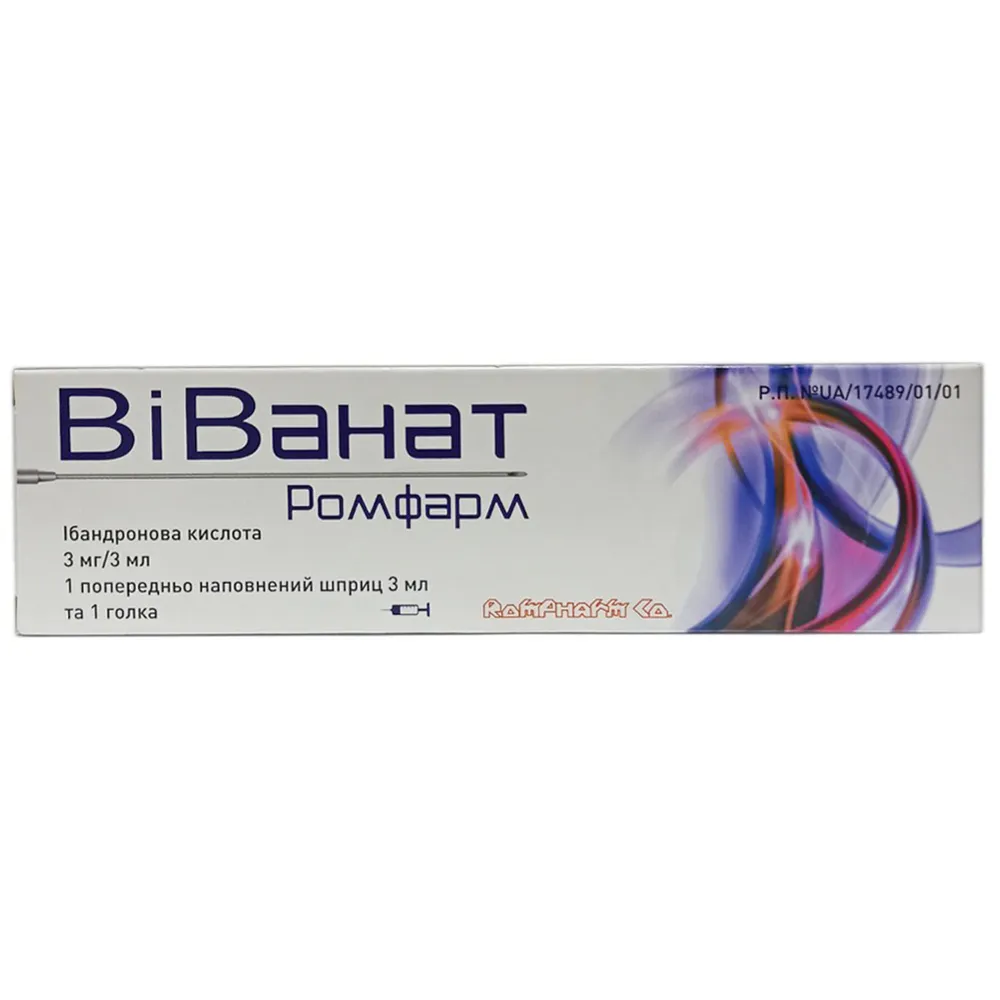
Table of Contents
INSTRUCTION FOR MEDICAL USE OF THE MEDICINAL PRODUCT VIVANAT ROMPHARM (VIVANATROMPHARM)
Composition:
Active substance: ibandronic acid;
1 pre-filled syringe (3 ml) contains 3 mg of ibandronic acid in the form of sodium ibandronate monohydrate 3.375 mg;
Excipients: sodium acetate trihydrate; glacial acetic acid; sodium chloride; 1 % acetic acid solution; water for injections.
Pharmaceutical form. Solution for injection.
Main physico-chemical properties: clear, colorless solution.
Pharmacotherapeutic group. Drugs affecting bone structure and mineralization. Bisphosphonates. Ibandronic acid. ATC code M05BA06.
Pharmacological Properties.
Pharmacodynamics.
Mechanism of action
Ibandronic acid is a highly active bisphosphonate belonging to the group of nitrogen-containing bisphosphonates. It acts selectively on bone tissue and specifically inhibits osteoclast activity, without having a direct effect on bone formation. The drug does not affect the replenishment of the osteoclast pool. In postmenopausal women, ibandronic acid reduces the elevated rate of bone turnover to premenopausal levels, resulting in progressive increases in bone mass and a reduction in fracture frequency.
Pharmacodynamic effects
The pharmacodynamic action of ibandronic acid is the inhibition of bone resorption. In vivo, ibandronic acid prevents bone destruction induced experimentally by gonadal function blockade, retinoids, tumors, and tumor extracts. In young (rapidly growing) rats, inhibition of endogenous bone resorption was also observed, leading to an increase in normal bone mass compared to untreated animals.
Animal models confirm that ibandronic acid is a highly potent inhibitor of osteoclast activity. In growing rats, no signs of impaired mineralization were observed even at doses more than 5000 times higher than the dose required for osteoporosis treatment.
Long-term daily administration and intermittent administration (with long intervals) over prolonged periods in rats, dogs, and monkeys were associated with the formation of new bone of normal quality, with preserved or increased mechanical strength, even at toxic dose ranges. The efficacy of both daily and intermittent administration of ibandronic acid with dosing intervals of 9–10 weeks was confirmed in a clinical study involving humans. Ibandronic acid demonstrated efficacy in preventing fracture occurrence.
In animal models, ibandronic acid induced biochemical changes indicating dose-dependent inhibition of bone tissue resorption, including reduced levels of urinary biochemical markers of bone collagen degradation (such as deoxypyridinoline and cross-linked N-telopeptide of type I collagen (NTX)).
Daily and intermittent administration (with dosing intervals of 9–10 weeks, quarterly) of ibandronic acid, administered orally or intravenously to postmenopausal women, resulted in biochemical changes indicating dose-dependent inhibition of bone resorption.
Intravenous administration of ibandronate led to a reduction in serum levels of the C-telopeptide of the alpha chain of type I collagen (CTX) within 3–7 days after initiation of treatment and a reduction in osteocalcin levels within 3 months.
After discontinuation of treatment, a return to the pathological level of increased bone resorption observed prior to treatment initiation—associated with postmenopausal osteoporosis—was observed.
Histological analysis of bone biopsy samples obtained after 2 and 3 years of treatment in postmenopausal women receiving oral ibandronic acid at a daily dose of 2.5 mg or intermittent intravenous doses up to 1 mg every 3 months showed normal bone tissue without signs of impaired mineralization. After 2 years of treatment with 3 mg injections of ibandronic acid, the expected reduction in bone metabolism was observed, along with normal bone tissue quality and absence of mineralization defects.
Pharmacokinetics.
As demonstrated in various studies in animals and humans, the primary pharmacological effect of ibandronic acid on bone is not directly related to its actual plasma concentration.
Plasma concentration of ibandronic acid increases proportionally to the dose following intravenous administration of 0.5–6 mg.
Distribution
Following initial systemic exposure, ibandronic acid rapidly binds to bone tissue or is excreted in urine. In humans, the apparent volume of distribution is at least 90 L, and approximately 40–50% of the circulating drug penetrates into bone tissue. About 85–87% binds to plasma proteins (determined in vitro at therapeutic concentrations of ibandronic acid); therefore, due to displacement, the potential for interaction with other medicinal products is low.
Biological transformation
There is no evidence that ibandronic acid is metabolized in humans or animals.
Elimination
Ibandronic acid is removed from the bloodstream via bone absorption (approximately 40–50% in postmenopausal women), with the remainder excreted unchanged by the kidneys.
The apparent elimination half-life range is broad and typically ranges from 10 to 72 hours. Since calculated values depend significantly on study duration, administered dose, and assay sensitivity, the terminal half-life is likely considerably longer, as seen with other bisphosphonates. Initial plasma levels decline rapidly, reaching 10% of peak values within 3 to 8 hours after intravenous or oral administration, respectively.
Total clearance of ibandronic acid is low, averaging 84–160 mL/min. Renal clearance (60 mL/min in healthy postmenopausal women) accounts for 50–60% of total clearance and depends on creatinine clearance. The difference between apparent total and renal clearance reflects drug uptake by bone tissue.
Excretion pathways likely do not involve known acid or base transport systems involved in the elimination of other active substances (see section "Interaction with other medicinal products and other forms of interaction"). Furthermore, ibandronic acid does not inhibit major human hepatic P450 isoenzymes and does not induce the hepatic cytochrome P450 system in rats.
Pharmacokinetics in special situations
Gender
The pharmacokinetics of ibandronic acid in men and women are similar.
Race
There are no data indicating clinically significant interethnic differences between Mongoloid and Caucasian patients regarding the distribution of ibandronic acid. Data in Negroid patients are limited.
Patients with renal impairment
Renal clearance of ibandronic acid in patients with varying degrees of renal impairment is linearly dependent on creatinine clearance (CrCl).
Dose adjustment is not required in patients with mild to moderate renal impairment (CrCl ≥ 30 mL/min).
In patients with severe renal impairment (CrCl < 30 mL/min) receiving oral ibandronic acid at a dose of 10 mg for 21 days, plasma concentrations were 2–3 times higher than in patients with normal renal function; total clearance of ibandronic acid was 44 mL/min. After intravenous administration of 0.5 mg ibandronic acid to patients with severe renal impairment, total, renal, and non-renal clearances were reduced by 67%, 77%, and 50%, respectively, but no reduction in drug tolerability due to increased exposure was observed. Due to limited clinical experience, Vivanat Rompharm is not recommended for patients with severe renal impairment (see sections "Special precautions for use" and "Dosage and administration"). Pharmacokinetics of ibandronic acid in patients with end-stage renal disease has been evaluated only in a small number of hemodialysis patients; therefore, pharmacokinetics in non-dialysis patients is unknown. Due to insufficient data, ibandronic acid should not be used in patients with end-stage renal disease.
Patients with hepatic impairment (see section "Dosage and administration")
There are no data on the pharmacokinetics of ibandronic acid in patients with hepatic impairment. The liver does not play a significant role in the clearance of ibandronic acid, which is not metabolized but is excreted by the kidneys and through uptake into bone tissue. Therefore, dose adjustment is not required in patients with hepatic impairment.
Elderly patients (see section "Dosage and administration")
Pharmacokinetic parameters evaluated by multivariate analysis do not depend on age. Since renal function declines with age, this is the only factor to consider (see section "Patients with renal impairment").
Pediatric population* (see section "Dosage and administration")
There are no data on the use of Vivanat Rompharm in children.
Clinical characteristics.
Indications.
Treatment of osteoporosis in postmenopausal women with increased risk of fractures. Reduction in the risk of vertebral fractures has been demonstrated; efficacy in preventing hip fractures has not been established.
Contraindications.
Hypersensitivity to ibandronic acid or to any of the excipients of the medicinal product (see section "Composition").
Hypocalcemia.
Interaction with other medicinal products and other forms of interaction.
Metabolic interactions are considered unlikely, since ibandronic acid does not inhibit the major human hepatic CYP450 isoenzymes and does not induce the hepatic cytochrome P450 system in rats (see section "Pharmacokinetics"). Ibandronic acid is eliminated exclusively via renal excretion and is not subject to biotransformation processes.
Special precautions for use
Administration errors
Caution should be exercised to avoid intra-arterial or paravenous administration of Vivana Rompharm, as this may lead to tissue damage.
Hypocalcemia
Administration of Vivana Rompharm, as with other intravenously administered bisphosphonates, may cause a temporary decrease in serum calcium levels.
Hypocalcemia should be corrected prior to initiating therapy with Vivana Rompharm. Other disorders of bone metabolism and mineral imbalances should also be effectively managed.
All patients should receive adequate calcium and vitamin D intake.
Anaphylactic reaction/shock
Anaphylactic reactions/shock, including fatal cases, have been reported in patients receiving intravenous ibandronic acid.
Appropriate medical support and monitoring equipment should be readily available during intravenous administration of Vivana Rompharm. If an anaphylactic or other severe hypersensitivity/allergic reaction occurs, the infusion should be immediately discontinued and appropriate treatment initiated.
Renal impairment
Patients with concomitant diseases or those taking medications that may adversely affect the kidneys should undergo regular monitoring during treatment, according to standard medical practice.
Due to limited clinical experience, Vivana Rompharm injections are not recommended in patients with serum creatinine levels exceeding 200 µmol/L (2.3 mg/dL) or creatinine clearance below 30 mL/min (see sections "Pharmacokinetics" and "Dosage and administration").
Heart failure
Patients at risk of developing heart failure should avoid excessive hydration.
Osteonecrosis of the jaw (ONJ)
Very rare cases of osteonecrosis of the jaw (ONJ) have been reported during post-marketing use in patients treated with ibandronate for osteoporosis (see section "Adverse reactions"). Treatment initiation or re-initiation should be postponed in patients with non-healing open soft tissue lesions in the oral cavity. Prior to starting treatment with Vivana Rompharm, patients with concomitant risk factors should undergo a dental examination with appropriate preventive interventions and an individual benefit-risk assessment.
The following risk factors should be considered when evaluating a patient's risk of developing ONJ:
- Potency of the bone resorption-inhibiting agent (higher risk with more potent compounds); route of administration (higher risk with parenteral administration); and cumulative dose of bone resorption therapy;
- Malignant neoplasms, concomitant medical conditions (e.g., anemia, coagulopathy, infection), tobacco smoking;
- Concomitant therapies: corticosteroids, chemotherapy, angiogenesis inhibitors, radiation therapy to the head and neck;
- Poor oral hygiene, periodontal disease, ill-fitting dentures, history of dental disease, invasive dental procedures such as tooth extractions.
During treatment with Vivana Rompharm, all patients should maintain good oral hygiene, undergo regular dental check-ups, and promptly report any oral symptoms such as tooth mobility, pain, swelling, non-healing ulcers, or discharge. Invasive dental procedures should only be performed after careful consideration and should be avoided during and shortly after treatment with Vivana Rompharm.
Management of patients who develop ONJ should be planned in close collaboration with a dentist or oral and maxillofacial surgeon experienced in ONJ treatment. Temporary discontinuation of Vivana Rompharm therapy should be considered until improvement and reduction of risk factors.
Osteonecrosis of the external auditory canal
Osteonecrosis of the external auditory canal has been reported with bisphosphonate use, primarily in association with long-term treatment. Potential risk factors include steroid use, chemotherapy, and/or local factors such as infection or trauma. The possibility of osteonecrosis of the external auditory canal should be considered in patients receiving bisphosphonates who present with ear symptoms, including chronic ear infections.
Atypical femoral fractures
Atypical subtrochanteric and diaphyseal femoral fractures have been reported with bisphosphonate therapy, particularly in patients receiving long-term osteoporosis treatment. These transverse or short oblique fractures may occur anywhere along the femur, from just below the lesser trochanter to just above the supracondylar flare. These fractures occur following minimal or no trauma; some patients experience thigh or groin pain, often associated with characteristic features of stress fractures, for several weeks to months before a complete femoral fracture occurs. Fractures are often bilateral; therefore, the contralateral femur should also be evaluated in patients receiving bisphosphonate therapy who have sustained a femoral shaft fracture. Poor healing of these fractures has also been reported. Discontinuation of bisphosphonate therapy should be considered in patients with suspected atypical femoral fractures pending full assessment, with individual benefit-risk evaluation.
During bisphosphonate treatment, patients should be advised to report any thigh, hip, or groin pain; all patients with such symptoms should be evaluated for incomplete femoral fractures (see section "Adverse reactions").
Atypical fractures of other long bones
Atypical fractures of other long bones, such as the ulna and tibia, have also been reported in patients receiving long-term bisphosphonate therapy. As with atypical femoral fractures, these fractures occur following minimal or no trauma, and some patients experience prodromal pain before complete fracture. In ulnar fractures, this may be associated with repetitive stress from prolonged use of walking aids (see section "Adverse reactions").
Vivana Rompharm does not contain sodium.
Disposal of unused medicine and expired products
Medicinal products should be kept from entering the environment. The medicine should not be disposed of via wastewater or household waste. Disposal should be carried out via a dedicated waste collection system, if available.
Use during pregnancy or breastfeeding
Pregnancy
Vivana Rompharm is indicated only for postmenopausal women. The medicine should not be used in women of reproductive age.
There are no adequate data on the use of ibandronic acid in pregnant women. Reproductive toxicity was observed in rat studies. The potential risk in humans is unknown. Vivana Rompharm should not be used during pregnancy.
Breastfeeding
It is unknown whether ibandronic acid is excreted in human breast milk. Studies have shown low levels of ibandronic acid in the milk of lactating rats after intravenous administration. Vivana Rompharm should not be used during breastfeeding.
Fertility
There are no data on the effect of ibandronic acid on human fertility. In reproductive studies in rats, oral administration at high daily doses reduced fertility. In intravenous studies in rats at high daily doses, ibandronic acid reduced fertility.
Effect on ability to drive and use machines
Considering the pharmacodynamic characteristics, pharmacokinetic profile, and reported adverse reactions, Vivana Rompharm is expected to have no effect or a negligible effect on the ability to drive or operate machinery.
Method of Administration and Dosage
Patients being treated with Vivanat Rompharm must be informed about important safety information they should know before and during treatment with Vivanat Rompharm (see section "Special Warnings and Precautions for Use") and about the patient reminder card published on the website of K.T. ROMPHARM COMPANY S.R.L.
Dosage
The recommended dose of ibandronic acid is 3 mg administered as an intravenous injection over 15–30 seconds, every 3 months.
Strict adherence to the intravenous route of administration is required (see section "Special Warnings and Precautions for Use").
Patients should also receive supplemental calcium and vitamin D (see sections "Interaction with Other Medicinal Products and Other Forms of Interaction" and "Special Warnings and Precautions for Use").
If a dose is missed, the injection should be administered as soon as possible. Subsequent injections should be given every 3 months from the date of the last administration.
The optimal duration of bisphosphonate treatment for osteoporosis has not been established. The need for continued treatment should be periodically re-evaluated based on the expected benefits and potential risks of Vivanat Rompharm for each individual patient, especially after 5 or more years of treatment.
Special Patient Populations
Patients with Renal Impairment
Injections of Vivanat Rompharm are not recommended in patients with serum creatinine levels exceeding 200 µmol/L (2.3 mg/dL) or creatinine clearance (measured or calculated) below 30 mL/min, due to limited clinical data, including in this patient group (see sections "Special Warnings and Precautions for Use" and "Pharmacokinetics").
Dose adjustment is not required in patients with mild or moderate renal impairment, in whom serum creatinine is ≤200 µmol/L (2.3 mg/dL) or creatinine clearance (measured or calculated) is ≥30 mL/min.
Patients with Hepatic Impairment
Dose adjustment is not required (see section "Pharmacokinetics").
Elderly Patients (>65 years)
Dose adjustment is not required (see section "Pharmacokinetics").
Special Instructions for Use
Strict adherence to the intravenous route of administration of Vivanat Rompharm is mandatory (see section "Special Warnings and Precautions for Use").
If the medicinal product is administered through an existing intravenous infusion system, the infusion solution must be either isotonic saline or 5% glucose solution (50 mg/mL). This also applies to solutions used for flushing the catheter and other devices.
Any unused injection solution, syringe, and injection needle should be disposed of in accordance with local requirements. Environmental contamination by medicinal products should be minimized.
The following recommendations for the use and disposal of syringes and other sharp instruments must be strictly observed:
- Needles and syringes must never be reused.
- All used needles and syringes should be placed in a sharps container (puncture-resistant, single-use container).
- This container must be kept out of reach of children.
- Do not dispose of the sharps container in household waste.
- A full container must be disposed of in accordance with local regulations or as instructed by the physician.
Children
There is no appropriate experience regarding the use of Vivanat Rompharm in children (under 18 years of age). The use of the medicinal product has not been studied in this patient population (see sections "Pharmacodynamics" and "Pharmacokinetics").
Overdose
There is no specific information on the treatment of ibandronic acid overdose.
Based on current knowledge of this class of compounds, overdose following intravenous administration may lead to hypocalcemia, hypophosphatemia, and hypomagnesemia. Clinically significant reductions in serum calcium, phosphate, and magnesium levels should be corrected by intravenous administration of calcium gluconate, potassium or sodium phosphate, and magnesium sulfate, respectively.
Adverse reactions
Summary of safety profile
The most serious adverse reactions reported are anaphylactic reaction/shock, atypical femoral fractures, osteonecrosis of the jaw, and ocular inflammation (see "Description of selected adverse reactions" and section "Special warnings and precautions for use").
The most commonly reported adverse reactions were arthralgia and influenza-like symptoms. These symptoms were usually associated with the first dose, were mostly transient, mild to moderate in severity, and typically resolved with continued treatment without requiring medical intervention (see "Description of selected adverse reactions").
Below is the complete list of known adverse reactions.
The safety of ibandronic acid 2.5 mg once daily orally was evaluated in 1,251 patients who participated in four placebo-controlled clinical trials, with the majority of patients enrolled in the pivotal three-year fracture study (MF 4411).
In the pivotal two-year study in postmenopausal women with osteoporosis (VM 16550), the overall safety profile was similar for ibandronic acid administered as 3 mg intravenous infusions every 3 months and ibandronic acid 2.5 mg orally once daily. The overall proportion of patients experiencing an adverse reaction was 26.0% and 28.6% after one and two years of treatment with ibandronic acid 3 mg intravenous infusion every 3 months, respectively. In most cases, adverse reactions did not lead to discontinuation of treatment.
List of adverse reactions in tabular form
The table below provides a complete list of known adverse reactions.
Adverse reactions are presented by MedDRA system organ class and frequency categories: very common (≥1/10); common (≥1/100 to <1/10); uncommon (≥1/1,000 to <1/100); rare (≥1/10,000 to <1/1,000); very rare (<1/10,000); frequency not known (cannot be estimated from available data). Within each frequency grouping, adverse reactions are listed in order of decreasing severity.
Adverse reactions observed during phase III studies VM16550 and MF4411 in postmenopausal women receiving the drug as 3 mg intravenous infusions every 3 months or ibandronic acid 2.5 mg orally once daily, and during post-marketing use:
| System organ class |
Common |
Uncommon |
Rare |
Very rare |
Frequency not known |
| Immune system disorders |
asthma exacerbation |
hypersensitivity reactions |
anaphylactic reaction/shock*† |
||
| Metabolism and nutrition disorders |
hypocalcemia† |
||||
| Nervous system disorders |
headache |
||||
| Eye disorders |
eye inflammation*† |
||||
| Vascular disorders |
phlebitis/thrombophlebitis |
||||
| Gastrointestinal disorders |
gastritis, dyspepsia, diarrhea, abdominal pain, nausea, constipation |
||||
| Skin and subcutaneous tissue disorders |
rash |
angioneurotic edema, facial swelling/edema, urticaria |
Stevens-Johnson syndrome†, multiform erythema†, bullous dermatitis† |
||
| Musculoskeletal and connective tissue disorders |
arthralgia, myalgia, musculoskeletal pain, back pain |
bone pain |
atypical subtrochanteric and diaphyseal femoral fractures† |
osteonecrosis of the jaw*†, osteonecrosis of the external auditory canal (adverse reaction characteristic of bisphosphonates as a class)†, osteoarthritis, joint function disorders |
atypical fractures of long bones other than femur |
| General disorders and administration site conditions |
influenza-like illness*, increased fatigue |
injection site reactions, asthenia |
* See below for additional information.
† Identified during post-marketing use.
Description of selected adverse reactions
Influenza-like illness
Influenza-like illness includes symptoms such as acute phase reactions or symptoms, including myalgia, arthralgia, fever, chills, increased fatigue, nausea, loss of appetite, and bone pain.
Osteonecrosis of the jaw (ONJ)
Cases of ONJ have been reported, predominantly in patients with malignancies who were receiving treatment with bone resorption inhibitors, including ibandronic acid (see section "Special precautions"). Cases of ONJ have been reported during post-marketing use of ibandronic acid.
Atypical subtrochanteric and diaphyseal femoral fractures
Although the pathophysiology is not fully understood, epidemiological data suggest an increased risk of atypical subtrochanteric and diaphyseal femoral fractures with long-term bisphosphonate therapy for postmenopausal osteoporosis, particularly after three to five years of treatment. The absolute risk of atypical subtrochanteric and diaphyseal fractures of long bones (a class effect of bisphosphonates) remains very low.
Ocular inflammation
Ocular inflammatory disorders such as uveitis, episkleritis, and scleritis have been reported during treatment with ibandronic acid. In some cases, these conditions resolved only after discontinuation of ibandronic acid.
Anaphylactic reaction/shock
Anaphylactic reactions/shock, including fatal cases, have been observed in patients receiving intravenous ibandronic acid injections.
Reporting of suspected adverse reactions
Reporting suspected adverse reactions after a medicinal product is authorized is important. It allows continued monitoring of the benefit-risk balance of the medicinal product. Healthcare professionals and patients are encouraged to report any suspected adverse reactions and lack of efficacy via the Automated Pharmacovigilance Information System at the following link: https://aisf.dec.gov.ua
Shelf life.
2 years.
Storage conditions.
Store in the original packaging, out of reach of children, at a temperature not exceeding 25 °C.
Incompatibilities.
Vivana Rompharm, solution for injection, must not be mixed with solutions containing calcium or with other medicinal products for intravenous use.
Packaging.
3 mL in a 5.0 mL pre-filled syringe; 1 or 4 pre-filled syringes with 1 or 4 needles in a blister pack, packed in a cardboard box.
Prescription status.
Prescription-only.
Manufacturer.
K.T. ROMPHARM COMPANY S.R.L.
Manufacturer's address and location of its operations.
Strada Eroilor No. 1A, Otopeni, 075100, Ilfov County, Romania – Building Rompharm 1 and Rompharm 2.