Vitamin c 500
Ukraine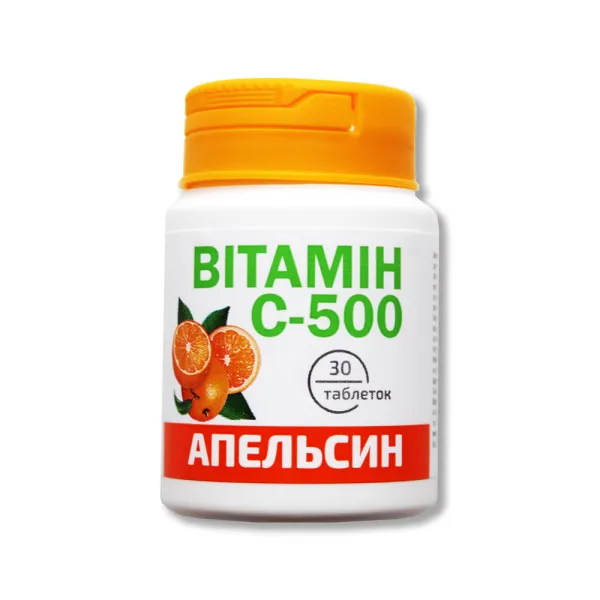
Table of Contents
INSTRUCTIONS FOR MEDICAL USE OF THE MEDICINAL PRODUCT VITAMIN C 500 (VITAMIN C 500)
Composition:
Active ingredient: 1 tablet contains ascorbic acid 199.5 mg, sodium ascorbate calculated as ascorbic acid 300.5 mg;
Excipients: refined sugar; aspartame (E 951); magnesium stearate; microcrystalline cellulose; orange flavor containing maltodextrin, gum arabic (E 414), ascorbic acid (E 300), alpha-tocopherol (E 307), sulfur dioxide (E 220); hypromellose; yellow sunset FCF (E 110).
Pharmaceutical form. Chewable tablets.
Main physicochemical properties: tablets from light yellow with speckles to orange or orange-pink with speckles, flat cylindrical shape with a score line and bevel.
Pharmacotherapeutic group. Vitamins. Simple ascorbic acid (vitamin C) preparations.
ATC code A11G A01.
Pharmacological Properties
Pharmacodynamics
Vitamin C (ascorbic acid) participates in redox processes; metabolism of carbohydrates, tyrosine, and iron; conversion of folic acid into folinic acid; blood coagulation; formation of steroid hormones, collagen, and procollagen; tissue regeneration; regulation of capillary permeability; synthesis of lipids and proteins; cellular respiration processes; enhances the body's resistance to infections and adverse environmental influences, improves general well-being, appetite, promotes normalization of sleep, increases the effectiveness of various therapeutic interventions; possesses antioxidant and radioprotective properties; reduces hemorrhagic manifestations of radiation sickness and stimulates hematopoiesis.
Deficiency of ascorbic acid in the diet leads to the development of hypovitaminosis and avitaminosis C, since this vitamin is not synthesized in the human body. Under certain conditions, the requirement for vitamin C may increase, for example, during periods of rapid growth, physical or mental overexertion, and infectious diseases, including influenza.
Pharmacokinetics
After oral administration, ascorbic acid is rapidly absorbed in the small intestine, with its maximum plasma concentration reached within 4–7 hours. From plasma, it penetrates primarily into blood elements (leukocytes, platelets, erythrocytes), then into all tissues. Ascorbic acid is excreted from the body predominantly in the urine.
Clinical characteristics.
Indications.
Treatment of hypovitaminosis and avitaminosis C.
Meeting the increased body requirements for vitamin C:
− during acute respiratory and infectious diseases;
- during the convalescence period after severe illnesses and surgical interventions;
- in various intoxications, hemorrhagic diatheses, connective tissue diseases (rheumatoid arthritis), bleeding (nasal, pulmonary, uterine);
- in radiation sickness, hepatitis, cholecystitis, Addison's disease, slowly healing soft tissue injuries, infected wounds, and bone fractures.
Contraindications.
Hypersensitivity to ascorbic acid or to any of the excipients. Thrombophlebitis, predisposition to thrombosis, diabetes mellitus, severe kidney diseases, urolithiasis.
Interaction with other medicinal products and other types of interactions.
Ascorbic acid reduces the toxicity of sulfonamide drugs, reduces the effect of heparin and indirect anticoagulants, promotes iron absorption, enhances penicillin absorption, and intensifies the adverse effects of salicylates (risk of crystaluria).
Quinolone derivatives, calcium chloride, salicylates, and glucocorticosteroids reduce vitamin C reserves in the body when used long-term.
When used concomitantly, the drug reduces the chronotropic effect of isoprenaline.
In high doses, the drug increases renal excretion of mexiletine.
Barbiturates and primidone increase urinary excretion of ascorbic acid.
The drug reduces the therapeutic effect of neuroleptics (phenothiazine derivatives), tubular reabsorption of amphetamines, and tricyclic antidepressants.
Acetylsalicylic acid, oral contraceptives, fresh juices, and alkaline beverages reduce the absorption of the drug. When used concomitantly with acetylsalicylic acid, urinary excretion of ascorbic acid increases and excretion of acetylsalicylic acid decreases. The intake of acetylsalicylic acid reduces the absorption of ascorbic acid by approximately one-third, which therefore requires an increase in the dose of vitamin C.
Taking vitamin C together with deferoxamine increases tissue iron toxicity, especially in the myocardium, which may lead to circulatory decompensation. It can be taken 2 hours after deferoxamine injection. Prolonged use of high doses of ascorbic acid in patients treated with disulfiram inhibits the "disulfiram–alcohol" reaction.
High doses of ascorbic acid affect vitamin B12 resorption.
Vitamin C enhances oxalate excretion in urine, thus increasing the risk of calcium oxalate stone formation in urine.
Ascorbic acid increases the total clearance of ethanol.
Tetracyclines reduce ascorbic acid reserves in the body when used long-term.
When used concomitantly, ascorbic acid enhances the absorption of ethinylestradiol from the gastrointestinal tract. A similar effect applies to aluminum; therefore, this should be considered when treating concomitantly with aluminum-containing antacids.
Special precautions for use.
When taking high doses or using the drug for prolonged periods, pancreatic function should be monitored. The drug should be used with caution in patients with a history of mild to moderate kidney disease.
Since ascorbic acid enhances iron absorption, its use in high doses may be hazardous for patients with hemochromatosis, thalassemia, polycythemia, leukemia, or sideroblastic anemia. Patients with high iron levels in the body should use the medication at minimal doses.
Use with caution in patients with glucose-6-phosphate dehydrogenase deficiency.
Ascorbic acid should be used cautiously in patients with progressive malignant disease, as its use may exacerbate the course of the disease.
Concurrent intake of the drug with alkaline beverages reduces the absorption of ascorbic acid; therefore, tablets should not be taken with alkaline mineral water. Absorption of ascorbic acid may also be impaired in intestinal dyskinesia, enteritis, and achylia.
As a reducing agent, ascorbic acid may affect laboratory test results, for example, when measuring blood levels of glucose, bilirubin, transaminase activity, and lactate dehydrogenase.
Since ascorbic acid has a mild stimulating effect on the central nervous system, the drug is not recommended to be taken late in the day.
Prolonged use of high doses of ascorbic acid may accelerate its own metabolism, leading to paradoxical vitamin deficiency after discontinuation of treatment. The recommended dose should not be exceeded.
Do not use simultaneously with other products containing vitamin C.
When using the drug, the test for occult blood in feces may yield a false-negative result.
It should be noted that high-dose vitamin C intake may alter certain laboratory test parameters (uric acid, creatinine, inorganic phosphates).
Due to the stimulatory effect of ascorbic acid on corticosteroid hormone production, renal function and arterial blood pressure should be monitored when using high doses.
The product contains 1.7 mmol (or 39.28 mg)/dose (1 tablet) of sodium. Caution is advised when administering to patients on a sodium-restricted diet.
If a patient has known sugar intolerances, consult a physician before taking this medication.
Aspartame is a phenylalanine derivative and may be hazardous for patients with phenylketonuria.
Sulfur dioxide may rarely cause hypersensitivity reactions and bronchospasm.
Yellow FCF may cause allergic reactions.
Use during pregnancy or breastfeeding.
The drug in this dosage is not intended for use during pregnancy or breastfeeding.
Ability to affect reaction rate while driving or operating machinery.
There are no data indicating that the drug has a negative effect on reaction speed when driving or operating complex machinery, provided the recommended usage guidelines are followed.
Dosage and Administration
For adults and children aged 14 years and older, take orally after meals, chewing the tablet.
For therapeutic purposes — 1 tablet per day. Treatment duration: 10–15 days.
In cases of colds, infectious diseases, and influenza — 1–2 tablets per day (in two divided doses) for 7–10 days. Afterwards — ½ tablet per day. The total duration of treatment should be determined individually by a physician.
Children.
The drug is recommended for children under 14 years of age at a different dosage.
Overdose.
Acute overdose is practically impossible, as unabsorbed ascorbic acid is rapidly excreted in the urine.
Prolonged use of large doses of the drug may lead to suppression of the pancreatic islet apparatus function, kidney dysfunction, increased arterial pressure, and development of other adverse reactions listed in the section "Adverse Reactions."
Side effects.
The medicinal product is very well tolerated at the recommended dose, and adverse reactions usually do not occur when the recommended dosage regimens are followed. However, with prolonged use at high doses, the following adverse reactions may occur.
Gastrointestinal tract: irritation of the gastrointestinal mucosa, nausea, vomiting, diarrhea, heartburn, stomach spasms.
Immune system: allergic reactions, angioedema, anaphylactic shock in the presence of sensitization.
Urinary system: glomerular apparatus damage of the kidneys, renal failure, crystalluria, formation of urinary concretions — urates, cystine, and oxalates.
Vascular system: arterial hypertension.
Blood and lymphatic system: thrombocytosis, thrombosis, hemolytic anemia, hyperprothrombinemia, erythrocytopenia, neutrophilic leukocytosis; in patients with glucose-6-phosphate dehydrogenase deficiency of erythrocytes, hemolysis of red blood cells may occur.
Metabolism and nutrition: damage to the islet apparatus of the pancreas (hyperglycemia, glucosuria) and impaired glycogen synthesis, up to the development of diabetes mellitus; disturbances in zinc and copper metabolism.
Cardiovascular system: myocardial dystrophy.
Psychiatric disorders: increased excitability, fatigue, sleep disturbances.
Nervous system: increased excitability of the central nervous system, headache.
Skin and subcutaneous tissue: skin rashes, eczema, urticaria, pruritus.
General disorders: sensation of heat, dental enamel erosion.
Shelf life. 2 years.
Storage conditions. Store in the original packaging at a temperature not exceeding 25 °C.
Keep out of reach of children.
Packaging. Chewable tablets: № 10 (10×1), № 20 (10×2), № 100 (10×10) in blisters in a box; № 10 in a blister; № 30, № 50 in a container.
Availability category. Over-the-counter.
Manufacturer. LIMITED LIABILITY COMPANY "CORPORATION "ZDOROVIYA".
Limited Liability Company "FARMEKS GROUP".
Manufacturer's address and place of business. Ukraine, 61013, Kharkiv region, city of Kharkiv, Shevchenko Street, 22.
(LIMITED LIABILITY COMPANY "CORPORATION "ZDOROVIYA")
Ukraine, 08301, Kyiv region, city of Boryspil, Shevchenko Street, 100.
(Limited Liability Company "FARMEKS GROUP")