Virolex
Ukraine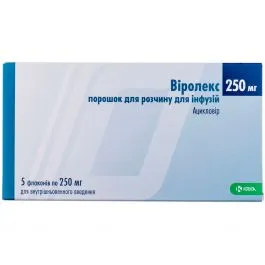
Table of Contents
INSTRUCTIONS FOR MEDICAL USE OF THE MEDICINAL PRODUCT Virolex (Virolex®)
Composition:
Active substance: acyclovir;
1 vial contains 250 mg of acyclovir as the sodium salt;
Excipients: none.
Pharmaceutical form. Powder for solution for infusion.
Main physicochemical properties: white or almost white powder.
Pharmacotherapeutic group. Antiviral agents for systemic use.
ATC code J05A B01.
Pharmacological Properties
Pharmacodynamics
Acyclovir is an antiviral agent with systemic action. It exerts a virostatic effect and is effective against Herpes simplex virus types 1 and 2 (HSV-1 and HSV-2), as well as against the Varicella-zoster virus (VZV).
Acyclovir is converted into its active form, which exerts antiviral activity, only after entering cells infected with herpes simplex virus (HSV). Subsequently, under the influence of viral thymidine kinase, acyclovir undergoes phosphorylation within the cells to form acyclovir monophosphate, which is then converted by cellular enzymes into acyclovir diphosphate and further into the active form, acyclovir triphosphate. This active form possesses antiviral activity and inhibits viral DNA replication. The affinity of acyclovir triphosphate for viral DNA polymerase is 10 to 30 times higher than for cellular DNA polymerase, enabling selective suppression of the viral enzyme's activity. Furthermore, viral DNA polymerase incorporates acyclovir into the viral DNA chain, resulting in chain termination during DNA synthesis. Through these mechanisms, acyclovir effectively suppresses viral replication without affecting normal cellular processes.
Pharmacokinetics
The bioavailability of acyclovir ranges from 13 to 21%, and it decreases with increasing dose.
Acyclovir readily distributes into all tissues, organs, and body fluids, including the brain, kidneys, lungs, liver, muscles, spleen, uterus, vaginal mucosa, vaginal secretions, cerebrospinal fluid, and vesicular fluid. Approximately 15.4% of acyclovir binds to plasma proteins.
Acyclovir does not undergo presystemic metabolism.
The elimination half-life after oral administration in adults with normal renal function is 3 hours. In healthy individuals, acyclovir is primarily excreted by the kidneys into urine (80%). Between 8.5% and 14% of acyclovir is excreted as the metabolite carboxymethoxymethylguanine. Acyclovir is also present in feces in amounts less than 2% and in negligible quantities in exhaled CO₂.
The pharmacokinetics of acyclovir in children aged 1 year and older is similar to that in adults.
Clinical characteristics.
Indications.
Treatment of infections caused by herpes simplex virus in patients with immunodeficiency and severe genital herpes in patients without immunodeficiency.
Prophylaxis of infections caused by herpes simplex virus in patients with immunodeficiency.
Treatment of infections caused by Varicella zoster virus.
Treatment of herpes simplex encephalitis.
Treatment of infections caused by herpes simplex virus in neonates and infants under 3 months of age.
Contraindications.
Hypersensitivity to acyclovir, valacyclovir, or to any other components of the drug in the medical history.
Interaction with other medicinal products and other forms of interactions.
Clinically significant interactions of acyclovir with other medications have not been identified.
Acyclovir is primarily excreted unchanged by the kidneys through tubular secretion; therefore, any medicinal products with a similar elimination mechanism may increase acyclovir plasma concentrations.
Probenecid and cimetidine prolong the elimination half-life and the area under the concentration-time curve (AUC) of acyclovir; however, due to the wide therapeutic index of acyclovir, dose adjustment is not required.
In patients receiving intravenous Valvir concurrently with other drugs that have a similar elimination pathway, increased plasma concentrations of one or both drugs or their metabolites may occur. When used concomitantly with immunosuppressive agents in organ transplant recipients, plasma levels of both acyclovir and the inactive metabolite of the immunosuppressive agent may increase.
When lithium is administered simultaneously with high-dose intravenous acyclovir, serum lithium concentrations should be closely monitored due to the risk of lithium toxicity.
Caution (with monitoring of renal function) is also required when administering intravenous Valvir with agents affecting renal function (such as cyclosporine, tacrolimus).
An experimental study in 5 men indicates that concomitant therapy with acyclovir increases the AUC of orally administered theophylline by approximately 50%. Monitoring of plasma concentrations is recommended during concomitant therapy with acyclovir.
Special precautions for use.
An adequate level of hydration should be maintained in patients receiving intravenous acyclovir or high oral doses of acyclovir.
Intravenous doses should be administered by infusion over one hour to avoid acyclovir precipitation in the kidneys. Rapid or bolus injection should be avoided.
The risk of renal impairment increases when other nephrotoxic drugs are used. Caution is required when administering intravenous acyclovir concomitantly with other nephrotoxic agents.
Patients with renal impairment and elderly patients
Acyclovir is primarily eliminated from the body via renal clearance; therefore, dosage reduction is required in patients with renal impairment. Elderly patients are likely to have reduced renal function, so dosage adjustment should be considered for this patient group. Both of these patient groups (those with renal impairment and elderly patients) are at increased risk of neurological adverse reactions and should therefore be closely monitored. Available data indicate that such reactions are generally reversible upon discontinuation of acyclovir therapy. Prolonged or repeated courses of acyclovir treatment in individuals with severely compromised immune systems may lead to the emergence of viral strains with reduced sensitivity, which may not respond to prolonged acyclovir therapy.
If patients receive high intravenous doses of the drug, e.g. for the treatment of herpes encephalitis, renal function parameters should be taken into account, especially in cases of dehydration or existing renal impairment.
Dosage adjustment is necessary for patients with renal impairment to prevent accumulation of acyclovir in the body.
Diluted Virolex for intravenous infusion has a pH of approximately 11.0 and must not be administered orally.
Use during pregnancy or breastfeeding.
Fertility
There is no information available regarding the effect of acyclovir on female fertility.
In a study of 20 male patients with normal sperm counts, oral administration of up to 1 g per day for six months did not reveal any clinically significant effect on sperm count, motility, or morphology.
Pregnancy
Pregnancy outcome data from a post-marketing surveillance registry include women exposed to any acyclovir-containing medications. Registry results showed no increased incidence of congenital malformations among acyclovir-exposed subjects compared to the general population, and no congenital defects showed a unique or consistent pattern suggesting a common cause. Systemic administration of acyclovir did not cause embryotoxic or teratogenic effects in rabbits, rats, or mice in internationally accepted standard tests. In a non-standard rat study, fetal abnormalities were observed, but only after such high subcutaneous doses that maternal toxicity occurred. The clinical significance of these findings is unclear.
Acyclovir should be administered only if, in the opinion of the physician, the expected benefit to the mother outweighs the potential risk to the fetus.
Breastfeeding
After oral administration of 200 mg acyclovir five times daily, acyclovir is excreted into breast milk at concentrations ranging from 0.6 to 4.1 times the plasma levels. A breastfed infant may potentially ingest acyclovir at up to 0.3 mg/kg body weight per day. Acyclovir should be used with caution in breastfeeding women, taking into account the risk/benefit ratio for the infant.
Ability to affect reaction speed when driving or operating machinery.
No studies have been conducted to evaluate the effect of the medicinal product on the ability to drive vehicles or operate machinery.
Method of administration and dosage.
Administer by slow intravenous infusion over not less than 1 hour.
The usual course of treatment with intravenous Virolex lasts 5 days, but the duration may be adjusted depending on the patient's condition and response to therapy. Treatment of herpes encephalitis usually lasts 10 days. Treatment of neonatal infections caused by herpes simplex virus typically lasts 14 days when involving skin and mucous membranes, and 21 days when disseminated disease or central nervous system involvement is present.
The duration of prophylactic use of intravenous Virolex is determined by the length of the period of infection risk.
For the treatment of infections caused by herpes simplex virus (except herpes encephalitis) or Varicella zoster virus, intravenous Virolex should be administered at a dose of 5 mg/kg body weight every 8 hours, provided normal renal function.
For the treatment of Varicella zoster virus infections in immunocompromised patients or patients with herpes encephalitis, intravenous Virolex should be administered at a dose of 10 mg/kg body weight every 8 hours, provided normal renal function.
For obese patients, the dose should be calculated based on ideal body weight rather than actual body weight.
Children
Dosages for children aged 3 months to 12 years are calculated per unit of body surface area.
For the treatment of infections caused by herpes simplex virus (except herpes encephalitis) or Varicella zoster virus, intravenous Virolex should be administered at a dose of 250 mg/m² body surface area every 8 hours, provided normal renal function.
For the treatment of Varicella zoster virus infections in immunocompromised children or children with herpes encephalitis, intravenous Virolex should be administered at a dose of 500 mg/m² body surface area every 8 hours, provided normal renal function.
Dosages of intravenous Virolex for newborns and infants under 3 months of age are calculated based on body weight.
The recommended treatment regimen for infants with herpes simplex virus infection is 20 mg/kg body weight every 8 hours for 21 days in cases of disseminated disease or central nervous system involvement, or 14 days for disease limited to skin and mucous membranes.
Dosage adjustments should be made for infants and children with impaired renal function according to the degree of impairment (see "Patients with renal impairment").
Elderly patients
Renal function impairment should be considered in elderly patients; in such cases, the drug dosage should be adjusted accordingly (see "Patients with renal impairment"). Adequate hydration should be maintained.
Patients with renal impairment
Virolex should be used with caution when administered intravenously to patients with renal impairment. Adequate hydration should be maintained.
The dosage adjustments specified below should be made according to creatinine clearance values.
Adults:
| Creatinine clearance |
Recommended dosage |
| 25-50 mL/min |
5-10 mg/kg body weight every 12 hours |
| 10-25 mL/min |
5-10 mg/kg body weight every 24 hours |
| 0 (anuria)-10 mL/min |
For patients undergoing long-term ambulatory peritoneal dialysis or hemodialysis – 2.5-5 mg/kg every 24 hours |
Children:
| Creatinine clearance |
Recommended dosage |
| 25-50 mL/min/1.73 m2 |
250-500 mg/kg/m2 body surface area or 20 mg/kg body weight every 12 hours |
| 10-25 mL/min/1.73 m2 |
250-500 mg/kg/m2 body surface area or 20 mg/kg body weight every 24 hours |
| 0 (anuria)– 10 mL/min/1.73 m2 |
For patients undergoing long-term ambulatory peritoneal dialysis or hemodialysis – 125-250 mg/kg/m2 body surface area or 10 mg/kg body weight every 24 hours. |
Administration method
The required dose of Virolex should be administered by slow intravenous infusion over at least 1 hour, regardless of the dose administered.
First, the contents of the Virolex for intravenous administration vial must be dissolved in an appropriate volume of water for injections or 0.9% sodium chloride solution for injections. To obtain a solution containing 25 mg of acyclovir per 1 mL, 250 mg of the drug should be dissolved in 10 mL of liquid.
After adding the liquid, gently shake the vial until its contents are completely dissolved.
To prepare the solution for intravenous infusion, the solution prepared as described above should be further diluted to achieve a concentration of no more than 5 mg/mL (0.5%): the solution formed after dissolving 250 mg of acyclovir in 10 mL of water for injections (or 0.9% sodium chloride solution) is added to the selected infusion fluid as specified below.
For children and infants, when it is necessary to minimize the volume of infused liquid, it is recommended to add 4 mL of diluted solution (100 mg of acyclovir) to 20 mL of infusion fluid.
For adults, the recommended volume of infusion fluid should be at least 100 mL, even if the acyclovir concentration is lower than 0.5%. Therefore, 100 mL of infusion fluid should be used for administration of Virolex at doses of 250 mg and 500 mg (10 or 20 mL of diluted solution). If higher doses of the drug are required (500–1000 mg of acyclovir), the volume of infusion fluid should be increased to 200 mL.
After reconstitution according to the recommendations above, Virolex for intravenous administration is compatible with the following infusion fluids and remains stable for 12 hours at room temperature (15–25 °C):
- 0.45% or 0.9% sodium chloride solution;
- 0.18% sodium chloride solution and 4% glucose solution;
- 0.45% sodium chloride solution and 2.5% glucose solution;
- Hartmann’s solution.
When solutions for intravenous infusion are prepared as described above, the resulting acyclovir concentration does not exceed 0.5%.
Since Virolex for intravenous administration does not contain any antimicrobial preservatives, reconstitution and dilution of the drug must be performed under aseptic conditions immediately before use.
If cloudiness or crystallization occurs, such solutions are unsuitable for use and must be discarded.
Children.
The drug can be used in pediatric practice.
Overdose.
Symptoms. In case of overdose (e.g., administration of a large single injection or high doses to patients with inadequate fluid and electrolyte balance regulation), nausea, vomiting, and skin rash may occur.
In cases of acyclovir overdose via intravenous administration, serum creatinine and blood urea nitrogen levels may increase, leading to renal failure. Neurological manifestations of overdose may include confusion, hallucinations, agitation, seizures, and coma.
Treatment. Patients should be closely monitored for signs of toxicity. Hemodialysis significantly enhances the elimination of acyclovir from the blood and thus may be considered as a treatment option in cases of overdose of this drug.
Adverse reactions.
The frequency of occurrence listed in the tables in the section "Adverse reactions" includes:
- very common (≥1/10);
- common (≥1/100 to <1/10);
- uncommon (≥1/1000 to <1/100);
- rare (≥1/10000 to <1/1/1000);
- very rare (<1/10000).
The adverse effects listed below are classified by organ systems.
Blood and lymphatic system disorders.
Uncommon: decreased hematological parameters (anemia, thrombocytopenia, leukopenia).
Immune system disorders.
Very rare: anaphylaxis.
Psychiatric and nervous system disorders.
Very rare: headache, dizziness, excitation, confusion, tremor, ataxia, dysarthria, hallucinations, psychotic symptoms, seizures, somnolence, encephalopathy, coma.
The above neurological reactions are generally reversible and usually occur in patients with impaired renal function and other risk factors (see section "Special precautions for use").
Cardiovascular system disorders.
Common: phlebitis.
Respiratory, thoracic and mediastinal disorders.
Very rare: dyspnea.
Gastrointestinal disorders.
Common: nausea, vomiting.
Very rare: diarrhea, abdominal pain.
Hepatobiliary disorders.
Common: reversible increase in liver enzymes.
Very rare: reversible increase in bilirubin levels, jaundice, hepatitis.
Skin and subcutaneous tissue disorders.
Common: pruritus, urticaria, rash (including photosensitivity), diffuse alopecia. Since hair loss may be associated with a large number of diseases and medications, a clear association with acyclovir has not been established.
Very rare: angioneurotic edema.
Renal and urinary disorders.
Common: increased blood urea and creatinine levels.
Rapid increases in blood urea and creatinine levels are believed to be related to peak plasma levels and the patient's hydration status. To avoid this effect, the drug should not be administered as an intravenous bolus, but only by slow infusion over a period of not less than 1 hour.
Very rare: renal dysfunction, acute renal failure, renal pain.
Adequate hydration should be maintained in these patients. Renal dysfunction usually resolves rapidly after rehydration therapy and/or dose reduction, or complete discontinuation of the drug. Acute renal failure may occur in exceptional cases.
Renal pain may be associated with renal insufficiency and crystalluria.
General disorders.
Very rare: increased fatigue, fever, local inflammatory reactions.
Severe local inflammatory reactions may sometimes lead to skin necrosis when acyclovir has been inadvertently administered into the extravascular space.
Shelf life. 5 years.
Storage conditions. Store at temperatures not exceeding 25 °C.
The prepared infusion solution should be used within 12 hours when stored at temperatures not exceeding 25 °C.
Keep out of reach of children.
Incompatibilities. Water for injections must not contain preservatives (benzyl alcohol or parabens) due to the risk of precipitate formation.
Do not use solvents not specified in the section "Administration and dosage".
Packaging. 5 vials per cardboard box.
Prescription category. Prescription only.
Manufacturer.
KRKA, d.d., Novo mesto, Slovenia.
Manufacturer's address and place of business.
Šmarješka cesta 6, 8501 Novo mesto, Slovenia.