Vinoksin mv
Ukraine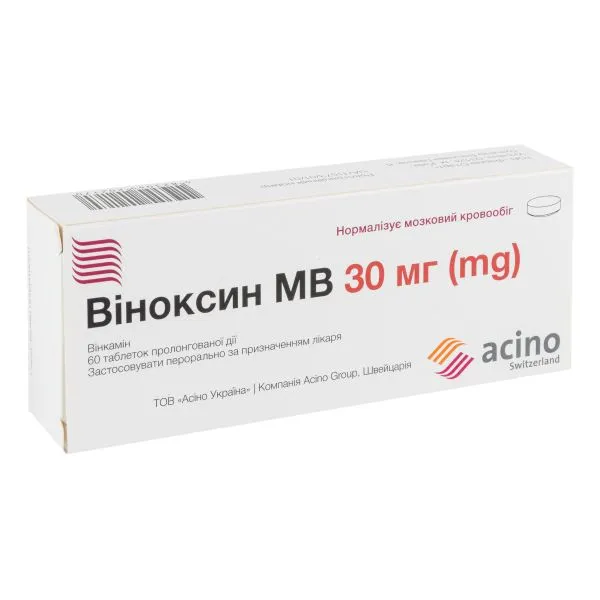
Table of Contents
INSTRUCTION for medical use of the medicinal product VINOXIN MR (VINOXIN MR)
Composition:
Active substance: vincamine;
1 tablet contains vincamine 30 mg;
Excipients: lactose monohydrate; hypromellose; copovidone; colloidal silicon dioxide, hydrophobic; colloidal silicon dioxide, aqueous; magnesium stearate.
Pharmaceutical form. Prolonged-release tablets.
Main physicochemical properties: round, flat cylindrical tablets with bevelled edges, white or almost white.
Pharmacotherapeutic group.
Peripheral vasodilators. ATC code C04AX07.
Pharmacological properties.
Pharmacodynamics.
Vinocamine exerts a selective vasoregulatory effect on cerebral circulation, promoting the adaptation of cerebral blood flow according to the brain's metabolic demands. The drug improves brain metabolism by enhancing glucose oxidation, thereby increasing energy production and contributing to an overall increase in the body's activity. Vinocamine increases oxygen supply to neurons in a state of hypoxia. The drug reduces and stabilizes peripheral resistance in cerebral blood vessels. It has been demonstrated that vinocamine does not exert biological or hematological toxicity, nor adverse effects on the kidneys and liver.
Pharmacokinetics.
Rapidly absorbed from the gastrointestinal tract; elimination half-life is 60–90 minutes; plasma protein binding is 64%. Vinocamine is completely metabolized in the liver, with only 4–6% excreted unchanged in urine.
Clinical characteristics.
Indications.
For normalization and adaptation of cerebral blood flow according to the brain's metabolic needs: for improvement, regulation, and support of brain functions in the following conditions:
- memory impairment;
- attention deficit;
- diabetic angiopathy;
- atherosclerotic cerebral vascular lesions;
- post-traumatic brain disorders;
- after acute cerebrovascular events;
- cerebral disturbances following cerebral ischemia;
- hypertensive encephalopathy;
- hearing and vision disorders of vascular origin;
- spatial and temporal disorientation, emotional disturbances resulting from various mental disorders.
Contraindications.
Hypersensitivity to any component of the drug. Brain tumors (or conditions causing increased intracranial pressure), seizure disorders, acute stroke, cardiac arrhythmias, severe electrolyte imbalances (hypokalemia or hypocalcemia).
Interaction with other medicinal products and other forms of interaction.
Concomitant use with medicinal products that may provoke torsade de pointes should be avoided. If co-administration is unavoidable, careful clinical and ECG monitoring is recommended.
Interactions typical for vinca alkaloids.
Quinupristin and dalbopristin are potent inhibitors of cytochrome P450 3A4 and may increase the concentration of vinca alkaloids when used concomitantly. Patients should be closely monitored for adverse effects of vinca alkaloids, and the dose of vinpocetine should be adjusted accordingly.
A possible mechanism of interaction between itraconazole and vinca alkaloids is inhibition of cytochrome P450 by itraconazole. Itraconazole may also inhibit the P-glycoprotein pump responsible for the elimination of vinca alkaloids. Therefore, patients receiving concomitant itraconazole and vinpocetine should be closely monitored.
Special precautions for use.
Do not exceed recommended doses.
Use with caution in patients with myocardial infarction, heart diseases or cardiac insufficiency. In such cases, start with low initial doses and perform clinical monitoring and ECG surveillance. Do not use in patients with prolonged QT interval, as this increases the risk of developing ventricular arrhythmias.
During prolonged use of vinpocetine, liver function should be monitored.
The preparation contains lactose and therefore should not be administered to patients with rare hereditary forms of galactose intolerance, lactase deficiency or glucose-galactose malabsorption syndrome.
Use during pregnancy or breastfeeding.
Contraindicated.
Ability to affect reaction speed when driving or operating machinery.
Vinpocetine may affect the ability to react quickly when driving a vehicle or operating machinery.
Dosage and Administration.
For adults, administer 1 tablet orally twice daily. The duration of treatment is determined individually by a physician, depending on the course of the disease.
Children.
Vinoxyn MV tablets are not recommended for use in children.
Overdose.
In case of overdose, careful clinical monitoring, ECG monitoring, symptomatic treatment, and supportive therapy to maintain vital functions are recommended. There is no specific antidote.
Adverse reactions.
Psychiatric disorders: slight increase in mental activity.
Nervous system disorders: headache, dizziness.
Cardiovascular disorders: QT interval prolongation, ventricular fibrillation (torsade de pointes).
Gastrointestinal disorders: nausea, heartburn, diarrhea, constipation, dry mouth.
Immune system disorders: hypersensitivity reactions, including angioneurotic edema.
Skin and subcutaneous tissue disorders: erythema, pruritus, allergic dermatitis, urticaria, papular rashes.
Shelf life. 3 years.
Storage conditions.
Keep out of reach of children, in the original packaging at a temperature not exceeding 25 °C.
Packaging.
20 tablets per blister; 1 or 3 blisters per cardboard pack.
Prescription status.
Prescription only.
Manufacturer.
LLC "Pharma Start".
Manufacturer's address and place of business.
8 Vatslava Havela Boulevard, Kyiv, Ukraine, 03124.