Verucutan
Ukraine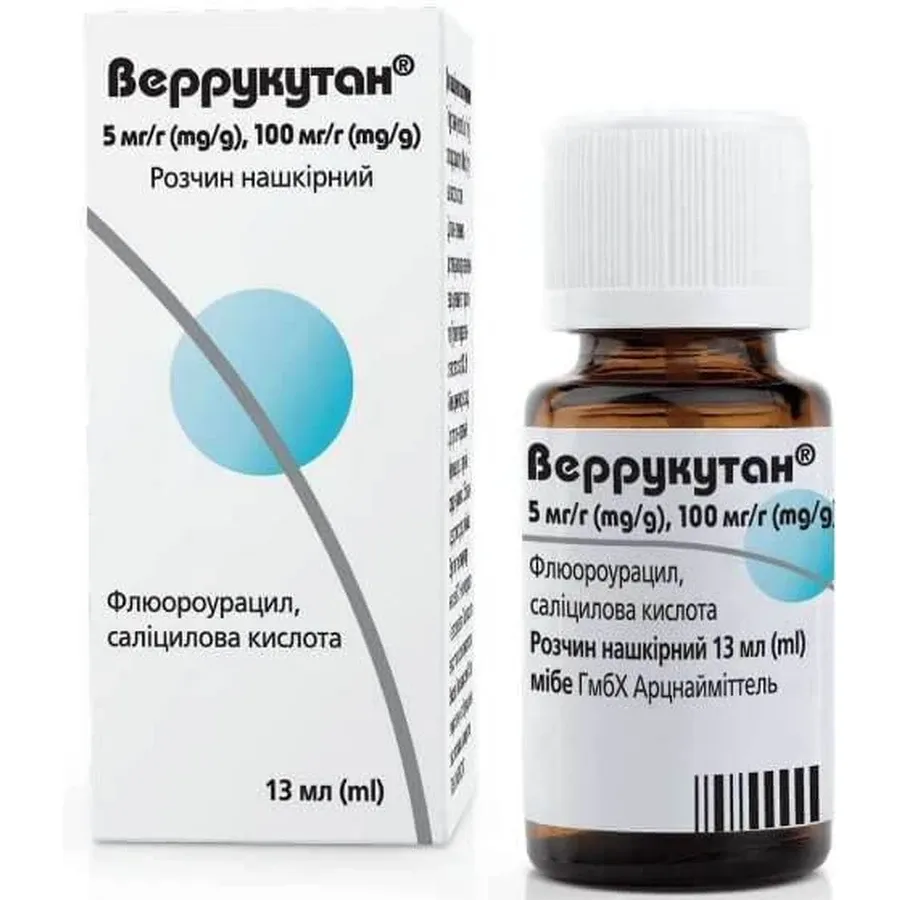
Table of Contents
INSTRUCTIONS FOR MEDICAL USE OF THE MEDICINAL PRODUCT VERRUCUTAN® (VERRUCUTAN)
Composition:
Active substances: fluorouracil, salicylic acid;
1 g of solution contains 5 mg of fluorouracil and 100 mg of salicylic acid;
Excipients: dimethyl sulfoxide, anhydrous ethanol, ethyl acetate, pyroxylin, poly(butyl methacrylate-co-methyl methacrylate) (80 : 20).
Pharmaceutical form. Topical solution.
Main physicochemical properties: clear solution ranging from colorless to slightly orange.
Pharmacotherapeutic group.
Other dermatological preparations. Agents against warts and calluses. ATC code D11AF.
Pharmacological Properties
Pharmacodynamics
Mechanism of action of fluorouracil
The active ingredient fluorouracil (FU) is a cytostatic agent with antimetabolite activity.
Due to its structural similarity to thymine, a component of nucleic acids (5-methyluracil), FU interferes with its formation and metabolism, thereby inhibiting the synthesis of both DNA and RNA. As a result, the growth of the wart virus is inhibited, leading to suppression of the virus, particularly in those wart cells that are in a phase of accelerated growth and therefore absorb FU in increased amounts.
Mechanism of action of salicylic acid
Salicylic acid, due to its keratolytic properties, facilitates the penetration of the active ingredient, which is particularly difficult in the case of warts. A similar effect is exerted by dimethyl sulfoxide, a solubilizing agent for the active ingredient FU.
The keratolytic effect of salicylic acid is due to its direct action on intercellular cement substances known as desmosomes, which promotes the process of keratinization.
Pharmacokinetics
During studies on absorption in pigs, fluorouracil was not detected in blood plasma after topical application of even large amounts of Veruccutan**®**, indicating that the active ingredient is not absorbed in quantities detectable by standard analytical methods (HPLC [high-performance liquid chromatography]).
According to recent studies, the extent of fluorouracil absorption in humans following application of Veruccutan**®** is significantly less than 0.1%.
After application to the skin, Veruccutan**®** forms a solid film that turns white after solvent evaporation. As a result, an occlusive effect is achieved, promoting penetration of the active substance into deeper layers of the wart.
Based on pharmacokinetic studies in animals and humans, it has been shown that penetration of salicylic acid is rapid and depends on the formulation base and factors influencing penetration, such as skin condition.
Salicylic acid is metabolized via conjugation with glycine to salicyluric acid, with glucuronic acid at the phenolic OH group forming a glucuronide ether, and at the COOH group forming an ester glucuronide, or via hydroxylation to gentisic acid or dihydroxybenzoic acid. At normal dose ranges, the half-life of salicylic acid is 2–3 hours and may increase to 15–30 hours at high doses due to the limited capacity of the liver to conjugate salicylic acid.
With topical application of salicylic acid (considering contraindications), no toxic adverse reactions are generally expected, as serum levels above 5 mg/dL are practically never reached. Early symptoms of salicylate intoxication may occur only at serum concentrations exceeding 30 mg/dL.
Clinical characteristics.
Indications.
Common warts (especially plantar warts subjected to high pressure), flat juvenile warts of limbs.
Contraindications.
Hypersensitivity to the active substances or to any of the excipients listed in the section "Composition".
Veructan**®** must not be used in women during breastfeeding, pregnancy, or in women in whom pregnancy cannot be definitely excluded (see section "Use during pregnancy or breastfeeding").
Veructan**®** must not be used in infants and in patients with renal insufficiency.
Veructan**®** must not be used concomitantly with brivudine, sorivudine, or their analogues. Brivudine, sorivudine, and their analogues are potent inhibitors of dihydropyrimidine dehydrogenase (DPD), the enzyme responsible for the breakdown of fluorouracil (see also sections "Special precautions" and "Interaction with other medicinal products and other forms of interaction").
Veructan**®** is not intended for use on large skin surfaces (the treated skin area should not exceed 25 cm²).
Contact of Veructan**®** with eyes and mucous membranes must be avoided.
Interaction with other medicinal products and other forms of interaction.
The enzyme dihydropyrimidine dehydrogenase (DPD) plays a key role in the breakdown of fluorouracil. Nucleoside analogues, such as brivudine and sorivudine, may cause a significant increase in plasma concentrations of fluorouracil and other fluoropyrimidines, thereby increasing their toxicity. For this reason, a minimum interval of 4 weeks must be maintained between the administration of fluorouracil and the intake of brivudine, sorivudine, or their analogues.
In case of accidental intake of nucleoside analogues such as brivudine and sorivudine by patients being treated with fluorouracil, effective measures should be taken to reduce fluorouracil toxicity. Hospitalization may be necessary. All appropriate measures to prevent systemic infections and dehydration should be initiated.
Increased plasma levels of phenytoin, leading to symptoms of phenytoin intoxication, have been reported during concomitant use of phenytoin and fluorouracil (see section "Special precautions").
There are no data indicating significant systemic absorption of salicylic acid. However, absorbed salicylic acid may interact with methotrexate and sulfonylureas.
Special precautions for use
Verrutcan® contains the cytostatic agent fluorouracil.
Deficiency of dihydropyrimidine dehydrogenase. The enzyme dihydropyrimidine dehydrogenase (DPD) plays an important role in the breakdown of fluorouracil. Inhibition, deficiency, or reduced activity of this enzyme may lead to accumulation of fluorouracil. However, since transdermal absorption of fluorouracil is negligible when Verrutcan® is used according to approved indications, no differences in safety profile are expected in individuals with dihydropyrimidine dehydrogenase deficiency, and dose adjustment is not considered necessary.
Patients receiving phenytoin concomitantly with fluorouracil should be monitored regularly for increased plasma phenytoin levels.
The product should be applied less frequently on skin areas with warts that have a thin epidermis, and treatment should be monitored more closely, as salicylic acid in Verrutcan**®** has a strong keratolytic effect on the stratum corneum, which may lead to scarring.
For warts prone to keratosis, it may sometimes be advisable to apply a salicylic acid plaster beforehand.
Verrutcan® should not be used on bleeding lesions.
Patients with somatosensory disorders (e.g., those with diabetes mellitus) require careful medical monitoring of the treated area.
After each use, the bottle should be tightly closed, as the preparation may dry out quickly and become unsuitable for use.
After drying, Verrutcan® can no longer be used. The solution should also not be used if crystals form.
Care should be taken to avoid contact of Verrutcan**®** solution with fabrics or acrylic surfaces (e.g., acrylic bathtubs), as it may cause permanent staining or formation of a lacquer-like film.
Warning: Fire hazard! Keep away from open flames.
This medicinal product contains dimethyl sulfoxide (80 mg/g), which may cause skin irritation.
This medicinal product contains alcohol (ethanol), which may cause a burning sensation on damaged skin.
Use during pregnancy or breastfeeding.
Pregnancy
Currently, there are no data available on the topical use of fluorouracil in pregnant women. Teratogenic effects have been observed in animals following systemic absorption of fluorouracil.
Verrutcan**®** is contraindicated during pregnancy (see section "Contraindications").
It is unknown whether systemic exposure to Verrutcan**®** achieved after topical application may be harmful to the embryo/fetus.
During the third trimester of pregnancy, systemic use of prostaglandin synthetase inhibitors may cause cardiopulmonary and renal toxicity in the fetus. Prolonged bleeding may occur in both mother and child near the end of pregnancy, and labor may be prolonged.
Breastfeeding
It is unknown whether fluorouracil or its metabolites pass into breast milk after topical application. Risk to the newborn infant cannot be excluded.
Verrutcan**®** is contraindicated during breastfeeding (see section "Contraindications").
Fertility
Fertility studies following systemic administration of fluorouracil have shown transient infertility in male animals and reduced pregnancy rates in female rodents. However, such effects in humans are unlikely due to the very low absorption of active substances after topical application of Verrutcan**®**.
Ability to affect reaction speed when driving or operating machinery.
Verrutcan**®** has no effect or a negligible effect on the ability to drive or operate machinery.
Method of Administration and Dosage
Dosage
Verrutcan® should usually be applied two to three times daily to each wart. The normal duration of treatment is 6 weeks. The product should be applied regularly every day. After the wart has disappeared, treatment should be continued for approximately another week.
Method of Administration
For topical use only.
Verrutcan® should come into contact only with the wart and not with the surrounding healthy skin; if possible, the surrounding skin should be protected with a plaster or ointment. Before application, it is recommended to wipe the spatula against the neck of the bottle. For very small warts, a toothpick or similar object is recommended for precise application instead of the spatula.
Before each new application of Verrutcan®, the existing film on the skin should be removed by gently peeling it off.
In the case of periungual and especially subungual warts, care must be taken to ensure that the nail matrix is not damaged and that Verrutcan® does not come into contact with the nail bed.
The area of application must not exceed 25 cm².
Experience shows that in many cases—for example, with large common warts and plantar warts—it may be beneficial for a physician to remove necrotic tissue during treatment with Verrutcan®.
Children
Verrutcan® should not be used in infants.
Overdose
When Verrutcan® is applied to a skin area of 25 cm², 0.2 g of Verrutcan® is applied, corresponding to 1 mg of fluorouracil (FU). For a person weighing 60 kg, 1 mg of FU equals a dose of 0.017 mg/kg body weight. Systemic intoxication occurs with intravenous doses of 15 mg/kg body weight; therefore, it can be excluded due to the thousand-fold safety margin.
Moreover, this safety margin is even greater because the skin absorption of FU from Verrutcan® is minimal (see also section "Pharmacokinetics").
In addition, since serum levels of salicylic acid barely exceed 5 mg/dL after skin absorption (see also section "Pharmacokinetics"), salicylate intoxication can practically be excluded when Verrutcan® is used according to instructions.
Early symptoms of salicylate intoxication may occur at serum levels above 30 mg/dL.
These include tinnitus, hearing loss, nasal bleeding, nausea, vomiting, and irritation and dryness of mucous membranes.
Therefore, when applied to the skin according to instructions, systemic intoxication with the active ingredients is highly unlikely (see above). However, if the recommended frequency of application is significantly exceeded, the frequency and severity of local reactions at the application site increase.
Children have a different body surface area to body weight ratio compared to adults. Therefore, if the maximum recommended treatment area or frequency of application is significantly exceeded, the risk of intoxication with salicylic acid increases, especially in young children.
Adverse reactions.
The adverse reactions are listed below by system organ classes according to MeDRA [Medical Dictionary for Regulatory Activities].
| Body systems |
Very common (>1/10) |
Common (from ≥1/100 to <1/10) |
Uncommon (from ≥1/1000 to <1/100) |
| Nervous system disorders |
Headache |
||
| Eye disorders |
Dry eyes, eye itching, increased lacrimation |
||
| Skin disorders |
Scaling |
||
| General disorders and administration site conditions |
Erythema, inflammation, irritation (including burning sensation), pain, itching |
Bleeding, skin erosion, crusting |
Dermatitis, swelling, ulcers |
Rarely, a sensation of intense burning may lead to discontinuation of treatment.
Due to the potent keratolytic effect, discoloration and desquamation of the skin may occur, especially around the wart.
Because of the salicylic acid content, mild irritation symptoms such as dermatitis and contact allergy reactions may occur in sensitive patients, which may manifest as itching, redness, and blisters, even outside the area of contact (so-called disseminated reactions).
Reporting suspected adverse reactions
Reporting adverse reactions after drug registration is of great importance. It enables continuous monitoring of the benefit-risk balance of the use of this medicinal product. Medical and pharmaceutical professionals, as well as patients or their legal representatives, should report all cases of suspected adverse reactions and lack of efficacy of the medicinal product through the Automated Pharmacovigilance Information System at the link https://aisf.dec.gov.ua.
Shelf life. 3 years.
After first opening — 6 months.
Storage conditions.
Store at a temperature not exceeding 30 °C. Do not cool or freeze. Keep out of reach of children.
Packaging.
13 ml of solution in a bottle with a child-resistant polyethylene screw cap and an attached spatula. 1 bottle per carton.
Prescription status. Prescription only.
Manufacturer: mibe GmbH & Co. KG.
Manufacturer's address and location of business activity:
Muenchener Strasse 15, Brehna, Saxony-Anhalt, 06796, Germany.