Vermox
Ukraine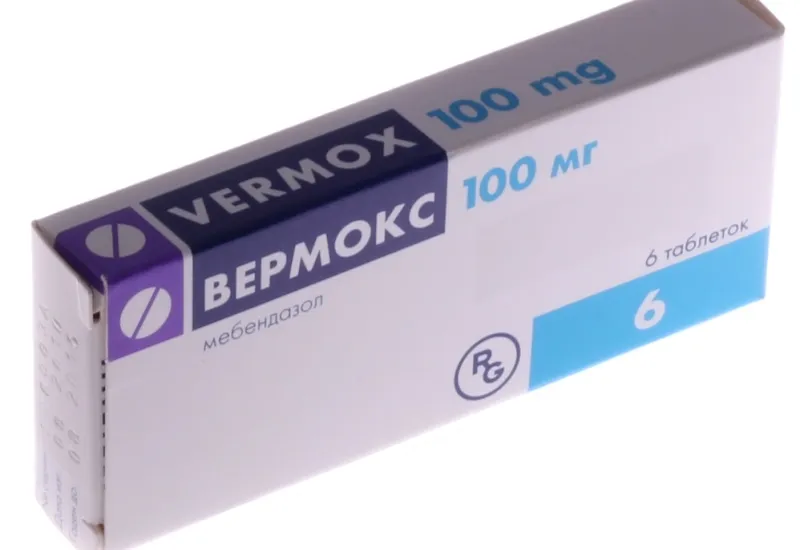
Table of Contents
INSTRUCTIONS for medical use of the medicinal product VORMIN (VERMOX)
Composition:
Active substance: mebendazole;
1 tablet contains mebendazole 100 mg;
Excipients: sodium lauryl sulfate, colloidal anhydrous silicon dioxide, magnesium stearate, sodium saccharin, talc, maize starch, lactose monohydrate.
Pharmaceutical form. Tablets.
Main physicochemical properties: flat, white or almost white tablets with a slight characteristic odor, disk-shaped, with a bevel, approximately 10 mm in diameter, marked «VERMOX» on one side and a score line on the other.
Pharmacotherapeutic group.
Anthelmintics. Benzimidazole derivatives. ATC code P02CA01.
Pharmacological properties.
Pharmacodynamics.
Mebendazole acts locally in the intestinal lumen, interfering with the formation of cellular tubulin in helminths, which leads to disruption of glucose utilization and digestive processes, and to autolysis of the parasite. There is no evidence of efficacy of Vermox in the treatment of cysticercosis.
Pharmacokinetics.
After oral administration, less than 10% of the dose reaches systemic circulation due to incomplete absorption and extensive presystemic metabolism (first-pass effect). Maximum plasma concentration is observed 2–4 hours after administration. Concomitant administration of the drug with a high-calorie meal slightly increases the bioavailability of mebendazole.
Distribution. 90–95% of the administered dose is bound to plasma proteins. The volume of distribution ranges from 1 to 2 L/kg, indicating the ability of mebendazole to penetrate vascular walls. This is supported by data from patients chronically receiving mebendazole (40 mg/kg/day for 3–21 months).
Metabolism. After oral administration, mebendazole is predominantly metabolized in the liver. Plasma concentrations of its main metabolites significantly exceed the concentration of mebendazole. Impaired liver function, or disturbances in metabolism or biliary elimination, may lead to increased plasma levels of mebendazole.
Elimination. Mebendazole, conjugated forms of mebendazole, and its metabolites undergo partial enterohepatic recirculation and are excreted in urine and bile. The apparent elimination half-life after oral administration in most patients is 3–6 hours.
Pharmacokinetics at steady state.
During long-term therapy (40 mg/kg/day for 3–21 months), plasma concentrations of mebendazole and its main metabolites increase, resulting in approximately a threefold increase in exposure at steady state compared to single-dose administration.
Paediatric population.
Limited data on plasma concentrations of mebendazole in children and adolescents aged 1 to 16 years are available. These data do not indicate significantly higher systemic exposure to mebendazole in patients aged 3 to 16 years compared to adults. In patients aged 1 to 3 years, systemic exposure is higher than in adults due to a higher dose per kilogram of body weight compared to adults.
Clinical characteristics.
Indications.
Treatment of infestations such as enterobiasis, ascariasis, ancylostomiasis, trichocephalosis, necatoriasis.
Contraindications.
Hypersensitivity to mebendazole or to any of the components of the drug.
Pregnancy, breastfeeding period.
Interaction with other medicinal products and other forms of interaction.
Concomitant use with cimetidine may enhance the effect of Vermox due to inhibition of mebendazole metabolism in the liver, resulting in increased plasma concentration of the latter.
Concomitant use of mebendazole and metronidazole should be avoided (see section "Special precautions for use").
Special precautions for use
During the post-marketing period, seizures have been rarely reported in children, including infants under 1 year of age (see section "Adverse reactions"). The use of mebendazole in children under 2 years of age has not been widely studied. Therefore, Vermox should be administered to children aged 1 to 2 years only if the potential benefit justifies the potential risk. Due to insufficient safety data, Vermox should not be used in children under 1 year of age.
Rare cases of reversible liver function abnormalities, hepatitis, and neutropenia have been reported in patients receiving mebendazole at standard doses for the approved indications. Cases of glomerulonephritis and agranulocytosis have been reported in association with doses significantly exceeding the recommended doses and with prolonged treatment duration.
Clinical data suggest a possible association between the use of mebendazole and metronidazole and the development of Stevens–Johnson syndrome / toxic epidermal necrolysis. Concomitant use of mebendazole and metronidazole should be avoided.
There is no need to prescribe a special diet or laxatives during treatment with this medicinal product.
One tablet contains 110 mg of lactose monohydrate; therefore, Vermox should not be administered to patients with rare hereditary forms of galactose intolerance, complete lactase deficiency, or glucose-galactose malabsorption syndrome.
This medicinal product contains less than 1 mmol (23 mg) of sodium per tablet, i.e. it is practically sodium-free.
Use during pregnancy or breastfeeding
Since Vermox is contraindicated during pregnancy, the drug should not be administered to pregnant patients or to those who suspect they may be pregnant.
Breastfeeding period
Available data indicate that a small amount of mebendazole may be present in human breast milk following oral administration. Therefore, breastfeeding is not recommended during treatment with Vermox.
Fertility
It is known that mebendazole does not affect fertility when administered at doses up to 10 mg/kg per day.
Reproductive studies have shown that mebendazole does not affect male fertility when administered at doses up to and including 40 mg/kg per day.
Ability to affect reaction speed when driving or operating machinery
Mebendazole does not impair the ability to drive a vehicle or operate machinery. However, due to the possibility of adverse reactions affecting the nervous system, caution should be exercised.
Method of Administration and Dosage.
For oral use. When taking Vermox, there is no need to follow a special diet or to use laxatives. Tablets may be chewed or swallowed whole. For younger children, the tablet may be crushed before administration. Administration of the medication to a child must be supervised by an adult.
For enterobiasis:
Adults and children aged 2 years and older, regardless of body weight and age – 1 tablet (100 mg) as a single dose. To prevent reinfection, repeat administration of 1 tablet (100 mg) should be carried out after 2 weeks.
For ascariasis, trichuriasis, ancylostomiasis, and necatoriasis:
Adults and children aged 2 years and older, regardless of body weight and age – 1 tablet (100 mg) twice daily (1 tablet in the morning and 1 tablet in the evening) for 3 consecutive days.
Children.
The use of this medicinal product is not recommended for children under 2 years of age (see section "Special Warnings and Precautions for Use").
Overdose.
In patients who received higher than recommended doses or were treated for prolonged periods, alopecia, reversible liver function abnormalities, hepatitis, agranulocytosis, neutropenia, and glomerulonephritis have been rarely observed. Such adverse reactions, except for agranulocytosis and glomerulonephritis, have also been observed in patients treated with mebendazole at standard doses (see section "Adverse Reactions").
Symptoms: In cases of accidental overdose, spasmodic abdominal pain, nausea, vomiting, and diarrhea may occur.
Treatment: There is no specific antidote. Gastric lavage may be performed soon after mebendazole ingestion. Activated charcoal may be administered if clinically indicated.
Adverse Reactions
Mebendazole is generally well tolerated at recommended doses. Diarrhea and abdominal pain have been observed in patients with significant parasitic burden during treatment with Mebendazole.
The adverse reactions observed are classified according to frequency of occurrence: very common (≥1/10); common (≥1/100 to <1/10); uncommon (≥1/1000 to <1/100); rare (≥1/10,000 to <1/1000); very rare (<1/10,000); frequency not known (cannot be estimated from available data).
Blood and lymphatic system disorders:
Rare: neutropenia, agranulocytosis (observed during high-dose and long-term treatment).
Immune system disorders:
Rare: hypersensitivity reactions, including anaphylactic and anaphylactoid reactions.
Central nervous system disorders:
Rare: seizures, dizziness.
Gastrointestinal disorders:
Common: abdominal pain (in cases of significant parasitic burden);
Uncommon: abdominal discomfort, diarrhea (in cases of significant parasitic burden), flatulence, nausea, vomiting.
Skin and subcutaneous tissue disorders:
Rare: rash, toxic epidermal necrolysis, Stevens–Johnson syndrome, exanthema, angioneurotic edema, urticaria, alopecia.
Hepatobiliary disorders:
Rare: hepatitis, increased liver enzyme activity.
Renal and urinary disorders:
Rare: glomerulonephritis (observed during high-dose and long-term treatment).
Pediatric population
An additional adverse reaction in children affecting the central nervous system:
Very rare: seizures.
Shelf life. 5 years.
Storage conditions. Store at a temperature not exceeding 30 °C.
Keep out of reach and sight of children.
Packaging. 6 tablets in a blister; 1 blister per cardboard pack.
Prescription status. Prescription only.
Marketing Authorization Holder. JSC "Gedeon Richter", Hungary.
Address of the Marketing Authorization Holder. H-1103 Budapest, Demréti Street 19-21, Hungary.
Manufacturer. JSC "Gedeon Richter", Hungary.
Address of the Manufacturer and site of activity.
H-1103 Budapest, Demréti Street 19-21, Hungary.
Manufacturer. Gedeon Richter Romania A.T.
Address of the Manufacturer and site of activity.
Calea lui Traian, No. 99-105, Târgu-Mureș, Mureș County, 540306, Romania.