Ventavis
Ukraine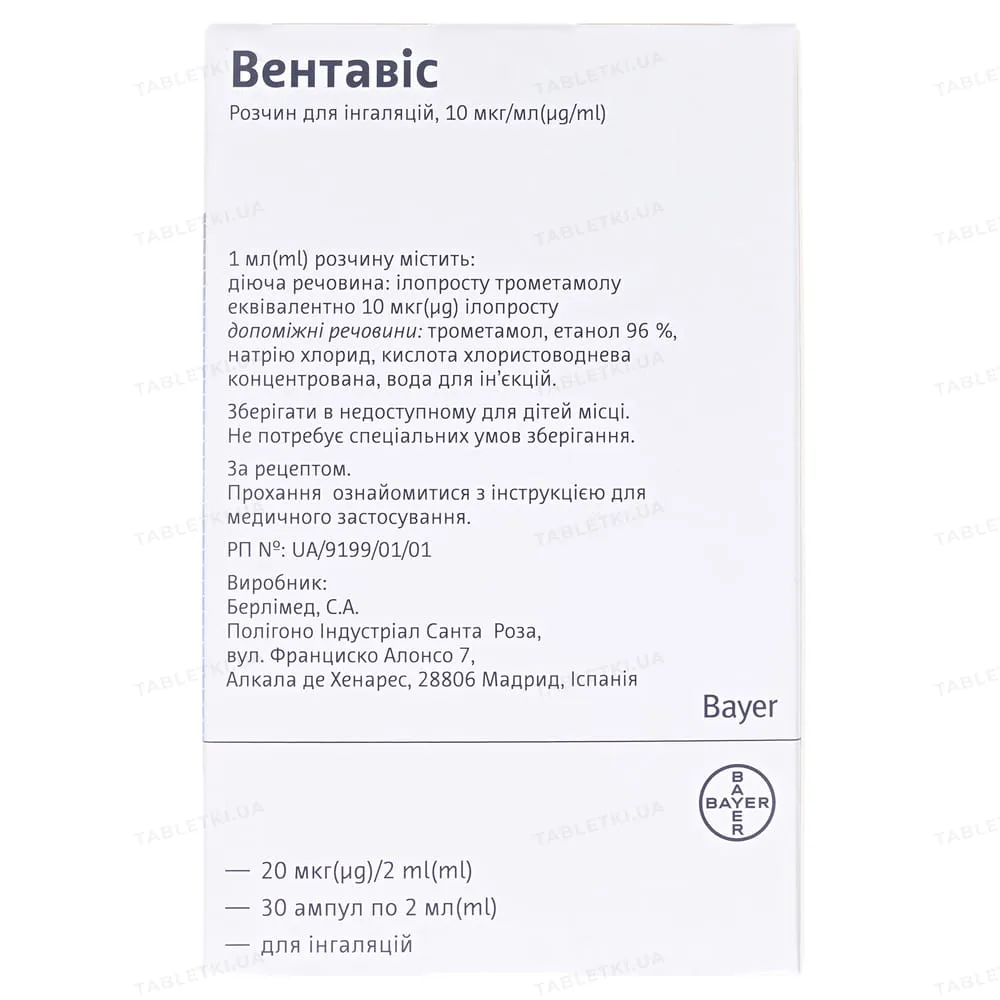
Table of Contents
INSTRUCTIONS FOR MEDICAL USE OF THE MEDICINAL PRODUCT VENTAVIS (VENTAVISÒ)
Composition:
Active substance: iloprost;
1 ml of solution contains iloprost tromethamine equivalent to 10 mcg of iloprost;
1 ampoule with 2 ml of solution for inhalation contains iloprost tromethamine equivalent to 20 mcg of iloprost;
Excipients: tromethamine, ethanol 96%, sodium chloride, concentrated hydrochloric acid, water for injections.
Pharmaceutical form. Solution for inhalation.
Main physicochemical properties: clear solution free from particles.
Pharmacotherapeutic group. Antithrombotic agents. Platelet aggregation inhibitors, excluding heparin.
ATC Code B01A C11.
Pharmacological Properties
Pharmacodynamics
Iloprost, the active substance in Ventavis, is a synthetic analogue of prostacyclin. Its pharmacological activity in vitro includes:
- inhibition of platelet aggregation, adhesion, and release reaction;
- dilation of arterioles and venules;
- increased capillary density and reduction of increased vascular permeability in the microcirculatory system induced by mediators such as serotonin or histamine;
- enhancement of endogenous fibrinolytic activity.
Pharmacological effects after inhalation of Ventavis
Direct pulmonary arterial vasodilation leads to significant beneficial effects on pulmonary arterial pressure, pulmonary vascular resistance, cardiac output, and mixed venous blood oxygen saturation.
In a small randomized, double-blind, placebo-controlled 12-week study (the STEP study), 34 patients who were hemodynamically stable prior to inclusion and had been receiving bosentan 125 mg twice daily for at least 16 weeks were treated with inhaled iloprost solution at a concentration of 10 µg/mL (delivered dose of iloprost via the inhalation tubing – up to 5 µg 6–9 times daily). The mean daily inhaled dose was 27 µg, and the mean number of inhalations per day was 5.6. Acute adverse events in patients receiving combination therapy with bosentan and iloprost were consistent with those observed in a large Phase III study of patients receiving iloprost alone. Due to the small size and short duration of this study, conclusions regarding concomitant use of these agents cannot be drawn.
There are no clinical data comparing acute hemodynamic responses in the same patient after intravenous administration versus inhaled iloprost. Hemodynamic parameters indicate an acute response and benefits of inhaled therapy. The vasodilatory effect of inhaled iloprost is short-lived (1–2 hours).
However, the prognostic value of acute hemodynamic response data is limited, as a rapid response does not always correlate with long-term favorable outcomes from inhaled iloprost therapy.
Efficacy in adult patients with pulmonary hypertension
A randomized, double-blind, multicenter, placebo-controlled Phase III study (study RRA02997) included 203 adult patients (inhaled iloprost solution at 10 µg/mL: n=101; placebo: n=102) with stable pulmonary hypertension. Inhaled iloprost (or placebo) was added to background therapy, which could include anticoagulants, vasodilators (e.g., calcium channel blockers), diuretics, oxygen, and cardiac glycosides, but not prostaglandin I2 (prostacyclin or its analogues). Among the 108 patients diagnosed with primary pulmonary hypertension and 95 with secondary pulmonary hypertension, 56 cases were associated with chronic thromboembolism, 34 with connective tissue diseases (including CREST and scleroderma), and 4 with appetite-suppressant drugs. The 6-minute walk test at baseline showed moderate exercise limitation: the mean distance was 332 meters (median 340 meters) in the iloprost group and 315 meters (median 321 meters) in the placebo group. The mean inhaled daily dose (i.e., the dose of iloprost delivered via the inhalation tubing) in the iloprost group was 30 µg (range: 12.5–45 µg/day). The primary endpoint of this study was a composite measure of treatment response: improvement in exercise capacity (6-minute walk test) at week 12 compared to baseline, improvement by at least one functional class of heart failure (NYHA classification) at week 12 compared to baseline, and absence of worsening pulmonary hypertension or death by week 12. The clinical response rate to iloprost was 16.8% (17/101), compared to 4.9% (5/102) in the placebo group (p=0.007).
In the iloprost group, the mean distance walked during the 6-minute walk test increased by 22 meters by week 12 (–3.3 meters in the placebo group, no mortality data available) compared to baseline.
In the iloprost group, the functional class of heart failure (NYHA classification) improved in 26% of patients (15% in the placebo group) (p=0.032), remained unchanged in 67.7% (76% in the placebo group), and worsened in 6.3% (9% in the placebo group). Invasive hemodynamic parameters were assessed at baseline and after 12 weeks of therapy.
Subgroup analysis showed no treatment effect compared to the placebo group in the 6-minute walk test among patients with secondary pulmonary hypertension.
A mean increase of 44.7 meters (in the 6-minute walk test compared to baseline of 329 meters) was observed in 49 patients with primary pulmonary hypertension treated with inhaled iloprost for 12 weeks (no imputed data for mortality or missing values). In 46 patients in the placebo group, the result was negative: a decrease in walking distance of 7.4 meters (compared to baseline of 324 meters).
Pediatric patients
Studies on the use of Ventavis in children with pulmonary hypertension have not been conducted.
Preclinical data
General toxicity
In acute toxicity studies, single intravenous and oral doses of iloprost twice the therapeutic dose caused severe intoxication symptoms or death (with intravenous administration). Given the high pharmacological potency of iloprost and the absolute doses required for therapeutic purposes, findings from acute toxicity studies do not indicate a risk of adverse events in humans. As expected for a prostacyclin, iloprost caused hemodynamic effects (vasodilation, skin flushing, hypotension, platelet function inhibition, respiratory distress) and general signs of intoxication such as apathy, gait disturbances, and postural reactions.
Continuous intravenous and subcutaneous infusions of iloprost for up to 26 weeks in animals at doses 14–47 times higher than therapeutic did not cause toxic effects. Only expected pharmacological effects were observed, such as arterial hypotension, skin flushing, dyspnea, and increased intestinal motility.
In inhalation toxicity studies in rats for up to 26 weeks, the highest dose of 48.7 µg/kg/day was determined as the "no observed adverse effect level" (NOAEL). After inhalation, systemic exposure in animals exceeded the corresponding therapeutic exposure in humans by approximately 10-fold (Cmax, cumulative AUC).
Genotoxic potential, oncogenicity
Studies on genotoxicity in vitro (bacterial, mammalian cells, human lymphocytes) and in vivo (micronucleus test) showed no evidence of mutagenic potential. Animal studies also showed no oncogenic effects of iloprost.
Reproductive toxicity
In studies of embryotoxicity and fetotoxicity in rats, prolonged intravenous administration of iloprost caused phalangeal abnormalities in the forelimbs of several embryos, independent of dose. These changes are not considered manifestations of teratogenic potential; rather, they are likely related to iloprost-induced growth retardation at the end of the organogenesis stage due to hemodynamic changes in the fetoplacental system. No postnatal developmental or reproductive function impairments were observed in offspring, indicating that growth retardation was compensated during postnatal development.
In comparative embryotoxicity studies in rabbits and monkeys, such malformations or other structural abnormalities were not observed, even after administration of doses many times higher than the human dose.
In rats, low concentrations of iloprost and/or metabolites were observed to pass into breast milk (less than 1% of the intravenously administered dose). No postnatal developmental or reproductive function impairments were observed in animals exposed to the drug during lactation.
Local irritant effect, contact sensitization, and antigenicity
In animal inhalation studies, administration of iloprost at a concentration of 20 µg/mL for up to 26 weeks did not cause local irritation of the upper and lower respiratory tract. Skin sensitization and antigenicity studies showed no sensitizing potential.
Pharmacokinetics
Absorption. When iloprost at a concentration of 10 µg/mL was inhaled by patients with pulmonary hypertension for 4.6–10.6 minutes with a delivered dose of 5 µg via the inhalation tubing, peak serum levels of 100–200 pg/mL were observed at the end of inhalation. These levels declined with a half-life of approximately 5–25 minutes. Iloprost was not detectable in the central chamber 30 minutes to 1 hour after the end of inhalation (quantification limit: 25 pg/mL).
Distribution. Distribution studies after inhalation have not been conducted. After intravenous infusion, the apparent volume of distribution was 0.6–0.8 L/kg in healthy volunteers. Total plasma protein binding of iloprost is concentration-independent within the range of 30–3000 pg/mL and is approximately 60%, of which 75% is bound to albumin.
Metabolism. Metabolism studies of inhaled iloprost (Ventavis) have not been conducted. After intravenous administration, iloprost is primarily metabolized via β-oxidation of the side carboxyl chain. The substance is not excreted unchanged. The main metabolite, tetranor-iloprost, is found in urine in free and conjugated forms. Tetranor-iloprost is pharmacologically inactive, as confirmed in animal studies. In vitro studies indicate that CYP450 enzyme-dependent metabolism plays only a minor role in iloprost biotransformation. Further in vitro studies suggest that metabolism of iloprost in the lungs after intravenous administration and inhalation is similar.
Elimination. Elimination studies after inhalation have not been conducted. In individuals with normal liver and kidney function, elimination of iloprost after intravenous infusion is mostly biphasic, with half-lives of 3–5 minutes and 15–30 minutes, respectively. Total clearance of iloprost is approximately 20 mL/kg/min, indicating extrahepatic metabolism pathways. A mass balance study using 3H-iloprost in healthy volunteers showed that 81% of radioactivity was recovered overall, with 68% and 12% found in urine and feces, respectively. Metabolites are eliminated from plasma and urine in two phases, with plasma half-lives of approximately 2 and 5 hours, and urine half-lives of 2 and 18 hours, respectively.
Special patient groups
Renal impairment. Study results in patients with end-stage renal failure undergoing intermittent dialysis indicate that clearance of iloprost during intravenous infusions is significantly lower (mean clearance: 5 ± 2 mL/min/kg) compared to patients with renal impairment not undergoing dialysis (mean clearance: 18 ± 2 mL/min/kg).
Hepatic impairment. Since iloprost is extensively metabolized by the liver, plasma levels are affected by changes in liver function. Study results were obtained from 8 patients with liver cirrhosis who received intravenous iloprost. The mean clearance of iloprost was 10 mL/min/kg.
Age and sex. The pharmacokinetics of iloprost are not influenced by patient age or sex.
Clinical characteristics.
Indications.
Treatment of adult patients with primary pulmonary hypertension NYHA class III to improve exercise tolerance and relieve symptoms.
Contraindications.
- Hypersensitivity to iloprost or to any other component of the medicinal product.
- Conditions in which the effect of the drug on platelets may increase the risk of bleeding (e.g. peptic ulcers in the acute phase, trauma, intracranial hemorrhage).
- Severe ischemic heart disease or unstable angina.
- Myocardial infarction within the last 6 months.
- Decompensated heart failure without careful physician supervision.
- Severe arrhythmias.
- Cerebrovascular diseases (including transient ischemic attack, stroke) within the last 3 months.
- Pulmonary hypertension due to pulmonary veno-occlusive disease.
- Hereditary or acquired valvular defects unrelated to pulmonary hypertension with significant myocardial dysfunction.
Special safety measures.
For each inhalation procedure, the contents of one opened ampoule of Ventavis should be transferred directly into the nebulizer chamber immediately before use.
After each inhalation procedure, any remaining solution should be discarded from the nebulizer. Additionally, hygiene and cleaning instructions provided by nebulizer manufacturers must be strictly followed.
Unused medicinal product and waste materials must be disposed of in accordance with local requirements.
Interaction with other medicinal products and other types of interactions.
Iloprost may enhance the effects of vasodilators and antihypertensive agents, potentially increasing the risk of hypotension (see section "Special precautions for use"). Caution should be exercised when Ventavis is used concomitantly with vasodilating agents or antihypertensive drugs, as dose adjustments may be necessary.
Due to iloprost's inhibition of platelet aggregation, its use in combination with the following agents may enhance inhibition of platelet aggregation and thereby increase the risk of bleeding:
- anticoagulants, e.g.
- heparin,
- oral anticoagulants (coumarin derivatives or direct-acting anticoagulants),
- or other platelet aggregation inhibitors, such as
- acetylsalicylic acid,
- nonsteroidal anti-inflammatory drugs,
- nonselective phosphodiesterase inhibitors, such as pentoxifylline,
- selective phosphodiesterase 3 (PDE3) inhibitors, such as cilostazol or anagrelide,
- ticlopidine,
- clopidogrel,
- glycoprotein IIb/IIIa antagonists:
- abciximab,
- eptifibatide,
- tirofiban,
- defibrotide.
Careful monitoring of patients receiving anticoagulants or other platelet aggregation inhibitors is required, in accordance with standard medical guidelines.
Intravenous infusions of iloprost do not affect the pharmacokinetic properties of digoxin following repeated oral administration. Iloprost has no effect on the pharmacokinetic properties of tissue plasminogen activator administered simultaneously.
Although no clinical studies have been conducted on this matter, results from in vitro studies investigating the inhibitory effect of iloprost on cytochrome P450 enzyme activity indicate that iloprost does not inhibit the metabolism of drugs via these enzymes.
Special precautions for use.
Use of Ventavis is not recommended in patients with unstable pulmonary hypertension or progressive right heart failure. If right heart failure worsens or progresses, the appropriateness of continuing therapy should be reconsidered, and alternative treatments should be considered.
Arterial hypotension
Blood pressure should be monitored at the beginning of Ventavis treatment. Patients with low systemic blood pressure, postural hypotension, or those receiving concomitant therapy with drugs that may reduce arterial pressure (BP) require precautions to prevent further BP reduction. Initiation of Ventavis therapy is not recommended if systolic BP is below 85 mm Hg.
Physicians should pay particular attention to the presence of concomitant diseases or concomitant use of medicinal products that may increase the risk of hypotension or syncope (see section "Interaction with other medicinal products and other forms of interaction").
Syncope
The vasodilatory effect of inhaled iloprost is transient (1–2 hours). Syncope is a common symptom of the disease itself but may also occur during therapy. Patients with pulmonary hypertension who experience syncope should avoid excessive exertion, such as physical exercise. Inhalation is recommended before physical activity. An increase in the frequency of syncope may reflect inadequacies in the treatment regimen and/or disease exacerbation; in such cases, the need to adjust and/or change the treatment regimen should be considered (see section "Undesirable effects").
Patients with respiratory disorders
Inhalation of Ventavis may increase the risk of bronchospasm, especially in patients with bronchial hyperreactivity (see section "Undesirable effects"). The benefit of therapy has not been established in patients with chronic obstructive pulmonary disease (COPD) or severe asthma. Patients with acute respiratory infections, COPD, or severe asthma require close medical supervision.
Patients with concomitant acute lung infections, COPD, or severe asthma require careful monitoring.
Pulmonary veno-occlusive disease
Pulmonary vasodilators may significantly worsen the cardiovascular status in patients with pulmonary veno-occlusive disease. If signs of pulmonary edema occur during inhaled iloprost therapy in patients with pulmonary hypertension, the possibility of associated pulmonary veno-occlusive disease should be considered. In such cases, treatment should be discontinued.
Discontinuation of therapy
There is a risk of rebound effect upon discontinuation of Ventavis therapy. Close monitoring of the patient's condition is required when stopping iloprost inhalations. Alternative treatment should be considered for critically ill patients.
Patients with hepatic or renal impairment
Elimination of the drug is reduced in patients with renal insufficiency requiring dialysis and in those with impaired liver function, as demonstrated in studies of intravenous iloprost administration (see section "Pharmacological properties"). Careful dose titration with dosing intervals of at least 3–4 hours is recommended (see section "Dosage and administration").
Serum glucose levels
Minor increases in fasting serum glucose levels were observed in animals after long-term (one year) oral administration of iloprost cileate. Such a possibility should not be excluded in humans during long-term use of Ventavis.
Unintended exposure to Ventavis
To minimize unintended exposure to Ventavis, it is recommended to use nebulizers equipped with an inhalation-triggered system and to ensure adequate room ventilation.
Newborns, infants, and pregnant women should not be present in the room where Ventavis is administered.
Contact with skin, eyes, or ingestion
Ventavis inhalation solution must not come into contact with skin or eyes; oral ingestion of the drug should be avoided. During inhalation sessions, a face mask is not recommended; the inhaler mouthpiece should be used.
Ventavis contains ethanol
Ventavis 10 mcg/mL contains 0.81 mg of ethanol per mL, equivalent to 0.081% (w/v). The amount of 0.81 mg of alcohol in 1 mL of this medicinal product is less than that in 1 mL of beer or wine. The small amount of alcohol in this product is unlikely to have noticeable effects.
Use during pregnancy or breastfeeding.
Women of reproductive potential
Women of reproductive potential should use reliable contraception during treatment with Ventavis.
Pregnancy
Women with pulmonary hypertension (PH) should avoid pregnancy, as it may lead to life-threatening exacerbation of the disease.
Animal studies have shown effects on reproductive function (see section "Pharmacological properties"). Information on the use of iloprost in pregnant women is limited. If pregnancy occurs, use of Ventavis during pregnancy may be considered for women who decide to continue the pregnancy despite the known risks of pulmonary hypertension in pregnancy, but only after careful assessment of benefit/risk ratio.
Breastfeeding
It is unknown whether iloprost/metabolites are excreted in human breast milk. Preclinical data indicate that iloprost is excreted in milk in small amounts (see section "Pharmacological properties"). As potential risk to the infant cannot be excluded, breastfeeding should be avoided during treatment with Ventavis.
Fertility
Animal studies did not show any adverse effects of iloprost on fertility.
Ability to affect reaction speed when driving or operating machinery.
In patients experiencing symptoms related to arterial hypotension, such as dizziness, reaction speed when driving or operating machinery may be significantly impaired.
Caution is advised at the beginning of therapy regarding the occurrence of any such effects.
Method of Administration and Dosage
The drug should be used only under the supervision of a physician experienced in the management of pulmonary hypertension.
Dosing
Dose per inhalation procedure
Treatment with Ventavis should be initiated at a low dose of 2.5 mcg iloprost (delivered dose through the inhaler mouthpiece). If the drug is well tolerated, the dose may be increased to 5 mcg iloprost (delivered dose through the inhaler mouthpiece) and maintained at this level. If 5 mcg iloprost is poorly tolerated, the dose should be reduced to 2.5 mcg. For each inhalation procedure, the contents of one ampoule (2 mL) of Ventavis 10 mcg/mL should be used.
Daily dose
The dose per inhalation procedure should be administered 6–9 times daily, depending on individual patient needs and tolerability (accordingly, 6 to 9 ampoules (2 mL each) of Ventavis 10 mcg/mL are used per day).
Duration of treatment
The duration of treatment depends on the clinical status and is determined by the physician. If the patient's condition worsens during therapy, intravenous prostacyclin administration should be considered.
Special patient groups
Patients with hepatic impairment. Elimination of iloprost is reduced in patients with impaired liver function (see section "Pharmacological properties").
To avoid unwanted drug accumulation during the day, special monitoring is required in this patient group during initial dose titration. Initially, doses of 2.5 mcg of Ventavis 10 mcg/mL (delivered dose through the inhaler mouthpiece) should be administered at intervals of at least 3–4 hours (corresponding to a maximum of 6 doses per day). Subsequently, the dosing intervals may be shortened according to patient tolerability. If further dose escalation to 5 mcg (delivered dose through the inhaler mouthpiece) is indicated, the drug should initially also be administered at 3–4 hour intervals, which may later be shortened depending on patient tolerability. Further unwanted drug accumulation after several days of treatment is unlikely due to the overnight treatment break.
Patients with renal impairment. Dose adjustment is not required for patients with creatinine clearance > 30 mL/min (calculated from serum creatinine using the Cockroft–Gault formula). Patients with creatinine clearance ≤ 30 mL/min were not included in clinical studies of Ventavis. Based on data obtained for intravenous iloprost, drug elimination is reduced in renal impairment requiring dialysis. Therefore, the dosing recommendations for patients with hepatic impairment should be applied (see above).
Method of administration
Ventavis is intended for inhalation using a nebulizer.
For each inhalation procedure, the contents of one opened ampoule of Ventavis (2 mL) should be placed directly into the nebulizer chamber immediately before use.
The ready-to-use Ventavis solution is administered using appropriate inhalation devices (inhalers) (see sections "Special precautions for safety" and "Special instructions").
Patients whose condition is stabilized using a specific nebulizer should not switch to another nebulizer without medical supervision, as different nebulizers produce aerosols with slightly different physical characteristics and solution delivery rates.
- I-Neb AAD System
The I-Neb AAD System is a portable handheld mesh nebulizer system utilizing vibrating mesh technology. The system generates droplets using ultrasound that forces the solution through a mesh. The I-Neb AAD nebulizer can also be used for inhalation of Ventavis 10 mcg/mL. The mass median aerodynamic diameter (MMAD) of aerosol droplets measured when using the I-Neb nebulizer system equipped with a power disc level 10 is approximately 2 micrometers.
The dose delivered by the I-Neb AAD nebulizer system is controlled by the nebulizer chamber and control disc. Each shutter has a coded color and a corresponding colored control disc (see Table 1).
The initial dose of Ventavis when using the I-Neb AAD nebulizer system should be 2.5 mcg iloprost delivered through the inhaler mouthpiece. If this dose is well tolerated, it should be increased to 5 mcg iloprost (delivered dose through the inhaler mouthpiece) and maintained at this level. If the 5 mcg dose is poorly tolerated, it should be reduced to 2.5 mcg iloprost.
This nebulizer system monitors breathing patterns to determine the required nebulization time for the pre-set dose of either 2.5 mcg or 5 mcg iloprost.
For the 2.5 mcg dose of Ventavis 10 mcg/mL, a nebulizer chamber with a red shutter and a red control disc must be used.
For the 5 mcg dose of Ventavis 10 mcg/mL, a nebulizer chamber with a purple shutter and a purple control disc must be used.
For each inhalation procedure, the contents of one ampoule of Ventavis 10 mcg/mL should be placed directly into the nebulizer chamber immediately before use.
Table 1
| Medicinal product |
Colored rings on the ampoule |
Dosage |
I-Neb AAD |
Expected duration of inhalation |
|
| Nebulizer chamber shutter |
Control disc |
||||
| Ventavis, 10 mcg/mL |
1 mL ampoules with colored rings (white – yellow) |
2.5 mcg |
red |
red |
3.2 min |
| 5 mcg |
purple |
purple |
6.5 min |
||
- Venta-Neb
Venta-Neb is a portable ultrasonic nebulizer powered by a rechargeable battery, suitable for the administration of Ventavis 10 mcg/mL, nebulizing solution (2 mL ampoules). The MMAD of aerosol droplets is 2.6 μm.
The initial dose of Ventavis when using the Venta-Neb nebulizer system should be 2.5 mcg of iloprost delivered through the inhalation tubing. If this dose is well tolerated, it should be increased to 5 mcg of iloprost (delivered through the inhalation tubing) and maintained at this level. If the 5 mcg dose is poorly tolerated, it should be reduced to 2.5 mcg of iloprost.
This nebulizer system monitors the breathing pattern to determine the required nebulization time for the pre-set dosages of either 2.5 mcg or 5 mcg of iloprost delivered through the inhalation tubing.
For each inhalation procedure using the Venta-Neb nebulizer system, the contents of one ampoule (2 mL) of Ventavis 10 mcg/mL should be placed directly into the nebulizer chamber immediately before use.
Two programs can be used:
P1 Program 1: 5 micrograms of active substance delivered through the inhalation tubing, 25 inhalation cycles (breaths).
P2 Program 2: 2.5 micrograms of active substance delivered through the inhalation tubing, 10 inhalation cycles (breaths).
The default program setting must be determined by the physician.
Venta-Neb reminds the patient of the inhalation treatment via optical and acoustic signals. The system stops automatically after the set dose has been delivered.
To achieve droplets of optimal size (when using Ventavis), the green nebulizing plate must be used. For further details, refer to the instructions for use of the Venta-Neb nebulizer.
Table 2
| Medicinal product |
Color ring of the ampoule |
Dosage |
Expected duration of inhalation |
| Ventavis, 10 mcg/mL |
2 mL ampoules marked with color rings (white – pink) |
2.5 mcg 5 mcg |
4 min 8 min |
Other non-nebulizer systems
The efficacy and tolerability of inhaled iloprost administered using other non-nebulizer systems with different iloprost solution aerosolization characteristics have not been investigated.
Children
Data on the efficacy and safety of Ventavis in children (under 18 years of age) are lacking.
Controlled clinical trial data are lacking.
Overdose
Overdose symptoms. Cases of overdose have been reported. Symptoms of overdose are primarily related to the vasodilatory action of iloprost. Frequently observed symptoms following overdose include dizziness, headache, facial flushing, nausea, jaw or back pain. Hypotension, increased blood pressure, bradycardia or tachycardia, vomiting, diarrhea, and limb pain may also occur.
Treatment in case of overdose. No specific antidotes are known. Discontinuation of the drug is recommended, along with symptomatic therapy and monitoring.
Adverse reactions.
In addition to local reactions caused by inhaled administration of iloprost, such as cough, adverse reactions to iloprost are related to the pharmacological properties of prostacyclins. Adverse reactions most frequently observed during clinical trials (≥ 20%) include vasodilation, particularly hypotension, headache, and cough. The most serious adverse reactions were arterial hypotension, episodes of bleeding, and bronchospasm.
The adverse reactions reported below are based on pooled data from Phase II and III clinical trials involving 131 patients who received Ventavis at a concentration of 10 \µg/mL, as well as on post-marketing surveillance data.
Adverse reactions identified from clinical trials are classified according to their frequency of occurrence: very common (≥ 1/10), common (≥ 1/100 to < 1/10). Adverse reactions identified only during post-marketing surveillance, for which frequency cannot be estimated, are categorized as "frequency unknown".
Within each group, adverse effects are listed in order of decreasing severity.
Table 3
| System organ classes (MedDRA) |
Very common ≥ 1/10 |
Common (≥ 1/100 – < 1/10) |
Frequency not known |
| Blood and lymphatic system disorders |
Bleeding episodes*§ |
Thrombocytopenia |
|
| Immune system disorders |
Hypersensitivity |
||
| Nervous system disorders |
Headache |
Dizziness |
|
| Cardiac disorders |
Tachycardia, palpitations |
||
| Vascular disorders |
Vasodilation, facial flushing |
Syncope§ (see section "Special precautions"), hypotension* |
|
| Respiratory, thoracic and mediastinal disorders |
Chest discomfort/pain, cough |
Dyspnea, pharyngeal and laryngeal pain, throat irritation |
Bronchospasm* (see section "Special precautions")/wheezing |
| Gastrointestinal disorders |
Nausea |
Diarrhea, vomiting, irritation of oral mucosa and tongue, including pain |
Dysgeusia |
| Skin and subcutaneous tissue disorders |
Rash |
||
| Musculoskeletal and connective tissue disorders |
Jaw pain/trismus |
||
| General disorders and administration site conditions |
Peripheral edema§ |
* Life-threatening and/or fatal cases have been reported.
§ See description of individual adverse reactions
Description of individual adverse reactions
Bleeding episodes (mainly epistaxis and hemoptysis) were very commonly observed in patients receiving concomitant anticoagulant therapy. The risk of bleeding may be increased in patients receiving concomitant platelet aggregation inhibitors or anticoagulants (see section "Interaction with other medicinal products and other forms of interaction"). Fatal cases of intracranial and intracerebral hemorrhage have been reported.
Syncope is a common symptom of the disease itself, but it may also occur during treatment. An increased frequency of syncope may indicate disease progression or inadequate drug efficacy (see section "Special precautions for use").
In clinical trials, peripheral edema was observed in 12.2% of patients treated with iloprost and in 16.2% of patients treated with placebo. Peripheral edema is a very common symptom of the disease itself, but it may also frequently occur during treatment. The appearance of peripheral edema may indicate disease progression or inadequate drug efficacy.
Reporting of suspected adverse reactions.
Reporting suspected adverse reactions after medicinal product authorization is very important. It allows continuous monitoring of the benefit-risk balance of the medicinal product. Healthcare professionals are required to report any suspected adverse reactions.
Shelf life.
4 years.
Storage conditions.
Keep out of the reach of children. No special storage conditions required.
Incompatibilities.
In the absence of compatibility studies, this medicinal product should not be mixed with other medicinal products.
Packaging.
2 ml in an ampoule. 30 ampoules in a cardboard pack.
Prescription status.
Prescription only.
Manufacturer.
Berlmed, S.A.
Manufacturer's address and place of business.
Polígono Industrial Santa Rosa, Calle Francisco Alonso 7, Alcalá de Henares, 28806 Madrid, Spain.