Venosmil
Ukraine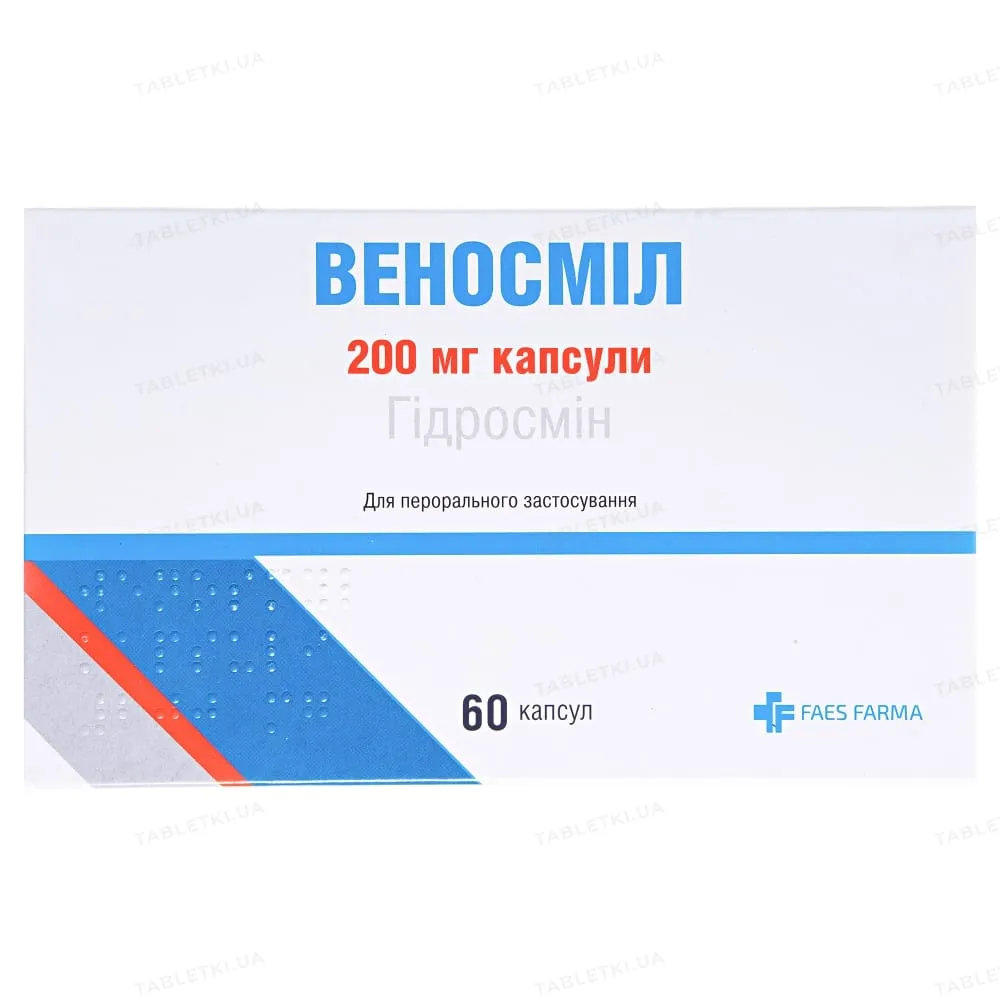
Table of Contents
INSTRUCTIONS FOR MEDICAL USE OF THE MEDICINAL PRODUCT Venosmil (Venosmil)
Composition:
Active substance: hidrosmin
1 capsule contains 200 mg of hidrosmin;
Excipients: magnesium stearate;
capsule shell: gelatin, erythrosine (E 127), quinoline yellow (E 104), titanium dioxide (E 171).
Pharmaceutical form. Capsules.
Main physicochemical properties: orange-colored capsules filled with yellow-colored powder.
Pharmacotherapeutic group.
Angioprotectors. Capillary-stabilizing agents. Bioflavonoids. Hidrosmin.
ATC code C05CA05.
Pharmacological properties.
Pharmacodynamics.
The active ingredient of Venosmil, hydrosmil, belongs to the flavonoid group based on its chemical structure. It is a standardized mixture consisting of 5 and 3’-mono-O-(β-hydroxyethyl)-diosmin and 5,3’-di-O-(β-hydroxyethyl)-diosmin. The mechanism of action of hydrosmil has not been fully elucidated, but may be related to inhibition of catecholamine degradation, primarily through inhibition of catechol-O-methyltransferase. Although the exact mechanism of action remains unknown, four levels of hydrosmil's effects can be identified:
a) Effect on permeability: reduces capillary permeability induced by various substances such as histamine and bradykinin; decreases capillary fragility in cases of improper nutrition;
b) Improves hemorheological properties of erythrocytes, enhances erythrocyte deformability, and reduces blood viscosity;
c) Effect on venous motor tone: gradually and steadily stimulates contraction of the smooth muscle in the venous wall;
d) Creates favorable conditions for improved lymph circulation. Hydrosmil induces dilation of lymphatic vessels and increases lymph flow velocity, thereby enhancing lymphatic drainage.
Venosmil alleviates clinical symptoms of peripheral venous insufficiency (pain, sensation of heaviness, swelling), with effects significantly different from those of placebo. The active ingredient exerts a significant effect on the consequences of venous stasis caused by varicose vein dilation in the lower limbs.
Pharmacokinetics.
After a single oral dose of hydrosmil administered to healthy volunteers, the plasma concentration-time curve of the drug exhibited a biphasic pattern. An initial peak was observed 15 minutes after administration, followed by a gradual decline. A second increase was observed at 4 hours post-administration, reaching a plateau between 5 and 8 hours, after which plasma levels declined and were nearly undetectable 24 hours after administration.
Approximately 90% of the hydrosmil dose is excreted within 48 hours. Elimination of the active ingredient occurs primarily via the intestine (80%). On average, 16–18% of the administered dose is excreted in the urine.
Clinical characteristics.
Indications.
The drug is indicated for the short-term reduction (within 2–3 months) of edema and symptoms associated with chronic venous insufficiency.
Contraindications.
Hypersensitivity to the active substance or to other components of the drug.
Interaction with other medicinal products and other forms of interaction.
Unknown. Specific pharmacokinetic and pharmacodynamic studies of hydrosmine with other drugs or food have not been conducted.
Special precautions for use
Patients should be informed that they must not use the medicinal product for prolonged periods without medical supervision.
Paediatric population
The use of Venosmil is not recommended in children.
Use during pregnancy or breastfeeding
Pregnancy
There are no clinical studies on the use of Venosmil in pregnant women.
Non-clinical studies have not shown any direct or indirect adverse effects on pregnancy, fetal development, delivery, or postnatal development.
However, as a precautionary measure, the use of Venosmil during pregnancy is not recommended, except when, in the opinion of the physician, the expected benefit of its use outweighs the potential risks.
Lactation
There are no clinical data on the use of Hydrosmine in breastfeeding women. Data on the passage of the drug into breast milk are lacking; therefore, its use is not recommended during breastfeeding.
Fertility
There are no data available on the effects on human fertility.
Ability to affect reaction speed when driving or operating machinery
Hydrosmine does not affect the speed of reaction when driving or operating machinery.
Method of Administration and Dosage
The medication should be taken orally during meals, with water.
For adults, the recommended dose is 1 capsule (200 mg) three times a day (every 8 hours). The duration of treatment is 2–3 months.
Children
The efficacy and safety of the medication in children have not been established.
Overdose
Due to the good tolerability of Venosmil, intoxication is practically excluded, even in case of overdose.
Side effects.
The treatment with the medicine is usually well tolerated. Hypersensitivity reactions may occur in individuals with individual intolerance to any component of the medicine.
Most common side effects:
Gastrointestinal system – stomach pain, nausea;
Skin – rash, itching;
Central nervous system – weakness, dizziness, headache.
Shelf life. 5 years.
Do not use after the expiry date stated on the packaging.
Storage conditions.
Store in the original packaging at a temperature not exceeding 30 °C.
Keep out of the reach of children.
Packaging.
10 capsules in a blister pack, 6 or 9 blisters in a cardboard box.
Supply category.
Over-the-counter.
Manufacturer.
Faes Farma, S.A.
Manufacturer's name and address of the place of business.
Maximo Aguirre, 14, 48940 Leioa (Biscay), Spain