Venorutinol
Ukraine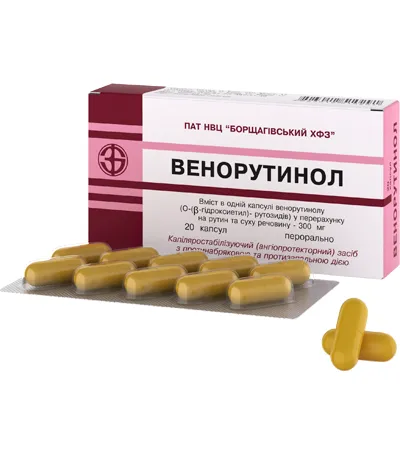
Table of Contents
INSTRUCTIONS FOR MEDICAL USE OF THE MEDICINAL PRODUCT VENORUTINOL (VENORUTINOL)
Composition:
Active substance: venorutinol;
1 capsule contains 300 mg of venorutinol (O-(β-hydroxyethyl) rutins), expressed in terms of rutin and dry substance;
Excipients: macrogol 6000, lactose monohydrate, calcium stearate; the capsule shell contains the colouring agent Yellow West FCF (E 110).
Pharmaceutical form. Capsules.
Main physicochemical properties: hard gelatin capsules with yellow cap and body. The capsule contents – powder with granules or a mass in the form of a partially or completely formed rod, yellow to brownish-yellow in colour, odourless.
Pharmacotherapeutic group. Angioprotectives. Capillary-stabilizing agents. Rutins. ATC Code C05CA01.
Pharmacological Properties
Pharmacodynamics
Venorutinol is a drug with P-vitamin activity and pronounced angioprotective properties. The drug reduces vascular-tissue permeability and capillary fragility, promotes normalization and improvement of tissue trophism, reduces venous and perivenous stasis, exerts anti-edematous and anti-inflammatory effects, and increases the tone of smooth muscles of venous blood vessels. It participates in redox processes; by inhibiting hyaluronidase activity, it stabilizes hyaluronic acid activity in cell membranes. It increases vascular wall density, reduces exudation of the liquid component of blood plasma and diapedesis of blood formed elements. By reducing manifestations of exudative inflammation in blood vessels, venorutinol limits platelet adhesion to the vascular wall surface.
Pharmacokinetics
After oral administration, the drug is well absorbed from the gastrointestinal tract. Maximum plasma concentration of the active substance is reached on average within 2 hours after oral intake. It penetrates well through the blood-brain barrier. It is metabolized in the liver, forming several inactive metabolites. Partially excreted unchanged in urine and bile.
Clinical characteristics.
Indications.
Symptomatic treatment of:
- chronic venous insufficiency with manifestations such as edema, trophic skin lesions, including leg ulcers;
- varicose vein enlargement (including after surgical interventions, during pregnancy in the II–III trimester), superficial thrombophlebitis, phlebitis, periphlebitis, postphlebitic conditions, post-thrombotic syndrome;
- hemorrhoids;
- diabetic retinopathy (as part of combination therapy);
- paresthesia and nocturnal leg cramps upon waking;
- post-traumatic edema and hematomas.
Contraindications.
- Hypersensitivity to venorutinol and/or any component of the drug;
- peptic ulcer of the stomach and duodenum, chronic gastritis (in the acute phase).
Interaction with other medicinal products and other forms of interactions.
The drug enhances the effect of ascorbic acid on strengthening the vascular wall structure and reducing its permeability.
Special precautions for use
The drug should be prescribed with caution to patients with severe liver and gallbladder diseases.
Prolonged use of Venorutinol is not recommended in patients with severe renal function impairment.
Venorutinol should be taken during meals, as it may irritate the gastric mucosa.
The drug contains lactose; therefore, patients with rare hereditary forms of galactose intolerance, lactase deficiency, or glucose-galactose malabsorption should not take this medication.
Patients with lower limb edema caused by heart, kidney, or liver diseases should not use the drug, as it is not effective in these conditions.
Use during pregnancy or breastfeeding
The drug should not be used during the first trimester of pregnancy.
During the second and third trimesters of pregnancy and during breastfeeding, the drug may be used under medical supervision if the expected benefit to the mother outweighs the potential risk to the fetus or infant.
Ability to influence reaction rate while driving or operating machinery
There are no data regarding the ability of Venorutinol to affect reaction speed while driving or operating machinery.
Dosage and Administration.
Take Venorutinol orally during meals, 1 capsule twice daily (in the morning and evening). Maintenance therapy: 1 capsule daily. Sometimes the desired effect is observed at a dose of 600 mg (2 capsules) per day.
Gelatin capsules should be swallowed whole without chewing.
The duration of treatment depends on the severity and course of the disease. Usually, the treatment course lasts 3–4 weeks.
Children.
The efficacy and safety of the drug in children have not been studied.
Overdose.
Symptoms of adverse reactions may intensify (nausea, diarrhea, dyspepsia, abdominal pain and headache, sleep disturbances, skin allergic reactions).
Treatment: symptomatic. Discontinue the drug. Induce vomiting or perform gastric lavage. If necessary, peritoneal dialysis may be administered.
Adverse reactions.
Unwanted reactions rarely occur during treatment with Venorutinol capsules.
Skin and subcutaneous tissue: urticaria and itching, facial flushing, skin rash, ecchymoses (large bruises).
Immune system: hypersensitivity reactions, including anaphylactic shock and anaphylactoid reactions.
Nervous system: dizziness, headache, sleep disturbances, fatigue.
Cardiovascular system: hot flushes.
Gastrointestinal tract: nausea, vomiting, flatulence, diarrhea, abdominal pain, discomfort, mild dyspeptic symptoms. Erosive-ulcerative lesions of the gastrointestinal tract are possible.
Adverse effects quickly disappear after discontinuation of the drug.
The product contains the colouring agent Sunset Yellow FCF (E 110), which may cause allergic reactions, including asthma. The risk of allergy is higher in patients with increased sensitivity to acetylsalicylic acid.
Reporting suspected adverse reactions
Reporting of suspected adverse reactions after registration of the medicinal product is of great importance. It allows continuous monitoring of the benefit-risk balance of the medicinal product. Medical and pharmaceutical professionals, as well as patients or their legal representatives, should report all suspected adverse reactions and lack of efficacy of the medicinal product via the Automated Pharmacovigilance Information System at the following link: https://аіsf.dec.gov.ua.
Shelf life. 4 years.
Storage conditions.
In the original packaging at a temperature not exceeding 25 °C.
Keep out of reach and sight of children.
Packaging.
10 capsules per blister, 2 blisters per carton.
Availability category. Over-the-counter (without prescription).
Manufacturer.
Public Joint-Stock Company "Scientific and Production Center "Borshchahivskyi Chemical and Pharmaceutical Plant".
Manufacturer's address and location of its business activities.
17 Miru Street, Kyiv, 03134, Ukraine.