Vazonit
Ukraine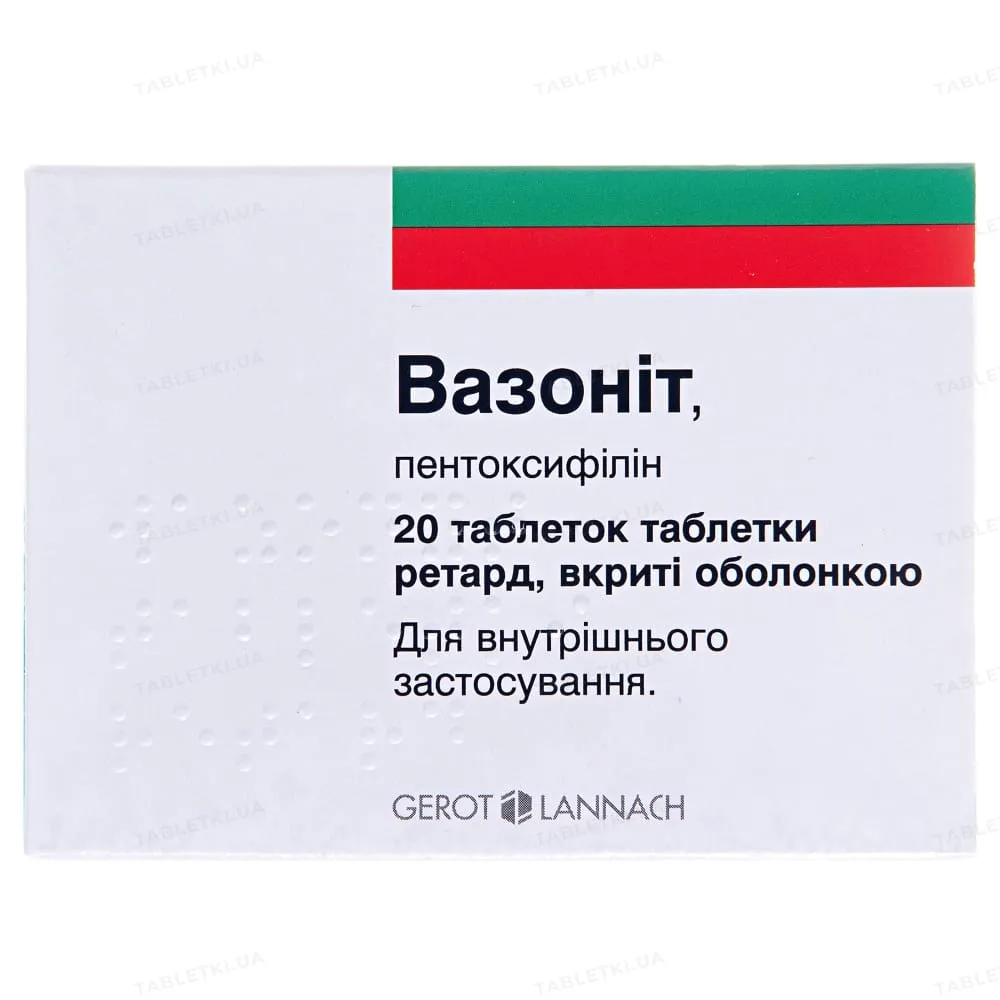
Table of Contents
INSTRUCTION FOR MEDICAL USE OF THE MEDICINAL PRODUCT VASONIT (VASONIT)
Composition:
Active substance: pentoxifylline;
1 tablet contains 600 mg of pentoxifylline;
Excipients: hypromellose 15000, hypromellose 5, crospovidone, microcrystalline cellulose, colloidal anhydrous silicon dioxide, magnesium stearate, macrogol 6000, talc, titanium dioxide (E 171), polyacrylate dispersion.
Pharmaceutical form. Retard tablets, coated.
Main physicochemical characteristics: elongated, biconvex coated tablets of white color, with a score line on both sides.
Pharmacotherapeutic group. Peripheral vasodilators. ATC code C04AD03.
Pharmacological properties.
Pharmacodynamics.
The drug improves microcirculation and the rheological properties of blood, exerting a vasodilating effect. The active substance, pentoxifylline, is a xanthine derivative. Its mechanism of action is related to inhibition of phosphodiesterase and accumulation of cAMP in vascular smooth muscle cells, blood formed elements, and other tissues and organs. Pentoxifylline inhibits platelet and erythrocyte aggregation, increases their elasticity, reduces plasma fibrinogen levels, and enhances fibrinolysis, thereby decreasing blood viscosity and improving its rheological properties. The drug improves tissue oxygen supply in areas of impaired circulation, primarily in the extremities and central nervous system, and to a lesser extent in the kidneys. It slightly dilates coronary vessels.
The special prolonged-release formulation from the tablet ensures sustained and prolonged effect, allowing administration at longer intervals.
Pharmacokinetics.
The tablet properties provide continuous release of the active substance and its uniform absorption from the gastrointestinal tract. The drug undergoes "first-pass" metabolism in the liver, resulting in the formation of several pharmacologically active metabolites. The absolute bioavailability of the drug is on average 19.4%. Vazonit does not bind to plasma proteins. Maximum plasma concentrations of pentoxifylline and its active metabolites are reached within 3–4 hours and are maintained at a therapeutic level for approximately 12 hours. The drug is primarily excreted in urine, with 90% of the dose eliminated by the kidneys as metabolites.
In patients with renal impairment (creatinine clearance < 30 mL/min), elimination of Vazonit and its metabolites is delayed.
In patients with hepatic impairment, the elimination half-life is prolonged and absolute bioavailability is increased.
Clinical characteristics.
Indications.
For increasing the pain-free walking distance in patients with chronic occlusive disease of peripheral arteries at Fontaine stage IIb (intermittent claudication), when other interventions such as walking training, angioplasty and/or revascularization procedures cannot be performed or are not indicated.
Inner ear dysfunction caused by circulatory disorders (including hearing loss and sudden hearing loss).
Contraindications.
Vasonit is contraindicated:
- in patients with hypersensitivity to pentoxifylline, to other methylxanthines, or to any of the excipients of the medicinal product;
- in patients with extensive retinal hemorrhage or hemorrhage into the brain (risk of exacerbating bleeding). If retinal hemorrhage occurs during treatment with pentoxifylline, the drug should be discontinued immediately;
- in patients with cerebral hemorrhage or other clinically significant bleeding;
- in patients during the acute phase of myocardial infarction;
- in patients with gastric or intestinal ulcers;
- in patients with hemorrhagic diathesis.
Interaction with other medicinal products and other forms of interaction.
When co-administering the following medications, potential drug interactions should be considered.
Agents that reduce arterial pressure.
Pentoxifylline may enhance the effect of antihypertensive agents, and the reduction in arterial pressure may be more pronounced.
Anticoagulants.
Pentoxifylline may potentiate the effects of anticoagulants. Patients with increased predisposition to bleeding, for example those receiving concomitant anticoagulant therapy, require careful monitoring (including regular monitoring of INR [International Normalized Ratio]), as there is a risk of developing more severe bleeding.
Oral antidiabetic agents, insulin.
A more pronounced decrease in blood glucose levels and the development of hypoglycemic reactions may occur. Blood glucose levels should be monitored at intervals individually determined for each patient.
Theophylline.
The concentration of theophylline in the blood may increase, and as a consequence, side effects during treatment of respiratory diseases may be exacerbated.
Cimetidine.
May lead to increased plasma levels of pentoxifylline and enhanced effects of pentoxifylline.
Ciprofloxacin.
Concomitant administration of the drug with ciprofloxacin may increase the serum concentration of pentoxifylline in individual patients. Therefore, the frequency and severity of adverse reactions associated with concomitant use of these drugs may increase.
Potential additive effect with platelet aggregation inhibitors: due to an increased risk of bleeding, concomitant use of platelet aggregation inhibitors (e.g., clopidogrel, eptifibatide, tirofiban, epoprostenol, iloprost, abciximab, anagrelide, NSAIDs [nonsteroidal anti-inflammatory drugs], except selective COX-2 inhibitors, acetylsalicylates [ASA/ASA], ticlopidine, dipyridamole) with pentoxifylline should be performed with caution.
Concomitant use with antiadrenergic agents and ganglion blockers may result in a significant decrease in arterial pressure. Concomitant use of adrenergic agents and xanthines leads to stimulation of the central nervous system.
Special precautions for use
At the first signs of an anaphylactic/anaphylactoid reaction, treatment with Vazonit should be discontinued immediately and medical advice must be sought.
When using Vazonit in patients with chronic heart failure, circulatory compensation should be achieved beforehand.
In patients with diabetes mellitus who are receiving insulin or oral antidiabetic agents, high doses of Vazonit may enhance the effect of these drugs on blood glucose levels (see section "Interaction with other medicinal products and other forms of interaction"). In such cases, the dose of insulin or oral antidiabetic agents should be reduced, and particularly careful monitoring of the patient is required.
Pentoxifylline may be administered to patients with systemic lupus erythematosus (SLE) or other connective tissue diseases only after a thorough assessment of potential risks and benefits.
Since there is a risk of developing aplastic anemia during pentoxifylline therapy, regular complete blood counts should be performed.
In patients with renal impairment (creatinine clearance less than 30 mL/min) or severe hepatic dysfunction, elimination of pentoxifylline may be delayed. Appropriate monitoring is required.
Particularly careful observation is necessary for:
- patients with severe cardiac arrhythmias;
- patients with myocardial infarction;
- patients with arterial hypotension;
- patients with severe atherosclerosis of cerebral and coronary vessels, especially when associated with arterial hypertension and cardiac rhythm disturbances. In these patients, treatment with the drug may provoke angina attacks, arrhythmias, and arterial hypertension;
- patients with renal impairment (creatinine clearance below 30 mL/min);
- patients with severe hepatic impairment;
- patients with a high predisposition to bleeding, e.g., due to anticoagulant therapy or coagulation disorders. For details on bleeding, see section "Contraindications";
- patients who have recently undergone surgery (increased risk of bleeding, requiring regular monitoring of hemoglobin and hematocrit levels);
- patients receiving concomitant treatment with pentoxifylline and vitamin K antagonists or platelet aggregation inhibitors (see section "Interaction with other medicinal products and other forms of interaction");
- patients receiving concomitant treatment with pentoxifylline and antidiabetic agents (see section "Interaction with other medicinal products and other forms of interaction");
- patients receiving concomitant treatment with pentoxifylline and ciprofloxacin (see section "Interaction with other medicinal products and other forms of interaction");
- patients receiving concomitant treatment with pentoxifylline and theophylline (see section "Interaction with other medicinal products and other forms of interaction").
Use during pregnancy or breastfeeding
Pregnancy
There is insufficient experience with the use of Vazonit in pregnant women. Therefore, the use of Vazonit during pregnancy is not recommended.
Breastfeeding
Pentoxifylline passes into breast milk in small amounts. Breastfeeding should be discontinued if treatment with Vazonit is indicated.
Effect on ability to drive and use machines
No effect.
Dosage and Administration
The dosage is determined individually by a physician, depending on the nature and course of the disease.
Chronic occlusive peripheral arterial disease at Fontaine stage IIb (intermittent claudication).
If otherwise not prescribed, administer 1 tablet of 600 mg once or twice daily (600–1200 mg of pentoxifylline per day).
Dosage adjustment is required for patients with low or unstable arterial blood pressure.
For patients with renal impairment (creatinine clearance less than 30 mL/min), dosage should be individualized based on tolerability.
Dose reduction is necessary for patients with severe hepatic dysfunction. The decision on dose reduction must be made by the physician, who should consider, in each individual case, the severity of the disease and the patient's tolerance to the drug.
Dysfunction of the inner ear caused by circulatory disorders (including hearing loss and sudden deafness).
If otherwise not prescribed, administer 1 tablet of 600 mg once or twice daily (600–1200 mg of pentoxifylline per day).
In cases of severe circulatory disorders, onset of action may be accelerated by administering tablets in combination with parenteral pentoxifylline. The total daily dose (parenteral + oral) must not exceed 1200 mg of pentoxifylline.
Depending on the severity of symptoms, treatment may be oral only, combined oral and parenteral (intravenous infusion), or parenteral only (intravenous infusion).
For patients with low or unstable arterial blood pressure, dose adjustment may be necessary.
For patients with renal impairment (creatinine clearance less than 30 mL/min), doses should be titrated to 50–70% of the standard dose, based on individual tolerability.
The decision on dose reduction for patients with severe hepatic dysfunction must be made by the physician, taking into account the severity of the disease and the individual patient's tolerance to the drug.
Method and duration of administration.
The tablet should be swallowed whole (without chewing) with sufficient fluid. The duration of treatment should be determined by the physician according to the clinical condition of each individual patient.
Note.
In cases of accelerated gastrointestinal transit (use of laxatives, diarrhea, surgical shortening of the intestine), undissolved tablet residues may occasionally be excreted in the feces. If premature excretion occurs only occasionally, this should not be of major concern.
Children.
Due to lack of sufficient clinical experience, Vazonit must not be administered to children (under 18 years of age).
Overdose.
Symptoms. Dizziness, nausea, hypotension, tachycardia, flushing, loss of consciousness, fever, agitation, areflexia, tonic-clonic seizures, arrhythmias, coffee-ground emesis indicating gastrointestinal bleeding, areflexia, and tonic-clonic seizures.
Treatment measures. If overdose has occurred recently, gastric lavage or activated charcoal may be administered to prevent further absorption.
Treatment should be symptomatic, as there is no known specific antidote. Monitoring in an intensive care unit may be necessary to prevent complications.
Emergency measures in case of severe hypersensitivity reactions (shock). At the first signs of severe reactions (e.g., skin reactions (urticaria), flushing, restlessness, headache, sudden sweating, nausea), a venous catheter should be inserted. Along with standard emergency measures such as placing the patient in a supine position with elevated legs, ensuring airway patency, and oxygen administration, emergency drug therapy is indicated, including intravenous fluid volume replacement, intravenous epinephrine (adrenaline), glucocorticoids (e.g., 250–1000 mg methylprednisolone intravenously), and histamine receptor antagonists.
Depending on the severity of clinical symptoms, mechanical ventilation may be required, and in case of circulatory arrest, resuscitation should be performed according to standard guidelines.
Adverse reactions.
The adverse reactions listed below occurred during clinical trials and in the post-marketing period. Frequency of occurrence is unknown.
| Organ systems |
Adverse reactions |
| Laboratory findings |
Elevated levels of liver enzymes (transaminases, alkaline phosphatase) |
| Cardiac disorders |
Arrhythmia, tachycardia, angina pectoris, decreased blood pressure, increased blood pressure |
| Blood and lymphatic system disorders |
Thrombocytopenia with thrombocytopenic purpura and aplastic anemia (partial or complete cessation of formation of all blood cells, pancytopenia), which may be fatal, leukopenia/neutropenia |
| Nervous system disorders |
Dizziness, headache, aseptic meningitis, tremor, paresthesia, convulsions, intracranial hemorrhage |
| Gastrointestinal disorders |
Gastrointestinal disturbances, sensation of pressure in the stomach, flatulence, nausea, vomiting, diarrhea, constipation, hypersalivation, gastrointestinal bleeding |
| Skin and subcutaneous tissue reactions |
Itching, redness of the skin and urticaria, toxic epidermal necrolysis and Stevens-Johnson syndrome, rash, skin and mucous membrane bleeding |
| Vascular disorders |
Feeling of warmth (flushing), bleeding, peripheral edema |
| Immune system reactions |
Anaphylactic reactions, anaphylactoid reactions, angioneurotic edema, bronchospasm and anaphylactic shock |
| Hepatobiliary disorders |
Intrahepatic cholestasis |
| Psychiatric disorders |
Agitation, sleep disturbances, hallucinations |
| Eye disorders |
Visual disturbances, conjunctivitis, retinal hemorrhage, retinal detachment |
| Other |
Hypoglycemia, increased sweating, elevated body temperature |
Shelf life. 5 years.
Storage conditions.
Store in a dry, protected from light and inaccessible to children place, at a temperature not exceeding 25 °C.
Packaging.
10 tablets per blister, 2 blisters per carton.
Prescription status. By prescription only.
Manufacturer.
G.L. Pharma GmbH.
Manufacturer's address.
Schlossplatz 1, 8502 Lannach, Austria;