Vazaprostane®
Ukraine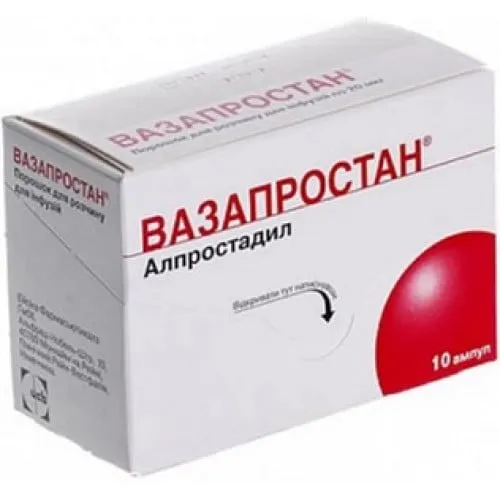
Table of Contents
INSTRUCTION FOR MEDICAL USE OF THE MEDICINAL PRODUCT VASAPROSTAN® (VASAPROSTAN®)
Composition:
Active substance: alprostadil;
1 ampoule contains 60 mcg of alprostadil;
Excipients: alphadex, anhydrous lactose.
Pharmaceutical form. Powder for solution for infusion.
Main physicochemical properties:
Contents of the ampoule: white lyophilisate, deposited at the bottom of the ampoule;
Ampoule: colorless ampoule, 5 ml "OPC" (one-point-cut) ampoule made of type I glass with a blue dot above the score line on the neck and one blue coding ring.
Pharmacotherapeutic group. Cardiological preparations. Prostaglandins.
ATC code C01EA01.
Pharmacological Properties
Pharmacodynamics
Vazaprostan® contains the active substance alprostadil, bound in the form of a clathrate with α-cyclodextrin.
Mechanism of action
Vazaprostan® improves impaired microcirculation. After intravenous administration in healthy volunteers and patients, increased erythrocyte deformability and reduced erythrocyte aggregation have been observed. In various animal species, Vazaprostan® inhibits platelet activation in vitro. This effect extends to parameters involving platelet shape change, aggregation, release of granule-contained substances, and thromboxane formation—a substance promoting aggregation. Vazaprostan® leads to inhibition of thrombus formation in vivo in animal models.
At low nanomolar concentrations in vitro, Vazaprostan® inhibits stimulated proliferation of vascular smooth muscle cells. At therapeutic doses, alprostadil reduces experimentally induced mitotic activity of vascular smooth muscle cells in rabbits and decreases the number of activated vascular smooth muscle cells in human peripheral vessels.
Furthermore, in a dose-dependent manner, Vazaprostan® inhibits cholesterol synthesis in isolated human monocytes. Data indicate that the drug reduces cholesterol uptake by atherosclerotic vessel walls in rabbits and increases low-density lipoprotein receptor activity in the liver of rats, pigs, and humans.
Vazaprostan® has demonstrated improvement in cellular metabolism due to increased delivery and utilization of oxygen and glucose in ischemic tissues.
In vivo and in vitro, alprostadil inhibits neutrophil activation, resulting in reduced release of toxic metabolites. Thus, the drug counteracts one of the mechanisms causing tissue damage in inflammatory processes and possibly in ischemia.
Alprostadil enhances blood flow by dilating arteries and precapillary sphincters.
Pharmacokinetics
Absorption
After reconstitution, alprostadil (PGE1) is no longer bound to α-cyclodextrin. After administration, both components remain separate.
Following intravenous placebo infusion over 2 hours and after completion of infusion, the mean concentration of endogenous PGE1 in plasma of healthy volunteers was 1–2 pg/mL. During a 2-hour intravenous infusion of 60 μg alprostadil, the plasma concentration of PGE1 rapidly increased, reaching a plateau of 6 pg/mL. After the end of infusion, plasma PGE1 concentration returned to baseline levels within several minutes.
Distribution
Approximately 90% of plasma PGE1 is protein-bound.
Metabolism
Enzymatic oxidation of the C15 hydroxyl group and reduction of the C13–C14 double bond leads to the formation of primary metabolites—15-keto-PGE1, PGE0 (13,14-dihydro-PGE1), and 15-keto-PGE0. Only PGE0 and 15-keto-PGE0 are detectable in human plasma. The potential activity of PGE0 is similar to that of PGE1 regarding most evaluated parameters, unlike the 15-keto metabolites, which exhibit lower pharmacological activity than the parent compound. The mean plasma concentration of PGE0 measured in healthy volunteers during and after a 2-hour intravenous placebo infusion was approximately 1 pg/mL. During intravenous administration of alprostadil at a dose of 60 μg/2 hours, plasma PGE0 concentration increased to 13 pg/mL.
Elimination
Following further degradation of the main metabolites via beta-oxidation and omega-oxidation, more polar metabolites are excreted over 72 hours, primarily in urine (88%) and feces (12%). 92% of the administered dose is eliminated within 24 hours after administration.
Unchanged PGE1 was not detected in urine. Furthermore, there is no evidence of accumulation of alprostadil or its metabolites in tissues.
Linearity/Non-linearity
Plasma concentration increases proportionally with the administered dose (doses evaluated: 30 μg/2 hours, 60 μg/2 hours, 120 μg/2 hours).
Clinical characteristics.
Indications.
Treatment of chronic obstructive arterial diseases at stage III (according to Fontaine classification), which are not amenable to revascularization or in which revascularization has been unsuccessful.
Contraindications.
- Hypersensitivity to alprostadil or to any of the excipients of the medicinal product;
- NYHA class III and IV heart failure;
- arrhythmias causing hemodynamic disturbances;
- unstable ischemic heart disease;
- insufficiency and/or stenosis of the aortic and/or mitral valves;
- recent myocardial infarction (within the last 6 months);
- acute pulmonary edema or history of pulmonary edema in patients with heart failure;
- severe chronic obstructive lung diseases or veno-occlusive lung diseases;
- disseminated lung infiltrates;
- hemorrhagic diathesis;
- active or potential source of bleeding, such as acute erosive gastritis, active gastric and/or duodenal ulcer, or suspicion of intracranial hemorrhage;
- pregnancy and breastfeeding;
- acute liver failure (elevated transaminase or gamma-GT levels) or documented severe liver insufficiency (including in medical history);
- severe renal dysfunction (oligoanuria) (eGFR ≤ 29 mL/min/1.73 m²);
- history of stroke within the last 6 months;
- severe arterial hypotension;
- general contraindications for infusion therapy (e.g., congestive heart failure, pulmonary or cerebral edema, and hyperhydration).
Interaction with other medicinal products and other forms of interaction.
Alprostadil may enhance the effect of medicinal products that lower blood pressure, including those used in the treatment of ischemic heart disease. Vasaprostan® may be administered concomitantly with antihypertensive medicinal products only under blood pressure monitoring.
Sympathomimetics, adrenaline, and noradrenaline reduce the vasodilatory effect of the drug.
Since Vasaprostan® exerts a weak inhibitory effect on platelet aggregation in vitro, it should be used with caution in patients receiving concomitant anticoagulants or platelet aggregation inhibitors.
Concomitant administration with cefamandole, cefoperazone, or cefotetan reduces the effect of Vasaprostan®.
Special precautions for use.
Patients receiving Vazaprostan® must remain under close supervision throughout each infusion. Cardiovascular function (including arterial pressure and heart rate) and fluid balance should be monitored.
Patients in risk groups should be treated with caution, with careful monitoring of the patient's condition during administration of each dose.
Patients who are at risk of heart failure due to age, as well as patients with ischemic heart disease, should be hospitalized during treatment and for one day after discontinuation of therapy with the drug. Exercise caution when administering the drug in cases of mild or moderate arterial hypotension.
Do not use the medicinal product after the expiry date stated on the packaging.
To prevent excessive hyperhydration, infusion volumes should not exceed 50–100 ml per day (administered via an infusion device), and recommendations provided in the section "Dosage and administration" must be strictly followed. Monitoring of body weight, central venous pressure, and echocardiography are necessary. A patient may be discharged from hospital only after stable cardiovascular parameters have been established.
The same level of monitoring is required for patients with peripheral edema.
Renal and cardiovascular function should be carefully monitored in patients with mild (glomerular filtration rate < 89 ml/min/1.73 m²) and moderate (glomerular filtration rate < 59 ml/min/1.73 m²) renal dysfunction treated with Vazaprostan® (e.g., monitoring fluid balance and renal function parameters).
Use the drug with caution in patients undergoing hemodialysis (treatment should be performed in the post-dialysis period), and in patients with type 1 diabetes mellitus, especially in the presence of significant vascular involvement.
Vazaprostan® should only be administered by physicians experienced in treating peripheral arterial occlusive diseases, who are familiar with modern methods of continuous monitoring of cardiovascular parameters and have appropriate equipment for this purpose.
Alprostadil should not be administered as a bolus injection. Alprostadil should not be used in women who may become pregnant. Women of childbearing potential who are to receive alprostadil should be advised to use reliable contraceptive methods during treatment.
Alprostadil should be used with caution in patients with a history of gastrointestinal disorders (including erosive gastritis, gastrointestinal bleeding, and gastric and/or duodenal ulcer) or suspected history of intracerebral hemorrhage, and in other conditions associated with bleeding (see section "Contraindications").
Caution is recommended when treating patients receiving concomitant therapy with medicinal products that may increase the risk of bleeding, such as anticoagulants or platelet aggregation inhibitors (see section "Interaction with other medicinal products and other forms of interaction").
Close monitoring for signs and symptoms of bleeding is required in such patients.
Children
Alprostadil is not recommended for use in children.
Use during pregnancy or breastfeeding.
Vazaprostan® is strictly contraindicated during pregnancy, when planning pregnancy, and during breastfeeding (see section "Contraindications").
Women of childbearing potential should use effective contraceptive methods to prevent pregnancy during treatment with the drug.
Preclinical fertility studies do not indicate any effect of the drug on fertility at clinically relevant doses.
Ability to affect reaction speed when driving or operating machinery.
Vazaprostan® may cause a decrease in systolic blood pressure and therefore may moderately affect the ability to drive or operate machinery. Patients should be informed about the potential effects of the drug and the need for caution when driving or operating machinery.
Method of Administration and Dosage
Dosage for Adults
According to current knowledge, when administering intravenous infusions of the drug, the following dosage recommendations should be followed.
The contents of 1 ampoule (60 mcg of alprostadil) should be dissolved in 50–250 mL of 0.9% sodium chloride solution and administered by intravenous infusion over 2 hours once daily.
The Vazaprostane® solution must be prepared immediately before infusion. The ampoule does not require additional scoring: the scoring mark is located beneath the blue dot. The ampoule should be opened in the usual manner.
Special Populations
Renal Impairment
Patients with mild (eGFR < 89 mL/min/1.73 m²) and moderate (eGFR < 59 mL/min/1.73 m²) renal dysfunction should be carefully monitored (e.g., fluid balance and renal function parameters).
For patients with impaired renal function (serum creatinine concentration > 1.5 mg/dL), intravenous administration of the drug should be initiated at 20 mcg twice daily, each infusion lasting 2 hours. Depending on the clinical condition, the dose may be gradually increased over 2–3 days to the dose recommended for patients with normal renal function.
For patients with renal insufficiency and those with cardiovascular insufficiency, the infusion volume should be reduced by limiting the volume of fluid administered with Vazaprostane® to 50–100 mL per day, and must be administered using an infusion device.
Women of Reproductive Age
Alprostadil must not be used in women who may become pregnant.
Children
Alprostadil is not recommended for use in children.
Duration of Treatment
After a three-week course of treatment, the effectiveness of the drug should be evaluated. If the patient does not show a therapeutic response, treatment should be discontinued. The treatment course must not exceed 4 weeks.
Method of Administration
The ampoule contents consist of a dry white powder forming a solid layer approximately 3 mm thick. Small cracks and particles may be present on this layer, which does not affect the quality of the drug. The dry substance dissolves immediately after adding 0.9% sodium chloride solution. Initially, the solution may appear slightly cloudy due to the formation of air bubbles. These bubbles disappear quickly, resulting in a clear solution.
The infusion solution must be prepared immediately before administration.
If the ampoule is damaged, the dry substance usually becomes moist and sticky, and loses volume. In such cases, the drug must not be used.
Children
Do not use in children.
Overdose
Symptoms
Overdose of the drug may cause the following systemic symptoms: decreased arterial blood pressure with tachycardia; other possible symptoms related to vagal stimulation: syncope with pallor, increased sweating, nausea, vomiting. Local reactions may also occur: pain, swelling, and redness along the vein used for infusion.
In case of overdose with symptomatic manifestations, the infusion rate should be reduced or the infusion should be immediately discontinued. If arterial blood pressure decreases, the patient should first be placed in a supine position with legs elevated. If symptoms persist, cardiovascular function should be assessed/monitored. If necessary, circulatory-stabilizing medications (e.g., sympathomimetic agents) should be administered. In cases of severe cardiovascular events (e.g., myocardial ischemia, heart failure), the infusion must be immediately stopped and emergency treatment initiated.
Side effects
Adverse reactions are classified by system organ classes and frequency as follows: very common (≥ 1/10), common (≥ 1/100, < 1/10), uncommon (≥ 1/1,000, < 1/100), rare (≥ 1/10,000, < 1/1,000), very rare (< 1/10,000, including isolated reports), frequency not known (cannot be estimated from available data).
Blood and lymphatic system disorders:
Rare – thrombocytopenia, leukopenia, leukocytosis, anemia.
Nervous system disorders:
Common – headache, limb paraesthesia at the site of intervention; rare – confusion, cerebral seizures; frequency not known – stroke.
Cardiac and vascular disorders:
Uncommon – decrease in systolic blood pressure, tachycardia, angina pectoris; rare – arrhythmia, biventricular heart failure with episodes of pulmonary edema, which may lead to global heart failure; frequency not known – myocardial infarction, hemorrhages.
Respiratory, thoracic and mediastinal disorders:
Rare – pulmonary edema; frequency not known – dyspnea.
Gastrointestinal disorders:
Uncommon – gastrointestinal reactions including diarrhea, nausea, vomiting, and increased intestinal peristalsis, which are properties of alprostadil (diarrhea, nausea, vomiting); frequency not known – gastrointestinal hemorrhages.
Hepatobiliary disorders:
Rare – disturbances in liver enzyme levels.
Investigations:
Uncommon – increased liver function parameters (transaminases); increased temperature; changes in CRP (C-reactive protein) levels; rapid normalization occurs after completion of treatment.
Skin and subcutaneous tissue disorders:
Common – erythema, swelling, hot flushes; uncommon – allergic reactions (skin hypersensitivity, including skin rash, joint pain, febrile reaction, sweating, chills).
General disorders and administration site conditions:
Very common – pain, erythema, or swelling of the limb receiving intra-arterial infusion; common – sensation of warmth, sensation of fullness, swelling at the site of administration, paraesthesia; with intravenous administration additionally – venous erythema at the infusion site, pain, headache; after intra-arterial administration – sensation of warmth, sensation of fullness, swelling at the site of administration, paraesthesia; uncommon – increased sweating, chills, fever; with intravenous administration – sensation of warmth, sensation of fullness, swelling at the site of administration, paraesthesia; very rare – anaphylactic or anaphylactoid reactions; frequency not known – phlebitis at the site of administration, thrombosis at the catheter site, local bleeding.
Immune system disorders:
Uncommon – allergic reactions (skin hypersensitivity reactions, including skin rash, sensation of swelling, joint discomfort, febrile reaction, sweating, chills); very rare – anaphylactic or anaphylactoid reactions.
Musculoskeletal and connective tissue disorders:
Uncommon – joint symptoms; very rare – reversible hyperostosis of long tubular bones after use of the drug for more than 4 weeks.
Frequency not known – orthostatic hypotension, increased fatigue.
Reporting of suspected side effects
Reporting of suspected adverse reactions after marketing authorization is important. It allows continued monitoring of the benefit-risk balance of the medicinal product. Healthcare professionals are asked to report any suspected adverse reactions via the national reporting system.
Shelf life. 4 years.
Storage conditions.
Store at a temperature not exceeding 25 °C. Keep out of the reach of children.
Incompatibilities.
Not established.
Packaging.
60 mcg alprostadil in 5 ml vials. 10 vials per cardboard box.
Prescription category.
Prescription only.
Manufacturer.
Aesica Pharmaceuticals GmbH, Germany.
Manufacturer's address and location of operations.
Alfred-Nobel-Str. 10, Monheim am Rhein, 40789, Germany.