Varilrix™/varilrix™ vaccine for prevention of varicella live attenuated
Ukraine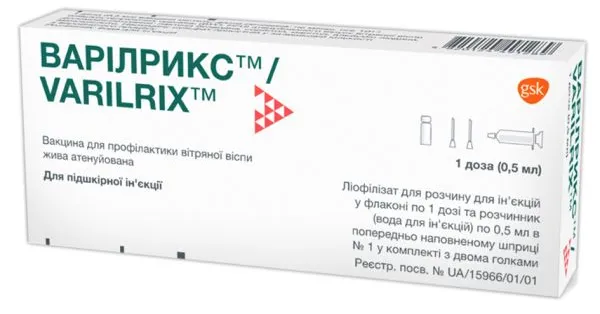
Table of Contents
INSTRUCTION FOR MEDICAL USE OF THE MEDICINAL PRODUCT VARILRIX™ / VARILRIX™ Live Attenuated Vaccine for Prevention of Varicella
Composition:
Active substance:
1 dose (0.5 mL) of vaccine contains:
Live attenuated varicella virus (Oka strain)1 not less than 103.3 PFU2
1Obtained by propagation in human diploid cells (MRC-5)
2PFU – plaque-forming unit
Excipients: anhydrous lactose, sorbitol, mannitol, amino acids.
The solvent is water for injections.
Neomycin sulfate is present in residual amounts from the manufacturing process.
Pharmaceutical form. Lyophilisate for solution for injection and solvent.
Main physicochemical properties: VARILRIX™ vaccine is a lyophilized preparation of live attenuated (weakened) varicella virus (Oka strain), obtained by culturing the virus strain in human diploid cell culture MRC-5. The lyophilisate has a light cream to yellowish or pinkish color and is supplied in a glass vial.
The sterile solvent is a clear, colorless liquid supplied in ampoules or syringes.
Pharmacotherapeutic group. Antiviral vaccines. Live attenuated vaccine for prevention of varicella. ATC code J07BK01.
Immunological and biological properties.
Pharmacodynamics.
Mechanism of action.
VARILRIX™ induces a mild, clinically asymptomatic form of varicella in vaccine-susceptible individuals. The presence of antibodies indicates protection.
Effect and efficacy.
The efficacy of the Oka strain vaccine for prevention of confirmed varicella (diagnosed by polymerase chain reaction or following contact with varicella patients) was evaluated in a large international controlled clinical efficacy study, in which children aged 12 to 22 months received either one dose of VARILRIX™ vaccine or two doses of a combined vaccine for prevention of measles, mumps, rubella, and varicella (Oka strain). Data on vaccine efficacy against confirmed varicella of any severity and against moderate or severe confirmed varicella were obtained during the second year of the primary observation period (mean follow-up 3.2 years). Persistent efficacy was observed in the same study during a long-term 6-year observation period (mean follow-up 6.4 years) and a 10-year observation period (mean follow-up 9.8 years). Data are presented in the table below.
| Group |
Period |
Vaccine efficacy against confirmed varicella cases of any disease severity |
Vaccine efficacy against confirmed moderate or severe varicella cases |
| Vaccine VARILRIX™ (1 dose) N = 2,487 |
Year 2 |
(97.5% CI: 57.2; 72.1) |
(97.5% CI: 85.9; 93.9) |
| Year 6(1) |
(95% CI: 61.8; 71.4) |
(95% CI: 86.9; 92.8) |
|
| Year 10(1) |
(95% CI: 62.3; 71.5) |
(95% CI: 86.1; 92.1) |
|
| Combined vaccine for the prevention of measles, mumps, rubella and varicella (Oka strain) (2 doses) N = 2,489 |
Year 2 |
(97.5% CI: 92.4; 96.6) |
(97.5% CI: 97.5; 99.9) |
| Year 6(1) |
(95% CI: 93.6; 96.2) |
(95% CI: 97.7; 99.6) |
|
| Year 10(1) |
(95% CI: 94.0; 96.4) |
(95% CI: 97.9; 99.6) |
N = number of vaccinated individuals
(1) Descriptive analysis
The effectiveness of a single dose of VARILRIX™ vaccine, assessed by various methods (outbreak surveillance, case-control studies, and database analyses), ranged from 20–92% against any clinical form of varicella and from 86–100% against moderate to severe forms of the disease.
The impact of a single dose of VARILRIX™ vaccine on reducing hospitalizations and outpatient visits due to varicella in children was 81% and 87%, respectively.
Data from studies indicate a higher level of protection and reduced transmission of varicella after administration of two vaccine doses compared to one dose.
Immune response.
Healthy individuals.
In children aged 11 to 21 months, the seroconversion rate measured by ELISA (50 mIU/mL) was 89.6% six months after the first vaccine dose and 100% after the second dose.
In children aged 9 months to 12 years, the overall seroconversion rate measured by immunofluorescence assay (IFA) was over 98% six weeks after vaccination with a single dose.
In children aged 9 months to 6 years, the overall seroconversion rate reached 100% six weeks after the second dose as measured by IFA. A significant increase in antibody titer was observed after the second dose (an increase in geometric mean titers (GMT) by 5–26 times).
In individuals aged 13 years and older, the seroconversion rate six weeks after the second dose, measured by IFA, was 100%. One year after vaccination, all individuals remained seropositive.
In clinical studies, the majority of vaccinated individuals subsequently exposed to wild-type virus were either completely protected from clinical varicella or developed milder forms of the disease (i.e., fewer vesicles, absence of fever).
Data on the level of protection against complications of varicella, such as encephalitis, hepatitis, or pneumonia, are insufficient.
Patients at high risk of varicella.
There are very limited data from clinical studies involving patients at high risk of varicella. The overall seroconversion rate in these patients has been shown to be ≥ 80%.
For high-risk patients, periodic assessment of antibody levels against varicella virus after immunization may be indicated to determine the need for revaccination.
Transmission of the vaccine virus (Oka strain), confirmed by its isolation and identification, has been documented in four cases among household contacts of vaccinated immunocompromised individuals who developed vesicular rashes. In each case, the rash in household contacts was always very mild.
Pharmacokinetics.
Assessment of pharmacokinetic properties is not required for vaccines.
Clinical characteristics.
Indications.
Healthy individuals.
The vaccine is indicated for active immunization against varicella in healthy individuals (from 9 months of age). Individuals who are in close contact with patients at high risk of disease should be vaccinated to reduce the risk of transmission of the causative agent. Such individuals include parents and close relatives of high-risk patients, medical (including mid-level medical) personnel, and other individuals who are in close contact with patients with varicella or with patients at high risk of disease.
Patients at high risk of varicella.
Patients at risk of severe varicella include: patients with leukemia, patients receiving immunosuppressive therapy (including corticosteroid therapy) for the treatment of malignancies or serious chronic diseases (such as chronic renal failure, autoimmune diseases, collagenoses, severe bronchial asthma), and individuals scheduled for organ transplantation. Immunization is indicated for such patients to reduce the risk of complications associated with varicella.
Due to limited clinical data on VARILRIX™, immunization of patients in the aforementioned risk group should be performed with the following precautions:
- when vaccinating patients during the acute phase of leukemia, maintenance chemotherapy should be discontinued one week before and for one week after immunization. Patients undergoing radiation therapy should generally not be vaccinated during the treatment period. Immunization should generally be performed during complete hematological remission;
- it is desirable that the total lymphocyte count be at least 1.2 x 10⁹/L or that there be no other evidence of immunodeficiency;
- vaccination should be performed several weeks before initiation of immunosuppressive therapy in preparation for organ transplantation (e.g., kidney transplantation).
When administering immunization in Ukraine, vaccination schedules, contraindications, and interactions with other medicinal products should be in accordance with current orders of the Ministry of Health of Ukraine.
Contraindications.
VARILRIX™ is contraindicated in individuals with severe humoral or cellular immunodeficiency, for example:
- individuals with primary or acquired immunodeficiency with a total lymphocyte count less than 1.2 x 10⁹/L;
- individuals with other signs of cellular immune deficiency (e.g., patients with leukemia, lymphoma, blood disorders, clinical manifestations of HIV infection);
- individuals receiving immunosuppressive agents, including high-dose corticosteroids;
- individuals with severe combined immunodeficiency, agammaglobulinemia, AIDS or symptomatic HIV infection, or age-appropriate percentage of CD4+ T-lymphocytes in children: CD4+ < 25% in children under 12 months; CD4+ < 20% in children aged 12–35 months; CD4+ < 15% in children aged 36–59 months (see section "Special precautions").
VARILRIX™ is contraindicated in individuals with known hypersensitivity to neomycin or to any other component of the vaccine. A history of contact dermatitis following the use of neomycin is not a contraindication.
VARILRIX™ is contraindicated in individuals who have previously exhibited signs of hypersensitivity after prior administration of varicella vaccine.
VARILRIX™ is contraindicated for use in pregnant women and in women who are breastfeeding. Pregnancy should be avoided for at least one month following vaccination (see section "Use during pregnancy or breastfeeding").
As with other vaccines, administration of VARILRIX™ to patients with acute severe febrile illness should be postponed. The presence of a minor infection is not a contraindication.
Interaction with other medicinal products and other forms of interaction.
If a tuberculin test has not been performed, it should be conducted prior to vaccination, as live viral vaccines have been reported to cause a temporary suppression of skin sensitivity to tuberculin. Since this condition may last up to 6 weeks, tuberculin testing should not be performed during this period after vaccination to avoid false-negative results.
Vaccination of individuals who have received immunoglobulins or blood transfusions should be delayed by at least 3 months due to the presence of passive antibodies against the varicella virus.
Salicylates should be avoided for 6 weeks after varicella vaccination, as Reye's syndrome has been reported following salicylate use during natural infection caused by the varicella virus.
Healthy individuals
VARILRIX™ may be administered simultaneously with any other vaccine. Different injectable vaccines should always be administered at separate injection sites. Inactivated vaccines may be administered at any time relative to this vaccine. If a measles-containing vaccine is not administered simultaneously with VARILRIX™, an interval of at least one month is recommended, as measles vaccination may cause a transient suppression of cell-mediated immune response.
High-risk patients
VARILRIX™ should not be administered simultaneously with other live attenuated vaccines. Inactivated vaccines may be administered at any time relative to this vaccine in the absence of specific contraindications. Different injectable vaccines should always be administered at separate injection sites.
Special precautions for use.
Syncope (fainting) may occur after or even before any injectable vaccination, as a psychogenic response to needle injection. Vaccination should be performed only with the vaccinated person in a sitting or lying position, and the person should remain in the same position (sitting or lying) for 15 minutes after vaccination to prevent the risk of injury.
Alcohol and other disinfectants must be allowed to evaporate from the skin surface before vaccine injection, as they may inactivate the attenuated viruses in the vaccine.
Limited protection against varicella may be achieved by vaccination administered no later than 72 hours after exposure to a person with varicella.
As with administration of any vaccine, adequate immune response may not be achieved in all vaccinated individuals.
As with other varicella vaccines, cases of varicella have been observed in patients previously immunized with VARILRIX™. These cases are rare, and clinical symptoms and degree of fever are generally milder compared to those in unvaccinated individuals.
Very rarely, transmission of the vaccine virus (Oka strain) has been reported to seronegative contacts of vaccinated individuals who developed a rash. Transmission of the Oka strain from vaccinated individuals cannot be excluded in the absence of skin rash in seronegative individuals.
As with all other injectable vaccines, appropriate treatment and supervision should always be readily available in case of a rare anaphylactoid reaction following vaccine administration. For this reason, the vaccinated person should remain under medical supervision for 30 minutes after immunization.
Due to limited data on the use of VARILRIX™ in immunocompromised patients, vaccination should be administered with caution and only when, in the physician’s opinion, the potential benefit outweighs the risks.
In immunocompromised patients without contraindications to this vaccination (see section "Contraindications") as well as in immunocompetent individuals, immune response may be absent; therefore, some of these patients may develop varicella despite proper administration of the vaccine. Immunocompromised patients should be closely monitored for signs of varicella.
There are very few reports of generalized varicella with internal organ involvement following varicella vaccination with the Oka strain, primarily observed in immunocompromised patients.
VARILRIX™ must not be administered intravenously or intradermally.
In case of intolerance to certain sugars, medical advice should be sought before using this medicinal product.
Use during pregnancy or breastfeeding.
Pregnancy. VARILRIX™ vaccination is contraindicated in pregnant women, as the effect on fetal development is unknown. Women planning pregnancy should be advised to delay conception. Pregnancy should be avoided for at least 1 month following vaccination.
There are no reliable data on the use of VARILRIX™ in pregnant women, and studies on toxic effects on animal reproductive systems have not been conducted.
Lactation. Data on the use of the vaccine in breastfeeding women are lacking.
Infants born to seronegative women are unlikely to have transplacentally acquired antibodies against the varicella virus. However, due to the theoretical risk of transmission of the vaccine virus strain from mother to infant, women should not be vaccinated during breastfeeding.
Effect on ability to drive or operate machinery.
The effect of the vaccine on the ability to drive or operate machinery is unlikely.
Method of Administration and Dosage
0.5 mL of reconstituted vaccine constitutes one immunizing dose.
VARILRIX™ vaccine is intended for subcutaneous injection only, administered in the deltoid muscle area or the anterior part of the thigh.
For information on preparation and reconstitution of the vaccine, see section "Instructions for Use of the Medicinal Product".
Healthy Individuals
Children from 9 months to 12 years of age (inclusive)
To achieve optimal protection against varicella, two doses of VARILRIX™ vaccine should be administered (see section "Pharmacodynamics").
The second dose should ideally be given at least 6 weeks after the first dose, but under no circumstances earlier than 4 weeks after the first dose.
Note: Appropriate official recommendations in different countries regarding the interval between doses and the need for one or two doses of varicella-containing vaccines in children aged 9 months to 12 years may vary.
Adolescents aged 13 years and older, and adults
Two doses should be administered with an interval of at least 6 weeks between doses, but under no circumstances earlier than 4 weeks after the first dose.
High-risk patients
The same vaccination schedules as for healthy individuals may be used for high-risk patients. For this patient group, periodic assessment of antibody levels against varicella virus after vaccination is recommended to identify individuals who may benefit from booster vaccination.
Interchangeability
Individuals who have already received one dose of another varicella-containing vaccine may be given VARILRIX™ as the subsequent dose.
Individuals who have received one dose of VARILRIX™ may be given another varicella-containing vaccine as the subsequent dose.
Instructions for Use of the Medicinal Product
Due to slight variations in the pH of the reconstituted vaccine, its color may range from light peach to pink.
Before injection, the solvent and the reconstituted vaccine should be inspected visually for the presence of any foreign particles and/or abnormalities in physical appearance prior to reconstitution or administration. If such abnormalities are observed, the solvent or reconstituted vaccine must not be used.
Instructions for reconstitution of the vaccine using solvent in ampoules
VARILRIX™ should be reconstituted by adding the entire contents of the solvent ampoule supplied with the vaccine to the vial containing the lyophilisate. The mixture should be shaken adequately to ensure complete dissolution of the powder.
The vaccine should be administered immediately after reconstitution.
Withdraw the entire contents of the vial into a syringe.
A new needle should be used for administration of the vaccine.
Instructions for reconstitution of the vaccine using solvent in a pre-filled syringe
VARILRIX™ should be reconstituted by adding the entire contents of the pre-filled syringe containing the solvent to the vial containing the powder.
To attach the needle to the syringe, carefully read the instructions illustrated in Figures 1 and 2. Note that the syringe supplied with VARILRIX™ vaccine may differ slightly from the one shown in the figures.
Always hold the syringe by the barrel, not by the plunger or the Luer-lock adapter (LLA). The needle should be held aligned with the syringe axis (as shown in Figure 2). Failure to follow these instructions may result in bending of the LLA and leakage of liquid.
If the LLA detaches during syringe assembly, a new vaccine dose (a new syringe and vial) should be used.
- Unscrew the syringe cap by turning it counterclockwise (as shown in Figure 1).
- Attach the needle to the syringe by carefully connecting the needle hub to the LLA and screwing it clockwise into the syringe until a click is felt, indicating secure attachment (as shown in Figure 2).
- Remove the needle cap, which may require some effort.
- Add the solvent to the lyophilisate. The mixture should be shaken adequately to ensure complete dissolution of the powder.
The vaccine should be administered immediately after reconstitution.
If the vaccine is not administered immediately after reconstitution, storage conditions for the reconstituted vaccine are described in the section "Shelf Life".
- Withdraw the entire contents of the vial.
- A new needle should be used for vaccine administration. Unscrew the needle from the syringe and attach an injection needle by repeating step 2.
Any unused medicinal product or waste material should be disposed of in accordance with local requirements.
Children
The vaccine is indicated for active immunization of children from 9 months of age, as specified in the sections "Indications" and "Method of Administration and Dosage".
Overdose
There have been reports of accidental administration of doses higher than recommended for VARILRIX™ vaccine. In some cases, adverse events such as lethargy and convulsions were reported. There have also been cases of overdose without any reported adverse events.
Adverse reactions.
Based on clinical studies data.
Healthy individuals.
Over 7,900 individuals participated in clinical studies on vaccine reactogenicity, in which the vaccine was administered either alone or concomitantly with other vaccines. The safety profile presented in Table 1 below is based on data from administration of 5,369 doses of VARILRIX™ vaccine given separately for immunization of children, adolescents, and adults.
The frequency of clinical events is classified as follows:
Very common (≥ 1/10)
Common (≥ 1/100 to < 1/10)
Uncommon (≥ 1/1,000 to < 1/100)
Rare (≥ 1/10,000 to < 1/1,000)
Very rare (< 1/10,000).
Table 1. Adverse reactions based on clinical studies data
| System organ class |
Frequency |
Adverse reactions |
| Infections and infestations |
Uncommon |
Upper respiratory tract infection, pharyngitis |
| Blood and lymphatic system |
Uncommon |
lymphadenopathy |
| Psychiatric disorders |
Uncommon |
irritability |
| Nervous system |
Uncommon |
headache, somnolence |
| Eye disorders |
Rare |
conjunctivitis |
| Respiratory system, thoracic and mediastinal disorders |
Uncommon |
cough, rhinitis |
| Gastrointestinal disorders |
Uncommon |
nausea, vomiting |
| Rare |
abdominal pain, diarrhea |
|
| Skin and subcutaneous tissue disorders |
Common |
rash |
| Uncommon |
rash similar to that seen in chickenpox, pruritus |
|
| Rare |
urticaria |
|
| Musculoskeletal and connective tissue disorders |
Uncommon |
arthralgia, myalgia |
| General disorders and administration site conditions |
Very common |
pain, redness |
| Common |
swelling at injection site*, fever ≥ 37.5 °C (oral/axillary) or ≥ 38.0 °C (rectal)* |
|
| Uncommon |
fever ≥ 39.0 °C (oral/axillary) or ≥ 39.5 °C (rectal), fatigue, malaise |
*Very common were injection site swelling and fever reported in clinical studies conducted among adolescents and adults. Injection site swelling after the second dose was reported very commonly in children under 13 years of age.
There was a tendency towards increased occurrences of pain, redness, and swelling after administration of the second vaccine dose compared to the first dose.
No differences in reactogenicity were observed between initially seropositive and seronegative individuals.
High-risk patients.
For this patient group, systematic data from clinical trials are limited. However, vaccine-related reactions (mainly papular-vesicular rash and fever) were generally of moderate intensity. As in healthy individuals, redness, swelling, and pain at the injection site were generally mild and transient.
Based on post-marketing surveillance data (Table 2).
Table 2. Adverse reactions following varicella vaccination reported from post-marketing surveillance data
| System organ class |
Frequency |
Adverse reactions |
| Infections and infestations |
Uncommon |
Herpes zoster |
| Blood and lymphatic system |
Uncommon |
Thrombocytopenia |
| Immune system |
Uncommon |
Hypersensitivity, anaphylactic reactions |
| Nervous system |
Uncommon |
Encephalitis, cerebral circulation disorder, cerebellitis, cerebellar-type symptoms (including transient gait disturbance and transient ataxia), convulsions |
| Vascular disorders |
Uncommon |
Vasculitis (including Henoch-Schönlein purpura and Kawasaki syndrome) |
| Skin and subcutaneous tissue |
Uncommon |
Polymorphic erythema |
Transmission of the vaccine virus from healthy vaccinated individuals to healthy unvaccinated individuals through close contact has been shown to occur very rarely.
Reporting of adverse reactions.
Reporting of adverse reactions following marketing authorization of the medicinal product is of great importance.
It allows continuous monitoring of the benefit-risk balance of the medicinal product. Healthcare professionals are required to report any adverse reactions.
Shelf life. The shelf life of VARILRIX™ vaccine stored at a temperature of 2 to 8 °C is 24 months. The expiry date of the vaccine is indicated on the label and packaging.
It has been demonstrated that the reconstituted vaccine may be stored for up to 90 minutes at room temperature (25 °C) and for up to 8 hours in a refrigerator at a temperature of 2 to 8 °C.
Storage conditions.
The lyophilized powder for injectable solution should be stored in a refrigerator at a temperature of 2 to 8 °C. Freezing does not affect the lyophilized vaccine. Protect from light. Keep out of reach of children. The vaccine should be administered immediately after reconstitution. If the vaccine is not administered immediately after reconstitution, storage conditions for the reconstituted vaccine are specified in the section “Shelf life”. The solvent should be stored in a refrigerator or at room temperature.
During transportation of VARILRIX™ vaccine from a central storage facility equipped with refrigeration units, proper practice involves the use of refrigerated transport, especially under hot climatic conditions.
Incompatibilities.
VARILRIX™ must not be mixed with other vaccines in the same syringe.
Packaging. Lyophilized powder for solution for injection in a vial containing 1 dose and solvent (water for injection) in a 0.5 mL ampoule №1 or in a pre-filled syringe №1, supplied with two needles; or 100 vials and 100 ampoules of solvent in separate boxes.
1 vial of lyophilized powder for solution for injection and 1 ampoule of solvent in a plastic container within a cardboard box.
1 vial of lyophilized powder for solution for injection and 1 pre-filled syringe with solvent supplied with two needles, in a plastic container within a cardboard box.
100 vials of lyophilized powder for solution for injection and 100 ampoules of solvent (in blister packs) in cardboard boxes.
Vials, syringes, and ampoules are made of neutral glass (Type I), complying with the requirements of the European Pharmacopoeia.
Prescription status. Prescription only.
Manufacturer. GlaxoSmithKline Biologicals S.A., Belgium.
Manufacturer's address and site of operations.
GlaxoSmithKline Biologicals S.A., Rue de l’Institut, 89, 1330 Rixensart, Belgium.