Valavir®
Ukraine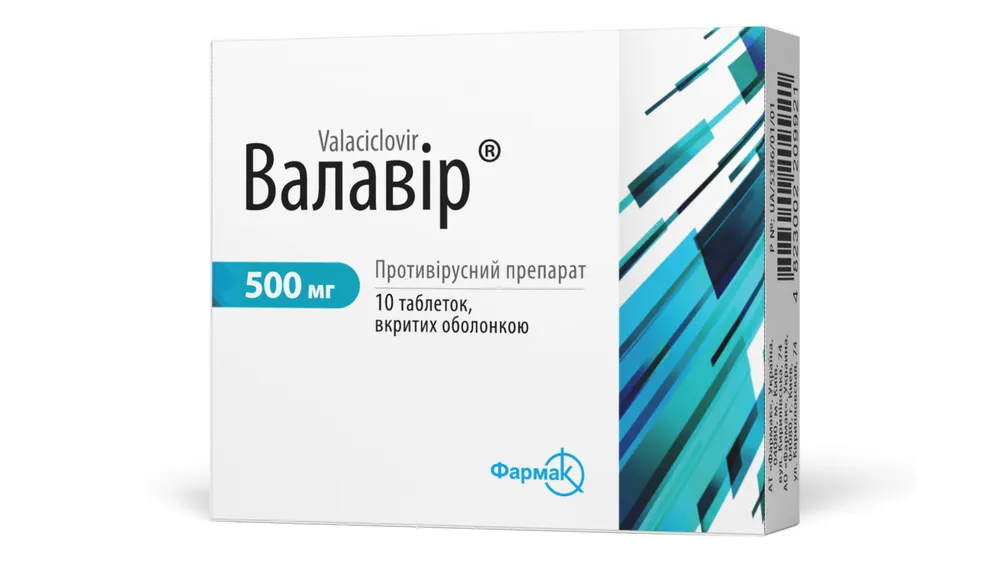
Table of Contents
INSTRUCTIONS FOR MEDICAL USE OF THE MEDICINAL PRODUCT VALAVIR® (VALAVIR)
Composition:
Active substance: valaciclovir;
1 tablet contains 556 mg of valaciclovir hydrochloride equivalent to 500 mg of 100 % anhydrous valaciclovir;
Excipients: microcrystalline cellulose (101), povidone, colloidal anhydrous silicon dioxide, crospovidone, magnesium stearate;
Coating composition: Sepifilm 050 (methylhydroxypropylcellulose, microcrystalline cellulose, acetylated (or acetates of mono- and diglycerides) mono- and diglycerides), Candurin.
Pharmaceutical form. Film-coated tablets.
Main physicochemical properties: elongated, biconvex tablets with a score line, coated with a pearly, almost white, film coating.
Pharmacotherapeutic group. Direct-acting antiviral agents. ATC code J05AB11.
Pharmacological Properties
Pharmacodynamics
Valavir® is an antiviral agent, the L-valyl ester of acyclovir, which is a purine (guanine) nucleoside analogue. In the human body, valacyclovir is rapidly and almost completely converted into acyclovir and valine by valacyclovir hydrolase. Acyclovir is a specific inhibitor of herpesviruses, with in vitro activity against herpes simplex virus types I and II, Varicella zoster virus, cytomegalovirus, Epstein-Barr virus, and human herpesvirus type VI. Acyclovir inhibits viral DNA synthesis after phosphorylation and conversion into its active form, acyclovir triphosphate. The initial phosphorylation step requires the activity of a virus-specific enzyme. For herpes simplex virus, Varicella zoster virus, and Epstein-Barr virus, this is the viral thymidine kinase (TK), which is present only in virus-infected cells. Partial selectivity of phosphorylation is maintained in cytomegalovirus infection, mediated by the UL97 phosphotransferase gene product. Activation of acyclovir by a specific viral enzyme largely explains its selectivity.
The phosphorylation of acyclovir (conversion from mono- to triphosphate) is further carried out by cellular kinases. Acyclovir triphosphate competitively inhibits viral DNA polymerase and is incorporated into viral DNA, resulting in obligate (complete) chain termination, cessation of DNA synthesis, and blockade of viral replication.
Resistance is caused by a deficiency of viral thymidine kinase, leading to uncontrolled viral spread in the host organism. Occasionally, reduced sensitivity to acyclovir results from the emergence of viral strains with altered viral TK or DNA polymerase structure. The virulence of these viral variants resembles that of wild-type strains.
Extensive monitoring of clinical isolates of herpes simplex virus and Varicella zoster virus in patients treated with acyclovir has shown that viruses with reduced sensitivity to acyclovir are exceptionally rare in immunocompetent patients and occur primarily in immunocompromised individuals, such as organ transplant recipients, bone marrow transplant recipients, patients undergoing chemotherapy for malignant neoplasms, and HIV-infected individuals.
Valacyclovir accelerates pain resolution in the treatment of herpes zoster, reduces the duration of pain syndrome, and decreases the number of patients with zoster-associated pain, including acute and postherpetic neuralgia.
Prophylaxis of cytomegalovirus infection with valacyclovir reduces the risk of acute transplant rejection (in kidney transplant recipients), the frequency of opportunistic infections, and other infections caused by herpesviruses (herpes simplex virus and Herpes zoster virus).
Pharmacokinetics
Absorption
After oral administration, valacyclovir is well absorbed and rapidly and almost completely converted into acyclovir and valine. This conversion appears to occur via the enzyme valacyclovir hydrolase, isolated from human liver. The bioavailability of acyclovir following a 1 g dose of valacyclovir is 54% and is not reduced when taken with food. The pharmacokinetics of valacyclovir are not dose-proportional. Both the rate and extent of absorption decrease with increasing dose, resulting in less than proportional increases in Cmax within the therapeutic dose range and reduced bioavailability when doses exceed 500 mg. The average peak concentration of acyclovir ranges from 10–37 µmol (2.2–8.3 µg/mL) after a single 250–2000 mg dose of valacyclovir administered to healthy volunteers with normal renal function, with a median time to peak concentration of 1–2 hours. The peak plasma concentration of valacyclovir itself is only about 4% of that of acyclovir, reached on average within 30–100 minutes, and decreases below measurable levels within 3 hours. The pharmacokinetic parameters of valacyclovir and acyclovir are similar after both single and repeated dosing.
Distribution
Plasma protein binding of valacyclovir is very low—approximately 15%. Penetration into cerebrospinal fluid (CSF), determined by the CSF/AUC plasma ratio, is approximately 25% for acyclovir and its metabolite 8-hydroxyacyclovir, and 2.5% for the metabolite 9-carboxymethoxymethylguanine.
Metabolism
Following oral administration, valacyclovir is converted to acyclovir and L-valine via first-pass metabolism in the intestine and/or liver. A small fraction of acyclovir is further metabolized to 9-carboxymethoxymethoxymethylguanine via alcohol and aldehyde dehydrogenase, and to 8-hydroxyacyclovir via aldehyde oxidase. Approximately 88% of total drug exposure in plasma is attributable to acyclovir, 11% to 9-carboxymethoxymethylguanine, and 1% to 8-hydroxyacyclovir. Neither valacyclovir nor acyclovir is metabolized by cytochrome P450 enzymes.
Elimination
The elimination half-life of acyclovir after single and multiple doses of valacyclovir in patients with normal renal function is approximately 3 hours. Valacyclovir is excreted in urine primarily as acyclovir (more than 80% of the dose) and its metabolite 9-carboxymethoxymethylguanine.
Special Patient Populations
In patients with end-stage renal disease, the elimination half-life of acyclovir is approximately 14 hours.
Varicella zoster virus and herpes simplex virus do not significantly alter the pharmacokinetics of acyclovir and valacyclovir after oral administration of valacyclovir.
In a pharmacokinetic study of valacyclovir and acyclovir during late pregnancy, the area under the concentration-time curve (AUC) of acyclovir at steady state after administration of 1000 mg valacyclovir was approximately twice higher than after oral administration of 1200 mg acyclovir per day.
In HIV-infected patients, the pharmacokinetic characteristics of acyclovir after single or multiple doses of 1000 mg or 2000 mg valacyclovir were unchanged compared to those in healthy individuals.
In organ transplant recipients receiving valacyclovir 2000 mg four times daily, the maximum concentration of acyclovir was equal to or higher than that observed in healthy volunteers receiving the same dose, and daily area under the concentration-time curve (AUC) values were significantly higher.
Clinical characteristics.
Indications.
Treatment of herpes zoster (Herpes zoster).
Treatment of skin and mucous membrane infections caused by herpes simplex virus, including primary and recurrent genital herpes.
Treatment of herpes labialis (cold sores).
Preventive treatment (suppression) of recurrent skin and mucous membrane infections caused by herpes simplex virus, including genital herpes.
Reduction of the risk of transmission of genital herpes virus to a healthy partner when Valavir® is used as suppressive therapy in combination with adherence to safe sex practices.
Prophylaxis of cytomegalovirus infection and disease following organ transplantation.
Contraindications.
Valavir® is contraindicated in patients with hypersensitivity to valacyclovir, acyclovir, or to any component of the medicinal product.
Interaction with other medicinal products and other forms of interactions.
No clinically significant interactions have been identified.
Acyclovir is primarily eliminated unchanged in urine via active tubular secretion. Any concurrently administered drugs affecting this elimination pathway may increase acyclovir plasma concentrations after administration of Valavir®. Following administration of Valavir® at a dose of 1 g with cimetidine and probenecid, which block tubular secretion, the area under the plasma concentration-time curve (AUC) of acyclovir increases and its renal clearance decreases; however, dosage adjustment is not required due to the wide therapeutic index of acyclovir.
Caution is advised in patients receiving higher doses of Valavir® (4 g or more per day) when coadministered with drugs competing with acyclovir for elimination pathways, as this may lead to increased plasma levels of one or both agents and their metabolites. Concomitant use with mycophenolate mofetil (an immunosuppressive agent used after organ transplantation) increases plasma concentrations of acyclovir and the inactive metabolite of mycophenolate mofetil.
Caution (with monitoring of renal function changes) is also advised when high doses of Valavir® (4 g or more) are administered concomitantly with other agents affecting renal function (e.g., cyclosporine, tacrolimus).
Special precautions for use.
Drug Reaction with Eosinophilia and Systemic Symptoms (DRESS).
Cases of DRESS syndrome, which may be life-threatening or fatal, have been reported during treatment with valacyclovir. Patients should be informed of the signs and symptoms of DRESS syndrome when valacyclovir is prescribed, and careful monitoring for possible skin reactions is required. If signs or symptoms suggestive of DRESS syndrome occur, valacyclovir should be discontinued immediately and alternative therapy considered if necessary. Re-administration of valacyclovir to a patient who has experienced DRESS syndrome is contraindicated.
Hydration: Adequate fluid intake should be maintained in patients at increased risk of dehydration, particularly elderly patients.
Use in renal impairment and elderly patients
Acyclovir is eliminated via the kidneys, and therefore the dose of Valavir® should be reduced in patients with impaired renal function (see section "Dosage and administration"). Elderly patients often have reduced renal function and require dose adjustment. The risk of developing neurological complications is increased in patients with renal impairment and in elderly patients; careful monitoring for such effects is necessary. These reactions are mostly reversible upon discontinuation of therapy (see section "Adverse reactions").
Use of higher doses of Valavir® in hepatic insufficiency and liver transplantation
There are no data on the use of higher doses of Valavir® (4 g or more per day) for the treatment of patients with liver disease; therefore, higher doses of Valavir® should be used with caution in such patients. Specific studies on the use of valacyclovir in liver transplantation have not been conducted; however, it has been established that prophylaxis with high-dose acyclovir reduces the incidence of cytomegalovirus-related infections and disease.
Use in the treatment of herpes zoster
Patients, especially those who are immunocompromised, should be closely monitored for clinical response during treatment. If the response to treatment is inadequate, intravenous antiviral therapy should be considered. Patients with complicated herpes zoster, such as visceral organ involvement, viral dissemination, motor neuropathy, encephalitis, or cerebrovascular complications, should be treated with intravenous antiviral agents.
Additionally, immunocompromised patients with ocular herpes lesions or those at high risk of disease dissemination and visceral organ involvement should be treated with intravenous antiviral agents.
Reduction of risk of transmission of genital herpes
Suppressive therapy with Valavir® reduces the risk of transmission of genital herpes. However, it does not cure herpes infection and does not completely eliminate the risk of viral transmission. In addition to Valavir® therapy, patients are advised to follow safe sex practices.
Use in cytomegalovirus infection
Data on efficacy obtained from treating patients at high risk of cytomegalovirus infection for prophylaxis after organ transplantation indicate that valacyclovir should be used in these patients if valganciclovir or ganciclovir has been discontinued for safety reasons. The use of high-dose valacyclovir required for cytomegalovirus prophylaxis may lead to a higher incidence of adverse reactions, including nervous system disorders, compared to lower doses used for other indications. Renal function should be closely monitored and appropriate dose adjustments made.
Use during pregnancy or breastfeeding.
Fertility
Valacyclovir did not affect fertility in animal studies. However, high parenteral doses of acyclovir caused testicular effects in rats and dogs.
Clinical studies evaluating the effect of valacyclovir on human fertility have not been conducted. However, no changes in sperm count, morphology, or motility were observed after 6 months of daily administration of acyclovir at doses ranging from 400 mg to 1 g.
Pregnancy
Data on the use of valacyclovir during pregnancy are limited. Valavir® should be used in pregnant women only if the potential benefit justifies the potential risk to the fetus. There are documented data from pregnancy registries for women exposed to valacyclovir or any form of acyclovir (active metabolite of valacyclovir): 111 and 1,246 women, respectively (29 and 756 women, respectively, used valacyclovir or any form of acyclovir during the first trimester of pregnancy). Observational data did not show an increased incidence of congenital malformations in newborns whose mothers took acyclovir during pregnancy compared to the general population. No congenital malformation had a unique or consistent pattern that would allow identification of a single cause. Due to the limited number of pregnant women observed, a definitive and reliable conclusion regarding the safety of valacyclovir use during pregnancy cannot be made (see section "Pharmacological properties").
Breastfeeding
Acyclovir, the major metabolite of valacyclovir, is excreted into human breast milk. After daily administration of 500 mg valacyclovir, the average peak concentration of acyclovir in breast milk was 0.5–2.3 times (on average, 1.4 times) higher than the plasma concentration in the mother. The ratio of acyclovir concentration in breast milk to maternal plasma concentration ranges from 1.4 to 2.6 (mean 2.2). The average concentration of acyclovir in breast milk was 2.24 µg/mL (9.95 µmol). When the mother takes valacyclovir at a dose of 500 mg twice daily, the infant receives approximately 0.61 µg/kg/day of acyclovir via breast milk. The elimination half-life of acyclovir in breast milk is similar to that in plasma. Unchanged valacyclovir is not detected in maternal plasma, breast milk, or infant urine.
Valavir® should be administered to nursing women only with caution and only if clearly needed. However, acyclovir is used for the treatment of neonatal herpes simplex virus infections by intravenous administration at doses of 30 mg/kg per day.
Ability to affect reaction speed when driving or operating machinery.
There are no clinical data specifically addressing this issue, and the pharmacology of valacyclovir does not suggest any expected negative effect. However, when assessing a patient's ability to drive or operate machinery, their clinical condition and the adverse effect profile of Valavir® should be taken into account.
Dosage and Administration
Herpes zoster treatment: Adults should be given 1000 mg (2 tablets) of Valavir® three times daily for 7 days.
Treatment of infections caused by herpes simplex virus.
Immunocompetent patients (adults): 500 mg (1 tablet) of the drug twice daily.
For recurrent episodes, treatment should last 3 or 5 days. In primary infections, which may be more severe, treatment should be extended from 5 to 10 days. Treatment should be initiated as early as possible. For recurrent herpes simplex virus infections, optimal efficacy is achieved when the drug is administered during the prodromal phase or immediately after the first symptoms appear. Valavir® may prevent lesion development in recurrent herpes simplex virus infections if treatment is started immediately upon onset of the first symptoms.
Alternatively, for the treatment of herpes labialis (cold sores), an effective regimen for Valavir® is 2000 mg (4 tablets) twice daily for 1 day. The second dose should be taken approximately 12 hours (but not earlier than 6 hours) after the first dose. With this dosing regimen, treatment duration should not exceed 1 day, as prolonged administration has not been shown to increase clinical efficacy. Treatment should be initiated at the first sign of early symptoms of herpes labialis (tingling, itching, or burning sensation around the lips).
Suppressive (prophylactic) therapy for recurrent herpes simplex virus infections:
- For immunocompetent patients (adults): 500 mg (1 tablet) once daily;
- For immunocompromised patients (adults): 500 mg (1 tablet) twice daily.
Reduction of transmission of genital herpes virus.
For immunocompetent adult heterosexuals experiencing 9 or fewer recurrences per year, Valavir® should be administered to the infected partner at a dose of 500 mg once daily.
There are no data on reduced transmission of genital herpes virus in other patient populations.
Prophylaxis of cytomegalovirus infection and disease following organ transplantation.
Adults and children aged 12 years and older: Valavir® should be administered at a dose of 2000 mg (4 tablets) four times daily, initiated as soon as possible after transplantation. Dosage should be reduced in cases of renal impairment (see "Dosage in Renal Impairment"). The usual duration of treatment is 90 days, but may be extended for patients at high risk.
Dosage in Renal Impairment
Valacyclovir should be administered with caution in patients with impaired renal function. Adequate hydration must be maintained.
The dosage regimen depends on creatinine clearance and the indication, and is specified in the table.
| Therapeutic indication |
Creatinine clearance, mL/min |
Valavir® dose |
| Herpes zoster — treatment in immunocompetent and immunocompromised adult patients |
50 and above 30–49 10–29 less than 10 |
1 g 3 times daily 1 g 2 times daily 1 g once daily 500 mg once daily |
| Herpes simplex — treatment |
||
| immunocompetent adult patients |
30 and above less than 30 |
500 mg 2 times daily 500 mg once daily |
| Herpes labialis — treatment immunocompetent adult patients |
50 and above 30–49 10–29 less than 10 |
2 g 2 times daily 1 g 2 times daily 500 mg 2 times daily 500 mg once |
| Herpes simplex — prophylaxis |
||
| immunocompetent adult patients |
30 and above less than 30 |
500 mg once daily 250* mg once daily |
| immunocompromised adult patients |
30 and above less than 30 |
500 mg 2 times daily 500 mg once daily |
| Prevention of cytomegalovirus infection |
75 and above 50–74 25–49 10–24 Less than 10 or dialysis |
2 g 4 times daily 1.5 g 4 times daily 1.5 g 3 times daily 1.5 g 2 times daily 1.5 g once daily |
*Use when 250 mg tablets of the drug are available.
For patients undergoing intermittent hemodialysis, the same doses of Valavir® are recommended as for patients with creatinine clearance less than 15 mL/min. Doses should be administered after hemodialysis.
Creatinine clearance should be monitored continuously, especially during periods when renal function may change rapidly, such as immediately after transplantation. Accordingly, the dose of Valavir® should be adjusted accordingly.
Dosing in hepatic impairment
Dosage adjustment is not required in patients with mild to moderate cirrhosis (preserved synthetic liver function). Pharmacokinetic data in advanced cirrhosis (with impaired synthetic liver function and signs of portal hypertension) suggest that dosage adjustment is not necessary; however, clinical experience is limited.
For use of higher doses (4000 mg per day and above), see section "Special precautions".
Geriatric patients
Valavir® dosage may require adjustment to avoid potential renal function impairment (see "Dosing in renal impairment").
Adequate hydration should be maintained.
Children.
Valavir® is indicated for use in children aged 12 years and older for prevention of cytomegalovirus infection and disease following organ transplantation.
Overdose.
Symptoms. In cases of valacyclovir overdose, acute renal failure and neurological symptoms have been reported, including confusion, hallucinations, agitation, decreased mental abilities, and coma. Nausea and vomiting may also occur. To prevent accidental overdose, caution should be exercised during administration. Many cases of overdose have been associated with administration of the drug to patients with renal impairment and elderly patients, in whom the dose was not appropriately reduced.
Treatment. Patients should be under close medical supervision to detect signs of toxicity. Hemodialysis significantly accelerates the elimination of acyclovir from the blood and therefore can be considered the optimal treatment approach in cases of symptomatic overdose.
Adverse Reactions
The most commonly reported adverse reactions in clinical trials were headache and nausea. More serious adverse reactions included reports of thrombotic thrombocytopenic purpura / hemolytic uremic syndrome, acute renal failure, and neurological disorders.
The adverse reactions listed below are classified by system organ class and frequency of occurrence: very common (≥ 1/10), common (≥ 1/100 to < 1/10), uncommon (≥ 1/1000 to < 1/100), rare (≥ 1/10000 to < 1/1000), very rare (< 1/10000).
From clinical trials
Nervous system disorders
Common: headache.
Gastrointestinal disorders
Common: nausea.
From post-marketing surveillance
Blood and lymphatic system disorders
Very rare: leukopenia (mainly observed in immunocompromised patients), thrombocytopenia.
Immune system disorders
Very rare: anaphylaxis.
Nervous system and psychiatric disorders
Rare: dizziness, confusion, hallucinations, cognitive decline.
Very rare: agitation, tremor, ataxia, dysarthria, psychotic symptoms, seizures, encephalopathy, coma.
The above symptoms are in most cases reversible and are mainly observed in patients with renal impairment or other predisposing factors (see section "Special precautions"). Neurological reactions occur more frequently in organ transplant recipients receiving high-dose valacyclovir (8 g daily) for cytomegalovirus infection prophylaxis than in patients receiving lower doses.
Respiratory, thoracic and mediastinal disorders
Uncommon: dyspnea.
Gastrointestinal disorders
Rare: abdominal discomfort, vomiting, diarrhea.
Hepatobiliary disorders
Very rare: reversible increase in liver function tests.
This has occasionally been described as hepatitis.
Skin and subcutaneous tissue disorders
Uncommon: rash, including photosensitivity reactions.
Rare: pruritus.
Very rare: urticaria, angioneurotic edema.
Not known: drug reaction with eosinophilia and systemic symptoms (DRESS) (see section "Special precautions").
Renal and urinary disorders
Rare: renal function abnormalities.
Very rare: acute renal failure, renal pain (may be associated with renal impairment), hematuria (often associated with other renal function abnormalities). Acyclovir precipitate formation in renal tubules has been reported. Adequate hydration should be maintained during treatment (see section "Special precautions").
Not known: tubulointerstitial nephritis.
Other: there have been reports of renal failure, microangiopathic hemolytic anemia, and thrombocytopenia (sometimes in combination) in severely ill immunocompromised patients, particularly those with advanced stages of HIV disease who received high doses (8000 mg daily) of valacyclovir for prolonged periods in clinical trials. These same phenomena have also been observed in patients with similar conditions who were not treated with valacyclovir.
Shelf life. 3 years.
Do not use the medicinal product after the expiry date stated on the packaging.
Storage conditions.
Store in the original packaging at a temperature not exceeding 25°C.
Keep out of the reach of children.
Packaging.
6 tablets in a blister. 7 blisters in a carton.
10 tablets in a blister. 1 blister in a carton.
Prescription status. Prescription only.
Manufacturer.
JSC "Farmak".
Manufacturer's name and address of the place of business.
74, Kyrylivska Street, Kyiv, 04080, Ukraine.