Vagitsin-zdorovya
Ukraine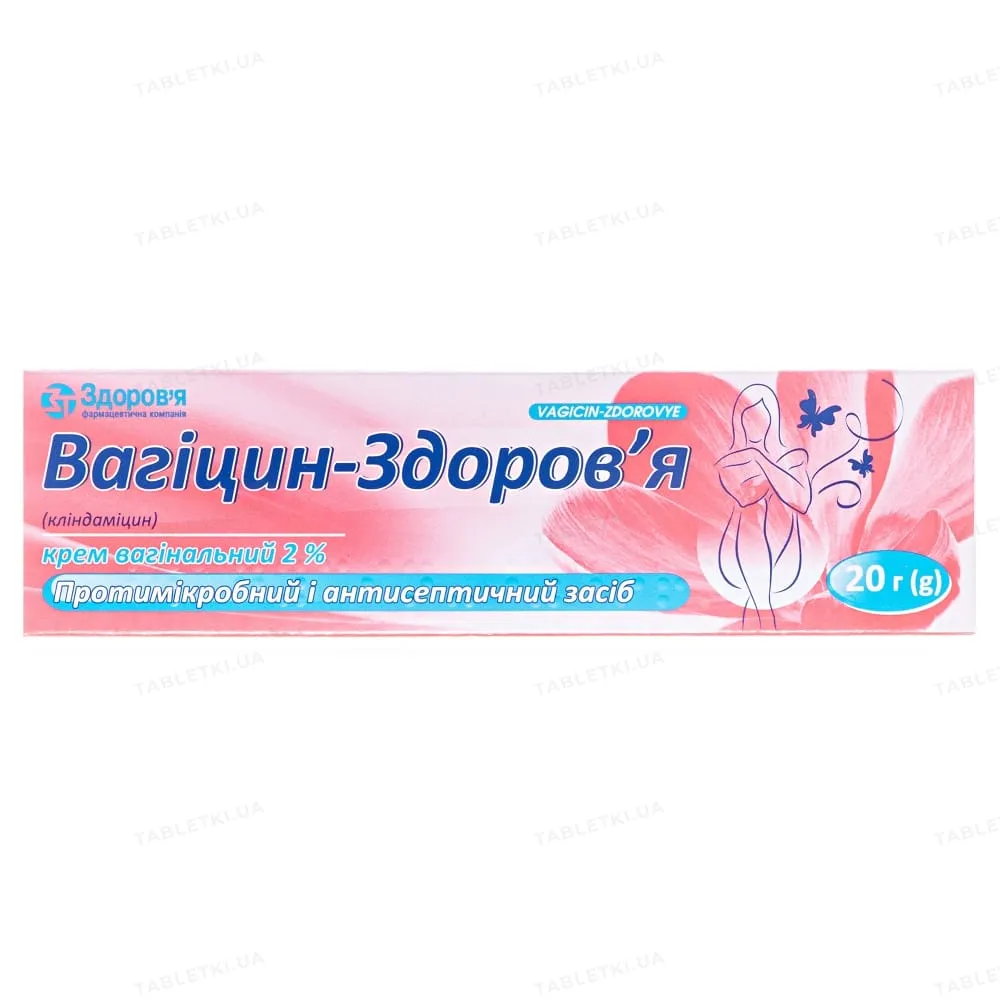
Table of Contents
INSTRUCTIONS FOR MEDICAL USE OF THE MEDICINAL PRODUCT VAGICIN-ZDOROVYE (VAGICIN-ZDOROVYE)
Composition:
Active substance: clindamycin;
1 g of cream contains clindamycin phosphate equivalent to 20 mg of clindamycin;
Excipients: methylparaben (E 218), cetearyl alcohol, polyethylene glycol stearate, glycerol monostearate, isopropyl myristate, polysorbate 60, propylene glycol, mineral oil, purified water.
Pharmaceutical form. Vaginal cream.
Main physicochemical properties: white homogeneous cream with a weak specific odor.
Pharmacotherapeutic group. Antimicrobial and antiseptic agents for gynecological use, excluding combined preparations containing corticosteroids.
ATC code G01A A10.
Pharmacological properties.
Pharmacodynamics.
Mechanism of action. Clindamycin is a lincosamide antibiotic that inhibits bacterial protein synthesis at the level of the bacterial ribosome. The antibiotic primarily binds to the 50S ribosomal subunit and affects the translation process. Although clindamycin phosphate is inactive in vitro, rapid hydrolysis in vivo converts this compound into the antibacterial active clindamycin.
Pharmacokinetic/pharmacodynamic relationship. Similar to other inhibitors of protein synthesis, efficacy is related to the duration of time that the concentration of clindamycin remains above the MIC (minimum inhibitory concentration) of the infecting organism.
Mechanism of resistance. Resistance to clindamycin in most cases is due to modification of ribosomal target sites, usually by chemical modification of ribosomal RNA bases or point mutations in RNA, or sometimes protein mutations. In vitro, cross-resistance between lincosamides, macrolides, and streptogramin B has been demonstrated in some organisms.
Cross-resistance between clindamycin and lincomycin has been demonstrated.
Breakpoints. Standard methodology for testing susceptibility of potential pathogens of bacterial vaginosis (Gardnerella vaginalis and Mobiluncus species) has not been defined. Methods for determining susceptibility of Bacteroides species, gram-positive anaerobic cocci, and Mycoplasma species are described by the Clinical and Laboratory Standards Institute (CLSI). Breakpoints for susceptibility of gram-negative and gram-positive anaerobes to clindamycin have been published by both EUCAST (European Committee on Antimicrobial Susceptibility Testing) and CLSI. However, these breakpoints are intended primarily for guiding systemic antibiotic therapy rather than topical treatment.
Microbiological susceptibility. Clindamycin is active in vitro against most strains of microorganisms reported to be associated with bacterial vaginosis: Bacteroides species; Gardnerella vaginalis; Mobiluncus species; Mycoplasma hominis; Peptostreptococcus species.
Pharmacokinetics. It is known that after intravaginal administration of 100 mg clindamycin phosphate as 2% vaginal cream once daily for 7 days in 6 healthy female volunteers, systemic absorption of the active substance averaged 4% of the administered dose (range 0.6% to 11%). Peak serum clindamycin concentration on day 1 averaged 18 ng/mL (range 4 to 47 ng/mL), and on day 7 averaged 25 ng/mL (range 6 to 61 ng/mL). These peak concentrations were recorded approximately 10 hours (range 4 to 24 hours) after drug administration.
Data exist showing that after intravaginal administration of 100 mg clindamycin phosphate as 2% vaginal cream once daily for 7 consecutive days in 5 patients with bacterial vaginosis, absorption was slower and variability lower compared to corresponding parameters in healthy women. Systemic absorption reached approximately 4% (range 2% to 8%) of the dose. Peak serum clindamycin concentration on day 1 averaged 13 ng/mL (range 6 to 34 ng/mL), and on day 7 averaged 16 ng/mL (range 7 to 26 ng/mL). These peak concentrations were recorded approximately 14 hours (range 4 to 24 hours) after drug administration.
Repeated (over 7 days) vaginal administration of clindamycin phosphate as 2% vaginal cream was not associated with systemic accumulation of clindamycin, or such accumulation was negligible. The systemic elimination half-life ranged from 1.5 to 2.6 hours.
Geriatric patients. Clinical studies of clindamycin phosphate as 2% vaginal cream did not include a sufficient number of patients aged 65 years and older to determine whether they respond differently from younger patients.
Clinical characteristics.
Indications. Treatment of bacterial vaginosis.
Contraindications. The medicinal product is contraindicated in patients with a history of hypersensitivity to clindamycin, lincomycin, or to any excipient listed in the section "Composition". The product is also contraindicated in patients with a history of inflammatory bowel disease or antibiotic-associated colitis.
Interaction with other medicinal products and other forms of interaction. Clindamycin has been shown to block neuromuscular transmission when administered systemically and may potentiate the effect of other neuromuscular blocking agents. Therefore, clindamycin should be used with caution in patients receiving such agents (see section "Overdose").
There is no information available regarding the concomitant use of clindamycin with other vaginal products.
Special precautions for use.
Other infections, including Trichomonas vaginalis, Candida albicans, Chlamydia trachomatis, and gonococcal infections, may require appropriate laboratory testing before or after starting clindamycin treatment.
Use of clindamycin may lead to overgrowth of nonsusceptible microorganisms, including yeasts.
Symptoms indicating pseudomembranous colitis may occur during or after antibiotic therapy (see section "Adverse reactions"). Pseudomembranous colitis has been reported with nearly all antibacterial agents, including clindamycin, and may range in severity from mild to life-threatening. This diagnosis must therefore be considered in patients who present with diarrhea following antibiotic use. Improvement may be observed after discontinuation of the drug in cases of moderate severity.
If pseudomembranous colitis occurs, clindamycin therapy should be discontinued and appropriate antibacterial treatment initiated. Antiperistaltic agents are contraindicated in this situation.
Clindamycin should be prescribed with caution in patients with intestinal inflammatory disorders such as Crohn's disease or ulcerative colitis.
As with any vaginal infection, sexual intercourse during treatment is not recommended. The vehicle of the product may reduce the effectiveness of latex condoms and diaphragms upon contact. Use of these contraceptive devices is not recommended within 72 hours after application of the vaginal cream, as such use may be associated with reduced contraceptive effectiveness or protection against sexually transmitted infections.
During treatment, the use of other products intended for intravaginal administration (such as tampons, douches) is not recommended.
Excipients. The medicinal product contains propylene glycol, cetostearyl alcohol, and methylparaben (E 218) (see section "Composition").
Methylparaben (E 218) may cause allergic reactions (possibly delayed).
Cetostearyl alcohol may cause local skin reactions (e.g., contact dermatitis).
Propylene glycol may cause skin irritation.
Elderly patients. Clinical studies of 2% clindamycin phosphate vaginal cream did not include sufficient numbers of patients aged 65 years and older to determine whether they respond differently from younger patients.
Use during pregnancy or breastfeeding.
Pregnancy. Clindamycin is not recommended during the first trimester due to the lack of adequate and well-controlled studies in pregnant women during this period.
Clinical data on the use of clindamycin phosphate in vaginal formulation during the second trimester of pregnancy and systemic use of clindamycin phosphate during the second and third trimesters have not shown an association with congenital anomalies.
The medicinal product may be used during the second and third trimesters of pregnancy only if clearly needed.
In clinical studies involving pregnant women during the second trimester, clindamycin in the form of vaginal cream was effective in treating bacterial vaginosis and was not associated with any adverse effects in newborns. However, as with any medicinal product used during pregnancy, a careful benefit-risk assessment should be performed before use.
Breastfeeding. It is not known whether clindamycin is excreted in human breast milk following vaginal administration. With systemic administration, clindamycin has been reported to be present in human breast milk at concentrations ranging from < 0.5 to 3.8 mcg/mL. Clindamycin may cause adverse effects on the gastrointestinal flora of a breastfed infant, such as diarrhea, blood in stool, or rash. If a breastfeeding mother requires oral or intravenous clindamycin, this is not a reason to discontinue breastfeeding; however, an alternative agent may be preferable. The benefits of breastfeeding for the child's development and health, the mother's clinical need for clindamycin, and any potential adverse effects of clindamycin or the mother's underlying condition on the breastfed child should be carefully considered.
Ability to affect the speed of reactions when driving or operating machinery. No systematic studies on the effect of clindamycin on the ability to drive or operate machinery have been conducted.
Method of Administration and Dosage
Apply 1 full vaginal applicator (approximately 5 g) intravaginally at bedtime for 7 consecutive days.
It has been shown that in patients for whom a shorter treatment course is recommended, a 3-day treatment regimen is effective.
Use of the Vaginal Applicator
- Remove the cap from the tube of cream. Screw the applicator onto the tube's nozzle.
- Squeezing the tube from the opposite end, carefully squeeze the cream into the applicator (the applicator is full when the plunger reaches the stop).
- Unscrew the applicator from the tube and replace the cap on the tube.
- Lie on your back with knees drawn up toward the chest.
- Holding the applicator horizontally, gently insert it as deeply as possible into the vagina without causing discomfort.
- Slowly press the plunger fully to its stop to release the cream into the vagina.
- Carefully remove the applicator from the vagina and discard it.
Children. The safety and efficacy of the drug in pediatric practice have not been established.
Overdose. There have been no reports of clindamycin overdose. The drug may be absorbed in amounts sufficient to produce systemic effects when administered vaginally.
In case of overdose, general symptomatic and supportive measures should be taken as needed.
In the event of accidental oral ingestion, effects similar to those observed with oral administration of therapeutic doses of clindamycin may occur.
Adverse Reactions
The adverse reactions listed below, identified during clinical trials and post-marketing surveillance, are presented by system organ classes and frequency. Adverse reactions identified from post-marketing use are indicated in italics. Frequency grouping is defined as follows: very common (≥1/10); common (≥1/100 to <1/10); uncommon (≥1/1,000 to <1/100); rare (≥1/10,000 to <1/1,000); very rare (<1/10,000); frequency not known (cannot be estimated from available data). Within each frequency group, adverse events are listed in order of decreasing severity.
The safety of clindamycin has been studied in non-pregnant women and in pregnant women during the second and third trimesters of pregnancy.
Infections and infestations
Common: fungal infections, infections caused by Candida species.
Uncommon: bacterial infections.
Frequency not known: cutaneous candidiasis.
Immune system disorders
Uncommon: hypersensitivity reactions.
Endocrine system disorders
Frequency not known: hyperthyroidism.
Nervous system disorders
Common: headache, dizziness, dysgeusia.
Ear and labyrinth disorders
Uncommon: vertigo.
Respiratory, thoracic and mediastinal disorders
Common: upper respiratory tract infections.
Uncommon: epistaxis.
Gastrointestinal disorders
Common: abdominal pain, constipation, diarrhea, nausea, vomiting.
Uncommon: bloating, halitosis, flatulence.
Frequency not known: gastrointestinal disorders, pseudomembranous colitis (see section "Special precautions for use"), dyspepsia.
Skin and subcutaneous tissue disorders
Common: pruritus (not at application site), rash.
Uncommon: erythema, urticaria.
Frequency not known: maculopapular rash.
Musculoskeletal and connective tissue disorders
Common: back pain.
Renal and urinary disorders
Common: urinary tract infections, glucosuria, proteinuria.
Uncommon: dysuria.
Reproductive system and breast disorders
Very common: vulvovaginal candidiasis.
Common: vulvovaginitis, vulvovaginal disorders, menstrual cycle disturbances, vulvovaginal pain, metrorrhagia, vaginal discharge.
Uncommon: trichomonal vulvovaginitis, vaginal infections, pelvic pain.
Frequency not known: endometriosis.
General disorders and administration site conditions
Frequency not known: pain, inflammation.
Investigations
Uncommon: abnormal microbiological test results.
Reporting suspected adverse reactions
Reporting of suspected adverse reactions after drug registration is important. It allows continued monitoring of the benefit-risk balance of the medicinal product. Medical and pharmaceutical professionals, as well as patients or their legal representatives, should report any suspected adverse reactions and lack of efficacy via the Automated Pharmacovigilance Information System at the following link: https://aisf.dec.gov.ua.
Shelf life. 2 years.
Storage conditions. Store in original packaging at a temperature not exceeding 25 °C. Do not freeze. Keep out of reach of children.
Packaging. 20 g in a tube with three vaginal applicators in a cardboard box.
Prescription category. Prescription only.
Manufacturer. LIMITED LIABILITY COMPANY "CORPORATION "ZDOROVIYA".
Manufacturer's address and location of operations. 22 Shevchenka Street, Kharkiv, Kharkiv Oblast, 61013, Ukraine.