Uromune-mv140
Ukraine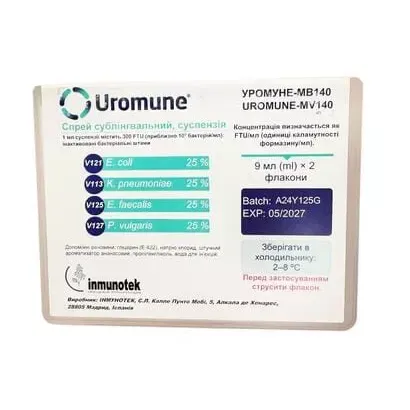
Table of Contents
INSTRUCTION FOR MEDICAL USE OF THE MEDICINAL PRODUCT UROMUNE-MV140 (UROMUNE-MV140)
Composition:
Active substances: 1 ml of suspension contains 300 FTU (approximately 109 bacteria/ml): inactivated bacterial strains – 25 % Escherichia coli (V121), 25 % Klebsiella pneumoniae (V113), 25 % Enterococcus faecalis (V125), and 25 % Proteus vulgaris (V127);
Excipients: glycerin (E 422), sodium chloride, artificial pineapple flavor, propylene glycol, water for injections.
Concentration is defined as FTU/ml (formazin turbidity units/ml).
Pharmaceutical form. Sublingual spray, suspension.
Pharmacotherapeutic group.
Anti-infective agents for systemic use. Bacterial vaccines. Other bacterial vaccines. ATC code J07AX.
Immunological and biological properties.
Pharmacodynamics.
Mechanism of action
UROMUNE-MV140 is a vaccine that stimulates the immune system to increase resistance to urinary tract infections.
The medicinal product UROMUNE-MV140 is indicated for secondary prophylaxis of recurrent bacterial urinary tract infections in adult patients.
The active substance of UROMUNE-MV140 is bacteria that are the main cause of urinary tract infections (UTIs). The bacteria contained in the preparation are completely inactivated and cannot enter the bloodstream from the oral mucosa. They are most likely actively taken up by oral dendritic cells. These cells induce a local adaptive immune response (site of induction), which spreads to other mucosal tissues, including the urinary bladder (site of effect).
Sublingual vaccination with UROMUNE-MV140 stimulates a specific immune response (Th17/Th1) – the main mechanism involved in resistance to bacterial bladder infections. It also induces a regulatory T-cell response, which, together with the Th1 response, suppresses harmful Th2 responses associated with bladder infection recurrence. These responses were observed in vitro and in vivo in preclinical studies. In vivo studies demonstrated these reactions in the spleen and distant (inguinal) lymph nodes after sublingual administration. Early TNF-α responses are also observed in the bladder of mice immunized sublingually following challenge with bacteria contained in UROMUNE-MV140. In an experimental model of Escherichia coli bladder infection, UROMUNE-MV140 provided early protection associated with a rapid T-cell response in the bladder along with increased influx of myeloid cells into urine. Furthermore, UROMUNE-MV140 induces an antibody response, including immunoglobulins A, G, and M, against the bacteria contained in its formulation.
Its pharmacodynamic effect is directed at the immune system.
Clinical efficacy and safety
The efficacy and safety of UROMUNE-MV140 for recurrent bacterial urinary tract infections were evaluated in a multicenter, randomized, double-blind, placebo-controlled, one-year Phase III study with parallel groups, including 240 women (aged 18 to 75 years). Women who had at least 5 episodes of uncomplicated cystitis in the previous year were enrolled and received either placebo or UROMUNE-MV140 for 3 or 6 months. The follow-up period lasted 12 months from the start of treatment.
During the 9-month efficacy evaluation period (i.e., after 3 months of treatment), the median number of UTI episodes was 3.0 [interquartile range (IQR), 0.5–6.0] in the placebo group compared to 0.0 [IQR, 0.0–1.0] in both groups receiving UROMUNE-MV140 (p < 0.001). Additionally, a significant increase in the proportion of patients free from UTIs (p < 0.001) was observed, amounting to 25 % in the placebo group versus 55.7 % and 58 % in patients receiving UROMUNE-MV140 for 3 or 6 months, respectively. The mean time to first UTI was significantly prolonged in individuals receiving UROMUNE-MV140 by at least 227 days. A very significant reduction in symptom scores along with a meaningful improvement in quality of life throughout the study period was also observed when comparing the active treatment group to the placebo group (p < 0.001). The median antibiotic score was 4.5 [IQR, 1.0–8.5] in the placebo group and decreased to 1.0 [IQR, 0.0–3.0] in both groups receiving UROMUNE-MV140 (p < 0.001) throughout the entire study period. Furthermore, a significant reduction in healthcare resource utilization was observed, primarily related to urologist visits and additional testing. There were no differences between active treatment arms in any clinical variable.
Regarding safety, only 5 patients (2.2 %) reported non-serious adverse reactions: 2 from the placebo group and 3 from the UROMUNE-MV140 group during the 3-month period.
Efficacy and safety from non-interventional studies
In various observational studies, prophylaxis with UROMUNE-MV140 demonstrated higher efficacy in treating recurrent bacterial urinary tract infections compared to prophylaxis with antibacterial agents, based on reduced frequency of UTIs and increased infection-free periods. Over a 15-month observation period (p < 0.001 for all studies), subjects who received UROMUNE-MV140 daily for 3 months (total of 519 women) had significantly higher rates of being free from UTIs (35–90 %), compared to those who received 6 months of antibiotic prophylaxis (0 % of 499 women total).
Women with recurrent bacterial urinary tract infections for whom conventional therapy proved ineffective received UROMUNE-MV140 for 3 months. The majority of participants (78 %) remained infection-free after the follow-up period (12 months), indicating the efficacy of UROMUNE-MV140 in preventing UTI recurrences in women. Another prospective study involving nearly 800 subjects showed that UROMUNE-MV140 significantly reduced the number of UTI episodes in both men and women. The most recent study involving women with various risk factors associated with UTIs demonstrated that UROMUNE-MV140 provides protection that remains, at least partially, for up to 2 years from the start of treatment. In this study, UROMUNE-MV140 significantly reduced antibiotic use and healthcare-related costs associated with UTIs.
Other studies evaluating subjects with complicated UTIs consistently reported favorable rates of absence of UTIs ranging from 30 to 50 %, significant reduction in UTI frequency, and improved quality of life. One of these studies included patients with autoimmune diseases, where immunosuppressive therapy makes them prone to infection episodes. The number of UTI episodes, antibiotic use, and healthcare resource needs, assessed 12 months after starting a 3-month course of UROMUNE-MV140, significantly decreased compared to the year prior to vaccination.
Some preliminary studies including women aged 16–18 years, and various case reports on treatment of children aged 6 to 12 years, based on real-life clinical experience, demonstrated clinical benefits of UROMUNE-MV140 in children. Most children reported absence of recurrences or reduced frequency of UTIs, decreased severity of infection episodes (asymptomatic bacteriuria or absence of febrile UTIs).
The above-mentioned studies were systematically reviewed, and it was concluded that UROMUNE-MV140 reduces UTIs by 2–6 times over 12 months, with nearly 90 % of patients remaining infection-free.
Studies in elderly patients show that after bacterial immunoprophylaxis, the number of UTIs 12 months after treatment with either autovaccine or UROMUNE-MV140 significantly decreased in both men and women across all treatment groups compared to the number of cases prior to vaccination. The average number of UTIs after prophylaxis ranged from 0.0 to 0.3 episodes per month depending on the study group.
Overall, the reduction rate varied from 7-fold in subjects receiving a new course of autovaccine to 40-fold in women receiving UROMUNE-MV140 for the first time. It is noteworthy that in all groups, a significantly greater reduction in UTIs was observed in individuals receiving UROMUNE-MV140 compared to those receiving autovaccines. Regarding the proportion of subjects free from urinary tract infections, nearly 60 % of individuals receiving UROMUNE-MV140 remained free from urinary tract infections at the end of the observation period, whereas none in the autovaccination groups. At the end of the study, no differences in the number of UTI cases were observed between patient groups by gender or between groups receiving primary treatment and those receiving autovaccination.
In several studies, the use of UROMUNE-MV140 as prophylactic treatment in patients with recurrent bacterial urinary tract infections reported good tolerability and absence of adverse reactions during and after 3 months of daily administration of UROMUNE-MV140. In post-marketing studies involving thousands of cases of UROMUNE-MV140 therapy, 13 spontaneous reports of adverse reactions were recorded worldwide over the last 6 years of UROMUNE-MV140 use.
Pharmacokinetics.
Due to the route of administration, the active substances (inactivated bacterial strains) are not absorbed into the vascular system. Therefore, pharmacokinetic studies in animals or clinical studies on the pharmacokinetic profile and metabolism of UROMUNE-MV140 have not been conducted.
Preclinical safety
Preclinical data reveal no special hazard to humans based on standard repeated-dose toxicity studies, local tolerance, and safety assessment performed during pharmacodynamic/mechanism of action studies.
Clinical characteristics.
Indications.
An immunotherapeutic medicinal product indicated for adults for the prevention of recurrent bacterial urinary tract infections.
Contraindications.
Hypersensitivity to the components of the drug (see section "Composition").
Pediatric age (under 18 years).
Pregnancy or breastfeeding period.
Interaction with other medicinal products and other types of interactions.
Interaction with other medicinal products has not been studied.
Special precautions for use.
The medicinal product should be prescribed by a physician only.
Any unused medicinal product or waste material must be disposed of in accordance with local requirements.
The medicinal product contains fully inactivated microorganisms and therefore has no infectivity.
This medicinal product contains less than 1 mmol of sodium (23 mg) per 1 ml, i.e. it is practically sodium-free.
Use during pregnancy or breastfeeding.
Pregnancy
Data on the use of the medicinal product UROMUNE-MV140 in pregnant women are lacking or limited; therefore, this medicinal product is not recommended during pregnancy.
Breastfeeding
There is insufficient information on the effect of the medicinal product UROMUNE-MV140 on newborns/infants; therefore, the use of this medicinal product is not recommended during breastfeeding.
Fertility
Data are lacking.
Ability to affect reaction speed when driving or operating machinery.
Allergen medicinal products do not affect the ability to drive or operate machinery.
Method of Administration and Dosage
The recommended dose is 2 sprays once daily (one dose = 2 sprays), with a maximum daily dose of 0.2 ml. The duration of treatment is approximately 90 days (3 months).
UROMUNE-MV140 should be administered separately from food and/or drinks (at least 30 minutes before or after eating or drinking). Do not brush teeth or rinse mouth within 30 minutes before or after administration.
Method of Administration
UROMUNE-MV140 is administered sublingually.
- Remove the plastic cap from one bottle.
- Gently shake the bottle.
- Turn the nozzle aside. Press 3 or 4 times to prime the pump mechanism (only when activating the bottle for the first time).
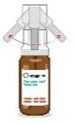
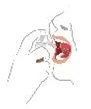
- Lift the tongue, direct the nozzle under the tongue, and spray twice to administer the correct dose.
**
**
- Hold the medication under the tongue for approximately 1–2 minutes before swallowing.
- Turn the nozzle back to its original vertical position, thereby locking the spray mechanism.
- Return the bottle to the box and store as indicated in the section "Storage Conditions".
Children
Not recommended for use in children (under 18 years of age).
Overdose
There have been no reported cases of overdose with UROMUNE-MV140. Due to the nature of the product, overdose is unlikely.
In the event of accidental overdose or incorrect administration, some adverse reactions may occur in patients (see section "Adverse Reactions").
Adverse reactions.
Gastrointestinal disturbances, sensation of and/or discomfort in the oropharynx may rarely occur. The presence of these reactions does not necessarily mean that treatment should be discontinued or postponed, but monitoring of drug administration may be required.
The information on adverse reactions listed below was obtained from clinical trials, spontaneous reports, and medical literature.
Adverse reactions are classified by frequency: very common (≥ 1/10); common (≥ 1/100 to < 1/10); uncommon (≥ 1/1000 to < 1/100); rare (≥ 1/10000 to < 1/1000); very rare (< 1/10000), frequency not known (cannot be estimated from the available data).
All adverse effects should be reported to a physician.
| Classes and organ systems |
Very common |
Common |
Uncommon |
Rare |
Very rare |
| Metabolism and nutrition disorders |
Decreased appetite |
||||
| Nervous system disorders |
Formication (tactile hallucinations such as sensation of crawling, bites of ants or other insects) Headache |
||||
| Eye disorders |
Eye pain |
||||
| Respiratory system disorders |
Asthma/exacerbation of asthma Upper airway cough syndrome Dyspnea |
||||
| Gastrointestinal disorders |
Oral pain Epigastric discomfort Oral mucosal peeling Dental discomfort Dry mouth Gastritis |
Abdominal discomfort Abdominal pain Glossitis Nausea Diarrhea Gastroesophageal reflux |
|||
| Skin and subcutaneous tissue disorders |
Itching |
Rash Itchy rash Perioral dermatitis |
|||
| Musculoskeletal system disorders |
Arthralgia Limb pain |
||||
| General disorders and administration site conditions |
Malaise |
Feeling of warmth Generalized edema Pain Hot flushes |
Most adverse reactions are rare or very rare. They can be local (at the site of administration) or systemic.
Local reactions (oropharyngeal), although infrequent, are the most commonly reported events. Their occurrence does not imply that treatment should be interrupted or postponed, but proper administration technique may need to be checked.
Systemic adverse reactions such as malaise, rash, and generalized pruritus may occur rarely. In addition, a very small number of cases of asthma or asthma exacerbation have been reported; if asthma exacerbation occurs, treatment should be discontinued and medical advice should be sought immediately.
Reporting of suspected adverse reactions
Reporting suspected adverse reactions after authorization of the medicinal product is important. It allows continued monitoring of the benefit/risk balance of the medicinal product. Healthcare professionals and patients, as well as their legal representatives, are encouraged to report all suspected adverse reactions and lack of efficacy via the Automated Pharmacovigilance Information System at: https://aisf.dec.gov.ua/.
Shelf life.
3 years.
Storage period after first opening of the vial: 45 days.
Storage conditions.
Store in the original packaging in a dark place.
Store in a refrigerator (2–8 °C). Keep out of the reach of children.
Packaging.
2 vials of 9 ml each, closed with a plastic applicator with built-in spray pump, in a plastic box.
Prescription status.
Prescription only.
Manufacturer.
INMUNOTECH, S.L.
Manufacturer's address and place of business.
Calle Punto Móvil, 5, Alcalá de Henares, 28805 Madrid, Spain