Ultravist 300
Ukraine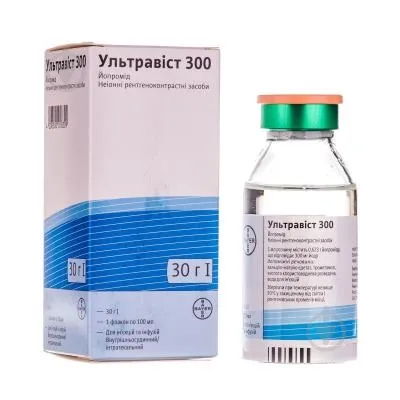
Table of Contents
INSTRUCTIONS FOR MEDICAL USE OF THE MEDICINAL PRODUCT ULTRAVIST 300 (ULTRAVIST® 300) ULTRAVIST 370 (ULTRAVIST® 370)
Composition:
Active substance: iopromide;
Ultravist 300: 1 ml contains 0.623 g of iopromide, equivalent to 300 mg of iodine;
Ultravist 370: 1 ml contains 0.769 g of iopromide, equivalent to 370 mg of iodine;
Excipients: calcium sodium edetate, trometamol, sodium hydroxide, diluted hydrochloric acid, water for injections.
Pharmaceutical form. Solution for injection and infusion.
Main physicochemical characteristics: clear, particle-free solution.
| Parameters |
Ultravist 300 |
Ultravist 370 |
|
| Iodine concentration (mg/mL) |
300 |
370 |
|
| Osmolality at 37°C (osm/kg H₂O) |
0.59 |
0.77 |
|
| Osmolarity at 37°C (osm/L solution) |
0.43 |
0.49 |
|
| Viscosity (mPa·s) |
|||
| at 20°C |
8.9 |
22.0 |
|
| at 37°C |
4.7 |
10.0 |
|
| Density (g/mL) |
|||
| at 20°C |
1.328 |
1.409 |
|
| at 37°C |
1.322 |
1.399 |
|
| pH value |
6.5–8.0 |
6.5–8.0 |
|
| Osmotic pressure at 37°C |
|||
| MPa |
1.59 |
2.02 |
|
| atm |
15.7 |
19.9 |
|
| Molecular weight (g/mol) |
791.12 |
||
Pharmacotherapeutic group.
Iodine-containing X-ray contrast agents. Water-soluble low-osmolar non-ionic X-ray contrast agents. Iopromide.
ATC CODE VO8AB05.
Pharmacological Properties
Pharmacodynamics
The contrast agent (iopromide) in all formulations of the medicinal product Ultravist is a non-ionic, water-soluble derivative of tri-iodinated isophthalic acid with a molecular weight of 791.12 g/mol, in which the tightly bound iodine absorbs X-rays.
Contrast-Enhanced Mammography. Nine studies involving 1531 patients evaluated diagnostic efficacy under appropriate conditions. In studies assessing suspected lesions, contrast-enhanced mammography demonstrated sensitivity ranging from 96.9% to 100% and specificity from 69.7% to 87%, compared to digital mammography, which showed sensitivity of 96.9% and specificity of 42.0%.
In studies evaluating the accuracy of contrast-enhanced mammography compared to other diagnostic methods, contrast-enhanced mammography showed 100% sensitivity and 100% negative predictive value, compared to MRI (93% and 65%, respectively; p = 0.04 and p < 0.001). Compared to full-field digital mammography combined with ultrasound, contrast-enhanced mammography demonstrated sensitivity of 92.3% versus 89.8% (p < 0.05), positive predictive value of 93% versus 88.7% (p < 0.01), and accuracy of 90.2% versus 87% (p < 0.05).
In patients with contraindications to MRI, both mammography and contrast-enhanced mammography showed significant correlation with histopathological classification. Contrast-enhanced mammography demonstrated sensitivity of 98.8% and specificity of 54.55%, compared to 89.16% and 36.36% for conventional mammography, respectively.
In studies evaluating preoperative assessment and staging of breast cancer, contrast-enhanced mammography demonstrated sensitivity, specificity, positive predictive value, negative predictive value, and accuracy of 93%, 98%, 90%, 98%, and 97%, respectively. Contrast-enhanced mammography altered the planned surgical approach in 18.4% of cases.
Pharmacokinetics
- Absorption and Distribution
After intravenous administration, plasma concentration of iopromide decreases rapidly due to distribution into the extracellular space and subsequent elimination. The steady-state volume of distribution is approximately 16 L, corresponding to the volume of the extracellular space.
Protein binding is negligible (about 1%). There is no evidence that iopromide crosses the intact blood-brain barrier. Animal experimental studies have shown that a minimal amount of iopromide may cross the placental barrier (≤ 0.3% of the administered dose in rabbit fetuses).
After administration into the bile duct and/or pancreatic duct during endoscopic retrograde cholangiopancreatography (ERCP), iodinated contrast agents are systemically absorbed and reach peak plasma concentrations within 1 to 4 hours after administration. The maximum serum iodine concentration following administration of a medium dose of approximately 7.3 g of iodine was about 40 times lower than the maximum serum concentration after equivalent intravenous administration.
- Metabolism
Iopromide is not metabolized.
- Elimination
The terminal half-life of iopromide is approximately 2 hours, independent of dose. When administered within the studied dose range, the mean total clearance of iopromide is 106 ± 12 mL/min, equivalent to a renal clearance of 102 ± 15 mL/min. This indicates that iopromide is exclusively eliminated via the kidneys. Only about 2% of the administered dose is excreted in feces over 3 days.
After intravenous administration, approximately 60% of the dose is excreted in urine within 3 hours (on average ≥ 93% of the dose within 12 hours). Elimination is largely complete within 24 hours.
After administration into the bile duct and/or pancreatic duct during ERCP, serum iodine concentration returns to pre-administration (baseline) levels within 7 days.
- Linearity/Non-linearity
Pharmacokinetic parameters of iopromide in humans change proportionally with dose (e.g., Cmax, AUC) or are dose-dependent (e.g., Vss, t½).
- Special Patient Groups
Elderly Patients (65 years and older)
In middle-aged (49–64 years) and older patients (65–70 years) without severe renal impairment, total plasma clearance ranged from 74 to 114 mL/min in middle-aged patients (mean 102 mL/min) and from 72 to 110 mL/min in older patients (mean 89 mL/min), which is slightly lower than values observed in younger, healthy individuals (88–138 mL/min, mean 106 mL/min). Individual half-life values ranged between 1.9–2.9 hours and 1.5–2.7 hours. The terminal half-life was similar to that in healthy young volunteers (range 1.4–2.1 hours). A slight difference can be expected due to the physiological decline in glomerular filtration rate with age.
Pediatric Patients
The pharmacokinetic properties of iopromide in children have not been studied (see section "Dosage and Administration").
Patients with Renal Impairment
In patients with renal impairment, the half-life of iopromide is prolonged due to reduced glomerular filtration rate.
In patients with mild to moderate renal impairment (creatinine clearance 30–80 mL/min/1.73 m²), plasma clearance decreases to 49.4 mL/min/1.73 m² (CV = 53%), similar to patients with severe renal impairment (creatinine clearance 30–10 mL/min/1.73 m²). In patients undergoing dialysis, clearance was determined as 18.1 mL/min/1.73 m² (CV = 30%).
The mean half-life is 6.1 hours (CV = 43%) in patients with mild to moderate renal impairment (creatinine clearance 30–80 mL/min/1.73 m²) and 11.6 hours (CV = 49%) in patients with severe renal impairment.
The amount of drug excreted in urine within 6 hours after administration is up to 38% in patients with mild to moderate renal impairment and 26% in patients with severe renal impairment. In healthy volunteers, this value was 83%. Within 24 hours after administration, approximately 60% of iopromide was eliminated in patients with mild to moderate renal impairment, 51% in those with severe renal impairment, and more than 95% in healthy volunteers.
Iopromide is eliminated by hemodialysis. Approximately 60% of iopromide can be removed during a 3-hour dialysis session.
Patients with Hepatic Impairment
In patients with impaired liver function, elimination is not affected, as iopromide is not metabolized and only 2% of the dose is excreted in feces.
Clinical characteristics.
Indications.
The medicinal product is used exclusively for diagnostic purposes.
Ultravist 300 and Ultravist 370 are indicated for contrast enhancement in computed tomography (CT), angiography, angiocardiography, digital subtraction angiography (DSA), urography, and imaging of body cavities (except myelography, ventriculography, and cisternography).
Ultravist 300 and Ultravist 370 are indicated in adult women for contrast-enhanced mammography to evaluate and detect known or suspected breast lesions, as an adjunct to mammography (with or without ultrasound), or as an alternative to magnetic resonance imaging (MRI) when MRI is contraindicated or unavailable.
Contraindications.
Hypersensitivity (allergic reaction) to the active substance iopromide and/or to any of the excipients.
Uncontrolled thyrotoxicosis.
Interaction with other medicinal products and other forms of interaction.
Biguanides (metformin). In patients with acute renal failure or severe chronic kidney disease, elimination of biguanides may be reduced, leading to their accumulation and development of lactic acidosis. Since administration of Ultravist may lead to development or progression of renal impairment, patients receiving metformin may have an increased risk of lactic acidosis, particularly in those with a history of renal impairment (see section "Special precautions for use. Intravascular administration – Acute kidney injury"). Depending on renal function parameters, careful consideration should be given to discontinuing metformin therapy.
Interleukin-2. Prior treatment with interleukin-2 (lasting up to several weeks) has been associated with an increased risk of delayed reactions to Ultravist.
Radioisotopes. After intravascular administration, iodine-containing contrast agents may reduce thyroid tissue uptake of isotopes. As a result, diagnosis and treatment of thyroid disorders using thyrostatic radioisotopes may be impaired for several weeks, and in some cases even longer, following administration of Ultravist.
Special precautions for use.
General information for all indications
- Allergic or anaphylactic reactions (hypersensitivity reactions)
Administration of Ultravist may be associated with dose-dependent pseudoallergic (allergoid) reactions/hypersensitivity reactions or other idiosyncratic reactions manifesting as cardiovascular, respiratory, and skin symptoms.
Hypersensitivity reactions of varying severity, up to and including severe reactions such as shock, may occur (see section "Adverse reactions"). Most of these reactions occur within 30 minutes after administration of the drug. However, delayed reactions (occurring several hours or days after administration) may also be observed.
The risk of hypersensitivity reactions is higher in patients with the following conditions or diseases:
- previous reaction to contrast agents;
- bronchial asthma or other predisposition to allergic reactions.
Prior to administration of any contrast agent, a careful medical history should be obtained regarding the presence of the above-mentioned risk factors.
Particular caution should be exercised when administering Ultravist to patients with allergic diathesis due to an increased risk of hypersensitivity reactions (including severe reactions).
However, such reactions are unpredictable and occur sporadically.
Patients receiving beta-blockers may experience more pronounced hypersensitivity reactions (especially if they have bronchial asthma) and may be unresponsive to standard beta-agonist therapy.
Patients with cardiovascular diseases are at higher risk of developing severe or even fatal hypersensitivity reactions.
When performing diagnostic imaging procedures with contrast agents in patients at increased risk of allergic-like reactions, including those with a history of moderate to severe acute reactions, asthma, or allergies, premedication with corticosteroids should be considered.
Preparation for emergency treatment
Regardless of the amount or route of administration of the contrast agent, even minor allergic-like symptoms may be the first signs of a serious anaphylactoid reaction requiring treatment. For this reason, iodinated contrast agents should be administered only in hospital settings where emergency treatment is available, including necessary equipment, medications, and experienced medical personnel with adequate clinical experience.
The department must be equipped to initiate emergency measures immediately for the treatment of serious reactions and have immediate access to necessary medications and surgical emergency kits.
Patients should be observed for at least 30 minutes after completion of the procedure, as experience shows that most serious events occur within this time period.
- Severe skin adverse reactions
During the use of iopromide, cases of severe skin reactions have been reported with an "unknown" frequency, including Stevens-Johnson syndrome (SJS), toxic epidermal necrolysis (TEN), drug reaction with eosinophilia and systemic symptoms (DRESS syndrome), and acute generalized exanthematous pustulosis (AGEP), which may be life-threatening or fatal, as well as exfoliative dermatitis. Patients should be informed about the signs and symptoms of these reactions and closely monitored for their occurrence.
In children, the initial rash may be mistaken for infection; therefore, physicians should consider the possibility of an iopromide reaction in children presenting with rash and fever.
Most such reactions occurred within 8 weeks (AGEP 1–12 days, DRESS 2–8 weeks, SJS/TEN from 5 days to 8 weeks).
If a patient develops severe skin reactions such as SJS, TEN, AGEP, or DRESS syndrome during iopromide administration, iopromide should never be re-administered to that patient.
- Thyroid dysfunction
Iodine-containing X-ray contrast agents affect thyroid function due to the presence of free iodides in the solutions, and additional iodide is released into the body after administration due to deiodination.
For patients with hyperthyroidism, goiter, or suspected conditions, a careful risk/benefit assessment should be performed before administering Ultravist, as iodine-containing contrast agents may induce hyperthyroidism or thyrotoxic crisis in such patients. Therefore, thyroid function should be evaluated prior to administration of Ultravist. Prophylactic antithyroid therapy should be considered for patients with hyperthyroidism or suspected hyperthyroidism.
There have been reports of test results indicating hypothyroidism or transient suppression of thyroid function after administration of iodinated contrast agents in adult and pediatric patients. The potential risk of hypothyroidism should be considered before using iodinated contrast agents in patients with known or suspected thyroid dysfunction.
Pediatric population. Thyroid dysfunction characterized by hypothyroidism or transient suppression of thyroid function has been reported in pediatric patients up to 3 years of age after both single and repeated exposure to iodine-containing contrast agents. The incidence ranges from 1 to 15%, depending on the age of the pediatric patient and the dose of the iodine-containing contrast agent, and is more frequently observed in newborns and premature infants. Newborns may also have been exposed in utero if their mothers received iodine-containing contrast agents during pregnancy.
Younger age, very low birth weight, prematurity, underlying diseases affecting thyroid function, hospitalization in neonatal or pediatric intensive care units, and congenital heart diseases are associated with an increased risk of hypothyroidism after exposure to iodine-containing contrast agents. Pediatric patients with congenital heart diseases may be at the highest risk, as they often require high doses of contrast during invasive cardiac procedures. Inadequate thyroid function in early life may negatively affect cognitive and neurological development and may require thyroid hormone replacement therapy. Individual monitoring of thyroid function based on risk factors is recommended after exposure to iodine-containing contrast agents, especially in term and preterm newborns.
- Central nervous system (CNS) disorders
Patients with CNS disorders may have an increased risk of neurological complications following iopromide administration. Neurological complications are more commonly observed during cerebral angiography and related procedures.
Encephalopathy has been reported with iopromide use (see section "Adverse reactions"). Contrast-induced encephalopathy may present with symptoms and signs of neurological dysfunction such as headache, visual disturbances, cortical blindness, confusion, seizures, loss of coordination, hemiparesis, aphasia, loss of consciousness, coma, and cerebral edema. Symptoms usually develop within minutes or hours after iopromide administration and resolve within several days.
Factors that increase blood-brain barrier permeability may facilitate the passage of contrast agents into brain tissue, potentially leading to CNS reactions such as encephalopathy. If contrast-induced encephalopathy is suspected, appropriate medical treatment should be initiated and iopromide should not be re-administered.
- Hydration
Adequate hydration should be ensured in all patients prior to intravascular administration of Ultravist. This is particularly important for patients at increased risk of contrast-induced acute kidney injury (see section "Special precautions for use. Intravascular administration – Acute kidney injury"), as well as patients with polyuria, oliguria, newborns, infants, young children, and elderly patients.
Adequate hydration can usually be achieved in most patients by oral fluid intake if necessary.
Prophylactic intravenous hydration should be considered, especially for patients at increased risk of contrast-induced acute kidney injury. The decision on which patients require prophylactic intravenous hydration should be based on recommendations and evidence-based guidelines, as well as individual benefit-risk assessment. This should include consideration of the administered dose (e.g., high dose), route of administration (first-pass effect), and renal function (presence of severe renal impairment). Concomitant diseases should also be taken into account. In patients with concomitant cardiac diseases (e.g., progressive heart failure), prophylactic intravenous hydration may lead to serious cardiac complications (see also sections "Special precautions for use" and "Adverse reactions").
- Anxiety state
Marked states of excitement, anxiety, and pain may increase the risk of adverse effects and intensify the body's reactions related to contrast agent administration. Diagnostic procedures in such patients should be performed with particular caution.
- Test dose
A test dose using a small amount of contrast agent is not recommended, as it has no predictive value. Moreover, the test dose itself has occasionally led to severe hypersensitivity reactions, even with fatal outcomes.
Intravascular administration
- Cardiovascular diseases
Patients with severe heart disease or severe ischemic heart disease are at increased risk of clinically significant hemodynamic changes and arrhythmias.
This is primarily observed after intracoronary, left and right ventricular administration of the contrast agent (see section "Adverse reactions").
Patients particularly susceptible to cardiac reactions include those with heart failure, severe ischemic heart disease, unstable angina, valvular heart disease, recent myocardial infarction, coronary bypass grafts, and pulmonary hypertension.
Intravascular administration of Ultravist may lead to pulmonary edema in patients with heart failure.
- Acute kidney injury
Acute kidney injury induced by contrast agent administration, manifesting as transient impairment of renal function, may occur after intravascular administration of Ultravist. Acute renal failure may sometimes develop.
Risk factors include:
- pre-existing renal impairment (also see section "Method of administration and dosage" for patients with renal impairment),
- dehydration (also see section "Special precautions for use", General information for all indications – Hydration),
- diabetes mellitus,
- multiple myeloma/paraproteinemia,
- repeated and/or large doses of Ultravist.
Patients with moderate to severe renal impairment (eGFR 44–30 mL/min/1.73 m²) have an increased risk of contrast-induced acute kidney injury when contrast agent is administered intra-arterially with first-pass renal exposure (e.g., administration into renal artery, thoracic or abdominal aorta).
Patients with severe renal impairment (eGFR < 30 mL/min/1.73 m²) have an increased risk of contrast-induced acute kidney injury when contrast agent is administered intravenously or intra-arterially with second-pass renal exposure (e.g., after injection into right heart, pulmonary artery, carotid artery, subclavian artery, coronary artery, mesenteric artery, or infrarenal artery) (also see section "Special precautions for use", General information for all indications – Hydration).
Patients on dialysis (even with severe renal impairment and no residual renal function) may receive contrast agents for radiological procedures, as iodine-containing substances are eliminated during dialysis. Hemodialysis should be performed immediately after the radiological examination.
In cases of severe renal impairment, any additional severe liver dysfunction may lead to significant delay in contrast agent elimination, which may necessitate hemodialysis.
- Diabetes mellitus
To prevent lactic acidosis in diabetic patients receiving metformin therapy, serum creatinine levels should be determined before intravascular administration of iodinated contrast agents (see section "Interaction with other medicinal products and other forms of interaction").
Based on renal function parameters, discontinuation of metformin therapy should be considered.
In cases of emergency and when renal function is limited or unknown, the physician must carefully weigh the risks and benefits of contrast imaging and take necessary preventive measures by discontinuing metformin therapy, hydrating the patient, monitoring renal function, serum lactate, and pH, and closely monitoring the patient for any clinical signs of lactic acidosis.
- Thromboembolic events
One of the characteristics of non-ionic contrast agents is their minimal effect on normal physiological functions. As a result, non-ionic contrast agents have less anticoagulant activity in vitro than ionic agents. Besides the contrast agent itself, numerous factors may contribute to thromboembolic events, including duration of the procedure, number of injections, material of the catheter and syringe, underlying disease condition, and concomitant therapy.
Therefore, during vascular catheterization procedures, careful attention should be paid to angiographic technique, frequent flushing of the catheter with physiological saline (preferably with added heparin, if possible), and minimizing procedure duration to reduce the risk of procedure-related thrombosis and embolism.
- CNS disorders
Caution should be exercised when administering intravascularly to patients with acute stroke or acute intracranial hemorrhage, patients with conditions that may damage the blood-brain barrier, and patients with cerebral edema or acute demyelination. The frequency of central-origin seizures may increase in patients with intracranial tumors, metastases, or epilepsy after administration of contrast agents. Neurological symptoms resulting from cerebrovascular diseases, intracranial tumors or metastases, degenerative or inflammatory processes may be exacerbated by intra-arterial administration of contrast agents. Intra-arterial injection of contrast agents may cause vasospasm leading to cerebral ischemia. Patients with symptoms of cerebrovascular disorders, recent stroke, or frequent transient ischemic attacks have a higher risk of contrast agent-induced neurological complications.
Anticonvulsant medications should be available in case emergency treatment is needed.
- Other risk factors
Patients with pheochromocytoma may have an increased risk of hypertensive crisis after intravascular administration of contrast agents.
Administration of Ultravist may exacerbate symptoms of myasthenia gravis.
Administration into body cavities
ERCP (endoscopic retrograde cholangiopancreatography) with Ultravist should not be performed in patients with acute pancreatitis or acute cholangitis without careful assessment of benefit/risk ratio. The procedure should be postponed until acute symptoms resolve (3–4 weeks), except when immediate therapeutic interventions are necessary, such as removal of obstructing stones or stenting of stenosis.
- Contrast-enhanced mammography
Contrast-enhanced mammography results in higher ionizing radiation exposure to the patient compared to standard mammography. Radiation dose depends on breast thickness, type of mammographic system, and system settings. The total radiation dose from contrast-enhanced mammography remains below the limit established in international mammography guidelines (below 3 mGy).
Important warnings regarding specific excipients
This medicinal product contains less than 1 mmol of sodium (23 mg) per dose (based on average amount for a 70 kg individual), i.e., it is practically sodium-free.
Unused medication and/or waste should be disposed of according to national recommendations.
Ultravist should be warmed to body temperature before administration.
Ultravist is supplied as a ready-to-use clear solution, ranging from colorless to pale yellow.
Contrast agents should be visually inspected before use. Since Ultravist is a solution with high concentration of active substance, crystallization (milky appearance or precipitate at the bottom or floating crystals) may very rarely occur. Contrast agents should not be used if there is a change in color, presence of mechanical particles (including crystals), or container damage.
The contrast solution should be drawn into a syringe or an infusion bottle connected to an infusion set only immediately before the start of the procedure.
The rubber stopper of the vial should be punctured only once to prevent large amounts of microparticles from the stopper entering the solution. Long-tipped cannulae no larger than 18 G (preferably special side-hole cannulae such as Nocore-Admix) are recommended for puncturing the rubber stopper and drawing the contrast agent.
Injectable or infusion contrast solutions are intended for single use only. Any unused contrast solution remaining after one procedure should be discarded.
If an automated drug delivery system is used, the manufacturer of the medicinal product must provide evidence of its suitability for use. The manufacturer's instructions for the device must be followed.
The use of automated delivery systems is contraindicated in newborns, infants, and young children.
Use during pregnancy or breastfeeding.
Adequate and well-controlled studies on the use of the drug in pregnant women have not been conducted. The safety of non-ionic contrast agents in pregnancy has not been sufficiently demonstrated. Since radiation exposure should be avoided as much as possible during pregnancy, the benefit of prescribing X-ray imaging—either with or without contrast—should be carefully weighed. Animal studies have not shown harmful effects on pregnancy, embryonic and fetal development, delivery, or postnatal development after iopromide administration for diagnostic procedures in humans. When assessing the risk/benefit ratio of using iodine-containing contrast agents, the iodine sensitivity of the fetal thyroid gland should also be considered.
The safety of Ultravist in infants has not been studied. Iodine-containing contrast agents are excreted in very small amounts into breast milk. Harm to infants is not expected (see section "Special precautions for use").
Free iodides present in the contrast solution and additional iodides released into the body through deiodination accumulate in breast milk in high concentrations. To protect the breastfed infant from iodide overload (risk of blocking thyroid hormone synthesis), for safety reasons, breastfeeding should be interrupted for 2 days after maternal administration of the drug in infants under 4 months of age, and breast milk should be expressed and discarded.
Ability to affect reaction speed when driving or operating machinery.
No effect on the ability to drive or operate machinery has been established.
Administration and Dosage
General Information
Dosage should be adjusted according to age, body weight, cardiac and renal function, the patient's general condition, the clinical objective, examination technique, and the body region being examined.
The physician determines the appropriate iodine concentration and required volume on an individual basis. Recommended volumes of iopromide solutions of different concentrations for each body region are shown in Table 1.
The dose should not exceed 1.5 g of iodine per kg of body weight on any day of examination. For Ultravist 300, this corresponds to a volume of 5 mL/kg body weight, and for Ultravist 370, to a volume of approximately 4 mL/kg body weight.
Table 1. Use of iopromide solutions of different concentrations for injection and infusion in X-ray diagnostics (recommended solution concentrations are indicated in bold)
| Areas of application |
Concentration of bound iodine (mg/mL) |
Volume (mL) |
|
| Conventional angiography |
Digital subtraction angiography |
||
| Cerebral angiography |
|||
| Aortic arch |
300 |
50–80 |
25–40 |
| 370 |
40–60 |
25–30 |
|
| A. carotis communis |
300 |
10–12 |
6–8 |
| A. carotis externa |
300 |
4–8 |
4–6 |
| A. vertebralis |
300 |
4–8 |
4–6 |
| Thoracic angiography |
|||
| Aorta |
300 |
50–70 |
30–50 |
| 370 |
50–60 |
25–30 |
|
| Abdominal angiography |
|||
| Aorta |
300 370 |
50–80 40–60 |
25–35 20–25 |
| A. coeliaca |
300 |
25–35 |
15–20 |
| A. mesenterica superior |
300 |
30–40 |
15–20 |
| A. mesenterica inferior |
300 |
15–25 |
8–12 |
| A. splenica |
300 |
15–30 |
8–15 |
| A. hepatica |
300 |
20–40 |
10–20 |
| A. renalis |
300 |
8–15 |
5–8 |
| Limb angiography |
|||
| Upper limbs |
|||
| Arteriography |
300 |
20–30 |
10–15 |
| Phlebography |
300 |
20–30 |
8–15 |
| Lower limbs |
|||
| Pelvis–lower limbs arteriography |
300 370 |
70–150 60–120 |
40–80 40–70 |
| A. femoralis |
300 |
20–30 |
10–15 |
| Phlebography |
300 |
60–80 |
60–80 |
| Angiocardiography |
|||
| Ventricles |
370 |
40–60 |
20–30 |
| A. coronaria sinistra |
370 |
6–10 |
4–5 |
| A. coronaria dextra |
370 |
4–8 |
4–5 |
| Computed tomography |
|||
| Head, adults |
300/370 |
100 |
|
| children |
300 |
2.0 mL/kg body weight |
|
| Whole body, adults |
300/370 |
100–150 |
|
| children |
300 |
1.0–3.0 mL/kg body weight |
|
| Intravenous urography |
|||
| Adults |
300/ 370 |
1–1.5 mL/kg body weight |
|
| Newborns, body weight <5 kg |
300/ 370 |
4 mL/kg body weight |
|
| Infants with body weight from 5 to 10 kg |
300/ 370 |
3 mL/kg body weight |
|
| Young children with body weight from 10 to 30 kg |
300/ 370 |
2 mL/kg body weight |
|
| School-age children, > 30 kg |
300/ 370 |
1.5 mL/kg body weight |
|
| Body cavities |
|||
| Arthrography |
300/ 370 |
2–15 |
|
| Hysterosalpingography |
300/ 370 |
10–25 |
|
| Fistulography |
300/ 370 |
1–10 |
|
| ERCP |
300/ 370 |
10–30 |
|
| Galactography |
300/ 370 |
1–3 |
|
| Esophagus–stomach–intestine |
300/370 |
10–100 |
|
| Ureterography, retrograde urography, urethrography, pyelography |
300/ 370 |
2–10 |
|
| Voiding cystography |
300/ 370 |
250–500 |
|
In general, a patient receiving intravascular contrast medium should remain in a semi-recumbent position during the procedure.
Contrast medium warmed to body temperature prior to administration is better tolerated and more easily injected due to lower viscosity.
Ultravist 300 and Ultravist 370 are intended for intravascular, intracavitary, or oral administration.
The following information refers to specific types of examinations.
Intravenous urography
It is important to remember that the physiological low concentrating capacity of immature nephrons in children's kidneys requires relatively high doses of contrast medium.
Contrast-enhanced mammography
Ultravist should be administered intravenously, preferably using an injector. Imaging should begin approximately 2 minutes after contrast administration.
Adults. Ultravist 300 and Ultravist 370 – 1.5 mL/kg body weight.
Computed tomography (CT)
Whenever possible, Ultravist 300 should be administered via bolus intravenous injection, preferably using an injection system (injector). For slow scanners only, to achieve relatively constant blood levels, approximately half of the total dose should be administered as a bolus, and the remainder infused over 2–6 minutes to ensure relatively constant, although not maximal, blood concentration. Scanning begins after completion of the initial injection phase.
Spiral CT, and especially multidetector CT, allows rapid acquisition of large data sets during a single breath-hold. To optimize the effect of intravenously administered bolus injection in the area under investigation (optimal enhancement is achieved at different times in different pathologically altered tissues), the use of an automatic injection system (injector) and bolus tracking is strongly recommended.
The required dose and rate of contrast medium administration in computed tomography depend on the organs examined, the diagnostic objective, and particularly on the scanning time and image acquisition characteristics of the scanner used. Infusion is recommended when using slow scanners, whereas bolus injection is recommended for fast scanners.
Digital subtraction angiography (DSA)
In most cases, intra-arterial DSA allows high-resolution imaging of large vessels and arteries of the neck, kidneys, and extremities, even when the concentration of iopromide solution (Ultravist 300 or Ultravist 370) used may be insufficient for conventional angiography. Therefore, this method is recommended for patients with impaired renal function.
During lower extremity arteriography, a higher volume of contrast medium (e.g., 200 mL) may sometimes be required, for example when examining both legs (see Table 1).
Body cavity opacification
When performing arthrography, hysterosalpingography, and ERCP, contrast medium should be administered under radiological control.
Additional information for specific patient groups
Neonates and infants
Infants (age < 1 year) and especially neonates are sensitive to electrolyte imbalances and hemodynamic changes. Particular caution should be exercised regarding the choice of contrast medium dose, the technical conduct of the radiological procedure, and the patient's clinical condition.
Patients with renal impairment
Since iopromide is almost entirely excreted unchanged by the kidneys, elimination of iopromide is prolonged in patients with renal impairment. To reduce the risk of contrast-induced nephropathy, patients with pre-existing renal impairment should receive the smallest possible dose of the agent (see also sections "Special precautions" and "Pharmacokinetics"). These patients should also be monitored for renal function for at least 3 days following the procedure.
Children.
Neonates and children under 1 year of age are particularly sensitive to electrolyte imbalances and hemodynamic changes. Care should be taken regarding the dose of contrast medium to be administered, the technical performance of the radiological procedure, and the patient's condition.
Overdose.
Symptoms of overdose may include fluid and electrolyte imbalance, renal failure, and cardiovascular or pulmonary complications. In case of accidental overdose during intravascular administration, monitoring of fluid and electrolyte balance and laboratory assessment of renal function is recommended. Treatment of overdose should focus on maintaining vital functions and immediate initiation of symptomatic therapy as indicated.
Ultravist can be removed from the body by dialysis.
Adverse reactions
The overall safety profile of the Ultravist medicinal product is based on data obtained from pre-marketing studies involving 3900 patients, post-marketing surveillance in more than 74,000 patients, as well as bibliographic data and individual case reports. The most common adverse reactions (≥ 4%) observed in patients receiving Ultravist are headache, nausea, and vasodilatation.
The most serious adverse reactions reported in patients receiving Ultravist include anaphylactoid shock, respiratory arrest, bronchospasm, laryngeal edema, pharyngeal edema, asthma, coma, cerebral infarction, stroke, cerebral edema, cerebral seizures/seizures, arrhythmia, cardiac arrest, myocardial ischemia, myocardial infarction, cardiac failure, bradycardia, cyanosis, arterial hypotension, shock, dyspnea, pulmonary edema, respiratory failure, and aspiration.
Various types of adverse reactions may occur with the use of iodine-containing contrast agents. It is important to distinguish between unpredictable pseudoallergic reactions (see section "Special precautions") and organ-specific toxic reactions, which are explained by pharmacological properties and are predictable. Pseudoallergic and organ-specific toxic reactions may occur simultaneously, making it not always possible to precisely classify the nature of the event.
Adverse reactions observed during administration of Ultravist are listed in Table 2 by system organ classes. The corresponding MedDRA terms are used to describe specific reactions and associated conditions.
The adverse reactions listed below, reported during clinical trials, are categorized according to frequency of occurrence as follows: common (≥1/100, <1/10), uncommon (≥1/1000, <1/100), rare (≥1/10,000, <1/1000), and frequency not known (cannot be estimated based on available data). The frequency of adverse reactions identified only during post-marketing surveillance, for which frequency cannot be determined, is designated as "frequency not known."
Table 2. Adverse reactions identified during clinical studies or post-marketing surveillance in patients receiving Ultravist
| System organ classes |
Common |
Uncommon |
Rare |
Frequency unknown |
| Immune system disorders |
Hypersensitivity/anaphylactoid reactions (anaphylactoid shock§*, respiratory arrest§*, bronchospasm*, laryngeal*/pharyngeal*/facial swelling, tongue swelling§, laryngeal/pharyngeal spasm§, asthma§*, conjunctivitis§, lacrimation§, sneezing, cough, mucosal swelling, rhinitis§, hoarseness§, throat irritation§, urticaria, pruritus, angioedema) |
|||
| Endocrine disorders |
Thyroid storm, thyroid disturbances |
|||
| Psychiatric disorders |
Restlessness |
|||
| Nervous system disorders |
Dizziness, headache, dysgeusia |
Vasovagal reactions, confusion, anxiety, paraesthesia/hypoaesthesia, somnolence |
Coma*, cerebral ischaemia/infarction*, stroke*, brain oedemaа*, cerebral seizures/seizures*, transient cortical blindnessа, loss of consciousness, excitement, amnesia, tremor, speech disorder, paresis/paralysis, contrast encephalopathy |
|
| Ophthalmological disorders |
Reduced visual acuity/visual disturbance |
|||
| Ear and labyrinth disorders |
Hearing impairment |
|||
| Cardiac disorders |
Chest pain/discomfort |
Arrhythmia* |
Cardiac arrest*, myocardial ischaemia*, palpitations |
Myocardial infarction*, heart failure*, bradycardia*, tachycardia, cyanosis* |
| Vascular disorders |
Arterial hypertension, vasodilation |
Arterial hypotension* |
Shock*, thromboembolic complicationsа, vasospasmа |
|
| Chest and mediastinal disorders, respiratory disorders |
Dyspnoea* |
Pulmonary oedema*, respiratory failure*, aspiration* |
||
| Gastrointestinal disorders |
Vomiting, nausea |
Abdominal pain |
Dysphagia, salivary gland enlargement, diarrhoea |
|
| Skin and subcutaneous tissue disorders |
Bullous conditions (e.g. Stevens-Johnson syndrome or Lyell's syndrome), exanthema, erythema, increased sweating, acute generalised exanthematous pustulosis, drug reaction with eosinophilia and systemic symptoms (DRESS) |
|||
| Musculoskeletal and connective tissue disorders |
Compartment syndrome in case of extravasationа |
|||
| Renal and urinary disorders |
Renal failureа, acute renal failureа |
|||
| General disorders and administration site conditions |
Pain, injection site reactions (various types, e.g. pain, sensation of warmth§, swelling§, inflammation§ and soft tissue damage§ in case of extravasation), feeling of heat |
Swelling |
Malaise, chills, pallor |
|
| Investigations |
Body temperature changes |
*Life-threatening and/or fatal cases have been reported.
aObserved only with intravascular administration.
§Identified only during post-marketing surveillance (frequency unknown).
Intravascular use
Adverse reactions associated with intravascular administration of iodine-containing contrast media are usually mild to moderate in severity and transient in nature. However, severe and sometimes life-threatening reactions may occur, requiring prompt and effective emergency treatment.
Reactions to contrast media following intravascular administration occur more frequently and are more severe than those following administration into body cavities (intraductal, intracavitary) or oral administration.
Administration into body cavities
Since a small amount of contrast medium may enter the bloodstream after intraductal or intracavitary administration, anaphylactoid reactions similar to those described with intravascular contrast media administration may also occur following administration into body cavities.
Symptoms observed during examination of body cavities vary depending on the area examined and are usually related to the technique used. Most adverse reactions occur within several hours after the examination of the body cavity.
Pain due to distension may occur when a body cavity is filled with contrast medium.
In addition to the adverse reactions listed above, adverse reactions such as elevated pancreatic enzyme levels and pancreatitis, including necrotizing pancreatitis (frequency unknown), have also been reported following use in ERCP. These reactions may result from increased pressure in the narrow pancreatic ducts due to overfilling with Ultravist.
Gastrointestinal complications have been observed following oral administration.
Reporting suspected adverse reactions
Reporting of suspected adverse reactions after marketing authorization is important. It allows continued monitoring of the benefit-risk balance of the medicinal product. Healthcare professionals, pharmacists, patients, and their legal representatives should report all suspected adverse reactions and lack of efficacy through the automated pharmacovigilance information system at the following link: https://aisf.dec.gov.ua.
Shelf life.
3 years.
Chemical and physical in-use stability of the ready-to-use preparation (solution for injection or infusion) has been demonstrated at 36–38°C for 10 hours. From a microbiological point of view, the ready-to-use preparation should be used immediately, except when the container has been opened under conditions that prevent microbial contamination.
If the ready-to-use preparation is not administered immediately, the user must ensure that the stored solution is used within the designated time period and under appropriate storage conditions.
Storage conditions.
Store at temperatures not exceeding 30°C, protected from light and X-rays, and keep out of reach of children.
Incompatibility.
Due to the risk of incompatibility, Ultravist must not be mixed with any other medicinal products.
Packaging.
Ultravist 300: 100 ml in a vial, 1 vial in a cardboard box.
Ultravist 370: 50 ml or 100 ml in a vial, 1 vial in a cardboard box; 500 ml in a vial, 8 vials in a cardboard box.
Prescription status.
Prescription only.
Manufacturer.
Bayer AG.
Berlmed, S.A.
Manufacturer's address and site of manufacturing operations.
13353 Berlin, Müllerstraße 178, Germany.
Polígono Industrial Santa Rosa, Calle Francisco Alonso 7, Alcalá de Henares, 28806 Madrid, Spain.