Tizin® bio
Ukraine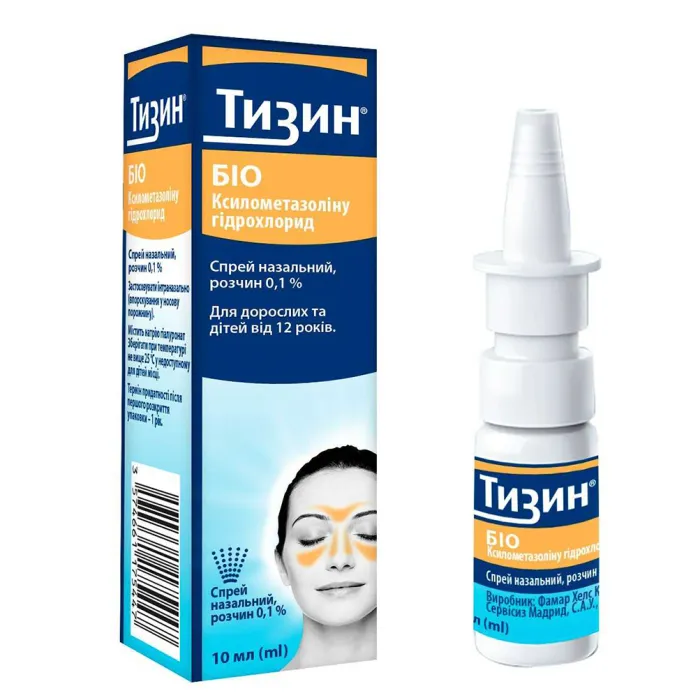
Table of Contents
INSTRUCTIONS FOR MEDICAL USE OF THE MEDICINAL PRODUCT TYZIN® BIO
Composition:
Active substance: xylometazoline hydrochloride;
1 ml of solution contains 1 mg of xylometazoline hydrochloride;
Excipients: sodium dihydrogen phosphate dihydrate; sodium hydrogen phosphate dihydrate; glycerol; sodium chloride; sorbitol (E 420); sodium hyaluronate; water for injections.
Pharmaceutical form. Nasal spray, solution.
Main physicochemical properties: a solution from clear to slightly opalescent, colorless to slightly yellowish.
Pharmacotherapeutic group. Medicinal products used in nasal cavity disorders. Decongestants and other agents for local use in nasal disorders. Simple sympathomimetics.
ATC code R01A A07.
Pharmacological properties.
Pharmacodynamics.
Xylometazoline hydrochloride, an imidazole derivative, is an alpha-adrenergic acting sympathomimetic agent. It exerts a vasoconstrictive effect and thus reduces swelling of the nasal mucosa.
The effect of the drug usually begins within several minutes (5–10 minutes) after administration, lasts up to 12 hours, and manifests as improved nasal breathing due to reduction of mucosal swelling and enhanced secretion drainage.
Pharmacokinetics.
After nasal administration, the absorbed amount may occasionally be sufficient to cause systemic effects, for example, on the central nervous or cardiovascular systems.
Pharmacokinetic data in humans are lacking.
Clinical characteristics.
Indications.
Symptomatic relief of nasal congestion in acute rhinitis associated with the common cold and influenza, sinusitis, allergic and non-allergic rhinitis.
Contraindications.
Tizin® Bio should not be used in the following cases:
- hypersensitivity to the active substance, xylometazoline hydrochloride, or to any of the excipients of the medicinal product;
- dry inflammation of the nasal mucosa with crust formation (dry rhinitis);
- concomitant treatment with monoamine oxidase inhibitors (MAOIs), treatment with MAOIs within two weeks prior to starting Tizin® Bio, or use of other medicinal products capable of increasing blood pressure;
- after hypophysectomy or surgical intervention on the dura mater;
- closed-angle glaucoma;
- acute coronary diseases;
- cardiac asthma;
- hyperthyroidism;
- atrophic or vasomotor rhinitis.
Interaction with other medicinal products and other forms of interaction.
Concomitant use of Tizin® Bio and monoamine oxidase inhibitors of the tranylcypromine type or tricyclic antidepressants, as well as other medicinal products that increase blood pressure, may lead to elevated arterial pressure (due to the effects of these active substances on the cardiovascular system).
When used together with β-blockers, it may cause bronchospasm or decreased arterial pressure.
Due to the low systemic absorption of xylometazoline following intranasal administration, interaction with medicinal products administered by other routes is considered unlikely.
Interaction studies have not been conducted.
Special precautions.
Tyzine® Bio should be used with caution and only after careful assessment of the benefit-risk ratio in patients:
- who have been treated with monoamine oxidase inhibitors (MAO inhibitors) and other medicinal products with potential hypertensive activity;
- with increased intraocular pressure, especially angle-closure glaucoma;
- with severe cardiovascular disorders (e.g., ischemic heart disease, hypertension);
- with pheochromocytoma;
- with metabolic disorders (e.g., hyperthyroidism, diabetes mellitus);
- with prostate hyperplasia.
Patients with prolonged QT syndrome who receive xylometazoline may have an increased risk of severe ventricular arrhythmias.
Prolonged use and overdose of sympathomimetic agents for reducing mucosal swelling may lead to a sensation of severe nasal congestion (reactive mucosal hyperemia of the nasal cavity).
After discontinuation of the drug, a rebound phenomenon may occur, characterized by narrowing or obstruction of the nasal passages, which may lead the patient to repeat or prolonged use of the medicinal product. This may result in chronic nasal mucosal edema (medication-induced rhinitis), which can lead to atrophy of the nasal mucosa.
In non-acute disease courses, administration of the sympathomimetic agent may be discontinued in one nostril while continuing treatment in the other nostril to maintain partial nasal breathing.
Tyzine® Bio contains sorbitol. If you have been diagnosed with intolerance to certain sugars, consult your doctor before taking this medicinal product.
Use during pregnancy or breastfeeding.
Pregnancy.
Due to the lack of studies on the effect of Tyzine® Bio on the fetus, the drug should not be prescribed during pregnancy.
Breastfeeding.
Tyzine® Bio should not be used during breastfeeding, as it is unknown whether the active substance and its metabolites pass into breast milk.
Ability to influence reaction rate while driving or operating machinery.
With prolonged use, possible adverse reactions affecting the central nervous system and cardiovascular system should be taken into account. In such cases, the ability to drive vehicles or operate machinery may be impaired.
Method of Administration and Dosage.
Dosing.
Administer intranasally (nasal spray into the nasal cavity).
Dosage depends on individual sensitivity and clinical response.
For adults: one spray into each nostril 2–3 times daily.
The medication should not be used for longer than 7 days, unless otherwise directed by a physician. Treatment may be repeated only after a break of several days.
In cases of chronic rhinitis, prolonged use of the medication is possible only under medical supervision due to the risk of developing atrophy of the nasal mucosa.
For children aged 12 years and older: one spray into each nostril up to 3 times daily. The duration of treatment for children should be determined by a physician.
Method of Administration.
Before use, open the protective cap. At first use, press the pump several times into the air until the liquid sprays evenly. For subsequent uses, the metered spray is ready for immediate use. Hold the bottle with the metered spray upright and press once to administer into each nostril. While spraying, inhale gently through the nose.
For hygienic purposes, wipe the nozzle after each use and replace the protective cap.
Children.
The medication may be used in children aged 12 years and older.
Overdose.
Symptoms
Symptoms of intoxication with imidazole derivatives may be clinically unclear, as periods of stimulation may alternate with periods of depression of the central nervous and cardiovascular systems.
Symptoms of central nervous system stimulation: fear, anxiety, hallucinations, and convulsions; symptoms due to central nervous system depression: decreased body temperature, lethargy, drowsiness, and coma.
Additional symptoms may include miosis, mydriasis, sweating, flushing, pallor, cyanosis, nausea, vomiting, tachycardia, bradycardia, cardiac arrhythmia, rapid heartbeat, cardiac arrest, arterial hypertension, shock-like hypotension, pulmonary edema, respiratory disturbances, and respiratory arrest.
Especially in children, overdose very often leads to significant effects on the central nervous system, manifested as seizures, coma, bradycardia, respiratory arrest, and arterial hypertension, which may later shift to hypotension.
Treatment
In cases of severe overdose, intensive therapy must be administered in a hospital. To rapidly reduce absorption of xylometazoline hydrochloride, activated charcoal (adsorbent), sodium sulfate (laxative), or gastric lavage (in cases of large doses) should be administered immediately. To lower blood pressure, non-selective alpha-blockers should be used.
Vasoconstrictors are contraindicated. If necessary, antipyretic and anticonvulsant medications should be administered, and oxygen therapy or artificial ventilation should be provided.
Side effects
Adverse reactions are classified by organ systems and frequency of occurrence. The frequency of adverse reactions was assessed according to the following criteria: very common (≥ 1/10), common (≥ 1/100 to < 1/10), uncommon (≥ 1/1,000 to < 1/100), rare (≥ 1/10,000 to < 1/1,000), very rare (< 1/10,000), frequency not known (cannot be estimated from available data).
Respiratory tract, thoracic organs and mediastinum: common – reactive hyperemia; uncommon – after effect subsides, increased nasal itching, mucosal swelling (nasal congestion), epistaxis, sneezing.
Nervous system: rare – headache, insomnia, fatigue; very rare – hallucinations, especially in children.
Eye disorders: very rare – transient visual disturbances.
Cardiovascular system: uncommon – systemic sympathomimetic effects (tachycardia, increased pulse, elevated blood pressure); very rare – arrhythmia.
Musculoskeletal and connective tissue disorders: very rare – seizures, especially in children.
Immune system disorders: uncommon – hypersensitivity reactions (angioneurotic edema, rash, pruritus).
Gastrointestinal disorders: common – nausea.
General disorders and administration site conditions: very rare – burning sensation or dryness of the nasal mucosa, rebound phenomenon.
Post-marketing surveillance
Occasionally, nausea, headache, and transient visual disturbances may occur.
Reporting suspected adverse reactions
Reporting of suspected adverse reactions after marketing authorization is important. It allows continued monitoring of the benefit-risk balance of the medicinal product. Healthcare professionals are asked to report any suspected adverse reactions via the national reporting system.
Shelf life. 2 years.
Shelf life after first opening of the packaging – 1 year.
Storage conditions. Store at temperatures not exceeding 25 °C, in a place inaccessible to children.
Packaging. 10 ml in a bottle with a spray dispenser containing a silver coil and a protective cap. 1 bottle per cardboard box.
Availability. Over-the-counter.
Manufacturer.
Famar Health Care Services Madrid, S.A.U.
Famar Health Care Services Madrid, S.A.U.
Manufacturer's address and place of business.
Avda. Leganes, 62, Alcorcon, Madrid, 28923, Spain.
Avda. Leganes, 62, Alcorcon, Madrid, 28923, Spain.
Marketing Authorization Holder.
McNeil Products Limited.
Address of the Marketing Authorization Holder.
50-100 Holmers Farm Way, High Wycombe, HP12 4EG, England.
Representative of the Marketing Authorization Holder. LLC "Johnson & Johnson Ukraine".
Address of the representative of the Marketing Authorization Holder.
32/2 Ostrizkykh Knyaziv St., Kyiv, 01010, Ukraine.
+38 (044) 498 0888
+38 (044) 498 7392