Citeal
Ukraine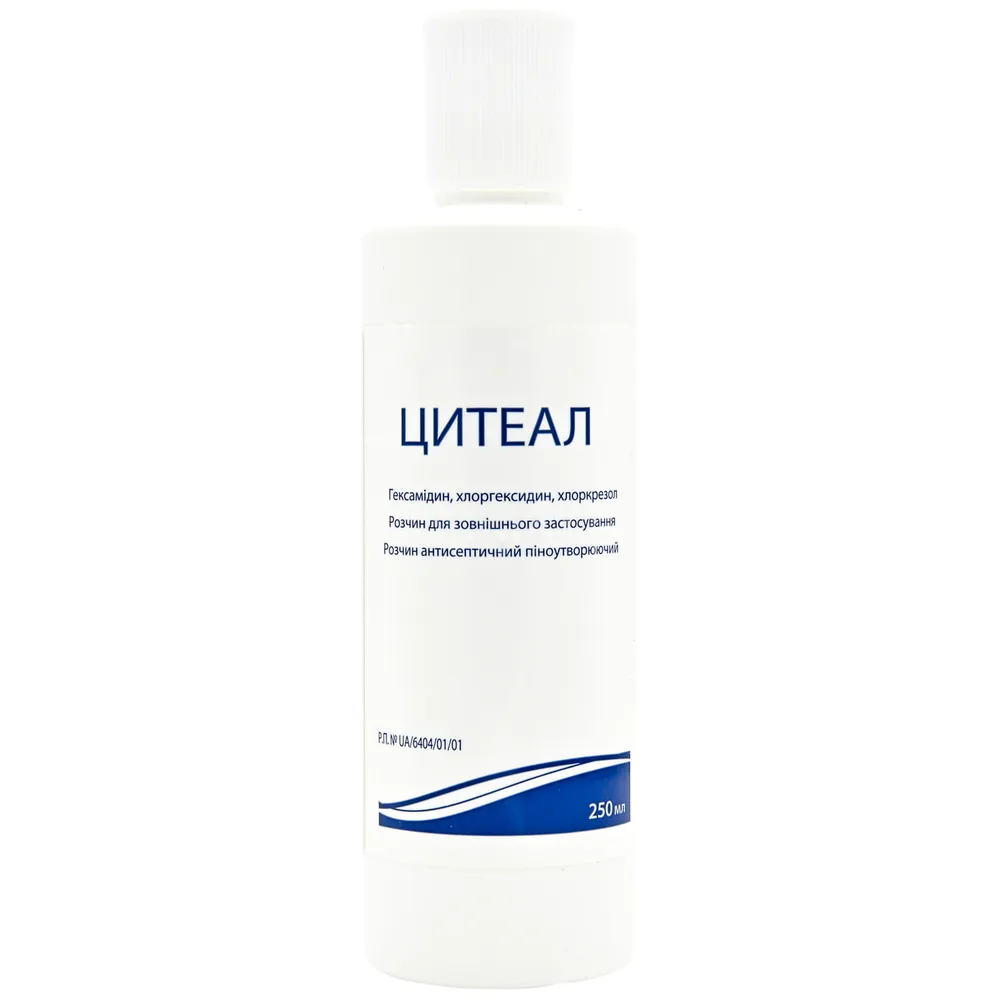
Table of Contents
INSTRUCTIONS FOR MEDICAL USE OF THE MEDICINAL PRODUCT CYTEAL (CYTEAL®)
Composition:
Active substances: hexamidine, chlorhexidine, chlorocresol;
100 ml of solution contain 0.1 g of hexamidine diisethionate, 0.1 g of chlorhexidine digluconate, 0.3 g of chlorocresol;
Excipients: cocamidopropyl betaine, diethanolamide of coconut fatty acids, ethylenediaminetetraacetic acid, coniferous fragrance, lactic acid, purified water.
Pharmaceutical form. Topical solution.
Main physicochemical properties: light yellow viscous liquid with a characteristic odor.
Pharmacotherapeutic group.
Antiseptics and disinfectants. ATC code D08AC52.
Pharmacological properties.
Pharmacodynamics.
An antiseptic solution for skin and mucous membranes containing:
- chlorhexidine (a cationic antiseptic belonging to the class of biguanides);
- hexamidine (a cationic antiseptic belonging to the class of diamidines);
- chlorocresol (a member of the halogenated phenols class).
The product is a mild antiseptic with bacteriostatic (but not bactericidal) and trichomonacidal activity, which is partially inhibited by organic substances. It forms complex compounds with cork, rubber and other polymers, macromolecules, anionic and non-ionic surfactants (soaps).
Pharmacokinetics.
Absorption
Pharmacokinetic studies of Cytéal have not been conducted.
Chlorhexidine: a cationic antiseptic that binds strongly to the skin and is very poorly absorbed through intact skin.
Hexamidine: percutaneous absorption through healthy skin occurs very slowly.
Chlorocresol: data on the effects of chlorocresol in humans are lacking. However, published literature indicates that the permeability of the human epidermis to many phenolic compounds may be related to their octanol/water partition coefficients.
Skin penetration of the active substances is low at therapeutic doses. The site of application, the size of the treated area, the condition of the skin (damaged or intact), and the duration of treatment should be taken into account (see section "Particular precautions for use").
Clinical characteristics.
Indications.
For antiseptic treatment of skin and mucous membranes in children under 18 years of age, including preterm infants, newborns, infants, adolescents, and adults, in cases of primary bacterial infections as well as lesions that may lead to the development of superinfections.
Note. Antiseptic agents are not sterilizing. They temporarily reduce the number of microorganisms.
Contraindications.
Hypersensitivity to the active substances or to any of the excipients of the medicinal product.
The medicinal product must not be used:
- for antiseptic treatment of the skin prior to punctures and injections;
- for any invasive procedure requiring surgical antisepsis (e.g., lumbar puncture, placement of central venous catheters, etc.);
- for disinfection of medical or surgical instruments.
Contact of the medicinal product with the eyes, meninges, and brain must be avoided. The medicinal product must not enter the ear, especially in cases of tympanic membrane perforation.
Interaction with other medicinal products and other forms of interaction.
Interaction studies have not been conducted.
Due to the potential for interactions (e.g., antagonism, inactivation, etc.), the product should not be used simultaneously or sequentially with other topical skin treatment agents. The medicinal product should not be used simultaneously with regular soap.
Special precautions for use
Due to the lack of data regarding transdermal absorption, systemic effects cannot be ruled out. The likelihood of such effects increases with repeated applications, especially when large areas are treated, mucous membranes are involved, under occlusive dressings, in the presence of skin damage (particularly burns), or when treating the skin of premature infants or newborns (due to the higher surface area to body weight ratio and the occlusive effect of diapers on the infant’s buttocks).
Cases of contact dermatitis (including allergic dermatitis) have been reported, associated with the presence of hexamidine and certain excipients in the medicinal product (see section "Adverse reactions"). Use of Cytéal must be discontinued if serious symptoms occur, and the patient should consult a physician before reapplying Cytéal.
The medicinal product may cause generalized allergic reactions due to the presence of chlorhexidine, which may occur within minutes after application.
As with all other surfactants, the treated area should be thoroughly rinsed with water after application. The medicinal product must not enter the eyes. Serious cases of persistent corneal damage, potentially requiring corneal transplantation, have been reported following accidental eye exposure to chlorhexidine-containing medicinal products. Extreme caution must be exercised during application to prevent contact with the eyes. If the product enters the eyes, they should be immediately and thoroughly rinsed with water. An ophthalmologist should be consulted.
After opening the bottle, there is a risk of microbial contamination of the product (for bottles larger than 250 ml).
As with the use of any other surfactant, the treated area should be thoroughly rinsed with water after application.
Use during pregnancy or breastfeeding
Pregnancy
There is insufficient data on the use of the combination of hexamidine diisethionate, chlorhexidine digluconate, and chlorocresol in pregnant women. Preclinical studies in animals have not revealed any direct or indirect harmful effects during pregnancy.
As a precautionary measure, it is advisable to avoid using the medicinal product during pregnancy.
Breastfeeding
No effect on the breastfed infant (newborn or infant) is expected, as excretion of the active substances of the product into breast milk is negligible.
The medicinal product can be used during breastfeeding.
As a precautionary measure, application of the product to the breasts is not recommended in breastfeeding women.
Fertility
Animal studies have not shown any effect of Cytéal on fertility under normal conditions of use.
Ability to affect reaction speed when driving or operating machinery
The product has no effect or has a negligible effect on the ability to drive or operate machinery.
Method of Administration and Dosage.
Method of Administration
The product is used as a liquid soap, either undiluted or diluted with water in a 1:10 ratio.
1–2 applications per day for 7–10 days.
After application, the treated areas must always be thoroughly rinsed with water.
The undiluted solution should be applied to small areas by rubbing in. Apply the undiluted solution and then thoroughly rinse the application site with water.
The diluted solution is used as a liquid soap for washing or wetting infected skin lesions during bathing or showering. After application, thoroughly rinse off with water.
The diluted solution must not be stored and should be used immediately.
The product is intended for external use only!
Parenteral or oral administration is prohibited! Do not swallow!
Children.
Can be used for antiseptic treatment of skin and mucous membranes in children under 18 years of age, including premature infants, newborns, infants, and adolescents.
Overdose.
No cases of overdose have been reported.
Do not perform gastric lavage in case of accidental ingestion of Citeal, as the product is foaming.
The physician should take general supportive measures.
Side effects
The side effects are presented according to the MedDRA classification: very common (≥ 1/10), common (≥ 1/100 to < 1/10), uncommon (≥ 1/1000 to < 1/100), rare (≥ 1/10000 to < 1/1000), very rare (< 1/10000), frequency not known.
Frequency not known:
- Immune system disorders: anaphylactic shock1, hypersensitivity1, contact dermatitis2;
- Skin and subcutaneous tissue disorders: local reactions4;
- Eye disorders: eye irritation3, corneal erosion, corneal epithelial defect/lesion, persistent significant visual disturbance.
1 There is a risk of generalized allergic reaction to chlorhexidine, which may lead to anaphylactic shock. Symptoms include difficulty breathing, facial swelling, and severe skin rash. If a patient experiences an allergic reaction to chlorhexidine, use of the medicinal product must be discontinued immediately and medical attention sought.
2 Contact dermatitis caused by hexetidine is associated with a specific Arthus-type reaction, suggesting the involvement of humoral immunological mechanisms.
Hexetidine may cause sensitization, the likelihood of which increases with the severity of epidermal damage. Clinical manifestations in such cases often differ from classic contact eczema: eruptions typically present with infiltrates, and papular or papulovesicular hemispherical lesions, isolated or grouped. These lesions are usually more numerous, coalesce at the site of antiseptic application, and may spread to isolated areas. Such lesions often resolve slowly.
Contact dermatitis may also be caused by excipients (cocamidopropyl betaine and diethanolamide of coconut fatty acids), as reported during the post-marketing period (see section "Special precautions for use").
Contact eczema (risk of local allergic reaction to chlorhexidine, particularly when applied to damaged skin, mucous membranes, and leg ulcers). Exacerbation of superinfected lesions is possible.
3 Eye irritation: occurs following accidental exposure.
4 Cases of severe corneal erosion and persistent significant visual deterioration have been reported following inadvertent ocular exposure, resulting in some patients requiring corneal transplantation.
5 Local reactions: sensation of intense pain, itching, burning, dryness, redness, especially with repeated use.
Reporting of suspected adverse reactions
Reporting suspected adverse reactions after authorization of the medicinal product is important. It allows continued monitoring of the benefit-risk balance of the medicinal product. Healthcare professionals and patients, or their legal representatives, are encouraged to report all suspected adverse reactions and lack of efficacy via the Automated Pharmacovigilance Information System at the following link: https://aisf.dec.gov.ua.
Shelf life
3 years.
Storage conditions
Store in a place protected from light and inaccessible to children, at a temperature not exceeding 25 °C.
Incompatibilities
The bottle must not be closed with a cork stopper.
Packaging
250 mL in a polyethylene bottle.
Prescription status
Over-the-counter (without prescription).
Manufacturer
Pierre Fabre Medicament Production /
Pierre Fabre Medicament Production.
Manufacturer's address and location of manufacturing site:
Progipharm production site, Rue du Lycee, 45500 Gien, France /
site Progipharm, Rue du Lycee, 45500 Gien, France.