Cystoral
Ukraine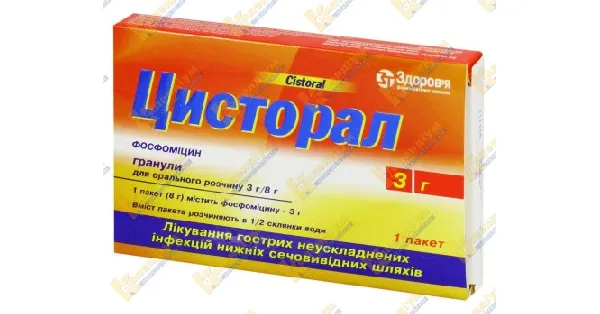
Table of Contents
INSTRUCTIONS FOR MEDICAL USE OF THE MEDICINAL PRODUCT CYSTORAL (CISTORAL)
Composition:
Active substance: fosfomycin;
1 sachet contains 3 g of fosfomycin;
Excipients: sucrose; sodium saccharin; orange flavor containing maltodextrin, acacia, ascorbic acid, alpha-tocopherol, sulfur dioxide (E 220).
Pharmaceutical form. Granules for oral solution.
Main physicochemical properties: granular powder of white or almost white color.
Pharmacotherapeutic group. Antimicrobial agents for systemic use. Other antimicrobial agents. ATC code J01X X01.
Pharmacological properties.
Cystoral contains the active substance fosfomycin in the form of fosfomycin trometamol salt. Fosfomycin is a bactericidal antibiotic (a derivative of phosphonic acid). It inhibits bacterial cell wall synthesis by blocking one of the initial steps in peptidoglycan synthesis.
Pharmacodynamics.
Cystoral contains fosfomycin [mono(2-amino-2-hydroxymethyl-1,3-propanediol) (2R-cis)-(3-methyloxiranyl)phosphonate] – an antibiotic derived from phosphonic acid, used for the treatment of urinary tract infections.
Fosfomycin affects the first stage of bacterial cell wall synthesis.
The structure of fosfomycin is analogous to that of phosphoenolpyruvate. Therefore, it inactivates the enzyme enolpyruvyl-transferase, thereby irreversibly blocking the condensation of uridine diphosphate-N-acetylglucosamine with phosphoenolpyruvate, one of the initial stages in bacterial cell wall synthesis. Fosfomycin may also reduce bacterial adhesion to the urothelial mucosa, which may be a triggering factor in the development of recurrent infections.
The table below presents in vitro activity data of fosfomycin trometamol against clinically isolated microorganisms. The minimal inhibitory concentration (MIC) was determined by the disk diffusion method using fosfomycin trometamol disks containing 200 μg. Microorganisms with a diameter of complete inhibition zone > 16 mm (on Mueller-Hinton medium) were classified as susceptible (corresponding to 200 μg/mL).
| MIK90 (μg/ml) |
Range |
|
| Susceptible microorganisms |
||
| E. coli |
8 |
0.25–128 |
| Klebsiella |
32 |
2–128 |
| Citrobacter spp. |
2 |
0.25–2 |
| Enterobacter ssp. |
16 |
0.5–64 |
| Proteus mirabilis |
128 |
0.12–256 |
| S. faecalis |
60 |
8–256 |
| Resistant microorganisms (diameter of the zone of complete inhibition > 16 mm) |
||
| Serratia spp. |
32 |
|
| Enterobacter cloacae |
256 |
|
| Pseudomonas aeruginosa |
256 |
|
| Morganella morganii |
>256 |
|
| Providencia rettgeri |
>256 |
|
| Providencia stuartii |
>256 |
|
| Pseudomonas ssp. |
>256 |
Resistance/Cross-resistance
Fosfomycin retains its effectiveness against the most common bacteria causing urinary tract infections.
Only a few bacterial species are capable of developing resistance. Resistance in E. coli, the primary pathogen responsible for uncomplicated urinary tract infections, is very low.
A large proportion of multidrug-resistant E. coli and other extended-spectrum beta-lactamase (ESBL)-producing Enterobacteriaceae remain susceptible to fosfomycin. Additionally, most strains of methicillin-resistant Staphylococcus aureus (MRSA) are susceptible to fosfomycin.
To date, no cases of cross-resistance with other antibacterial agents have been reported. Cross-resistance is unlikely because fosfomycin differs from all other antibiotics in its chemical structure and has a unique mechanism of action.
Clinical Efficacy
Fosfomycin has a broad spectrum of antibacterial activity, including against most gram-positive and gram-negative microorganisms responsible for urinary tract infections, as well as penicillinase-producing strains.
In vivo, susceptibility has been observed for Enterobacter spp., Klebsiella spp., Enterococci, Proteus mirabilis, Staphylococcus aureus, and Staphylococcus saprophyticus.
Moreover, fosfomycin reduces bacterial adhesion to the urothelial mucosa, which may be a contributing factor in the development of recurrent infections.
Pharmacokinetics.
Absorption
After oral administration, approximately 50% of fosfomycin trometamol is rapidly absorbed. Following a dose of 50 mg/kg body weight, Tmax is 2–2.5 hours and Cmax is 20–30 µg/mL.
Distribution
Plasma protein binding of fosfomycin is very low (less than 5%). The volume of distribution is 1.5–2.4 L/kg body weight.
Fosfomycin crosses the placental barrier and is excreted into breast milk.
Metabolism
Fosfomycin is not metabolized.
Elimination
The plasma half-life is approximately 4 hours. After a single 3 g dose of fosfomycin trometamol, urinary concentrations of 1800–3000 µg/mL are achieved within 2–4 hours. Therapeutically effective concentrations (200–300 µg/mL) may persist for up to 48 hours after administration. 40–50% of the administered dose is excreted unchanged in the urine within the first 48 hours.
Pharmacokinetics in Special Patient Populations
In patients with renal impairment, elimination of the drug is slowed in proportion to the degree of functional impairment, and the plasma half-life is prolonged (T1/2 up to 50 hours when creatinine clearance is 10 mL/min).
Clinical characteristics.
Indications.
Treatment of acute uncomplicated lower urinary tract infections caused by microorganisms sensitive to fosfomycin in males, girls aged 12 years and older, and adult women. Prophylaxis during diagnostic procedures and surgical interventions in adult patients.
Contraindications.
Hypersensitivity to the components of the drug, severe renal impairment (creatinine clearance < 10 ml/min), pediatric age under 12 years, undergoing hemodialysis.
Interaction with other medicinal products and other types of interactions.
Concomitant administration with metoclopramide and other drugs that enhance gastrointestinal motility reduces absorption of fosfomycin, resulting in decreased drug concentrations in serum and urine.
Administration of the drug during meals reduces plasma and urinary levels of fosfomycin. Therefore, it is recommended to take the medicinal product on an empty stomach or 2–3 hours after eating or taking other medications.
Specific issues regarding fluctuations in INR (International Normalized Ratio). Numerous cases of increased antagonistic activity of vitamin K antagonists have been reported in patients taking antibiotics. Risk factors include severe infections or inflammatory conditions, advanced age, and poor general health status. In such cases, it is difficult to determine whether changes in INR are related to the infectious disease or caused by drug administration. However, certain classes of antibiotics are more frequently associated with INR fluctuations: fluoroquinolones, macrolides, tetracyclines, co-trimoxazole, and some cephalosporins.
Interaction studies were conducted only in adults.
Special precautions for use.
There is insufficient evidence of efficacy of Cystoral in children, since the 3 g dose is not intended for use in children under 12 years of age; therefore, the medicinal product should not be used in this age group.
Administration of fosfomycin may lead to hypersensitivity reactions, including anaphylaxis and anaphylactic shock, which may be life-threatening (see section "Adverse reactions"). If such reactions occur, fosfomycin should be discontinued immediately, and re-administration of fosfomycin to these patients is contraindicated. Appropriate therapeutic measures should be initiated promptly.
Antibiotic use, including trometamol fosfomycin, may lead to antibiotic-associated diarrhea. The severity may range from mild diarrhea to fatal colitis. The development of severe, persistent and/or bloody diarrhea during or after (including several weeks after) completion of antibiotic therapy may indicate Clostridium difficile-associated diarrhea (CDAD). Therefore, this diagnosis should be considered in patients who develop severe diarrhea during or after treatment with trometamol fosfomycin. If CDAD is suspected or confirmed, appropriate therapy should be initiated immediately. In such cases, drugs that inhibit peristalsis are contraindicated.
Renal impairment: The concentration of fosfomycin in urine remains therapeutically effective for 48 hours if creatinine clearance is above 10 ml/min.
The product contains sucrose. If the patient has been diagnosed with intolerance to certain sugars, medical advice should be sought before taking this medicinal product.
The medicinal product may rarely cause hypersensitivity reactions and bronchospasm (reactions to the excipient sulfur dioxide).
Use during pregnancy or breastfeeding.
Pregnancy
Single-dose treatment of urinary tract infections in pregnant women is not considered appropriate.
Animal studies have not revealed any direct or indirect adverse effects with regard to pregnancy, embryonal development, fetal development, or postnatal development.
There are only limited data on the safety of fosfomycin use in pregnant women. Available data do not indicate the development of congenital malformations or fetal/neonatal toxicity associated with fosfomycin.
During pregnancy, the medicinal product may be used only if clearly necessary, when the expected benefit to the pregnant woman outweighs the potential risk to the fetus.
Breastfeeding
Fosfomycin is excreted in breast milk even after a single dose. The use of the medicinal product should be discontinued during breastfeeding.
Effects on ability to drive and use machines.
Cystoral may cause dizziness, which may affect the ability to drive vehicles or operate machinery.
Method of Administration and Dosage
Cystoral is taken orally on an empty stomach, preferably before bedtime, after emptying the urinary bladder. The contents of the sachet should be dissolved in one glass of water and the prepared solution should be consumed immediately.
Concurrent food intake delays the absorption of fosfomycin. Therefore, it is advisable to administer the drug on an empty stomach or 2–3 hours after a meal.
The medicinal product at this dosage (3 g) is indicated for patients with a body weight of 50 kg or more.
Treatment
Adults and adolescents with body weight ≥50 kg: one 3 g sachet of Cystoral once daily.
Prophylaxis
Adults with body weight ≥50 kg: one 3 g sachet of Cystoral 3 hours before and 24 hours after the procedure.
Children
Cystoral may be used for the treatment of acute uncomplicated lower urinary tract infections in girls aged 12 years and older.
There is insufficient data on the therapeutic use of the drug in boys aged 12 years and older, as well as insufficient data on prophylactic use in both boys and girls.
Overdose
Data on fosfomycin overdose following oral administration are limited.
Symptoms: vestibular disturbances, impaired hearing, metallic taste in the mouth, and general reduction in taste perception.
Cases of hypotension, severe drowsiness, electrolyte imbalances, thrombocytopenia, and hypoprothrombinemia have been reported following parenteral administration of fosfomycin.
Treatment: symptomatic and supportive therapy. Increased fluid intake is recommended to enhance diuresis.
Adverse reactions.
The most common adverse reactions associated with a single dose of fosfomycin trometamol are gastrointestinal disorders, primarily diarrhea. These events are usually transient and resolve spontaneously.
The table below lists the adverse reactions that have been observed during clinical trials or reported from post-marketing experience.
The frequency of adverse effects is defined as follows:
- very common (≥ 1/10);
- common (≥ 1/100 to <1/10);
- uncommon (≥ 1/1000 to <1/100);
- rare (≥ 1/10,000 to <1/1000);
- very rare (< 1/10,000);
- frequency not known (cannot be estimated from the available data).
Within each frequency category, adverse reactions are listed in order of decreasing severity.
| System organ classes |
Adverse reactions and frequency of occurrence |
|||
| Common |
Uncommon |
Rare |
Frequency not known |
|
| Infections and infestations |
Vulvovaginitis |
|||
| Immune system disorders |
Anaphylactic reactions, including anaphylactic shock, hypersensitivity |
|||
| Nervous system disorders |
Headache, dizziness |
Paresthesia |
||
| Cardiac disorders |
Tachycardia |
|||
| Respiratory, thoracic and mediastinal disorders |
Asthma |
|||
| Gastrointestinal disorders |
Diarrhea, nausea, dyspepsia |
Vomiting, abdominal pain |
Antibiotic-associated colitis |
|
| Skin and subcutaneous tissue disorders |
Rash, urticaria, pruritus |
Angioneurotic edema |
||
| General disorders |
Fatigue |
|||
| Vascular disorders |
Hypotension |
|||
Reporting of Adverse Reactions
It is important to report adverse reactions following the registration of medicinal products. This enables ongoing monitoring of the benefit-risk balance of the medicinal product. Healthcare professionals are required to report any suspected adverse reactions through the national reporting system.
Shelf life. 2 years.
Storage conditions.
Store in the original packaging at a temperature not exceeding 25 °C.
Keep out of the reach of children.
Packaging. 8 g of granulated powder (3 g of active ingredient) in an alu-complex sachet; one sachet per cardboard box.
Prescription category. Prescription only.
Manufacturer. LIMITED LIABILITY COMPANY "CORPORATION "ZDOROV'YA".
Manufacturer's address and location of business operations.
22, Shevchenka Street, Kharkiv, Kharkiv Oblast, 61013, Ukraine.