Ciprofloxofarm
Ukraine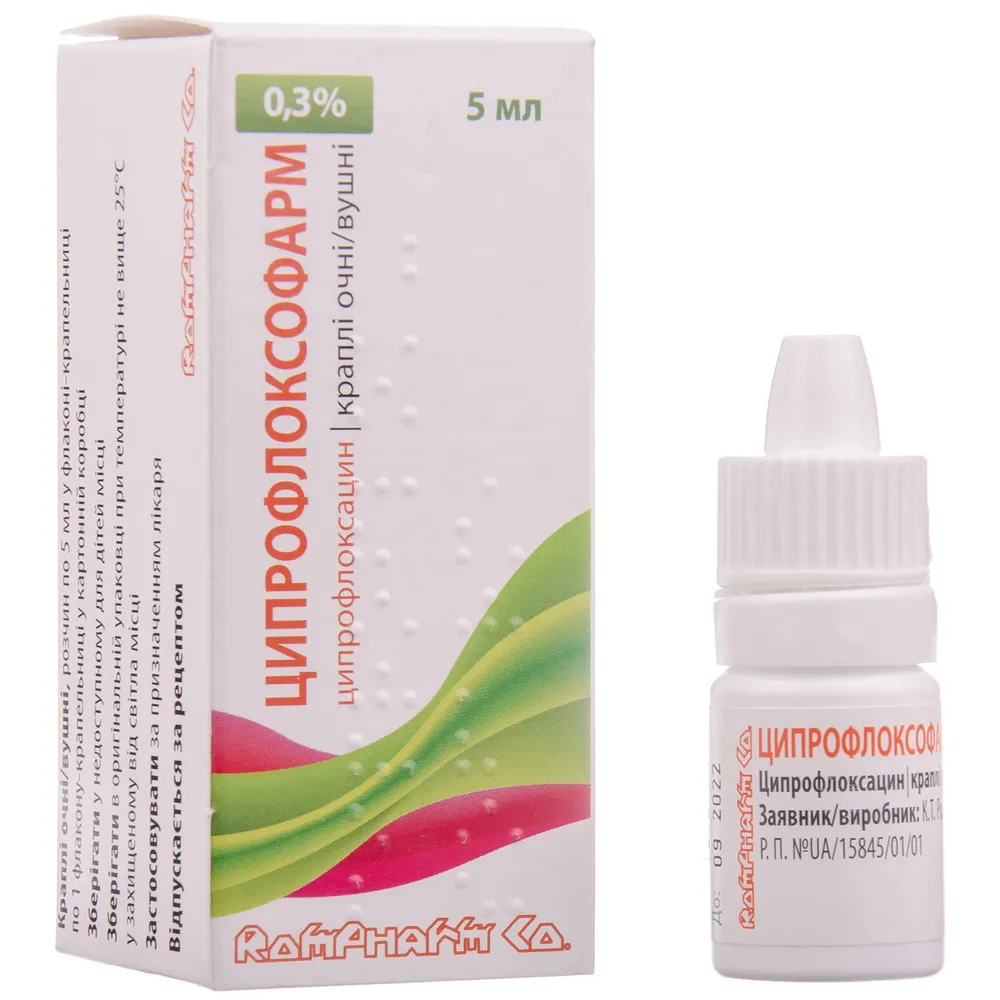
Table of Contents
INSTRUCTIONS FOR MEDICAL USE OF THE MEDICINAL PRODUCT CIPROFLOXOPHARM
Composition:
Active substance: ciprofloxacin;
1 ml of solution contains 3.5 mg of ciprofloxacin hydrochloride, equivalent to 3 mg of ciprofloxacin;
Excipients: sodium acetate trihydrate, mannitol, disodium edetate, benzalkonium chloride, glacial acetic acid 10%, purified water.
Pharmaceutical form. Eye/ear drops, solution.
Main physicochemical properties: the solution is practically clear and practically free from visible particles.
Pharmacotherapeutic group.
Agents for ophthalmological and otological use. Antimicrobial agents.
ATC Code S03AA07.
Pharmacological properties.
Pharmacodynamics.
Mechanism of action
Ciprofloxopharm contains ciprofloxacin hydrochloride, a member of the quinolone class. The bactericidal action of quinolones, which primarily affects bacterial DNA synthesis, is expressed through inhibition of DNA gyrase.
Ciprofloxacin demonstrates high in vitro activity against most Gram-negative microorganisms, including Pseudomonas aeruginosa. It is also effective against aerobic Gram-positive microorganisms, such as staphylococci and streptococci.
Susceptibility of microorganisms
Ophthalmic use
Both in vitro studies and clinical use in ocular infections have demonstrated that ciprofloxacin is active against most strains of the following organisms.
Aerobic Gram-positive microorganisms:
Staphylococcus aureus (including both methicillin-susceptible and methicillin-resistant strains);
Staphylococcus epidermidis;
Other Staphylococcus spp., including coagulase-negative species such as
S. haemolyticus and S. hominis;
Corynebacterium spp.;
Streptococcus pneumoniae;
Streptococcus group Viridans.
Aerobic Gram-negative microorganisms:
Acinetobacter spp.;
Haemophilus influenzae;
Pseudomonas aeruginosa;
Moraxella spp. (including M. catarrhalis).
Otological use
Ciprofloxacin demonstrates high in vitro activity against most aerobic Gram-negative microorganisms, including Pseudomonas aeruginosa. It is also effective against aerobic Gram-positive microorganisms such as staphylococci and streptococci.
Ciprofloxacin is also active against pathogenic microorganisms isolated from patients with acute otitis media with tympanostomy tubes.
Ophthalmic use
Ciprofloxacin has demonstrated in vitro activity against most strains of the following microorganisms; however, the clinical significance of these data in ophthalmic infections is unknown. The safety and efficacy of ciprofloxacin in treating corneal ulcers or conjunctivitis caused by these microorganisms have not been established in adequate and well-controlled clinical trials.
The following bacteria are considered susceptible based on evaluation using systemic breakpoints for microbial growth inhibition zone diameters. However, the correlation between systemic in vitro microbial growth inhibition zone diameter values and ophthalmic efficacy has not been established. In vitro, ciprofloxacin demonstrates minimum inhibitory concentrations (MIC) of 1 µg/mL or less (systemic breakpoints for microbial growth inhibition zone diameters) against most (90%) strains of the following ocular pathogenic microorganisms.
Aerobic Gram-positive microorganisms:
Bacillus spp.
Aerobic Gram-negative microorganisms:
Acinetobacter calcoaceticus;
Enterobacter aerogenes;
Escherichia coli;
Haemophilus parainfluenzae;
Klebsiella pneumoniae;
Neisseria gonorrhoeae;
Proteus mirabilis;
Proteus vulgaris;
Serratia marcescens.
Others:
Peptococcus spp., Peptostreptococcus spp., Propionibacterium acnes, and Clostridium perfringens are susceptible microorganisms.
Resistant:
Some strains of Burkholderia cepacia and Stenotrophomonas maltophilia are resistant to ciprofloxacin, as are some anaerobic bacteria, particularly Bacteroides fragilis.
Additional information:
The minimum bactericidal concentration (MBC) usually does not exceed the minimum inhibitory concentration (MIC) by more than a factor of 2.
Otological use
Ciprofloxacin has demonstrated in vitro activity against most strains of the following microorganisms; however, the clinical significance of these data in ear infections is unknown. The safety and efficacy of ciprofloxacin in treating acute external otitis caused by these microorganisms have not been established in adequate and well-controlled clinical trials.
The following bacteria are considered susceptible based on evaluation using systemic breakpoints for microbial growth inhibition zone diameters. However, the correlation between systemic in vitro microbial growth inhibition zone diameter values and efficacy in otic use has not been established. In vitro, ciprofloxacin demonstrates a minimum inhibitory concentration (MIC) of 1 µg/mL or less (systemic breakpoints for microbial growth inhibition zone diameters) against most (90%) strains of the following pathogenic microorganisms.
Aerobic Gram-positive microorganisms:
Bacillus spp.;
Corynebacterium spp.;
Enterococcus faecalis;
Staphylococcus aureus;
Staphylococcus epidermidis;
Staphylococcus caprae;
Staphylococcus capitis;
Staphylococcus haemolyticus;
Streptococcus pneumoniae;
Streptococcus group Viridans.
Aerobic Gram-negative microorganisms:
Achromobacter xylosoxidans subsp. xylosoxidans;
Acinetobacter baumannii;
Acinetobacter junii;
Acinetobacter lwoffii;
Acinetobacter radioresistens;
Acinetobacter genomic species 3;
Citrobacter freundii;
Citrobacter koseri;
Enterobacter aerogenes;
Enterobacter cloacae;
Escherichia coli;
Haemophilus influenzae;
Klebsiella oxytoca;
Klebsiella pneumoniae;
Moraxella catarrhalis;
Proteus mirabilis;
Pseudomonas stutzeri;
Serratia marcescens.
Ciprofloxacin has also demonstrated in vitro activity against most strains of the following microorganisms causing otitis media.
Aerobic Gram-positive microorganisms:
Staphylococcus aureus;
Staphylococcus epidermidis;
Streptococcus pneumoniae.
Aerobic Gram-negative microorganisms:
Escherichia coli;
Haemophilus influenzae;
Moraxella catarrhalis;
Pseudomonas aeruginosa.
Resistance to ciprofloxacin generally develops slowly. However, cross-resistance is observed within this group of gyrase inhibitors.
Susceptibility testing has shown that most microorganisms resistant to ciprofloxacin are also resistant to other fluoroquinolones. During clinical trials, the frequency of isolates with acquired resistance to ciprofloxacin was low.
Due to its unique mechanism of action, there is no cross-resistance between ciprofloxacin and other antibacterial agents with different chemical structures, such as beta-lactam antibiotics, aminoglycosides, tetracyclines, macrolides and peptides, as well as sulfonamides, trimethoprim derivatives, and nitrofurans. Thus, microorganisms resistant to these drugs may remain susceptible to ciprofloxacin.
Preclinical safety data
Ciprofloxacin and other quinolones have been shown to cause arthropathy in young animals of most species studied after oral administration. When ciprofloxacin was administered at a dose of 30 mg/kg, joint effects were minimal. This dose is 27 times higher than the recommended clinical otic dose for a child weighing 10 kg, receiving 0.27 mg of ciprofloxacin in each ear twice daily. No joint lesions were observed in animals after topical administration of Ciprofloxopharm eye drops. Furthermore, there was no evidence that topical application affects joints in any way. Additionally, in 634 children who received oral ciprofloxacin, no skeletal toxicity was detected on clinical and radiological examination.
Reproductive studies in animals using doses 50 times higher than the maximum ophthalmic daily human dose and 900 times higher than the recommended otic dose (in a child weighing 10 kg or an adult weighing 50 kg receiving 0.27 mg or 0.36 mg of ciprofloxacin per ear twice daily, respectively) showed no evidence of impaired fertility or fetal harm due to ciprofloxacin.
Oral administration of ciprofloxacin at doses of 30 and 100 mg/kg did not result in teratogenic effects in animals, although significant maternal toxicity was observed at both doses. After intravenous administration of doses up to 20 mg/kg, no maternal toxicity, embryotoxicity, or teratogenic effects were observed.
Pharmacokinetics.
After topical ocular administration in humans, ciprofloxacin is well absorbed. Concentrations detected in the tear film, cornea, and anterior chamber of the eye are ten to several hundred times higher than the MIC90 for susceptible ocular pathogenic microorganisms.
Systemic absorption of ciprofloxacin after topical ocular administration is low. Plasma concentrations of ciprofloxacin after 7 days of topical use ranged from undetectable (< 1.25 ng/mL) to 4.7 ng/mL. The maximum plasma concentration of ciprofloxacin after topical ocular administration was approximately 450 times lower than the concentration observed after oral administration of a single 250 mg dose of ciprofloxacin.
In children with otorrhea due to tympanostomy tubes or tympanic membrane perforation, plasma concentrations of ciprofloxacin after topical otic administration were below the quantification limit of 5 ng/mL. In animals, ciprofloxacin distributed into plasma and middle ear fluid after intramuscular injection and was absorbed into the inner ear after topical application to the middle ear.
The systemic pharmacokinetic properties of ciprofloxacin are well characterized.
Ciprofloxacin distributes well into body tissues; tissue concentrations are generally higher than plasma concentrations. The steady-state volume of distribution is 1.7–2.71 L/kg. Protein binding to serum proteins ranges from 16% to 43%. The serum half-life of ciprofloxacin is 3–5 hours. After a single oral dose of 250–750 mg in adult patients with normal renal function, 15–50% of the dose is excreted in urine as unchanged drug and 10–15% as metabolites within 24 hours. Both ciprofloxacin and its four primary metabolites are excreted in urine and feces. Renal clearance of ciprofloxacin is typically 300–479 mL/min. Approximately 20–40% of the dose is eliminated in feces as unchanged drug and metabolites over 5 days.
Clinical characteristics.
Indications.
Corneal ulcers and superficial ocular infections (eye[s]) and its adnexa caused by bacterial strains sensitive to ciprofloxacin.
Acute external otitis, as well as acute suppurative otitis media with drainage through a tympanostomy tube, caused by bacterial strains sensitive to ciprofloxacin.
Contraindications.
Hypersensitivity to ciprofloxacin or to other quinolones, or to any of the components of the medicinal product.
Interactions with other medicinal products and other forms of interaction.
Since ciprofloxacin has low systemic concentration when administered topically in ophthalmic or otic applications, interaction with other medicinal products is unlikely. If several topical ophthalmic medicinal products are prescribed simultaneously, the interval between their administration should be at least 5 minutes. Ophthalmic ointments should be administered last.
Special precautions for use.
The medicinal product is intended for topical use (in the conjunctival sac or in the external auditory canal).
General
- Severe, including fatal, (anaphylactic) hypersensitivity reactions have been observed in patients receiving quinolone therapy, sometimes after administration of the first dose. These reactions have sometimes been accompanied by cardiovascular collapse, loss of consciousness, tinnitus, throat or facial swelling, dyspnea, urticaria, and pruritus. Only some of the patients who experienced hypersensitivity reactions had a history of such reactions.
- Severe cases of acute hypersensitivity to ciprofloxacin may require emergency treatment. Oxygen therapy and measures to restore airway patency should be initiated as clinically indicated.
- Administration of ciprofloxacin should be discontinued at the first signs of skin rash or any other signs of hypersensitivity.
- As with all antibacterial agents, prolonged use may lead to overgrowth of antibiotic-resistant bacterial strains or fungi. If superinfection develops, appropriate therapy should be instituted.
- Tendon inflammation and rupture may occur during systemic therapy with fluoroquinolones, including ciprofloxacin, particularly in elderly patients and in patients receiving concomitant corticosteroid therapy. Therefore, treatment with Ciprofloksofarm eye/ear drops should be discontinued at the first signs of tendon inflammation.
Eye drops
- Clinical experience with use in children under 1 year of age, especially neonates, is limited.
- Use of Ciprofloksofarm eye drops in neonates with gonococcal or chlamydial neonatal ophthalmia is not recommended, as such use has not been evaluated in this patient population. Neonates with neonatal ophthalmia should receive treatment appropriate to their condition.
- When using Ciprofloksofarm eye drops, the risk of the drug entering the nasopharynx should be considered, as this may contribute to the development and spread of bacterial resistance.
- Ciprofloksofarm eye drops contain benzalkonium chloride, which may cause irritation and may discolor soft contact lenses.
- Wearing contact lenses during treatment of ocular infection is not recommended.
Therefore, patients should be advised not to wear contact lenses during treatment with Ciprofloksofarm eye drops. If patients are permitted to wear contact lenses, they should remove them before instilling the eye drops and wait at least 15 minutes before reinserting them.
Ear drops
The efficacy and safety of use in children under 1 year of age have not been evaluated.
Medical monitoring is required during ear instillation to allow timely implementation of other therapeutic interventions.
Benzalkonium chloride may cause irritation and skin reactions when applied topically.
Use during pregnancy or breastfeeding.
Reproductive function
No studies on the effect on reproductive function have been conducted with topical use of the medicinal product Ciprofloksofarm.
Pregnancy
There are no adequate data on the use of the medicinal product Ciprofloksofarm in pregnant women. Animal studies do not indicate a direct harmful effect via reproductive toxicity.
It is advisable to avoid using Ciprofloksofarm during pregnancy.
Breastfeeding
Ciprofloxacin has been detected in breast milk following oral administration. It is unknown whether ciprofloxacin is excreted in breast milk after topical administration to the eye or ear. Ciprofloksofarm should be used with caution in women who are breastfeeding.
Ability to affect the ability to drive and use machines.
This medicinal product has no or negligible effect on the ability to drive or use machinery. Transient blurred vision or other visual disturbances may affect the ability to drive or operate machinery. If blurred vision occurs after instillation, patients should wait until vision clears before driving or operating machinery.
There are no data on the effect on the ability to drive or use machinery with use of Ciprofloksofarm ear drops.
Method of Administration and Dosage
Ophthalmological Use
Dosage for adolescents and adults, including elderly patients
Corneal ulcers:
Ciprofloxopharm should be administered at the following intervals, including during nighttime:
- On Day 1: instill 2 drops into the conjunctival sac of the affected eye(s) every 15 minutes for the first 6 hours, then 2 drops every 30 minutes for the remainder of the first day;
- On Day 2: instill 2 drops into the conjunctival sac of the affected eye(s) every hour;
- From Day 3 to Day 14: instill 2 drops into the conjunctival sac of the affected eye(s) every 4 hours.
For corneal ulcers, treatment may last longer than 14 days; the dosage regimen and duration of therapy should be determined by the physician.
Bacterial superficial eye infections and associated structures
The standard dose is 1–2 drops instilled into the conjunctival sac of the affected eye(s) four times daily.
In severe infections, the dose may be increased to 1–2 drops every 2 hours during daytime for the first two days.
Treatment typically lasts 7–14 days.
After instillation, it is recommended to close the eyelids tightly or perform nasolacrimal occlusion. This reduces systemic absorption of ophthalmic medications and lowers the risk of systemic adverse effects.
When using other topical ophthalmic agents concomitantly, an interval of 10–15 minutes between administrations should be maintained.
Dosage for children aged 1 year and older is the same as for adults.
A clinical study in neonates and infants up to one month of age demonstrated that Ciprofloxopharm is clinically and microbiologically effective in treating bacterial conjunctivitis in this patient group when administered three times daily for 4 days.
Patients with hepatic or renal impairment
The use of Ciprofloxopharm has not been studied in this patient population.
Administration precautions
To prevent contamination of the dropper tip and solution, care must be taken not to touch the eyelids, surrounding areas, or any other surfaces with the tip of the dropper bottle.
Otological Use
Dosage for adults, including elderly patients
For adults, the dose is 4 drops of Ciprofloxopharm instilled into the ear canal twice daily.
For patients requiring ear wicks, the dose may be doubled only at the first application (i.e., 6 drops for children and 8 drops for adults).
The total duration of treatment should generally not exceed 5–10 days. In some cases, treatment may be extended; however, sensitivity testing of the local flora is recommended in such instances.
When using other topical medicinal products concomitantly, an interval of 10–15 minutes between administrations should be maintained.
Dosage for children
The dose is 3 drops of Ciprofloxopharm instilled into the ear canal twice daily. The safety and efficacy of ciprofloxacin have been studied in children aged 1 to 12 years. Safety and efficacy in children under 1 year of age have not been established.
Patients with hepatic or renal impairment
The use of Ciprofloxopharm has not been studied in this patient population.
Administration precautions
The external auditory canal should be carefully cleaned. To avoid vestibular stimulation, the solution should be administered at room or body temperature.
The patient should lie on the side opposite to the affected ear. Remaining in this position for 5–10 minutes is recommended. After local cleaning, a moistened gauze or absorbent cotton pledget may be inserted into the ear canal for 1–2 days and should be moistened twice daily to ensure adequate drug saturation.
To prevent contamination of the dropper tip and solution, care must be taken not to touch the auricle, external auditory canal, adjacent areas, or any other surfaces with the tip of the dropper bottle.
Children
Ophthalmic drops
The safety and efficacy of 3 mg/mL ciprofloxacin ophthalmic drops have been evaluated in children aged 0 to 12 years. No serious adverse reactions related to the use of the drug have been reported in this patient population.
Otic drops
For use in children aged 1 year and older.
The safety and efficacy of 3 mg/mL ciprofloxacin otic drops have been evaluated in children aged 1 to 12 years. No serious adverse reactions related to the use of the drug have been reported in this patient population.
Safety and efficacy of the drug in children under 1 year of age have not been established.
Overdose
Due to the characteristics of this medicinal product intended for topical use, no toxic effects are expected following ophthalmological or otological administration at recommended doses, or even after accidental ingestion of the contents of one bottle.
Adverse reactions.
The adverse reactions listed below are classified as follows: very common (≥ 1/10), common (≥ 1/100 to < 1/10), uncommon (≥ 1/1000 to < 1/100), rare (≥ 1/10,000 to < 1/1000), very rare (< 1/10,000), or frequency not known (cannot be estimated from the available data). Within each group, adverse effects are presented in order of decreasing severity.
Table 1
Adverse effects observed after ophthalmic administration of ciprofloxacin
| Body systems |
Adverse reactions according to MedDRA classification |
| Infections and infestations |
Occasional: hordeolum, rhinitis |
| Immune system disorders |
Occasional: hypersensitivity |
| Nervous system disorders |
Common: dysgeusia Uncommon: headache Occasional: dizziness |
| Eye disorders |
Common: corneal deposits, eye discomfort, ocular hyperemia Uncommon: keratopathy, corneal infiltrates, corneal pigmentation, photophobia, decreased visual acuity, eyelid edema, blurred vision, eye pain, dry eye, eye swelling, eye pruritus, foreign body sensation in eye, increased lacrimation, eye discharge, scaling of eyelid margins, eyelid scaling, conjunctival edema, eyelid erythema Occasional: ocular toxicity, punctate keratitis, keratitis, conjunctivitis, corneal function disorder, corneal epithelial defect, diplopia, ocular hypoesthesia, asthenopia, eye irritation, eye inflammation, conjunctival hyperemia |
| Ear and labyrinth disorders |
Occasional: ear pain |
| Respiratory system disorders |
Occasional: nasopharyngeal secretion increased |
| Gastrointestinal disorders |
Uncommon: nausea Occasional: diarrhea, abdominal pain |
| Skin and subcutaneous tissue disorders |
Occasional: dermatitis |
| General disorders and administration site conditions |
Occasional: drug intolerance |
| Investigations |
Occasional: abnormal laboratory test results |
Table 2
Adverse reactions reported with otic use of ciprofloxacin
| System organ classes |
Adverse reactions according to MedDRA classification |
| Nervous system disorders |
Uncommon: irritability, headache |
| Ear and labyrinth disorders |
Uncommon: ear pain, ear fullness, otorrhea, ear pruritus Unknown: tinnitus |
| Skin and subcutaneous tissue disorders |
Uncommon: dermatitis |
| General disorders and administration site conditions |
Uncommon: hyperthermia |
Description of individual adverse reactions
Very rarely, topical application of fluoroquinolones has been associated with reactions such as (generalized) rash, toxic epidermal necrolysis, exfoliative dermatitis, Stevens-Johnson syndrome, and urticaria.
In isolated cases, administration of ciprofloxacin into the eye has been associated with incidents of blurred vision, decreased visual acuity, and signs of drug residue (white precipitate).
Rarely, components of the medicinal product may cause hypersensitivity reactions when administered into the ear. However, as with the application of any substance to the skin, there is always a possibility of an allergic reaction to any component of the medicinal product (for Ciprofloxofarm ear drops only).
Serious, and in some cases fatal (anaphylactic) hypersensitivity reactions have been reported in patients receiving systemic quinolone therapy, sometimes after the first dose. Some of these reactions were accompanied by cardiovascular collapse, loss of consciousness, paresthesia, throat or facial swelling, dyspnea, urticaria, and pruritus.
Tendon ruptures of the shoulder, hand, Achilles tendon, or other tendons have been observed in patients receiving systemic fluoroquinolones, requiring surgical repair or resulting in prolonged disability. Studies and post-marketing experience with systemic fluoroquinolones indicate that the risk of such tendon ruptures increases in patients receiving corticosteroids, particularly in elderly patients, and with high levels of tendon stress, including the Achilles tendon. To date, clinical and post-marketing data have not demonstrated a clear association between ciprofloxacin use and adverse reactions affecting the musculoskeletal system and connective tissue.
In patients with corneal ulceration, repeated administration of Ciprofloxofarm has been associated with the appearance of a white precipitate in the eye (drug residue), which disappeared upon continued use. The presence of precipitate does not necessitate discontinuation of Ciprofloxofarm, nor does it negatively affect the clinical course of recovery.
Shelf life. 3 years.
Storage period after first opening of the bottle — 4 weeks.
Storage conditions.
Store in the original packaging at a temperature not exceeding 25 °C, in a place protected from light. Keep out of reach of children.
Packaging. 5 ml in a polyethylene dropper bottle. One dropper bottle per cardboard box.
Prescription status. Prescription only.
Manufacturer.
K.T. Rompharm Company S.R.L. / S.C. Rompharm Company S.R.L.
Manufacturer's address and location of business operations.
Str. Eroilor No. 1A, Otopeni, 075100, Ilfov County, Romania – Rompharm 1 and Rompharm 2 buildings / Eroilor str. No 1A, Otopeni city, 075100, county Ilfov, Romania – building Rompharm 1 and Rompharm 2.
Marketing Authorization Holder.
FORC-FARMA DISTRIBUTION LLC, Ukraine, 03127, Kyiv, Hолосіївський проспект, 132.