Cinatropil®-zdorovya
Ukraine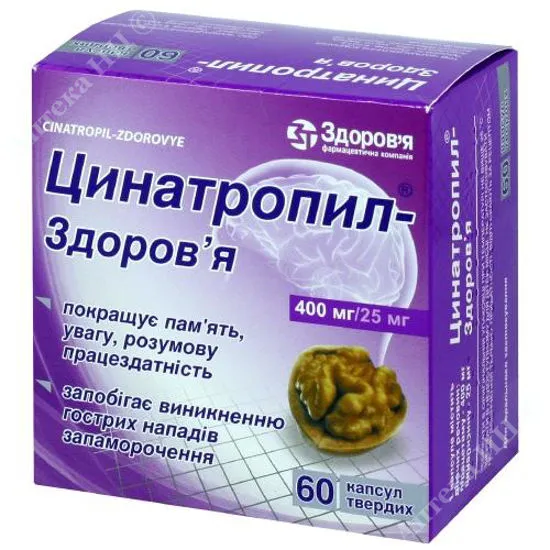
Table of Contents
INSTRUCTIONS FOR MEDICAL USE OF THE MEDICINAL PRODUCT CINATROPIL-ZDOROVYE
Composition:
Active substances: piracetam, cinnarizine;
1 capsule contains 400 mg of piracetam and 25 mg of cinnarizine;
Excipients: calcium hydrogen phosphate, colloidal anhydrous silicon dioxide, magnesium stearate; the capsule shell contains titanium dioxide (E 171), gelatin.
Medicinal form. Hard capsules.
Main physicochemical properties: white hard gelatin capsules. The capsule contents are a mixture of granules and powder of white or white with a yellowish tinge color. The presence of powder particle agglomerates is acceptable. The manufacturer's trademark (ZT) may be printed on the capsule.
Pharmacotherapeutic group. Psychostimulants and nootropic agents.
ATC code: N06BX.
Pharmacological Properties.
Pharmacodynamics.
Cynatrofil®-Zdorovye is a combined medication. The active components of the drug are piracetam, a cyclic derivative of γ-aminobutyric acid, and cinnarizine – a selective calcium channel blocker.
Piracetam is a nootropic agent acting on the brain, improving cognitive functions such as learning ability, memory, attention, and mental performance. The mechanisms of the drug's action on the central nervous system are likely multiple: altering the rate of excitation propagation in the brain; enhancing metabolic processes in nerve cells; improving microcirculation by affecting blood rheological properties, without causing vasodilatory effects. It improves interhemispheric connections in the brain and synaptic conduction in neocortical structures. After prolonged use in patients with impaired brain functions, improvements in cognitive functions and attention are observed.
Cinnarizine inhibits contractions of smooth vascular muscle cells by blocking calcium channels. In addition to direct calcium antagonism, cinnarizine reduces the contractile effects of vasoactive substances such as norepinephrine and serotonin by blocking the receptors controlling their calcium channels. The blockade of calcium influx into cells depends on the tissue type, resulting in antivasoconstrictive effects without affecting blood pressure or heart rate. Cinnarizine may further improve impaired microcirculation by increasing erythrocyte membrane elasticity and reducing blood viscosity. Cellular resistance to hypoxia is increased. Cinnarizine suppresses stimulation of the vestibular system, thereby reducing nystagmus and other autonomic disturbances. It prevents the occurrence of acute vertigo attacks.
Pharmacokinetics.
The drug is rapidly and completely absorbed in the gastrointestinal tract. Cinnarizine reaches peak plasma concentrations within one hour after oral administration. It is completely metabolized. It is 91% bound to blood proteins. 60% is excreted unchanged in feces, and the remainder is excreted in urine as metabolites.
Maximum plasma concentration of piracetam is reached within 2–6 hours. Piracetam freely penetrates the blood-brain barrier and is excreted unchanged in urine.
Clinical characteristics.
Indications.
- Chronic and latent cerebral circulation insufficiency in atherosclerosis and arterial hypertension; angiodystonic ischemic stroke and post-stroke state.
- Post-traumatic cerebрастhenia.
- Encephalopathy of various etiologies.
- Psycho-organic syndrome with predominant memory and other cognitive function disorders, or emotional-volitional sphere disturbances.
- Labyrinthopathies – vertigo, tinnitus, nausea, vomiting, nystagmus.
- Ménière's syndrome.
- Prevention of kinetoses.
Contraindications.
Hypersensitivity to piracetam, cinnarizine, or any excipient of the medicinal product; individual sensitivity to pyrrolidone derivatives.
Severe renal insufficiency, acute disturbance of cerebral circulation (hemorrhagic stroke), Huntington's chorea, parkinsonism, increased intraocular pressure, psychomotor agitation.
Pregnancy or breastfeeding period.
Interaction with other medicinal products and other types of interactions.
Concomitant use of alcohol and drugs that depress the central nervous system (CNS), as well as tricyclic antidepressants, may enhance their sedative effect.
The drug potentiates the action of nootropic, antihypertensive, and vasodilating agents. Concurrent use with vasodilators enhances its effect, while the presence of cinnarizine reduces the activity of hypertensive agents.
Цинатропил®-Здоров’я enhances the activity of thyroid hormones and may cause tremor and restlessness.
Diagnostic intervention: due to its antihistaminic effect, cinnarizine contained in the drug may mask positive skin reactivity responses during skin testing; therefore, its use should be discontinued 4 days prior to the test.
Antiepileptic medicinal products: no interaction has been observed with carbamazepine, phenytoin, phenobarbital, or sodium valproate (information based on available data from piracetam use at a dose of 20 mg/day daily for 4 weeks).
May enhance the effect of oral anticoagulants.
Acenocoumarol.
In patients with severe recurrent thrombosis, administration of high-dose piracetam (9.6 g/day) did not affect the dosing of acenocoumarol required to achieve a prothrombin time ratio (INR — International Normalized Ratio) of 2.5–3.5. However, when used concomitantly, a significant reduction was observed in platelet aggregation, fibrinogen levels, von Willebrand factor levels [coagulation activity (VIII:C); ristocetin cofactor activity (VIII:vW:Rco); and plasma protein levels (VIII:vW:Ag)], as well as blood and plasma viscosity.
Pharmacokinetic interactions.
The likelihood of changes in piracetam's pharmacodynamics due to other medicinal products is low, as 90% of piracetam is excreted unchanged in urine.
In vitro, piracetam does not inhibit cytochrome P450 isoenzymes CYP1A2, 2B6, 2C8, 2C9, 2C19, 2D6, 2E1, and 4A9/11 at concentrations of 142, 426, and 1422 mcg/mL.
At a concentration of 1422 mcg/mL, slight inhibition of CYP2A6 (21%) and 3A4/5 (11%) was observed. However, the Ki values for these two CYP isoenzymes are sufficiently high above 1422 mcg/mL. Therefore, metabolic interactions with drugs undergoing biotransformation by these enzymes are unlikely.
Special precautions for use.
Renal impairment.
The drug should be prescribed with caution to patients with kidney disease. In cases of mild or moderate renal insufficiency, it is recommended to reduce the therapeutic dose or increase the dosing interval, especially when creatinine clearance is < 60 mL/min.
Hepatic impairment.
The drug should be administered with caution to patients with hepatic insufficiency. Liver enzyme levels should be monitored in patients with impaired liver function.
Elderly patients.
During long-term therapy in elderly patients, regular monitoring of renal function parameters is recommended; dose adjustment should be performed as necessary based on creatinine clearance test results.
The drug passes through the filtering membranes of hemodialysis equipment.
The use of the drug should be avoided in porphyria.
Effect on laboratory tests.
The drug may cause false-positive results in doping control tests in athletes, as well as in tests for radioactive iodine, due to the presence of iodine-containing dyes in the capsule coating.
Effect on platelet aggregation.
Since piracetam reduces platelet aggregation, the drug should be prescribed with caution to patients with coagulation disorders, conditions that may be associated with bleeding (e.g., gastrointestinal ulcers), during major surgical procedures (including dental interventions), in patients with signs of severe hemorrhage or a history of hemorrhagic stroke, and in patients receiving anticoagulants or antiplatelet agents, including low-dose acetylsalicylic acid.
Like other antihistamine drugs, Цинатропил®-Здоров’я may cause irritation in the epigastric region; taking the drug after meals may reduce gastric irritation.
The drug should be used with particular caution in patients with Parkinson's disease.
Concomitant use of alcohol or antidepressants should be avoided, as the drug may cause drowsiness, especially at the beginning of treatment (see section "Interaction with other medicinal products and other forms of interaction").
Use during pregnancy or breastfeeding.
The drug should not be used during pregnancy or breastfeeding.
If treatment with the drug is necessary, breastfeeding should be discontinued.
Ability to affect reaction speed when driving or operating machinery.
Caution should be exercised when driving or operating machinery due to the potential for adverse reactions affecting the central nervous system.
Dosage and Administration
Cereaxon®-Zdorovya capsules should be taken orally after meals, without chewing, with water.
Adults
1–2 capsules three times daily.
Treatment duration: 1–3 months, depending on the severity of the disease.
Do not use for longer than 3 months without interruption! 2–3 courses per year are possible.
Children. Not recommended.
Overdose.
Symptoms: intensified adverse drug reactions. In individual cases of acute overdose, dyspeptic symptoms (diarrhea with blood, abdominal pain), altered consciousness ranging from drowsiness to stupor and coma, vomiting, extrapyramidal symptoms, and arterial hypotension may occur. In children, excitatory reactions predominate in overdose—insomnia, restlessness, euphoria, irritability, tremor, and rarely nightmares, hallucinations, and seizures.
Treatment: induce vomiting and perform gastric lavage (preferably within the first hour after ingestion); administer activated charcoal. Provide symptomatic therapy. Hemodialysis may be used.
Adverse reactions.
Central nervous system: hyperkinesis, ataxia, headache, sleep disturbances, insomnia, vestibular disorders, dizziness, increased frequency of epileptic seizures/worsening of epilepsy, impaired balance, tremor, hypersomnia, lethargy, dyskinesia, parkinsonism, fatigue. Prolonged use in elderly patients may lead to the development of extrapyramidal symptoms.
Immune system: hypersensitivity, including anaphylaxis, skin reactions.
Gastrointestinal tract: dry mouth, dyspepsia, abdominal pain, upper abdominal pain, gastric discomfort, diarrhea, cholestatic jaundice, increased salivation, nausea, vomiting.
Skin: angioneurotic edema, dermatitis, pruritus, rash, urticaria, photosensitivity, hyperhidrosis (excessive sweating), lichenoid keratosis, erythematous lupus, and discoid lupus erythematosus.
Psychiatric disorders: increased excitability, nervousness, confusion, somnolence, depression, anxiety, hallucinations.
Musculoskeletal system: muscle rigidity.
Other: asthenia, sexual arousal, hemorrhagic disorders.
With prolonged treatment, weight gain may be observed in isolated cases.
Shelf life. 2 years.
Storage conditions. Store in the original packaging at a temperature not exceeding 25°C.
Keep out of reach of children.
Packaging. Hard capsules: № 30 (10 × 3), № 60 (10 × 6) in blisters in a box.
Prescription category. Prescription only.
Manufacturer: LIMITED LIABILITY COMPANY "CORPORATION "ZDOROVIYA".
Manufacturer's address and location of business activity.
22 Shevchenka Street, Kharkiv, Kharkiv Region, Ukraine, 61013.