Cyclemide
Ukraine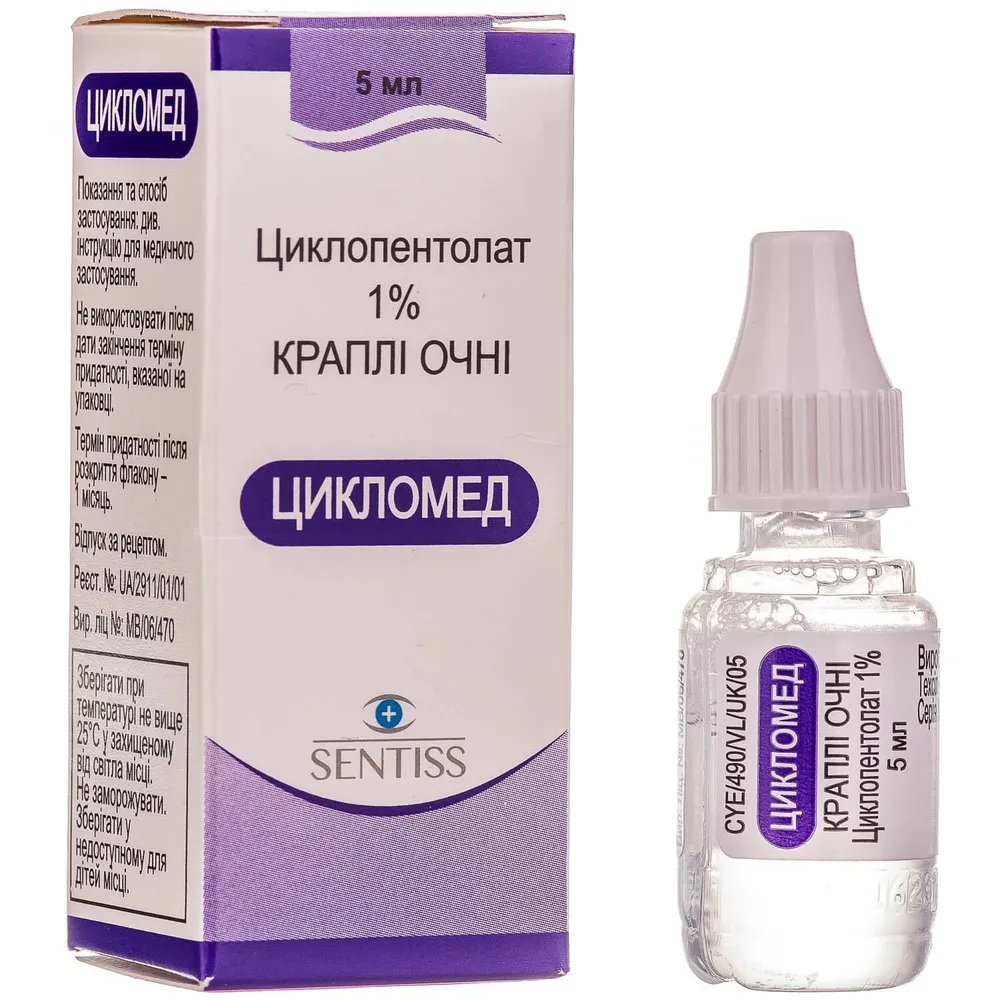
Table of Contents
INSTRUCTIONS FOR MEDICAL USE OF THE MEDICINAL PRODUCT CYCLAMED (CYCLOMED)
Composition:
Active substance: cyclopentolate;
1 ml contains cyclopentolate hydrochloride 10 mg;
Excipients: benzalkonium chloride, sodium hydroxide, disodium edetate, sodium chloride, water for injections.
Pharmaceutical form. Eye drops.
Main physico-chemical properties: clear, colorless solution.
Pharmacotherapeutic group. Medicinal products used in ophthalmology. Mydriatic and cycloplegic agents. Anticholinergic agents. Cyclopentolate.
ATC code: S01FA04.
Pharmacological Properties.
Pharmacodynamics.
Cyclopentolate, by blocking M-cholinergic receptors, prevents the action of the neurotransmitter at cholinergic synapses – acetylcholine.
As a result of blocking cholinergic synapses located in the iris sphincter and ciliary muscle, the pupil dilates due to predominant tone of the pupil-dilating muscle and relaxation of the pupil-constricting muscle. Simultaneously, relaxation of the ciliary (accommodative) muscle leads to paralysis of accommodation (cycloplegia).
Pupil dilation occurs within 15–30 minutes after a single instillation. Mydriasis persists for 6–12 hours; in particularly sensitive patients, mild mydriasis may last significantly longer. Residual cycloplegic effects persist for 12–24 hours. The drug exerts a weak spasmolytic effect, reduces secretion of salivary, gastric, bronchial, sweat, and pancreatic glands; increases intraocular pressure; reduces vagus nerve tone, leading to increased heart rate with slight elevation of arterial pressure.
It penetrates the blood-brain barrier; at medium therapeutic doses, it produces a moderate stimulatory effect on the central nervous system and stimulates respiration.
Pharmacokinetics.
Well absorbed through the conjunctiva. Significant levels in the central nervous system are achieved within 0.5–1 hour. Plasma protein binding is moderate. The elimination half-life is 2 hours.
Clinical characteristics.
Indications.
The drug is used to achieve mydriasis and cycloplegia.
Contraindications.
Suspicion of glaucoma, closed-angle glaucoma.
Intestinal obstruction.
Hypersensitivity to any component of the drug.
Organic disorders of the central nervous system in children.
Interaction with other medicinal products and other forms of interaction.
The effect of the drug may be enhanced by sympathomimetics (mesaton), while M-cholinomimetics (pilocarpine) may reduce it. Medicinal products with M-cholinomimetic properties, when used concomitantly with Cyclomed, may enhance manifestations of its adverse effects. Cyclopentolate may affect the ocular antihypertensive effect of carbachol or cholinesterase inhibitors for ophthalmic use.
Special precautions for use.
Warnings.
FOR OPHTHALMIC USE ONLY. NOT FOR INJECTION.
This drug may cause central nervous system (CNS) disturbances. This is particularly relevant for younger age groups but may occur in patients of any age, especially when using solutions with higher concentrations.
Mydriatics may cause a temporary increase in intraocular pressure.
General instructions. To reduce absorption and the risk of systemic effects, after instillation the inner corners of the eyes (near the bridge of the nose) should be gently pressed with clean fingers for two to three minutes. This helps minimize passage of the drug through the nasolacrimal duct into the nasal cavity and oropharynx. This procedure is especially important when administering the drug to children. Caution should be exercised when using this drug in patients with Down's syndrome and in those predisposed to angle-closure glaucoma. Children should be observed for at least 45 minutes after administration.
Information for patients. Do not touch any surface with the dropper tip, as this may contaminate the solution. Patients should avoid driving or performing other hazardous activities while pupils are dilated. Transient burning sensation in the eye and increased sensitivity to light may occur after instillation. In case of photophobia, eyes should be protected from bright light while pupils remain dilated. Parents should be warned about the danger of the drug entering the child's mouth, and advised to wash their own and the child's hands after administration to prevent systemic toxicity. In newborns, feeding intolerance may occur if mothers breastfeed after ophthalmic use of this drug. It is recommended to avoid breastfeeding for 4 hours after the procedure.
The drug is less effective in young children, individuals with dark skin, and/or darkly pigmented irises. In these individuals, residual accommodation may reach 2–4 diopters. When use in these patient groups is necessary, appropriate dosing should be selected. Use with caution in children, debilitated or elderly patients, and in the presence of ocular hyperemia (which may enhance absorption and systemic reactions).
In children with partial or complete accommodative spasm, cycloplegia is better achieved by a course of atropine sulfate instillations.
When administering the drug to elderly patients, monitoring of intraocular pressure is required.
Use with caution in young children (under 3 years), patients aged 60 years and older, and in patients with benign prostatic hyperplasia.
Use with caution in patients with coronary diseases, heart failure, or ataxia.
Use with special caution in children and patients sensitive to belladonna derivatives, as the risk of systemic toxicity increases.
Recovery of accommodation occurs within 24 hours.
The drug contains the preservative benzalkonium chloride, which may be absorbed by soft contact lenses, discolor them, or cause eye irritation. Contact lenses must be removed before instillation. Lenses may be reinserted no earlier than 15 minutes after drug administration.
Children.
The use of cyclopentolate in children may be associated with psychotic reactions and behavioral disturbances. Increased sensitivity to cyclopentolate is observed in newborns, young children, and children with cerebral palsy or brain damage. Such disturbances include ataxia, incoherent speech, restlessness, hallucinations, hyperactivity, seizures, disorientation in time and space, and inability to recognize people. In newborns, feeding intolerance may occur if they are breastfed after maternal ophthalmic use of this drug.
It is recommended to avoid breastfeeding for 4 hours after the procedure.
Elderly patients. Generally, no differences in safety or efficacy have been observed between elderly and younger patients. Cyclopentolate should be used with caution in elderly patients due to the possible presence of undiagnosed angle-closure glaucoma.
If other eye drops are used, wait at least 15 minutes before administering the next drug.
Hands should be thoroughly washed after administration, as there is a risk of systemic toxicity if the drug is accidentally ingested.
Use during pregnancy or breastfeeding.
Pregnancy.
This drug may be used during pregnancy or breastfeeding only in emergency cases, when the expected benefit to the woman outweighs the potential risk to the fetus/child.
Breastfeeding.
It is unknown whether cyclopentolate is excreted in breast milk. However, the drug may enter systemic circulation, and infants whose mothers receive cyclopentolate locally may be at increased risk of toxic effects.
Reproductive function.
Animal studies on the effect of cyclopentolate on reproductive function have not been conducted. It is unknown whether cyclopentolate may cause adverse effects on the fetus when administered to pregnant women or whether it affects reproductive function.
Ability to affect reaction speed when driving or operating machinery.
The drug reduces visual acuity and affects reaction speed. Therefore, patients should refrain from driving and operating machinery during treatment with this drug.
Method of Administration and Dosage
Ophthalmic drops should be used with maximum adherence to hygiene rules. Do not touch the dropper tip to any surfaces or fingers. Keep the bottle closed after each use. During instillation, pull down the lower eyelid.
Adults. Instill 1–2 drops into the conjunctival sac. Maximum effect develops within 30–60 minutes. If necessary, instillation may be repeated after 5–10 minutes.
Children from 3 months of age and adolescents. Instill 1–2 drops, with a 15–20 minute interval, 2–3 times daily.
Children. The drug is contraindicated in children under 3 months of age and in children with organic disorders of the central nervous system, including epilepsy.
Overdose.
Symptoms: hyperpyrexia (elevated body temperature), dryness of skin and mucous membranes, tachycardia, excitement and behavioral disturbances, disturbances in mental reactions (incoherent speech, increased fatigue, impaired recognition of nearby objects, spatial disorientation, emotional changes), tachycardia, hypertension, increased intraocular pressure, vasodilation, urinary retention, decreased gastrointestinal motility, reduced secretion of salivary, sweat, pharyngeal, bronchial, and nasal glands; at very high doses – respiratory paralysis and coma.
Treatment: intravenous administration of the specific antidote physostigmine. For children: 0.5 mg; if no effect is observed within 5 minutes, repeat the dose (maximum dose should not exceed 2 mg). For adults: administer the antidote at a dose of 2 mg; if no effect is observed within 20 minutes, repeat administration at a dose of 1–2 mg.
Adverse Reactions
Local Reactions (Ophthalmic Disorders)
Transient burning sensation, conjunctival redness, disturbances in visual acuity, increased intraocular pressure in patients with narrow angles or open-angle glaucoma, photophobia, swelling, irritation, conjunctivitis, blepharoconjunctivitis, punctate keratitis, synechiae.
Systemic Reactions
Central Nervous System: Inappropriate behavior, hallucinations (visual or auditory), slurred and incoherent speech, delirium, generalized/tonic-clonic epileptic seizures, disorientation in time and space, memory impairment, excitement, acute psychotic reactions, psychosis, agitation, dizziness, weakness, asthenia, fatigue, cerebellar signs or cerebellar dysfunction, confusion, ataxia, anxiety, unexplained fear, altered sensations, increased fatigue, delirium, acute progressive hemorrhage of the midbrain, medullary paralysis, coma, death.
Toxic Effects on the Central Nervous System in Children: Ataxia, generalized tonic-clonic seizures, speech disorders, excitement, incoherent speech, inappropriate talking, hallucinations, disorientation in time and space, impaired recognition of familiar people, amnesia, dysarthria, cerebral signs or dysfunctions, hyperactivity, anxiety, fear, delirium, central anticholinergic syndrome, drowsiness, tearfulness.
Cardiovascular System: Cardiac arrhythmias (tachycardia, tachyarrhythmia); bradycardia alternating with tachycardia; arterial hypotension or hypertension, facial and extremity flushing, vasodilation, palpitations.
Skin: Urticaria (including contact urticaria), contact dermatitis, sensation of warmth and dryness of the skin, unprovoked sweating.
Gastrointestinal System: Nausea, abdominal distension (especially in infants), increased gastric aspirate, gastric discomfort, transient paralytic ileus, vomiting, food intolerance, necrotic enterocolitis, constipation, epiphora, hypersalivation, decreased secretion in the pharynx and salivary glands (dry mouth).
Immune System: Severe anaphylactic reactions, respiratory failure.
Urinary System: Urinary retention, imperative urges to urinate, difficulty in urination.
Other: Heat exhaustion, facial flushing, decreased secretions in bronchi, nasal passages, and sweat glands.
Effects due to the preservative content: Corneal edema, corneal endothelial damage, cytotoxic effect on corneal cells.
Shelf Life: 2 years.
Shelf life after opening the bottle – 1 month.
Do not use after the expiry date stated on the packaging.
Storage Conditions: Store at a temperature not exceeding 25°C, in a place protected from light. Do not freeze! Keep out of reach of children.
Packaging: 5 ml in a dropper bottle; one bottle per pack.
Prescription Category: Prescription only.
Manufacturer:
SENTESS PHARMA PVT. LTD., India
Manufacturer's Address:
Village Khera Nihla, Tehsil Nalagarh, Distt. Solan, Himachal Pradesh, 174 101, India
Marketing Authorization Holder:
SENTESS PHARMA PVT. LTD., India
Address of the Marketing Authorization Holder:
212/D-1, Ashirwad Commercial Complex, Green Park, New Delhi, 110016, India