Cybor 3500
Ukraine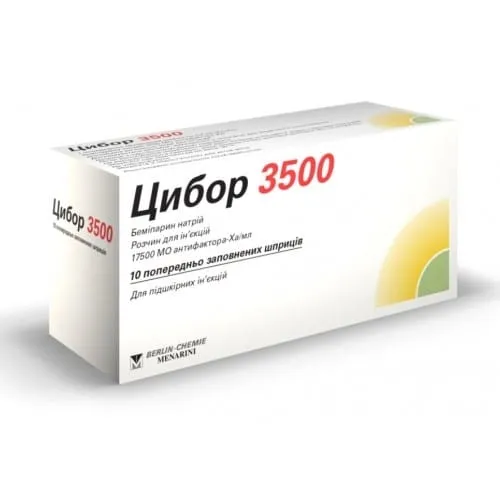
Table of Contents
INSTRUCTIONS FOR MEDICAL USE OF THE MEDICINAL PRODUCT CYBOR 3500 (ZIBOR 3500)
Composition:
Active substance: bemiparin sodium;
1 ml of injection solution contains 17,500 IU anti-factor Xa (activity is expressed in international units of anti-factor Xa activity according to the 1st International Standard for low-molecular-weight heparin);
1 pre-filled syringe contains 3,500 IU of bemiparin sodium (anti-factor Xa/0.2 ml);
Excipient: water for injections.
Pharmaceutical form. Solution for injection.
Main physicochemical properties: clear, practically particle-free solution, colorless to light yellow in color.
Pharmacotherapeutic group. Antithrombotic agents. Heparin group.
ATC code B01A B12.
Pharmacological properties.
Pharmacodynamics.
Bemiparin sodium is a low molecular weight heparin (LMWH) obtained by depolymerization of sodium heparin isolated from porcine intestinal mucosa. The average molecular weight (MW) of bemiparin is approximately 3600 daltons. The fraction of molecular chains with MW less than 2000 daltons is less than 35%. The fraction of molecular chains with MW between 2000 and 6000 daltons ranges from 50 to 75%. The fraction of molecular chains with MW above 6000 daltons is less than 15%. The anti-Xa factor activity of bemiparin ranges from 80 to 120 anti-Xa IU per 1 mg of dry substance, and the anti-IIa factor activity ranges from 5 to 20 anti-IIa IU per 1 mg of dry substance. The ratio of anti-Xa to anti-IIa factor activity is approximately 8:1. Experimental studies in animals have demonstrated the antithrombotic activity and moderate hemorrhagic effect of bemiparin. Use of bemiparin in humans confirms its antithrombotic activity and, when the recommended dosage is followed, causes only a slight prolongation of blood coagulation test times.
Pharmacokinetics.
The pharmacokinetic properties of bemiparin were studied by measuring anti-Xa factor activity in plasma using an amidolytic method calibrated against the 1st International Standard for low molecular weight heparin (National Institute for Biological Standards and Control, NIBSC).
Absorption and elimination processes follow linear first-order kinetics.
Absorption. Bemiparin sodium is rapidly absorbed after subcutaneous injection, with a bioavailability estimated at 96%. Maximum anti-Xa factor activity following prophylactic doses of 2500 IU and 3500 IU is achieved within 2–3 hours after subcutaneous injection, with peak activity levels of approximately 0.34±(0.08) and 0.45±(0.07) IU anti-Xa/mL, respectively. Anti-IIa factor activity is not detectable after administration of these doses. Maximum anti-Xa factor activity after administration of 5000 IU, 7500 IU, 10000 IU, and 12500 IU is reached within 3–4 hours after subcutaneous injection, with peak activity levels of approximately 0.54±(0.06), 1.22±(0.27), 1.42±(0.19), and 2.03±(0.25) IU anti-factor-Xa/mL, respectively. Anti-IIa factor activity of approximately 0.01 IU/mL was detected after administration of 7500 IU, 10000 IU, and 12500 IU doses.
Elimination. The elimination half-life of bemiparin administered at doses ranging from 2500 IU to 12500 IU is between 5 and 6 hours. Therefore, bemiparin should be administered once daily. Currently, there are no data available regarding the ability of bemiparin to bind to plasma proteins, its metabolism, or excretion in humans.
Elderly patients.
Pharmacokinetic analysis results from a clinical study involving young healthy volunteers and elderly patients (≥65 years) with normal renal function showed no significant differences in the pharmacokinetic profile of bemiparin.
Renal impairment (see sections "Dosage and administration" and "Special precautions").
Pharmacokinetic analysis from a clinical study involving young volunteers, elderly patients, and patients with varying degrees of renal impairment (creatinine clearance < 80 mL/min) demonstrates a relationship between multiple prophylactic dosing (3500 IU/24 h) and single therapeutic dosing (115 IU/kg) of bemiparin and creatinine clearance, as well as most pharmacokinetic parameters of anti-Xa factor activity. Furthermore, it was found that the effect of bemiparin (assessed by the area under the concentration-time curve (AUC) of anti-Xa factor activity) was significantly higher in the group of volunteers with severe renal impairment (creatinine clearance < 30 mL/min) compared to other volunteer groups.
On the other hand, pharmacokinetic modeling was performed to evaluate the bemiparin profile after administration of ten consecutive daily doses. The average maximum anti-Xa factor activity (Cmax), reproduced after administration of ten prophylactic doses (3500 IU/24 h), ranged from 0.35 to 0.60 IU anti-Xa/mL across all groups; however, in the group of volunteers with severe renal impairment (creatinine clearance <30 mL/min), one patient had a Cmax value of 0.81 IU anti-Xa/mL after the tenth dose. Modeling with dose reduction to 2500 IU/24 h predicted Cmax values below 0.60 IU anti-Xa/mL (mean Cmax = 0.42 IU anti-Xa/mL) for all volunteers with severe renal impairment. Additionally, the predicted mean Cmax after administration of ten therapeutic doses (115 IU/kg/24 h) ranged from 0.89 to 1.22 IU anti-Xa/mL across all groups; in a volunteer from the severe renal impairment group, the Cmax value was 2.09 IU anti-Xa/mL after the last dose. When modeling dose adjustment to 75% of the therapeutic dose (86.25 IU/kg/24 h), the predicted Cmax for this volunteer was 1.60 IU anti-Xa/mL, while the mean Cmax (0.91 IU anti-Xa/mL) for the severe renal impairment group remained within the range observed in other groups without dose adjustment.
Preclinical safety data
Preclinical safety data based on conventional safety pharmacology studies, repeated-dose toxicity, genotoxicity, and reproductive toxicity indicate no special hazard to humans.
Acute and repeated-dose toxicity studies in animals following bemiparin administration revealed changes primarily consisting of reversible, dose-dependent hemorrhagic lesions at the injection site. These were considered to be the result of excessively high pharmacological activity.
In reproductive toxicity studies conducted in pregnant rats and rabbits between days 6 and 18 of gestation, no lethality was observed. The main clinical signs of reproductive toxicity recorded were subcutaneous hematomas, which may also be attributed to the pharmacological effects of the test substance. No embryotoxic effects related to the drug were observed in fetuses, including external malformations, skeletal damage, or internal organ abnormalities.
Clinical characteristics.
Indications.
Prevention of venous thromboembolism with high risk associated with surgical procedures.
Prevention of blood coagulation in the extracorporeal circulation system during hemodialysis.
Prevention of venous thromboembolism in non-surgical patients at high risk of developing venous thromboembolism.
Secondary prevention of recurrent venous thromboembolism in patients with deep vein thrombosis and transient risk factors.
Contraindications.
- Hypersensitivity to bemiparin or to any of the excipients.
- Hypersensitivity to heparin or its derivatives, including other low molecular weight heparins, or substances of porcine origin.
- History of confirmed immune-mediated heparin-induced thrombocytopenia (HIT) or suspicion thereof.
- Active bleeding or increased risk of bleeding due to coagulation disorders.
- Severe impairment of liver or pancreatic function.
- Injury or surgical procedures involving the central nervous system, organs of vision, or organs of hearing within the past 2 months.
- Disseminated intravascular coagulation (DIC) syndrome associated with heparin-induced thrombocytopenia.
- Acute bacterial endocarditis and subacute bacterial endocarditis.
- Any organic disorders with high risk of bleeding (e.g., active peptic ulcer, hemorrhagic stroke, cerebral aneurysm, or cerebral neoplasia).
Interaction with other medicinal products and other types of interactions.
Drug interactions of bemiparin have not been studied, and information in this section is based on data obtained from other low molecular weight heparins.
Concomitant use of bemiparin with the following drugs is not recommended:
vitamin K antagonists and other anticoagulants, acetylsalicylic acid, other salicylates and NSAIDs, ticlopidine, clopidogrel and other platelet inhibitors, systemic glucocorticoids, and dextran.
All the above-mentioned drugs enhance the pharmacological effect of bemiparin due to additive effects on coagulation and/or platelet function, thereby increasing the risk of bleeding.
If concomitant use cannot be avoided, careful clinical and laboratory monitoring is required.
Concomitant administration of medicinal products that increase serum potassium concentration should be performed under particularly close medical supervision.
Interaction between heparin and intravenously administered nitroglycerin cannot be excluded with bemiparin (this may lead to reduced efficacy).
Special precautions for use.
The packaging contains a single dose of the drug. After use, any unused content of the syringe must be disposed of according to current regulations. Do not use the drug if the protective film of the packaging is opened or damaged. Use only a clear, colorless or slightly yellowish solution free from particles.
Do not administer by intramuscular injection. Due to the risk of hematoma development, intramuscular injections of other drugs should be avoided during bemiparin treatment.
When administered at a dose of 3500 IU, the pharmacokinetics of bemiparin may be altered in patients with severe renal impairment (creatinine clearance <30 mL/min). Regular monitoring of such patients is recommended. A careful individual assessment of the risk of bleeding and thrombosis should be performed before initiating treatment. Dose adjustment is not considered necessary in patients with mild or moderate renal impairment (creatinine clearance 30–80 mL/min), although caution should be exercised (see sections "Dosage and administration" and "Pharmacokinetics").
Caution is advised when prescribing the drug to patients with hepatic impairment, uncontrolled arterial hypertension, history of peptic ulcer disease of the stomach or duodenum, thrombocytopenia, kidney stones or urolithiasis, vascular disorders of the iris or retinal vessels, or other organic conditions associated with an increased risk of bleeding, as well as when performing spinal or epidural anesthesia or lumbar puncture.
Like other low-molecular-weight heparin (LMWH) drugs, bemiparin may suppress aldosterone secretion by the adrenal glands, leading to hyperkalemia, particularly in patients with diabetes mellitus, chronic renal impairment with pre-existing metabolic acidosis, elevated plasma potassium levels, or those taking potassium-sparing medications. The risk of hyperkalemia increases proportionally with the duration of therapy, but such hyperkalemia is usually reversible. In high-risk patients, plasma electrolyte levels should be measured before starting bemiparin and monitored regularly during treatment, especially if therapy lasts longer than 7 days.
Mild transient thrombocytopenia (Type I heparin-induced thrombocytopenia, HIT I) (platelet count 100,000/mm³–150,000/mm³), related to transient platelet activation, may occasionally occur at the beginning of heparin treatment. This condition usually does not lead to complications, and therapy may be continued.
Rarely, severe antibody-mediated thrombocytopenia (Type II HIT) occurs, with platelet counts significantly below 100,000/mm³. This reaction typically develops between the 5th and 21st day of treatment. In patients with a history of heparin-induced thrombocytopenia, this complication may develop more rapidly. Therefore, platelet counts should be monitored before starting bemiparin, then regularly every 3–4 days during treatment, and after discontinuation. In practice, if a significant decrease in platelet count (30–50%) occurs in the presence of bemiparin, other LMWHs, and/or heparins, especially when associated with positive or unknown in vitro test results for antiplatelet antibodies, bemiparin therapy must be immediately discontinued and alternative treatment initiated.
As with other heparins, cases of skin necrosis have been reported during bemiparin treatment, sometimes preceded by erythema or painful erythematous lesions. In such cases, treatment must be immediately discontinued.
Prophylactic use of heparin in combination with epidural or spinal anesthesia or lumbar puncture may very rarely lead to the development of epidural or spinal hematomas, which can result in prolonged or permanent paralysis. The risk of hematoma formation increases with the use of epidural or spinal catheters, concomitant use of drugs affecting blood coagulation (e.g., nonsteroidal anti-inflammatory drugs, platelet aggregation inhibitors, or anticoagulants), and traumatic or repeated punctures.
When determining the time interval between the last prophylactic dose of heparin and insertion or removal of an epidural or spinal catheter, the pharmacological characteristics of the drug and the patient's condition must be considered. The next dose of bemiparin may be administered no sooner than 4 hours after catheter removal. Administration of the next bemiparin dose should also be delayed until completion of the surgical procedure. Extreme caution is required when deciding on anticoagulant therapy in the context of epidural or spinal anesthesia, with frequent monitoring of the patient for neurological symptoms, including back pain, sensory and motor disturbances (numbness and weakness of the lower limbs), and bowel or bladder dysfunction. Medical personnel must be able to recognize these symptoms. Patients should immediately inform nurses or physicians if such symptoms occur. In suspected cases of epidural or spinal hematoma, immediate diagnosis and therapeutic interventions, including spinal decompression, are required.
Pregnancy.
Animal studies have not shown any teratogenic effects of bemiparin. Clinical data on the use of bemiparin in pregnant women are limited; therefore, the drug should be used during pregnancy only if clearly needed. Currently, there is no information on the ability of bemiparin to cross the placental barrier.
Breast-feeding period.
There is currently insufficient information on whether bemiparin is excreted in breast milk. Therefore, if Cibor 3500 must be prescribed to a nursing woman, breast-feeding should be avoided.
Ability to affect reaction speed when driving or operating machinery.
Cibor 3500 has no effect or has a negligible effect on the ability to drive or operate machinery.
Method of administration and dosage.
| Warning: different low molecular weight heparin medicinal products are not necessarily equivalent in efficacy, therefore a specific dosage regimen and method of administration must be followed for each such medicinal product. |
The medicinal product should be used immediately after opening.
Adults.
Surgical procedures with a high risk of venous thromboembolism (e.g., orthopedic procedures or major surgery due to cancer).
On the day of surgery, 3500 IU anti-factor Xa is administered subcutaneously 2 hours before the procedure or 6 hours after surgery, followed by 3500 IU anti-factor Xa once daily for subsequent days. Prophylactic treatment is administered at the physician's discretion during the period of thromboembolic risk or patient immobilization. Prophylaxis is generally continued for at least 7–10 days after surgery, until the risk of thromboembolism has decreased.
In patients undergoing major orthopedic surgery, prophylaxis should be continued for up to 35 days. In patients undergoing abdominal or pelvic cancer surgery, prophylaxis should be continued for up to 28 days if they have an increased risk of thromboembolism and a low risk of bleeding.
Prevention of blood coagulation in the extracorporeal circulation system during hemodialysis. In patients undergoing repeated hemodialysis sessions lasting no more than 4 hours and who have no bleeding risk, anticoagulation in the extracorporeal circuit during the procedure is achieved by a single bolus injection of the drug into the arterial line at the beginning of the session. For patients with body weight less than 60 kg, the dose is 2500 IU; for patients with body weight over 60 kg, the dose is 3500 IU.
Prophylaxis of thromboembolism in non-surgical patients at high risk of venous thromboembolism (e.g., patients with acute medical conditions). The recommended daily dose of bemiparin is 3500 IU subcutaneously. Prophylactic treatment is administered at the physician's discretion during the period of thromboembolic risk or patient immobilization.
Secondary prevention of recurrent venous thromboembolism in patients with deep vein thrombosis and transient risk factors.
Bemiparin may be administered at a fixed dose of 3500 IU daily (maximum treatment duration up to 3 months) to patients receiving anticoagulant therapy for deep vein thrombosis with or without pulmonary embolism, as a therapeutic alternative to oral anticoagulants or when such agents are contraindicated.
Elderly patients.
Dose adjustment is not required provided renal function is normal (see sections "Dosage and administration (Renal impairment)", "Special precautions", "Pharmacokinetics").
Patients with renal impairment.
(See sections "Special precautions", "Pharmacokinetics").
When bemiparin is administered at daily doses of 3500 IU in patients with renal impairment (creatinine clearance 30–80 mL/min), dose adjustment is not required. However, careful monitoring is recommended.
Severe renal impairment (creatinine clearance <30 mL/min) may affect the pharmacokinetics of bemiparin. Physicians should assess the individual risk of bleeding and thrombosis in these patients. Dose adjustment may occasionally be necessary. Due to limited pharmacokinetic data, a reduced dose of 2500 IU anti-Xa once daily may be considered. Careful monitoring is recommended. Measurement of peak anti-Xa levels approximately 4 hours after administration should be considered.
Patients with hepatic impairment.
Insufficient data are available to provide recommendations for dose adjustment of bemiparin in this patient population.
Route of administration. Technique of subcutaneous injection.
Pre-filled syringes are ready for immediate use and do not require sterilization before injection. When administering Cibor 3500 subcutaneously, the injection should be administered into the subcutaneous fat layer of the anterior-lateral abdominal wall or the posterior-lateral area of the back, alternating between right and left sides. The needle should be inserted perpendicularly, not at an angle, to its full depth into a skin fold formed by the thumb and index finger. The skin fold should not be released and should be held until the injection is complete. The injection site must not be massaged. Before injection, do not press the plunger to expel air bubbles to avoid loss of medicinal product.
Children.
The safety and efficacy of Cibor 3500 in children have not been established; therefore, its use in children is not recommended.
Overdose.
The main manifestation of overdose is bleeding. In the event of bleeding, the decision to discontinue bemiparin therapy should be based on the severity of hemorrhage and the risk of thrombosis. Minor hemorrhages rarely require specific treatment. Significant bleeding may require administration of protamine sulfate. Neutralization of bemiparin by protamine sulfate has been studied in vitro and in vivo to observe reduction in anti-Xa activity and effect on activated partial thromboplastin time (aPTT). Protamine sulfate causes partial reduction of bemiparin's anti-Xa factor activity within 2 hours after intravenous administration at a dose of 1.4 mg protamine sulfate per 100 IU anti-Xa factor.
Adverse Reactions
The most frequently reported adverse reactions were hematoma and/or ecchymosis at the injection site, observed in approximately 15% of patients treated with Cibor 3500. Long-term use of heparin may lead to the development of osteoporosis.
Adverse reactions are classified by organ systems and frequency: very common (≥ 1/10); common (≥ 1/100 to < 1/10); uncommon (≥ 1/1000 to < 1/100); rare (≥ 1/10,000 to < 1/1000); very rare (< 1/10,000); and not known (cannot be estimated from available data).
The frequency of adverse reactions with bemiparin is consistent with the frequency of adverse reactions observed with other low-molecular-weight heparin agents and is presented in the table below:
| Organ system |
Frequency of adverse reactions |
| Blood and lymphatic system disorders |
Common: complicated bleeding (in the skin, mucous membranes, wounds, gastrointestinal tract, genitourinary tract), which may lead to hemorrhagic anemia. Occasional: mild reversible thrombocytopenia (HIT type I). Rare: severe thrombocytopenia (type II). |
| Immune system disorders |
Occasional: allergic skin reactions (urticaria, pruritus). Rare: anaphylactic reactions (nausea, vomiting, chills, dyspnea, bronchospasm, laryngeal edema, hypotension, urticaria, pruritus). |
| Metabolism and nutrition disorders |
Not known: hyperkalemia. |
| Hepatobiliary disorders |
Common: slight transient increase in transaminase levels (AST, ALT) and gamma-GT. |
| Skin and subcutaneous tissue disorders |
Rare: skin necrosis at the injection site. |
| General disorders and administration site conditions |
Very common: bruising at injection site; hematoma and pain at injection site. Rare: epidural and spinal hematoma following epidural or spinal anesthesia or lumbar puncture. These hematomas may lead to neurological impairments of varying degrees, including long-term or permanent paralysis. |
Reporting of suspected adverse reactions: it is very important to report suspected adverse reactions after the drug has been registered. This allows continuous monitoring of the benefit-risk balance of the medicinal product.
Shelf life.
2 years. After first opening, Cibor 3500 should be used immediately. Do not use the medicinal product after the expiry date stated on the packaging.
Storage conditions.
Store at a temperature not exceeding 30 °C. Do not freeze. Keep out of the reach and sight of children.
Incompatibilities.
This medicinal product must not be mixed with other medicinal products, as compatibility studies have not been conducted.
Packaging.
0.2 mL of solution for injection in a pre-filled syringe (glass) with a plunger rod (polypropylene), plunger seal (chlorobutyl rubber), injection needle (stainless steel), and a rigid needle cap (natural rubber and rigid polypropylene layer).
Blister pack covered with a protective film containing 2 pre-filled syringes; 1, 5, or 50 blisters per cardboard box.
Prescription status.
Prescription only.
Manufacturer.
Rovi Farmaceutici Industrial Services, S. A.
Manufacturer’s address and location of the manufacturing site.
C/Julian Camarero, 35, Madrid, 28037 Madrid, Spain.
Marketing Authorisation Holder.
PROPHARMA International Trading Limited.
Address of the Marketing Authorisation Holder.
Level 1, LM Complex, Brewery Street, Zone 3, Central Business District, Birkirkara, CBD3040, Malta.