Cyanocobalamin (vitamin b12)
Ukraine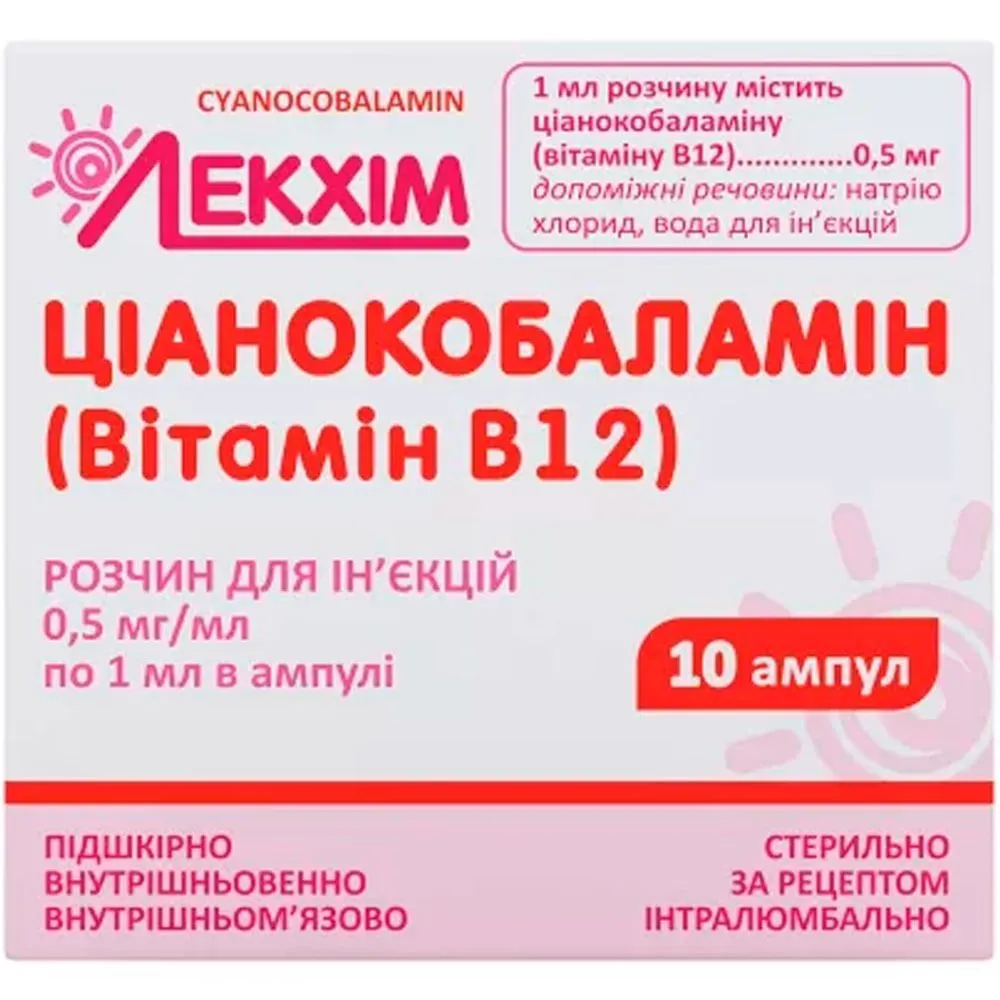
Table of Contents
INSTRUCTIONS FOR MEDICAL USE OF THE MEDICINAL PRODUCT CYANOCOBALAMIN (VITAMIN B12)
Composition:
Active ingredient: cyanocobalamin;
1 ml of solution contains: cyanocobalamin, recalculated to 100 % substance – 0.5 mg;
Excipients: sodium chloride, water for injections.
Pharmaceutical form. Solution for injection.
Main physicochemical properties: clear, bright red liquid.
Pharmacotherapeutic group.
Vitamin B12 (cyanocobalamin and its analogs). ATC code B03B A01.
Pharmacological properties.
Pharmacodynamics.
Cyanocobalamin, as a metabolite, activates carbohydrate, protein, and lipid metabolism, participates in the synthesis of labile groups, in the formation of choline, methionine, nucleic acids, creatine, promotes accumulation of sulfhydryl group-containing compounds in erythrocytes. As a growth factor, it stimulates bone marrow function, which is necessary for normoblastic erythropoiesis. Cyanocobalamin promotes normalization of impaired liver and nervous system functions, activates the blood coagulation system, at high doses causes increased thromboplastin activity and prothrombin activity. It reduces blood cholesterol concentration. Enhances tissue regenerative capacity.
In the human and animal body, cyanocobalamin is synthesized by intestinal microflora, but this synthesis does not fully meet the body's vitamin requirements; therefore, the additional amount is obtained from food.
Pharmacokinetics.
After parenteral administration, vitamin B12 rapidly enters systemic circulation. In the blood, it binds to transcobalamins I and II, which transport it to tissues. It is deposited predominantly in the liver. Plasma protein binding is 90%. Time to reach maximum concentration (TCmax) after subcutaneous or intramuscular administration is about 1 hour. It is excreted from the liver into the intestine via bile and then reabsorbed into the blood. The half-life (T½) from the liver is 500 days. With normal kidney function, 7–10% is excreted by the kidneys and about 50% in feces; with impaired kidney function, 0–7% is excreted by the kidneys and 70–100% in feces. It crosses the placental barrier.
Clinical characteristics.
Indications.
Treatment of malignant, post-hemorrhagic, and iron-deficiency anemias; aplastic anemias in children; alimentary anemias caused by toxic substances and drugs; anemias associated with vitamin B12 deficiency, regardless of the cause of deficiency (gastrectomy, helminthic infestations, impaired intestinal absorption, pregnancy). Polyneuropathies, trigeminal neuralgia, radiculitis, causalgias, migraine, diabetic neuropathies, amyotrophic lateral sclerosis, cerebral palsy in children, Down's syndrome, alcoholic delirium. Use in children with dystrophy, following infectious diseases, in sprue (together with folic acid), liver diseases (hepatitis, cirrhosis), radiation sickness, psoriasis, dermatitis herpetiformis, neurodermatitis, and photodermatoses.
Contraindications.
Hypersensitivity to the components of the drug. Erythremias, erythrocytosis. Neoplasms, except cases associated with megaloblastic anemia and vitamin B12 deficiency. Acute thromboembolic diseases. High functional class angina pectoris.
Interaction with other medicinal products and other forms of interaction.
Aminoglycosides, salicylates, antiepileptic drugs, colchicine, and potassium preparations reduce absorption of the drug and affect its kinetics.
Concomitant use with kanamycin, neomycin, polymyxins, and tetracyclines decreases absorption of cyanocobalamin.
Pharmaceutically incompatible with ascorbic acid and salts of heavy metals (inactivation of cyanocobalamin); thiamine bromide, pyridoxine, riboflavin (cobalt ion present in the cyanocobalamin molecule destroys other vitamins).
Thiamine – increased risk of allergic reactions caused by thiamine.
Chloramphenicol – reduces hematopoietic response to the drug.
Cytamen – concomitant use reduces the effect of Cytamen.
Oral contraceptives – reduce blood concentration of cyanocobalamin.
Special precautions for use.
Cyanocobalamin must not be used with drugs that increase blood coagulation. During cyanocobalamin therapy, peripheral blood parameters must be monitored: reticulocyte count and iron concentration should be determined on day 5–8 of treatment. The number of erythrocytes, hemoglobin, and color index should be monitored once or twice weekly during the first month, and thereafter 2–4 times per month. Hematological remission is achieved when erythrocyte count reaches 4.0–4.5×10¹²/L, erythrocyte size returns to normal, anisocytosis and poikilocytosis disappear, and reticulocyte levels normalize following the reticulocyte crisis. After achieving hematological remission, peripheral blood monitoring should be performed at least once every 4–6 months.
In patients with a predisposition to thrombosis and in patients with angina pectoris, caution is required during treatment, and blood coagulation parameters should be monitored.
If there is a tendency toward leukocytosis or erythrocytosis, the dose of the drug should be reduced or treatment temporarily discontinued.
This medicinal product contains less than 1 mmol (23 mg)/dose of sodium, i.e., it is practically sodium-free.
Use during pregnancy or breastfeeding.
Cyanocobalamin must not be used during pregnancy (there are individual reports of teratogenic effects of vitamin B12 at high doses) or during breastfeeding.
Ability to affect reaction speed when driving or operating machinery.
During treatment, patients should refrain from driving vehicles or engaging in potentially hazardous activities that require heightened attention and rapid psychomotor reactions.
Administration and Dosage.
Cyanocobalamin is administered intramuscularly, subcutaneously, or intravenously; in cases of funicular myelosis and amyotrophic lateral sclerosis, it is also administered intraluminally.
Adults.
In vitamin B12-deficient anemias, administer the drug at doses of 100–200 mcg (0.1–0.2 mg) every other day until remission is achieved.
In cases of symptoms of funicular myelosis and macrocytic anemias with nervous system involvement, cyanocobalamin should be administered at a single dose of 400–500 mcg (0.4–0.5 mg) or higher. During the first week, administer daily, then at intervals of 5–7 days (folic acid should be co-administered). In severe cases, administer intraspinally, starting with a single dose of 15–30 mcg, increasing the dose with each subsequent injection (50, 100, 150, 200 mcg). Administer intralumbar injections every 3 days; a total of 8–10 injections per course is required. During remission, in the absence of funicular myelosis symptoms, maintenance therapy consists of 100 mcg twice per month; in the presence of neurological symptoms, 200–400 mcg 2–4 times per month.
In posthemorrhagic and iron-deficiency anemias, administer 30–100 mcg 2–3 times per week.
In amyotrophic lateral sclerosis, encephalomyelitis, and neurological disorders with pain syndrome, administer in increasing doses from 200 to 500 mcg per injection (once improvement occurs, 100 mcg daily). Treatment course duration: 14 days. In peripheral nerve injuries, administer 200–400 mcg once every 2 days for 40–45 days.
In hepatitis and liver cirrhosis, administer 15–30 mcg daily or 100 mcg every other day for 25–40 days.
In diabetic neuropathy, sprue, and radiation sickness, administer 60–100 mcg daily for 20–30 days.
In vitamin B12 deficiency, for treatment: intramuscularly or intravenously 1 mg daily for 1–2 weeks; maintenance dose: 1–2 mg intramuscularly or intravenously, from once weekly to once monthly. The duration of cyanocobalamin therapy and repetition of treatment courses depend on the disease course and treatment efficacy.
Children.
In posthemorrhagic and iron-deficiency anemias, administer 30–100 mcg 2–3 times per week. In aplastic anemias in children, administer 100 mcg until clinical and hematological improvement occurs. In nutritional anemias in childhood, administer 30 mcg for 15 days.
In dystrophies in young children, Down syndrome, and cerebral palsy, administer 15–30 mcg every other day.
In hepatitis and liver cirrhosis, administer 15–30 mcg daily or 100 mcg every other day for 25–40 days.
Children.
Administer to children aged 3 years and older.
Overdose.
Symptoms: pulmonary edema, congestive heart failure, peripheral vascular thrombosis.
Treatment: symptomatic therapy.
Adverse Reactions.
Blood system side effects: hypercoagulation.
Cardiovascular system side effects: tachycardia, chest pain.
Nervous system side effects: headache, dizziness, nervous excitement.
Metabolic side effects: acne, bullous rashes, nausea, sweating, purine metabolism disorders.
Immune system side effects: allergic reactions, including skin manifestations such as erythema, urticaria, rashes, pruritus, dermatitis, edema, including Quincke's edema; respiratory disturbances, including asthma attack, anaphylactic shock, anaphylactoid reactions.
Gastrointestinal tract side effects: loose stools.
General disorders: malaise, fever.
Local reactions, including erythema, pruritus, pain, swelling, induration, and necrosis at the injection site.
Shelf life. 2 years.
Storage conditions.
Store in the original packaging at a temperature not exceeding 25 °C. Keep out of reach of children.
Incompatibility.
When cyanocobalamin is used in the same solution with ascorbic acid, thiamine, and pyridoxine, mutual destruction of vitamins occurs; with nicotinic acid – destruction of cyanocobalamin; with riboflavin – accumulation of cobalt ions.
Packaging.
1 ml in an ampoule. 10 ampoules in a contour cellular pack, 1 contour cellular pack in a carton.
Prescription status.
By prescription only.
Manufacturer.
PJSC "Halychpharm".
Manufacturer's address and location of business activities.
6/8 Opryshkivska St., Lviv, 79024, Ukraine.