Cefixime-vista
Ukraine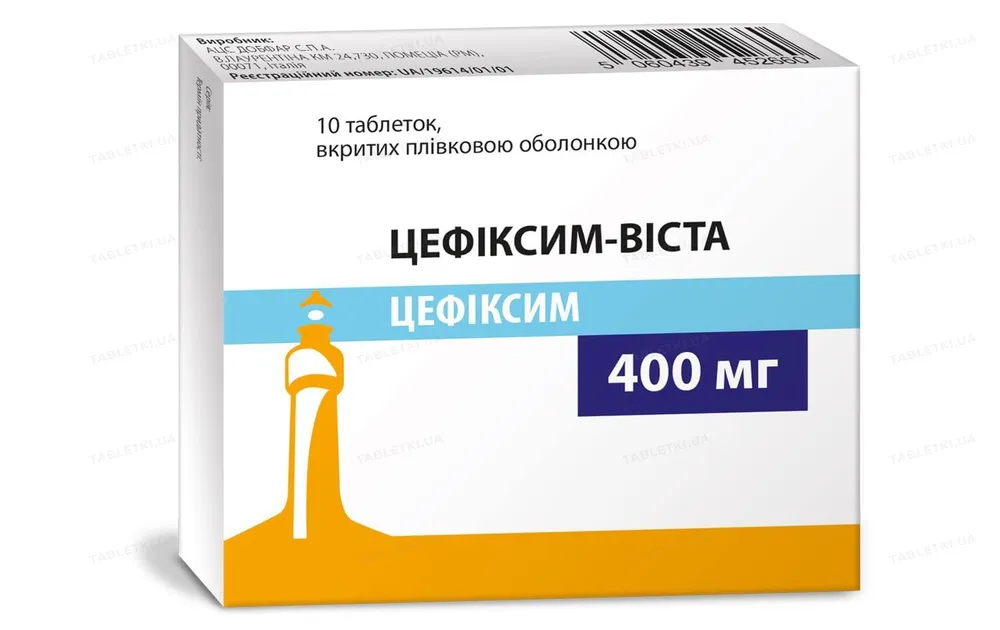
Table of Contents
INSTRUCTIONS FOR MEDICAL USE OF THE MEDICINAL PRODUCT CEfixime-VISTA (CEFIXIME–VISTA)
Composition:
Active substance: cefixime;
One film-coated tablet contains 400 mg of cefixime (as cefixime trihydrate);
Excipients: microcrystalline cellulose; pregelatinized starch; calcium hydrogen phosphate dihydrate, unmilled; calcium hydrogen phosphate dihydrate, powder; magnesium stearate.
Film coating: Opadry AMB White OY-B-28920 or equivalent amount; polyvinyl alcohol; titanium dioxide (E 171); talc; lecithin; xanthan gum.
Pharmaceutical form. Film-coated tablets.
Main physicochemical properties: elongated, film-coated tablets, white in color, with a break line on both sides and embossing: F on one side and P1 on the other.
Pharmacotherapeutic group. Third-generation cephalosporin antibiotic. ATC code J01D D08.
Pharmacological Properties
Pharmacodynamics
Cefixime is a third-generation oral cephalosporin antibiotic. In vitro, it demonstrates significant bactericidal activity against a broad spectrum of gram-positive and gram-negative microorganisms.
It is clinically effective in the treatment of infections caused by the most common pathogenic microorganisms, including Streptococcus pneumoniae, Streptococcus pyogenes, E. coli, Proteus mirabilis, Klebsiella species, Haemophilus influenzae (beta-lactamase-positive and beta-lactamase-negative), Branhamella catarrhalis (beta-lactamase-positive and beta-lactamase-negative), and Enterobacter species. It has a high degree of stability in the presence of beta-lactamases. Most strains of enterococci (Streptococcus faecalis, group D Streptococci) and Staphylococci (including coagulase-positive, coagulase-negative, and methicillin-resistant strains) are resistant to cefixime. In addition, most strains of Pseudomonas, Bacteroides fragilis, Listeria monocytogenes, and Clostridia are also resistant to cefixime.
Pharmacokinetics
Absorption. Absolute bioavailability after oral administration of cefixime ranges from 22% to 54%. Since the presence of food does not significantly affect absorption, cefixime can be administered independently of food intake. The maximum serum concentration after administration of recommended doses in adults or children ranges from 1.5 to 3 mcg/mL. With repeated dosing, there is either minimal or negligible accumulation of cefixime.
Distribution. Cefixime is almost entirely bound to serum albumin, with the mean free fraction being approximately 30%.
Metabolism. Metabolites of cefixime have not been detected in human serum or urine.
Elimination. Cefixime is primarily excreted unchanged in the urine. The main elimination mechanism is glomerular filtration.
There are no data available on the penetration of cefixime into breast milk.
Clinical characteristics.
Indications.
Infectious and inflammatory diseases caused by microorganisms sensitive to the drug:
- infections of the upper respiratory tract (including otitis media, sinusitis, pharyngitis, bacterial tonsillitis) in cases of known or suspected resistance of the causative agent to other commonly used antibiotics or in the presence of a risk of treatment inefficacy;
- infections of the lower respiratory tract (including acute bronchitis and exacerbations of chronic bronchitis);
- urinary tract infections (including cystitis, cystourethritis, uncomplicated pyelonephritis).
Clinically effective in the treatment of infections caused by the most common pathogenic microorganisms, including Streptococcus pneumoniae, Streptococcus pyogenes, E. coli, Proteus mirabilis, Klebsiella species, Haemophilus influenzae (beta-lactamase-positive and negative), Branhamella catarrhalis (beta-lactamase-positive and negative), and Enterobacter species. Exhibits a high degree of stability in the presence of beta-lactamases.
Most strains of enterococci (Streptococcus faecalis, group D streptococci) and Staphylococci (including coagulase-positive, coagulase-negative, and methicillin-resistant strains) are resistant to cefixime. In addition, most strains of Pseudomonas, Bacteroides fragilis, Listeria monocytogenes, and Clostridia are resistant to cefixime.
Contraindications.
- Confirmed hypersensitivity to cephalosporin antibiotics or to other components of the drug.
- Hypersensitivity to penicillins; porphyria.
Interaction with other medicinal products and other forms of interactions.
Probenecid (and other tubular secretion blockers) increases the maximum blood concentration of cefixime by slowing renal excretion of cefixime, which may lead to symptoms of overdose.
Salicylic acid increases the concentration of free cefixime by 50% due to displacement of cefixime from protein-binding sites; this effect is concentration-dependent.
Carbamazepine may increase the plasma concentration of cefixime; therefore, monitoring of its plasma levels is advisable.
Nifedipine increases the bioavailability of cefixime.
Furosemide and aminoglycosides increase the nephrotoxicity of the drug.
Like other antibiotics, cefixime may reduce the reabsorption of estrogens and decrease the effectiveness of combined oral contraceptives.
Coumarin-type anticoagulants.
Cefixime should be used with caution in patients receiving anticoagulant therapy, such as warfarin. Since cefixime may potentiate the effect of anticoagulants, prolongation of prothrombin time may occur, with or without clinical signs of bleeding.
Other forms of interactions: the use of cephalosporins may cause false-positive reactions when testing for glucose in urine using Benedict's or Fehling's solutions or with Clinistix tablets. During cefixime administration, the direct Coombs test may yield false-positive results.
Special precautions for use.
Encephalopathy.
When using beta-lactam antibiotics, including Cefixime-Vista, the risk of developing encephalopathy (which may manifest as seizures, confusion, impaired consciousness, and movement disorders) increases, particularly in cases of overdose or in patients with pre-existing renal function impairment.
Severe skin reactions.
Serious skin adverse reactions such as toxic epidermal necrolysis, Stevens-Johnson syndrome, and drug rash with eosinophilia and systemic symptoms (DRESS) have been observed in some patients receiving cefixime. In the event of serious skin adverse reactions, cefixime should be discontinued immediately and appropriate treatment initiated and/or necessary preventive measures taken.
Hypersensitivity reactions.
Before administering cefixime, a careful assessment of the patient's history of hypersensitivity reactions to penicillins, cephalosporins, or other drugs is required.
Cefixime-Vista should be used with caution in patients with allergic reactions to penicillins. Evidence from both in vivo (in the human body) and in vitro studies has demonstrated cross-allergic reactions between penicillins and cephalosporins. Such cases are rare. Reactions occurred via an anaphylactic mechanism, particularly after parenteral administration.
Antibiotics should be administered with caution to patients with a history of any type of hypersensitivity reactions, especially following administration of medicinal products. If an allergic reaction occurs, the drug should be discontinued immediately.
Anemia.
Cases of hemolytic anemia, including severe cases with fatal outcomes, have been reported following the use of cephalosporins. Recurrent episodes of hemolytic anemia after cephalosporin administration have also been reported in patients who previously developed hemolytic anemia after the first dose of a cephalosporin, including cefixime.
Acute renal failure.
Like other cephalosporins, Cefixime-Vista may cause acute renal failure, including tubulointerstitial nephritis as the primary pathological condition. If acute renal failure occurs, cefixime should be discontinued and appropriate therapy and/or measures initiated.
Renal impairment.
For patients with severe renal impairment and for patients undergoing hemodialysis or peritoneal dialysis, the dose of Cefixime-Vista should be appropriately reduced (see section "Dosage and administration").
Alterations in intestinal flora.
Prolonged use of antibacterial medicinal products may lead to overgrowth of resistant microorganisms and disruption of normal intestinal flora, potentially resulting in overgrowth of Clostridium difficile and development of pseudomembranous colitis. In mild cases of pseudomembranous colitis caused by antibiotic use, discontinuation of the drug may be sufficient. If colitis symptoms do not improve after discontinuation, oral vancomycin—considered the drug of choice for pseudomembranous colitis—should be administered.
In cases of moderate to severe colitis requiring treatment, electrolytes and protein solutions should be added. Concomitant use of medicinal products that reduce intestinal peristalsis should be avoided. Antibiotics with broad-spectrum activity should be prescribed with caution to patients with a history of gastrointestinal disorders, particularly colitis.
Laboratory test data.
Reversible changes in liver function, kidney function, and blood parameters (thrombocytopenia, leukopenia, and eosinophilia) may occur during treatment with Cefixime-Vista.
Cephalosporins increase the toxicity of alcohol; therefore, consumption of alcoholic beverages during cefixime therapy is not recommended.
Use during pregnancy or breastfeeding.
There are no data on the use of this medicinal product during pregnancy. Cefixime crosses the placenta. The drug should not be used during pregnancy or breastfeeding—use is possible only under strict medical supervision and only if absolutely necessary.
Ability to affect reaction rate when driving or operating machinery.
The use of Cefixime-Vista does not affect reaction speed when driving or operating machinery. However, if dizziness occurs, driving or operating machinery should be avoided.
Method of Administration and Dosage
The medicinal product can be taken independently of food intake.
The daily dose for adults and children aged 12 years and older is 400 mg given in 1 or 2 doses. The duration of treatment depends on the nature of the disease course and the type of infection. After the disappearance of infection symptoms and/or fever, it is advisable to continue taking the medicinal product for at least 48–72 hours.
To prevent complications, treatment with cefixime for upper respiratory tract or urinary tract infections is usually continued for 5–10 days, and for lower respiratory tract infections—for 10–14 days.
Treatment of otitis media typically lasts 10–14 days.
For infections caused by group A beta-hemolytic streptococci, to prevent the development of late complications (acute rheumatic fever, glomerulonephritis), treatment should last at least 10 days.
For uncomplicated lower urinary tract infections in women, the medicinal product may be administered for 1–3 days.
The medicinal product should be prescribed with caution to patients with renal impairment; when creatinine clearance is ≤ 20 mL/min, the daily dose of the medicinal product should be reduced to 200 mg. There are no age-related dosage precautions for elderly patients.
Children.
The medicinal product Cefixime-Vista is administered to children aged 12 years and older.
Overdose.
There is a risk of encephalopathy when beta-lactam antibiotics, including Cefixime-Vista, are used, particularly in cases of overdose or in patients with existing renal function impairment.
Cases of overdose have not been observed. Adverse reactions observed with doses up to 2 g in healthy study participants did not differ from those noted in patients receiving the medicinal product at recommended doses.
Symptoms: intensification of adverse reactions.
Treatment: gastric lavage, symptomatic and supportive therapy. There is no specific antidote. Hemodialysis or peritoneal dialysis contributes only minimally to the elimination of cefixime from the body.
Adverse Reactions
When cephalosporins are used, gastrointestinal disturbances are most commonly observed, while hypersensitivity reactions occur less frequently.
Hypersensitivity reactions are more commonly observed in patients who have previously experienced hypersensitivity reactions and in patients with a history of allergies, hay fever, urticaria, or bronchial asthma with an allergic component.
The following adverse reactions have been rarely observed during cefixime administration:
Gastrointestinal system: glossitis, nausea, vomiting, heartburn, abdominal pain, diarrhea, digestive disturbances, dyspepsia, oral candidiasis, stomatitis, flatulence. Switching to 200 mg twice daily may alleviate diarrhea. Severe, prolonged diarrhea associated with some classes of antibiotics may indicate pseudomembranous colitis; in such cases, appropriate diagnostic evaluation should be performed. If the diagnosis is confirmed by colonoscopy, all antibiotic therapy should be discontinued immediately, and oral vancomycin should be initiated. Medicinal products that reduce intestinal peristalsis are contraindicated.
Immune system: serum sickness-like reactions, anaphylaxis, arthralgia, drug fever, interstitial nephritis, angioedema.
Hematological system: transient leukopenia, agranulocytosis, pancytopenia, transient neutropenia, granulocytopenia, thrombocytopenia, thrombocytosis, eosinophilia. Hemolytic anemia has been reported in patients receiving cephalosporins. Isolated cases of coagulation disorders have also been reported.
Hepatic system: jaundice, transient elevations in transaminases [aspartate aminotransferase (AST), alanine aminotransferase (ALT)], alkaline phosphatase, total bilirubin; isolated cases of hepatitis.
Renal system: transient increases in serum urea and creatinine levels; acute renal failure, including tubulointerstitial nephritis.
Respiratory system: dyspnea.
Skin: urticaria, skin rashes, pruritus, erythema multiforme, Stevens-Johnson syndrome, toxic epidermal necrolysis, drug reaction with eosinophilia and systemic symptoms (DRESS).
Nervous system: headache, dizziness, dysphoria. Seizures have been reported during treatment with cephalosporins, including cefixime (frequency unknown).
When beta-lactam antibiotics, including Cefixime-Vista, are used, the risk of encephalopathy (which may manifest as seizures, confusion, impaired consciousness, and movement disorders) increases, particularly in cases of overdose or in patients with pre-existing renal impairment (frequency unknown).
Ear and vestibular system: hearing loss.
General disorders: increased body temperature, facial swelling.
Other: anorexia, Candida-induced vaginitis, genital pruritus.
Reporting of suspected adverse reactions.
Reporting suspected adverse reactions after drug registration is an important procedure. It enables continuous monitoring of the benefit-risk profile of the medicinal product. Healthcare professionals are required to report any suspected adverse reactions through the national reporting system.
Shelf life. 2 years.
Storage conditions.
Store in the original packaging at a temperature not exceeding 25 °C. Keep out of reach of children.
Packaging.
5 tablets per blister; 1 or 2 blisters per cardboard box.
Prescription status.
Prescription only.
Manufacturer.
ACS DOBFAR S.P.A.
Manufacturer's address and location of operations.
V. LAURENTINA KM 24,730, POMEZIA (RM), 00071, Italy