Cefepime
Ukraine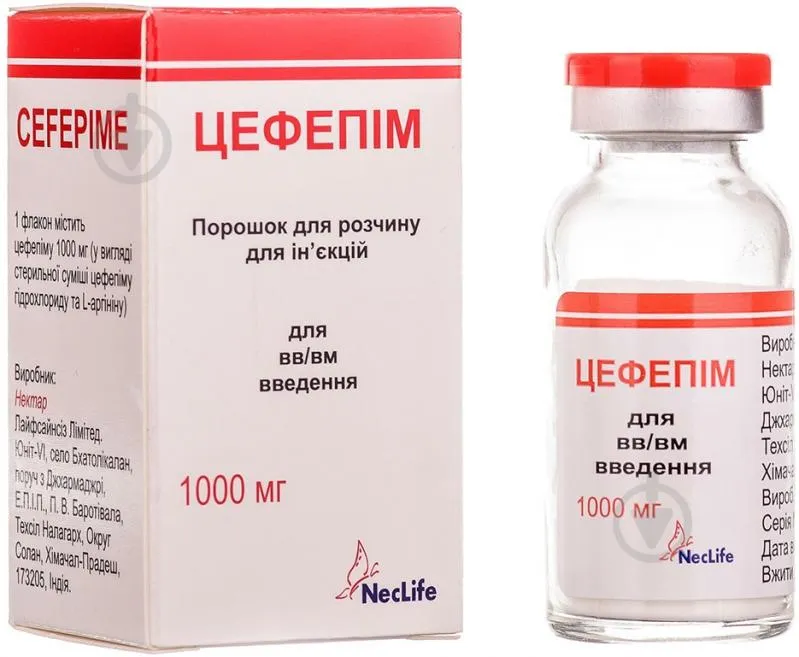
Table of Contents
INSTRUCTIONS FOR MEDICAL USE OF THE MEDICINAL PRODUCT CEFEPIME (CEFEPIME)
Composition:
Active substance: cefepime;
1 vial contains cefepime (as cefepime hydrochloride) 1.0 g;
Excipient: L-arginine.
Pharmaceutical form. Powder for solution for injection.
Main physicochemical characteristics: powder ranging from white to light yellow in color.
Pharmacotherapeutic group. Antimicrobial agents for systemic use. β-lactam antibiotics. Fourth-generation cephalosporins. ATC code J01D E01.
Pharmacological properties.
Pharmacodynamics.
Cefepime inhibits the synthesis of bacterial cell wall enzymes and has a broad spectrum of activity against various Gram-positive and Gram-negative bacteria. Cefepime is highly resistant to hydrolysis by most β-lactamases, has low affinity for chromosomally mediated β-lactamases, and rapidly penetrates Gram-negative bacterial cells.
Antibacterial spectrum of activity.
Microorganisms sensitive to cefepime include:
Gram-positive aerobes: Staphylococcus, methicillin resistant, Streptococcus, Streptococcus pneumoniae;
Gram-negative aerobes: Acinetobacter baumannii, Branhamella catarrhalis, Citrobacter freundii, Citrobacter koseri, Enterobacter, Escherichia coli, Haemophilus influenzae, Klebsiella, Morganella morganii, Neisseria, Proteus mirabilis, Proteus vulgaris, Providencia, Salmonella, Serratia, Shigella;
Anaerobes: Clostridium perfringens, Fusobacterium, Peptostreptococcus, Prevotella.
Microorganisms with moderate sensitivity to cefepime (in vitro):
Pseudomonas aeruginosa (Gram-negative aerobes).
Microorganisms resistant to cefepime:
Gram-positive aerobes: Enterococci, Listeria, Staphylococcus, methicillin resistant*;
Gram-negative aerobes: Burkholderia cepacia, Stenotrophomonas maltophilia;
Anaerobes: Bacteroides fragilis, Clostridium difficile.
* Methicillin resistance occurs in approximately 30–50% of all Staphylococcus strains and is mostly associated with hospital settings.
Pharmacokinetics.
Cefepime pharmacokinetics are linear over the dose range of 250 mg – 2 g (intravenous) and 500 mg – 2 g (intramuscular), and remain unchanged throughout the treatment period.
After intramuscular administration, absorption is rapid and complete.
Distribution. Mean plasma concentrations of cefepime after single 30-minute intravenous infusions of 250 mg, 500 mg, 1 g, 2 g, or after single intramuscular injections of 500 mg, 1 g, 2 g in males are shown in Table 1.
Plasma concentrations of cefepime (mcg/mL)
following intravenous (IV) and intramuscular (IM) administration
Table 1
| Cefepime dose |
0.5 hour |
1 hour |
2 hours |
4 hours |
8 hours |
12 hours |
| 1 g IV |
78.7 |
44.5 |
24.3 |
10.5 |
2.4 |
0.6 |
| 1 g IM |
14.8 |
25.9 |
26.3 |
16.0 |
4.5 |
1.4 |
Cefepime distribution in tissues is not altered over the dose range of 250–2000 mg. The mean volume of distribution at steady state is 18 liters. The mean elimination half-life is 2 hours. Drug accumulation was not observed in patients receiving 2 g intravenously every 8 hours for 9 days. Plasma protein binding is less than 19% and is independent of cefepime plasma concentration. The elimination half-life is prolonged in patients with renal impairment.
Metabolism. Cefepime is not metabolized. Approximately 7% of the administered dose is converted to N-methylpyrrolidine, which is rapidly oxidized to N-methylpyrrolidine oxide and excreted in urine.
Excretion. The mean total clearance is 120 mL/min. The mean total renal clearance of cefepime is 110 mL/min, and its elimination occurs predominantly via glomerular filtration. 85% of the administered dose is excreted unchanged in urine. After intravenous administration of 500 mg cefepime, plasma concentrations fall below the quantifiable limit within 12 hours and in urine within 16 hours. The mean urinary concentration 12–16 hours after administration is 17.8 mcg/mL. After intravenous administration of 1 g or 2 g of cefepime, the mean urinary concentration over the 12–24 hour period is 26.5 and 28.8 mcg/mL, respectively. Twenty-four hours after administration, cefepime plasma concentrations are below the quantifiable limit.
In patients with hepatic dysfunction, cefepime pharmacokinetics were unchanged following a single 1 g dose. Therefore, dosage adjustment is not necessary.
Cefepime distribution in elderly patients has been studied only in those with normal renal function. There is no need to adjust the dosing regimen when treating this patient group.
Cefepime pharmacokinetics in children aged 2 months and older do not differ from those in adults.
In patients with impaired renal function of varying degrees, the elimination half-life of the drug is significantly prolonged. A linear correlation is observed between total clearance and creatinine clearance in patients with renal impairment. The elimination half-life of cefepime in patients undergoing dialysis is 13–17 hours.
Clinical characteristics.
Indications.
Infections caused by pathogens sensitive to cefepime.
Adults:
- sepsis;
- intra-abdominal infections, including peritonitis and biliary tract infections;
- skin and soft tissue infections;
- gynecological infections;
- respiratory tract infections, including pneumonia, bronchitis;
- prevention of postoperative complications in intra-abdominal surgery;
- empirical therapy in patients with febrile neutropenia.
Children:
- pneumonia;
- urinary tract infections, including pyelonephritis;
- skin and soft tissue infections;
- sepsis;
- empirical therapy in patients with febrile neutropenia;
- bacterial meningitis.
Contraindications.
Hypersensitivity to cephalosporin antibiotics or L-arginine, penicillins, or other β-lactam antibiotics.
Interaction with other medicinal products and other forms of interaction.
Cases of increased activity of oral anticoagulants have been reported in patients receiving cephalosporins.
When administering high doses of aminoglycosides concomitantly with Cefepime, renal function should be closely monitored due to the potential nephrotoxicity and ototoxicity of aminoglycoside antibiotics. Nephrotoxicity has been observed after concomitant administration of other cephalosporins with diuretics such as furosemide.
Cefepime is compatible with the following diluents: water for injections, 0.9% sodium chloride injection solution (with or without 5% glucose solution), 5% and 10% glucose injection solutions, 1/6M sodium lactate injection solution, Ringer's lactate solution (with or without 5% glucose solution), lidocaine hydrochloride solution.
As with other cephalosporins, the reconstituted solution may turn yellow-amber in color, but this does not indicate loss of activity.
To avoid potential drug interactions, the 5% solution of the drug (as with most other β-lactam antibiotics) should not be administered simultaneously with solutions of metronidazole, vancomycin, gentamicin, tobramycin sulfate, or netilmicin sulfate. If Cefepime is prescribed concomitantly with the above-mentioned drugs, each antibiotic should be administered separately.
Special precautions.
If allergic reactions occur, administration of the drug must be discontinued.
Severe immediate-type hypersensitivity reactions may require the use of epinephrine and other forms of intensive therapy.
Before initiating treatment with cefepime, a thorough medical history should be obtained to determine whether the patient has experienced hypersensitivity reactions to cefepime or to any other cephalosporin, penicillin, or β-lactam antibiotics.
Antibiotics should be prescribed with caution to all patients with any type of allergy, particularly to medications. If in doubt, a physician should be present during the first administration to take immediate action in case of an anaphylactic reaction.
Cases of pseudomembranous colitis have been reported with the use of nearly all broad-spectrum antibiotics. Therefore, it is important to consider the possibility of this condition developing if diarrhea occurs during treatment. Mild forms of colitis may resolve after discontinuation of the drug, while moderate or severe cases may require specific treatment.
The onset of diarrhea may indicate pseudomembranous colitis, the diagnosis of which is based on colonoscopy findings. This condition requires immediate discontinuation of treatment and initiation of appropriate specific therapy.
Since renal function declines with age, dosage in elderly patients should be adjusted according to the individual patient's renal function status.
Dosage adjustment is not required in patients with normal renal function. Monitoring of renal function is advisable when cefepime is used concomitantly with potentially nephrotoxic antibiotics (particularly aminoglycosides) and potent diuretics.
Cephalosporins may be adsorbed onto the surface of erythrocytes and react with antibodies directed against these drugs, resulting in a positive Coombs' test. A positive Coombs' test in the absence of hemolysis has been reported in patients receiving cefepime twice daily.
In patients at high risk of developing severe infections (e.g., patients with a history of bone marrow transplantation with impaired marrow function occurring in the context of malignant hematologic disorders with severe progressive neutropenia), monotherapy may be insufficient, and combination antimicrobial therapy is indicated.
False-positive results may occur in urine glucose testing. For this reason, urine glucose testing during treatment with Cefepime should be performed using glucose oxidase-based methods.
As with other antibiotics, the use of Cefepime may lead to colonization by resistant microorganisms. If superinfections develop during treatment, appropriate measures should be taken.
Use during pregnancy or breastfeeding.
Pregnancy.
There are insufficient clinical data on the use of cefepime in pregnant women. Cefepime should be administered to pregnant women only when the expected benefit to the mother outweighs the potential risk to the fetus.
Breastfeeding period.
Cefepime passes into breast milk in small concentrations. Therefore, breastfeeding should be discontinued if cefepime is prescribed.
Ability to affect reaction speed when driving vehicles or operating machinery.
The effect of cefepime on the ability to drive vehicles or operate machinery has not been studied; however, during treatment with the drug, the possibility of adverse reactions affecting the nervous system should be taken into account.
Method of administration and dosage.
Before administering the drug, a skin test for tolerance should be performed.
The usual dosage for adults is 1 g; the drug is administered intravenously or intramuscularly every 12 hours. The usual duration of treatment is 7–10 days; in severe infections, longer treatment may be required.
Dosage and route of administration vary depending on the sensitivity of the causative microorganisms, the severity of the infection, and the patient's renal function. Dosage recommendations for the drug Cefepime in adults are provided in Table 2.
Table 2
| Uncomplicated and moderately severe urinary tract infections |
500 mg – 1 g IV or IM |
every 12 hours |
| Other uncomplicated and moderately severe infections |
1 g IV or IM |
every 12 hours |
| Severe infections |
2 g IV |
every 12 hours |
| Very severe and life-threatening infections |
2 g IV |
every 8 hours |
For the prevention of infections during surgical procedures.
One gram of the drug is administered intravenously over 30 minutes, 60 minutes before the start of surgery. At the end of this infusion, an additional 500 mg of metronidazole is administered intravenously. Metronidazole solutions should not be administered simultaneously with the drug Cefepime. The infusion system must be flushed before administering metronidazole.
During prolonged surgical procedures (exceeding 12 hours), a repeat dose of the same amount of Cefepime should be administered 12 hours after the first dose, followed by administration of metronidazole.
Renal function impairment. Cefepime is eliminated by the kidneys via glomerular filtration; therefore, dose adjustment of Cefepime is required in patients with impaired renal function (creatinine clearance less than 30 mL/min).
Recommended doses of cefepime for adults
Table 3
| Creatinine clearance (mL/min) |
Recommended doses |
|||
| >50 |
Standard dosage appropriate to the severity of infection (see previous table); dose adjustment not required |
|||
| 2 g every 8 hours |
2 g every 12 hours |
1 g every 12 hours |
500 mg every 12 hours |
|
| 30–50 |
Dose adjustment according to creatinine clearance |
|||
| 2 g every 12 hours |
2 g every 24 hours |
1 g every 24 hours |
500 mg every 24 hours |
|
| 11–29 |
2 g every 24 hours |
1 g every 24 hours |
500 mg every 24 hours |
500 mg every 24 hours |
| ≤10 |
1 g every 24 hours |
500 mg every 24 hours |
250 mg every 24 hours |
250 mg every 24 hours |
| Hemodialysis * |
500 mg every 24 hours |
500 mg every 24 hours |
500 mg every 24 hours |
500 mg every 24 hours |
* On the day of dialysis, the injection must be administered after the dialysis session.
If only serum creatinine concentration is known, creatinine clearance can be calculated using the formula below.
Men
body weight (kg) × (140 – age)
creatinine clearance (mL/min) = ---------------------------------------------------.
72 × serum creatinine (mg/dL)
Women:
creatinine clearance (mL/min) = value calculated by the above formula × 0.85.
During 3-hour hemodialysis, approximately 68% of the drug dose is eliminated from the body. After each dialysis session, a supplemental dose equal to the initial dose should be administered. For continuous ambulatory peritoneal dialysis (CAPD), the drug can be administered at the standard recommended initial doses of 500 mg, 1 g, or 2 g, depending on the severity of infection, with a 48-hour interval.
Children aged 1 to 2 months. Cefepime should be administered only for life-threatening indications at a dose of 30 mg/kg body weight every 12 or 8 hours, depending on the severity of infection. Children with body weight below 40 kg receiving cefepime therapy must be closely monitored.
Children aged 2 months and older. The maximum dose for children should not exceed the recommended adult dose. The usual recommended dose for children with body weight below 40 kg in complicated or uncomplicated urinary tract infections (including pyelonephritis), uncomplicated skin infections, pneumonia, and empirical treatment of febrile neutropenia is 50 mg/kg every 12 hours (every 8 hours for patients with febrile neutropenia and bacterial meningitis). The usual duration of treatment is 7–10 days; severe infections may require longer treatment. For children with body weight of 40 kg or more, cefepime should be administered at adult doses.
For children with impaired renal function, dose reduction or increased dosing intervals are recommended.
Calculation of creatinine clearance in children:
0.55 × height (cm)
creatinine clearance (mL/min/1.73 m²) = ------------------------------------------
serum creatinine (mg/dL)
or
0.52 × height (cm)
creatinine clearance (mL/min/1.73 m²) = ------------------------------------------ – 3.6
serum creatinine (mg/dL)
Cefepime can be administered by deep intramuscular injection (0.5 g and 1 g), slow intravenous injection, or infusion (from 3–5 minutes up to 30 minutes).
Intravenous administration. Cefepime is reconstituted with water for injection or any other compatible diluent at concentrations specified in Table 4. Solutions for intravenous administration may be given directly into a vein by slow (3–5 minutes) injection via an intravenous line or directly into a compatible infusion solution (infusion time – 30 minutes).
For intravenous administration, cefepime is compatible with the following diluents: water for injection, 0.9% sodium chloride injection solution (with or without 5% dextrose), 5% and 10% dextrose injection solutions, 1/6 M sodium lactate injection solution, lactated Ringer's solution (with or without 5% dextrose).
Intramuscular administration. Cefepime can be reconstituted with water for injection, 0.9% sodium chloride injection solution, 5% dextrose injection solution, bacteriostatic water for injection with parabens or benzyl alcohol, or 0.5% or 1% lidocaine hydrochloride solution, at concentrations specified in Table 4.
When lidocaine is used as a diluent, a skin test for tolerance should be performed before administration.
Table 4
| Volume of diluent (ml) |
Approximate volume of reconstituted solution (ml) |
Approximate concentration of cefepime (mg/ml) |
|
| Intravenous administration: 1 g/vial |
10 |
11.4 |
90 |
| Intramuscular administration: 1 g/vial |
3 |
4.4 |
230 |
As with other parenterally administered medicinal products, the prepared solutions of the drug should be inspected for the presence of mechanical particles before administration.
Appropriate microbiological investigations should be carried out to identify the causative microorganism(s) and to determine susceptibility to cefepime. However, cefepime may be used as monotherapy prior to identification of the causative microorganism, because it has a broad spectrum of antibacterial activity against both gram-positive and gram-negative microorganisms. In patients at risk of mixed aerobic-anaerobic infection (including Bacteroides fragilis), treatment with cefepime may be initiated in combination with an agent active against anaerobes, pending identification of the causative pathogen.
Children.
The drug is administered to children aged 1 month and older.
Overdose.
Symptoms. In cases of significant overdose, particularly in patients with impaired renal function, adverse reactions may intensify. Symptoms of overdose include encephalopathy accompanied by hallucinations, disturbances of consciousness, stupor, coma, myoclonus, epileptiform seizures, and neuromuscular excitability.
Treatment. Administration of the drug should be discontinued and symptomatic therapy initiated. Hemodialysis accelerates the elimination of cefepime from the body; peritoneal dialysis is poorly effective. Severe immediate-type allergic reactions require administration of adrenaline and other forms of intensive therapy.
Adverse reactions.
Cefepime is generally well tolerated.
Allergic reactions: rash, itching, urticaria, erythema, anaphylactic shock, fever.
Gastrointestinal disorders: diarrhea, nausea, vomiting, constipation, abdominal pain, dyspepsia, stomatitis, colitis (including pseudomembranous colitis).
Cardiovascular disorders: chest pain, tachycardia.
Hematological disorders: agranulocytosis, hyper-eosinophilia, neutropenia, thrombocytopenia, prolonged prothrombin time and activated partial thromboplastin time, arterial hypotension, vasodilation, decreased serum phosphate concentration.
Respiratory disorders: cough, sore throat, dyspnea.
Central nervous system disorders: headache, dizziness, insomnia, paresthesia, restlessness, confusion, seizures; encephalopathy, which may manifest as loss of consciousness, hallucinations, stupor, coma; myoclonus.
Infections: candidiasis.
Local reactions at site of administration: phlebitis and inflammation following intravenous infusion; pain and inflammation following intramuscular injection.
Laboratory abnormalities: increased levels of alanine aminotransferase, aspartate aminotransferase, alkaline phosphatase, total bilirubin; anemia, eosinophilia, prolonged prothrombin time or partial thromboplastin time, and positive Coombs test without hemolysis; occasionally transient increases in blood urea nitrogen and/or serum creatinine, and transient thrombocytopenia. Transient leukopenia and neutropenia have also been observed.
Other: asthenia, increased sweating, vaginitis, peripheral edema, back pain.
Shelf life.
Cefepime, 1.0 g powder for injection solution – 2 years.
Water for injections, solvent for parenteral use, 10 mL in ampoule – 4 years.
The shelf life of the final preparation is determined by the component (powder or solvent) with the earlier expiration date.
Storage conditions. Store in the original packaging, out of reach of children, at a temperature not exceeding 25 °C.
Incompatibility.
Do not mix with other medicinal products in the same container. Use only solvents specified in the section "Administration and dosage".
Packaging. 1 g of powder in a vial; 1, 5, or 50 vials per carton; or 1 or 5 vials in a blister, 1 blister per carton; 1 vial with 1 ampoule of solvent (water for injections, 10 mL per ampoule) in a blister, 1 blister per carton.
Prescription status. Prescription only.
Manufacturer. Private Joint-Stock Company "Lekhim-Kharkiv". LLC "Lekhim-Obukhiv".
Manufacturing and bulk packaging by the manufacturer company Quill Pharmaceutical Co., Ltd., China.
Manufacturer's address and location of business activity.
Ukraine, 61115, Kharkiv region, Kharkiv city, Severina Pototskoho Street, 36.
Ukraine, 08700, Kyiv region, Obukhiv city, Kyivska Street, 126 A.