Trittiko xr
Ukraine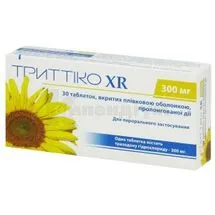
Table of Contents
INSTRUCTIONS FOR MEDICAL USE OF THE MEDICINAL PRODUCT Trittico XR (Trittico® XR)
Composition:
Active ingredient: trazodone hydrochloride;
1 tablet contains trazodone hydrochloride 300 mg;
Excipients: hypromellose, colloidal anhydrous silicon dioxide, sodium stearyl fumarate, modified pregelatinized starch (E 1442);
Coating composition: coating mixture "Opadry® II, Pink 85F94306" (polyvinyl alcohol, talc, macrogol, titanium dioxide (E 171), yellow iron oxide (E 172), red iron oxide (E 172)).
Pharmaceutical form. Prolonged-release film-coated tablets.
Main physicochemical properties: beige-orange elongated tablets, film-coated, with a central break line on both sides.
Pharmacotherapeutic group. Psychoanaleptics. Antidepressants. Other antidepressants. ATC code N06AX05.
Pharmacological properties.
Pharmacodynamics.
Trazodone is a triazolopyridine derivative. It is effective in the treatment of depressive disorders, including depression associated with anxiety and sleep disturbances, and is characterized by a rapid onset of action (approximately 1 week).
Trazodone is a serotonin reuptake inhibitor and a 5-HT2 receptor antagonist, the activation of which is usually associated with insomnia, anxiety, psychomotor agitation, and changes in sexual function.
Unlike other psychotropic drugs, trazodone is not contraindicated in glaucoma and urinary tract disorders, has no extrapyramidal effects, and does not potentiate adrenergic transmission. Trazodone lacks anticholinergic activity; therefore, it is not associated with the typical cardiac effects seen with tricyclic antidepressants.
Pharmacokinetics.
After administration of trazodone hydrochloride (in the form of film-coated, prolonged-release tablets), at steady-state conditions (up to 300 mg daily for 11 consecutive days), Cmax (maximum plasma concentration at steady state) reaches 2068.0 ± 635.7 ng/mL, with tmax (time to reach maximum concentration) of 7.57 ± 2.3 hours and AUC (area under the pharmacokinetic curve at steady state) of 31671.32 ± 10120.98.
In vitro studies using human liver microsomes have shown that trazodone is primarily metabolized via cytochrome P450 3A4 (CYP3A4).
Clinical characteristics.
Indications.
Depressive disorders with/without anxiety.
Contraindications.
Known hypersensitivity to the drug or its components.
Alcohol intoxication and intoxication with sedatives.
Acute myocardial infarction.
Interaction with other medicinal products and other forms of interaction.
General
The sedative effects of antipsychotics, hypnotics, anxiolytics, and antihistamines may be enhanced. A dose reduction of these agents is recommended.
Oral contraceptives, phenytoin, carbamazepine, and barbiturates accelerate the metabolism of antidepressants due to their hepatic effects. Cimetidine and certain other antipsychotics slow down the metabolism of antidepressants.
CYP3A4 inhibitors
In vitro metabolism studies indicate a potential for drug interactions when trazodone is used concomitantly with cytochrome CYP3A4 inhibitors such as erythromycin, ketoconazole, itraconazole, ritonavir, indinavir, and nefazodone. Concomitant use of CYP3A4 inhibitors may significantly increase trazodone plasma concentrations. In vivo studies in healthy volunteers have confirmed that after administration of ritonavir 200 mg twice daily, trazodone plasma levels increased by more than two-fold, resulting in nausea, syncope, and arterial hypotension. Therefore, when trazodone is used concomitantly with a potent CYP3A4 inhibitor, a reduction in trazodone dose is advisable.
However, whenever possible, concomitant use of trazodone and potent CYP3A4 inhibitors should be avoided altogether.
Carbamazepine
When trazodone is used concomitantly with carbamazepine, trazodone plasma concentrations decrease. When used concomitantly with carbamazepine 400 mg daily, plasma concentrations of trazodone and its active metabolite m-chlorophenylpiperazine decreased by 76% and 60%, respectively. Close monitoring of the patient is required to determine whether an increase in trazodone dosage is necessary.
Tricyclic antidepressants
There is a risk of drug interaction; therefore, concomitant use with trazodone should be avoided. If used together, serotonin syndrome and cardiovascular adverse reactions may be expected.
Fluoxetine
Rare cases of increased trazodone plasma levels and adverse effects have been reported during concomitant use of trazodone and fluoxetine (a CYP1A2/2D6 inhibitor). The mechanism underlying this pharmacokinetic interaction is not fully understood. A pharmacodynamic interaction (serotonin syndrome) cannot be excluded.
Monoamine oxidase inhibitors (MAOIs)
Isolated cases of interactions between trazodone and MAO inhibitors have been reported. Although some physicians practice concomitant use of these agents, it is not recommended to use trazodone together with MAO inhibitors or within 2 weeks after discontinuation of MAO inhibitors. It is also not recommended to initiate MAOI therapy within 1 week after discontinuation of trazodone.
Phenothiazines
Cases of severe orthostatic hypotension have been observed when trazodone is used concomitantly with phenothiazines such as chlorpromazine, fluphenazine, levomepromazine, and perphenazine.
Anesthetics/muscle relaxants
Trazodone hydrochloride may enhance the effects of muscle relaxants and volatile anesthetics. Such combinations should be used with caution.
Alcohol
The sedative effects of alcohol are intensified under the influence of trazodone. Patients should avoid alcohol consumption during trazodone therapy.
Levodopa
Antidepressants may accelerate the metabolism of levodopa.
Other agents
When trazodone is used concomitantly with medicinal products known to prolong the QT interval, the risk of ventricular arrhythmias, including polymorphic ventricular tachycardia (torsade de pointes), may increase. These agents should be used concomitantly with trazodone with caution.
Trazodone is only a very weak inhibitor of norepinephrine reuptake and does not affect the arterial pressure response to tyramine; therefore, an effect of trazodone on the hypotensive action of guanethidine-like compounds is not expected. However, studies in laboratory animals have shown that trazodone may inhibit most of the rapid effects of clonidine.
Although no drug interactions have been reported with concomitant use of other types of antihypertensive agents and trazodone, the possibility of potentiation of effects should be considered.
The frequency of adverse effects may increase when trazodone is used concomitantly with products containing St. John's wort (Hypericum perforatum).
Oral anticoagulants and/or antiplatelet agents: Rarely, effects on anticoagulant activity (laboratory test deviations and/or appearance of clinical signs and symptoms) with increased bleeding have been reported.
Cases of changes in prothrombin time values have been reported in patients receiving trazodone concomitantly with warfarin.
Serum levels of digoxin or phenytoin may increase when these agents are used concomitantly with trazodone. Serum levels of these agents should be monitored in patients receiving such therapy.
Special precautions for use.
The prolonged-release film-coated tablets of the medicinal product Trittiko XR should be taken before meals, unlike other dosage forms of the Trittiko preparation, which should be taken immediately after food.
When switching from other dosage forms of the Trittiko preparation to treatment with Trittiko XR prolonged-release film-coated tablets, the physician should reassess the dosing regimen and route of administration, as well as monitor the patient's clinical condition until stabilization.
Use in children and adolescents
Trazodone should not be used in children and adolescents. In clinical trials involving children and adolescents, suicidal behavior (suicide attempts and suicidal ideation) and hostility (mainly aggression, oppositional behavior, and anger) were observed more frequently in the antidepressant treatment group than in the placebo group. Furthermore, there are currently no data on the long-term safety of the drug in children and adolescents regarding its effects on growth, sexual maturation, and cognitive and behavioral development.
Suicide/suicidal thoughts or clinical worsening
Depression is associated with an increased risk of suicidal thoughts, self-harm, and suicide (suicidal behavior). This risk persists until significant remission occurs. There may be no improvement during the first few weeks of therapy or longer. Patients should be closely monitored until such improvement occurs. General clinical experience indicates a possible increased risk of suicide in the early stages of recovery.
Patients with a history of suicidal behavior or those who had a high degree of suicidal ideation before starting therapy have a higher risk of developing suicidal thoughts or suicide attempts and therefore require careful monitoring during treatment. A meta-analysis of placebo-controlled clinical trials of antidepressants in psychiatric disorders showed that among patients under 25 years of age, individuals receiving antidepressants had a higher risk of suicidal behavior compared to those receiving placebo.
Treatment with this medicinal product should be accompanied by careful monitoring of patients, particularly those at high risk, especially at the beginning of treatment and after dose adjustments. Patients (and caregivers) should be warned to monitor for any clinical worsening, suicidal thoughts or behavior, or unusual changes in behavior, and to seek immediate medical advice if such symptoms occur.
To minimize the potential risk of suicide attempts, especially at the beginning of therapy, the physician should prescribe only limited quantities of trazodone at each visit.
Careful dose selection and regular monitoring are recommended in patients with the following conditions:
- epilepsy (particularly, these patients should not abruptly increase or decrease the dose);
- hepatic or renal impairment, especially severe;
- cardiac diseases such as angina pectoris, conduction disorders, or various degrees of atrioventricular block; recent myocardial infarction;
- hyperthyroidism;
- urinary retention, e.g., due to benign prostatic hyperplasia, although such problems are not expected since the anticholinergic effect of trazodone is minimal;
- acute angle-closure glaucoma, elevated intraocular pressure, although significant changes are not expected since the anticholin游戏副本
Dosage and Administration
This medicinal product is intended for use in adult patients only.
For initial dosing and titration period, other formulations of trazodone are recommended.
The tablets should be taken before a meal with a glass of water; when administered once daily, the drug is preferably taken in the evening or immediately before bedtime.
To ensure prolonged action, the tablets must not be crushed or chewed; if necessary, the tablets can be divided by pressing on both sides of the tablet along the central break line on both sides.
Adult patients
The initial dose of trazodone is 75\–150 mg per day and may be increased by 75 mg per day every three days (e.g., up to 225 mg per day on the fourth day of treatment) up to the maximum dose of Trittico XR 300 mg once daily.
The long-term efficacy of prolonged-release trazodone in maintaining antidepressant effect has not been studied.
Elderly patients
For elderly or debilitated patients, the recommended initial dose of trazodone is 75 mg once daily, taken before bedtime. The dose may be increased as described above, under medical supervision and taking into account tolerability and efficacy.
Hepatic impairment: trazodone is extensively metabolized in the liver and has been associated with hepatotoxicity. Therefore, it should be prescribed with caution in patients with hepatic impairment, especially in cases of severe impairment. Periodic monitoring of liver function may be recommended.
Renal impairment: dose adjustment is generally not required, but caution is advised when prescribing to patients with severe renal impairment.
Children. Not to be used in children.
Overdose.
The most commonly observed symptoms in overdose include drowsiness, dizziness, nausea, and vomiting. In severe cases, coma, tachycardia, hypotension, hyponatremia, seizures, and respiratory depression have occurred.
Cardiac symptoms may include bradycardia, QT interval prolongation, and polymorphic ventricular tachycardia (torsade de pointes).
Symptoms may appear within 24 hours after overdose or later.
Concomitant overdose with trazodone and other antidepressants may lead to serotonin syndrome.
Treatment of overdose
There is no specific antidote. Activated charcoal should be administered to adults who have ingested more than 1 g of trazodone, or to children who have ingested more than 150 mg of trazodone, within 1 hour of overdose detection. In other cases in adults, gastric lavage may be considered within 1 hour after ingestion of potentially life-threatening doses.
Patient monitoring is required for at least 6 hours after drug intake (or 12 hours in case of intake of extended-release formulation). Blood pressure, pulse, and Glasgow Coma Scale (GCS) scores should be monitored. In case of decreased GCS score, oxygen saturation should be monitored.
Cardiac monitoring is necessary in symptomatic patients.
Isolated, brief seizures do not require treatment. For frequent or prolonged seizures, intravenous diazepam (0.1\–0.3 mg/kg body weight) or lorazepam (4 mg for adults and 0.05 mg/kg for children) should be administered.
If these measures fail to control seizures, intravenous infusion of phenytoin may be considered. Oxygen should be administered as needed, and acid-base balance and metabolic disturbances should be corrected.
In cases of hypotension and excessive sedation, symptomatic and supportive therapy should be provided. If severe hypotension persists, the use of inotropic agents such as dopamine or dobutamine should be considered.
Side effects.
Cases of suicidal ideation and suicidal behavior have been reported during therapy with trazodone or shortly after discontinuation.
The following symptoms have also been observed in patients receiving trazodone therapy, some of which are common in untreated depression.
| MedDRA System Organ Class |
Frequency unknown (cannot be estimated from available data) |
| Blood and lymphatic system disorders |
Blood dyscrasias (including agranulocytosis, thrombocytopenia, eosinophilia, leukopenia, and anemia) |
| Immune system disorders |
Allergic reactions |
| Endocrine disorders |
Syndrome of inappropriate antidiuretic hormone secretion |
| Metabolism and nutrition disorders |
Hypotension1, weight decrease, loss of appetite, increased appetite |
| Psychiatric disorders |
Suicidal ideation or suicidal behavior2, confusion, insomnia, disorientation, mania, anxiety, nervousness, agitation (rarely progressing to delirium), delirium, aggressive reaction, hallucinations, nightmares, decreased libido, drug withdrawal syndrome |
| Nervous system disorders |
Serotonin syndrome, seizures, neuroleptic malignant syndrome, dizziness, vertigo, headache, somnolence3, restlessness, decreased attention, tremor, blurred vision, memory impairment, myoclonus, expressive aphasia, paresthesia, dystonia, taste disturbances |
| Cardiac disorders |
Cardiac arrhythmias4 (including polymorphic ventricular tachycardia (torsade de pointes), palpitations, ventricular extrasystoles, paired ventricular extrasystoles, ventricular tachycardia), bradycardia, tachycardia, ECG abnormalities (prolonged QT interval)2 |
| Vascular disorders |
Orthostatic hypotension, hypertension, syncope |
| Respiratory, thoracic and mediastinal disorders |
Nasal congestion, dyspnea |
| Gastrointestinal disorders |
Nausea, vomiting, dry mouth, constipation, diarrhea, dyspepsia, abdominal pain, gastroenteritis, increased salivation, paralytic ileus |
| Hepatobiliary disorders |
Liver function abnormalities (including jaundice and hepatocellular injury)5, intrahepatic cholestasis |
| Skin and subcutaneous tissue disorders |
Skin rashes, pruritus, hyperhidrosis |
| Musculoskeletal and connective tissue disorders |
Limb pain, back pain, myalgia, arthralgia |
| Renal and urinary disorders |
Urinary disorders, urinary incontinence, urinary retention |
| Reproductive system and breast disorders |
Priapism6 |
| General disorders |
Weakness, edema, influenza-like symptoms, increased fatigue, chest pain, increased body temperature |
| Investigations |
Elevated liver enzymes |
1 In patients with relevant symptoms, fluid levels and electrolyte balance in the body should be monitored.
2 See also section "Special precautions for use".
3 Trazodone is a sedative antidepressant, and drowsiness sometimes experienced by patients during the first days of therapy usually disappears with continued use of the drug.
4 Animal studies have shown that trazodone has less cardiotoxicity than tricyclic antidepressants, and clinical data suggest that trazodone is less likely to cause cardiac arrhythmias in humans. However, clinical studies in patients with pre-existing heart disease indicate that trazodone may have arrhythmogenic effects in some individuals within this population.
5 Rare cases of adverse reactions, sometimes severe, affecting the liver have been reported.
6 See also section "Special precautions for use".
Reporting suspected adverse reactions.
Reporting suspected adverse reactions after drug registration is of great importance. It enables ongoing monitoring of the benefit-risk balance of the drug. Healthcare and pharmacy professionals, as well as patients or their legal representatives, should report all suspected adverse reactions and lack of drug efficacy via the Automated Pharmacovigilance Information System at the following link: https://aisf.dec.gov.ua
Shelf life.
4 years.
Storage conditions.
This medicinal product does not require any special storage conditions. Half a tablet may be stored for up to 24 hours in the original packaging to protect from light.
Packaging.
10 tablets in a PVC-PVdCH/aluminum blister; 1, 2, or 3 blisters in a cardboard box. 7 tablets in a PVC-PVdCH/aluminum blister; 2 or 4 blisters in a cardboard box.
Prescription status. Prescription only.
Manufacturer/Applicant. Azienide Chimiche Riunite Angelini Francesco A.C.R.A.F. S.p.A., Italy.
Address of manufacturer and its place of business/Address of applicant. Via Vecchio del Pinocchio, 22 - 60131 Ancona (AN), Italy / Viale Amelia, 70 – 00181 - Rome, Italy.