Trimistin®-darnitsa
Ukraine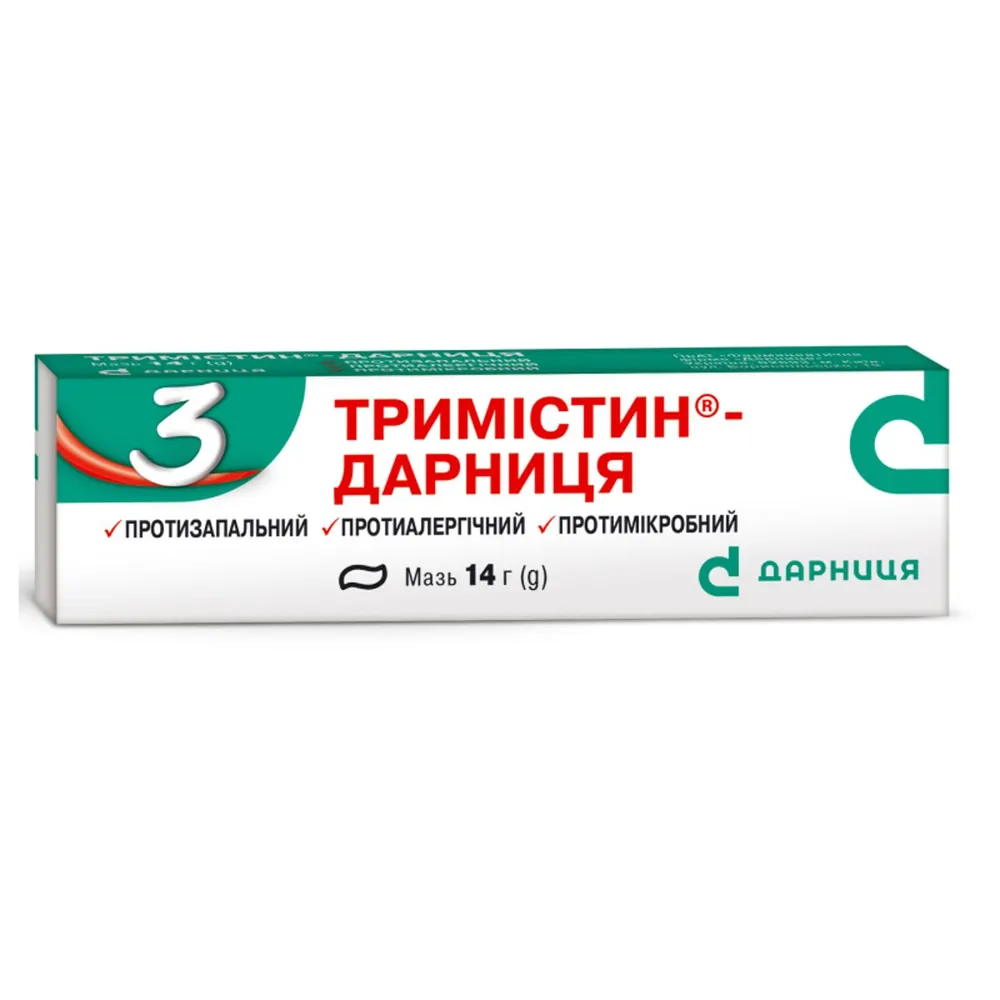
Table of Contents
INSTRUCTIONS for medical use of the medicinal product Trimistin®-Darnitsa (Trimistin-Darnitsa)
Composition:
Active substances: 1 g of ointment contains micronized triamcinolone acetonide 0.25 mg, miramistin 5 mg;
Excipients: propylene glycol, betacyclodextrin, cetyl alcohol, stearyl alcohol, purified water.
Medicinal form. Ointment.
Main physicochemical properties: white ointment, gel-like consistency, with a faint specific odor; should be homogeneous in appearance.
Pharmacotherapeutic group. Corticosteroids in combination with antiseptics.
ATC code D07BB03.
Pharmacological Properties.
Pharmacodynamics.
Trimistin®-Darnytsia ointment is a combined medicinal product for topical use. Active ingredients: triamcinolone acetonide and miramistin.
Triamcinolone is a fluorinated glucocorticosteroid with pronounced anti-inflammatory, antiallergic, and anti-exudative effects. By interacting with specific protein receptors in target tissues, it regulates the expression of corticosteroid-dependent genes and influences protein synthesis. It reduces the formation, release, and activity of inflammatory mediators (histamine, kinins, prostaglandins, lysosomal enzymes). It inhibits cell migration to the site of inflammation, reduces vasodilation and vascular permeability at the inflammatory focus, stabilizes lysosomal enzymes in leukocyte membranes, suppresses antibody synthesis, and disrupts antigen recognition. It inhibits the release of interleukin-1, interleukin-2, and gamma-interferon from lymphocytes and macrophages. It induces lipocortin production, suppresses the release of inflammatory mediators by eosinophils, and stabilizes mast cell membranes. All these effects suppress tissue inflammatory responses to mechanical, chemical, or immune injury.
Miramistin is a broad-spectrum antiseptic agent with bactericidal activity (hydrophobic interaction with microbial membranes leads to their destruction). It is effective against Gram-positive (primarily Staphylococcus spp., Streptococcus spp., Streptococcus pneumoniae) and Gram-negative microorganisms (including aerobes and anaerobes), spore-forming and non-spore-forming microflora, both as monocultures and microbial associations (including hospital strains with polyresistance to antibiotics). It has antifungal activity against Aspergillus and Penicillium genera, yeast fungi (Rhodotorula rubra, Torulopsis gabrata, etc.), yeast-like fungi (Candida albicans, Candida tropicalis, Candida krusei, etc.), dermatophytes (Trichophyton rubrum, Trichophyton mentagrophytes, Trichophyton verrucosum, Trichophyton schoenleinii, Trichophyton violaceum, Epidermophyton Kaufman-Wolf, Epidermophyton floccosum, Microsporum gypseum, Microsporum canis, etc.), as well as other pathogenic fungi such as Pityrosporum orbiculare (Malassezia furfur), both as monocultures and microbial associations, including fungal microflora resistant to chemotherapeutic agents. Miramistin reduces microbial resistance to antibiotics. It effectively prevents wound infection and stimulates regenerative processes.
Pharmacokinetics.
The physicochemical properties of the ointment base, along with high-molecular-weight polymers possessing sorption properties present in the base, retain the active components of the ointment at the site of application and prevent their diffusion into the systemic circulation.
Clinical characteristics.
Indications.
Inflammatory skin diseases, particularly those complicated by bacterial or fungal infections: eczema, atopic dermatitis, neurodermitis, psoriasis in progressive stage and in exudative form, parapsoriasis, pemphigus, contact dermatitis, seborrheic dermatitis, dermatitis herpetiformis, discoid lupus erythematosus, photodermatoses, cutaneous lymphoma.
Contraindications.
Hypersensitivity to triamcinolone and miramistin or to any of the excipients. The product must not be applied into the eyes or on skin areas near the eyes. Skin tuberculosis localized at the site of ointment application; viral skin infections, especially herpes simplex and varicella; parasitic infections (scabies); syphilitic skin lesions; generalized plaque psoriasis; skin reactions following vaccination; varicose veins; leg ulcers; perianal and genital pruritus; facial skin lesions (rosacea, vulgar acne, perioral dermatitis); skin maceration caused by wet diapers; treatment of dry desquamation; application of ointment on breasts immediately before breastfeeding. Skin cancer.
Interaction with other medicinal products and other forms of interactions.
The efficacy of the ointment is partially reduced when applied to surfaces with a high content of purulent-necrotic material. Therefore, it is preferable to apply the ointment after cleansing the skin with warm soapy solution or, if necessary, with antiseptic solutions.
Products containing anionic surfactants (soapy solutions) inactivate the medicinal product.
When miramistin is used concomitantly with systemic or topical antibiotics, decreased microbial resistance to the latter has been observed.
Special precautions for use.
The efficacy of the ointment is partially reduced when applied to surfaces with a high content of purulent-necrotic masses. Therefore, it is preferable to apply the ointment after cleansing the skin with warm soapy water or, if necessary, with antiseptic solutions.
During the use of the cream, microorganisms present on the skin (primarily pyogenic microorganisms, sometimes blastomycetes) may penetrate through the softened stratum corneum and cause various pyodermas, which are treated with washable disinfecting agents.
Do not use the medicinal product in ophthalmology. Avoid contact of the medicinal product with the eyes, and do not apply the ointment to the skin around the eyes, as this may lead to the development of glaucoma, cataract, fungal eye infections, exacerbation of herpes infection, or central serous chorioretinopathy (CSCR)—a rare condition reported with systemic and topical corticosteroid use.
If skin irritation or signs of hypersensitivity occur during the use of the ointment, treatment should be discontinued and appropriate therapy should be initiated. Prolonged use of the medicinal product on the facial skin is not recommended, as it may enhance adverse effects. The ointment should not be used for the treatment of varicose ulcers.
With prolonged use of the medicinal product or when occlusive dressings are applied to the same area of the body, skin atrophy may develop. Additionally, when treating large body surfaces, systemic adverse effects on the endocrine system are possible. These adverse reactions are extremely rare, reversible, and resolve immediately after discontinuation of the medicinal product. Patients undergoing treatment with the ointment should have regular monitoring of hypothalamic-pituitary-adrenal (HPA) axis function. If symptoms of HPA axis suppression occur, the medicinal product should be discontinued or the intervals between applications should be increased.
Topical steroids used in psoriasis treatment may in some cases lead to disease relapse, development of tolerance, withdrawal syndrome, increased risk of generalized pustular psoriasis, and risk of local or systemic toxicity (reversible suppression of the hypothalamic-pituitary-adrenal system) due to impaired skin barrier function. Treatment of patients with psoriasis using topical corticosteroids should only be performed under strict medical supervision.
Certain body areas, such as axillae and inguinal folds (where natural occlusion occurs), are more susceptible to the risk of developing striae and clearly noticeable, irreversible skin atrophy. Therefore, use of the medicinal product on these areas should be short-term.
If fungal or bacterial superinfection of the skin develops, additional treatment with antifungal or antibacterial agents is required.
The use of the ointment on the hairy part of the scalp is not recommended.
Use during pregnancy or breastfeeding.
The use of the cream during the first trimester of pregnancy is contraindicated. The decision regarding use of the medicinal product during the second and third trimesters of pregnancy and during breastfeeding must be made by the physician on an individual basis, carefully weighing the benefit to the mother against the potential risk to the fetus/child. Data confirming the safety of the medicinal product during the second and third trimesters of pregnancy are insufficient.
Systemic absorption of glucocorticosteroids is associated with their passage into breast milk and potential effects on the adrenal cortex and growth of the infant. Local application of triamcinolone during breastfeeding is not recommended.
Application of the ointment to the skin of the breasts immediately before breastfeeding is contraindicated.
Ability to influence reaction rate when driving or operating machinery.
The medicinal product generally does not affect the patient's reaction speed when driving or operating machinery. However, when driving or operating machinery, particular caution is advised due to the potential for adverse nervous system reactions.
Method of Administration and Dosage
For external use only.
Before application, if there is exudation, treat the eroded surface with 1% boric acid solution, 3% hydrogen peroxide, or 0.05% chlorhexidine digluconate solution. If necessary, apply the ointment under a sterile gauze dressing.
Adults: Apply a thin layer of ointment once or twice daily to the affected area of skin (maximum dose – no more than 15 g of ointment per day). Alternatively, the medicinal product may be used under an occlusive dressing (maximum dose – 10 g of ointment per day). The duration of treatment should be determined individually by a physician.
Elderly patients: The medicinal product should be used with caution and for short periods, as skin in this patient group is typically thinner.
Children
Due to insufficient experience with the use of Trimistin®-Darnytsia ointment in pediatric patients, it should not be used in pediatric practice.
Overdose
When applied to large areas of affected skin, partial absorption of the active components into the systemic circulation cannot be excluded, although the amounts absorbed are not sufficient to cause acute poisoning.
However, depending on the amount of corticosteroid absorbed, local and systemic adverse reactions may occur. Systemic effects of miramistin are manifested as those of a cationic detergent and may prolong bleeding time.
In case of overdose, treatment should not be abruptly discontinued; instead, it should be gradually tapered by reducing the dose. If symptoms of adrenal insufficiency develop, intravenous hydrocortisone may be required. Treatment is symptomatic.
Adverse reactions.
Ocular disorders: cataract, posterior subcapsular cataract, exophthalmos, glaucoma, optic disc edema, corneal ulcer, exophthalmos, choroidoretinopathy, blurred vision. The risk of cataract development is higher in children.
Gastrointestinal disorders: gastric bleeding, gastrointestinal bleeding, gastrointestinal perforation, esophagitis, pancreatitis, peptic ulcer.
Nervous system disorders: psychiatric disorders, seizures, dizziness, headache, increased intracranial pressure, insomnia.
Cardiovascular disorders: heart failure, arterial hypertension.
Immune system disorders: hypersensitivity reactions.
Skin and subcutaneous tissue disorders: hyperemia, burning sensation, irritation, dryness, increased sensitivity, skin thinning, folliculitis, hirsutism, acneiform eruptions, hypopigmentation, perioral dermatitis, facial erythema and telangiectasias, increased sweating, striae formation, allergic contact dermatitis, intertrigo, secondary infections, delayed wound healing, increased swelling, itching, weeping, skin atrophy, delayed skin test reactions, contact eczema, steroid acne, purpura.
Musculoskeletal and connective tissue disorders: growth retardation in children, steroid myopathy, osteoporosis, osteonecrosis, aseptic necrosis.
Infections and parasitic diseases: activation of latent infections, masking of infection symptoms, opportunistic infections.
General disorders: in some patients, prolonged use over large areas may lead to systemic adverse effects: adrenal cortex suppression, reduced carbohydrate tolerance, Cushing's syndrome; negative nitrogen balance due to enhanced protein catabolism may occur.
Water-electrolyte metabolism disorders: adrenal cortex suppression (secondary adrenal insufficiency), hypokalemic alkalosis, water and sodium retention, hypokalemia, arterial hypertension.
Laboratory abnormalities: elevated intraocular pressure, negative nitrogen balance, delayed skin test reactions.
Shelf life. 2 years.
Storage conditions.
Store in the original packaging at a temperature not exceeding 25 °C. Do not freeze.
Keep out of reach of children.
Packaging.
14 g in a tube; 1 tube per carton.
Prescription status. Over-the-counter.
Manufacturer. JSC "Pharmaceutical Company "Darnytsia".
Manufacturer's address.
13, Boryspylska Street, Kyiv, 02093, Ukraine.