Trixilor
Ukraine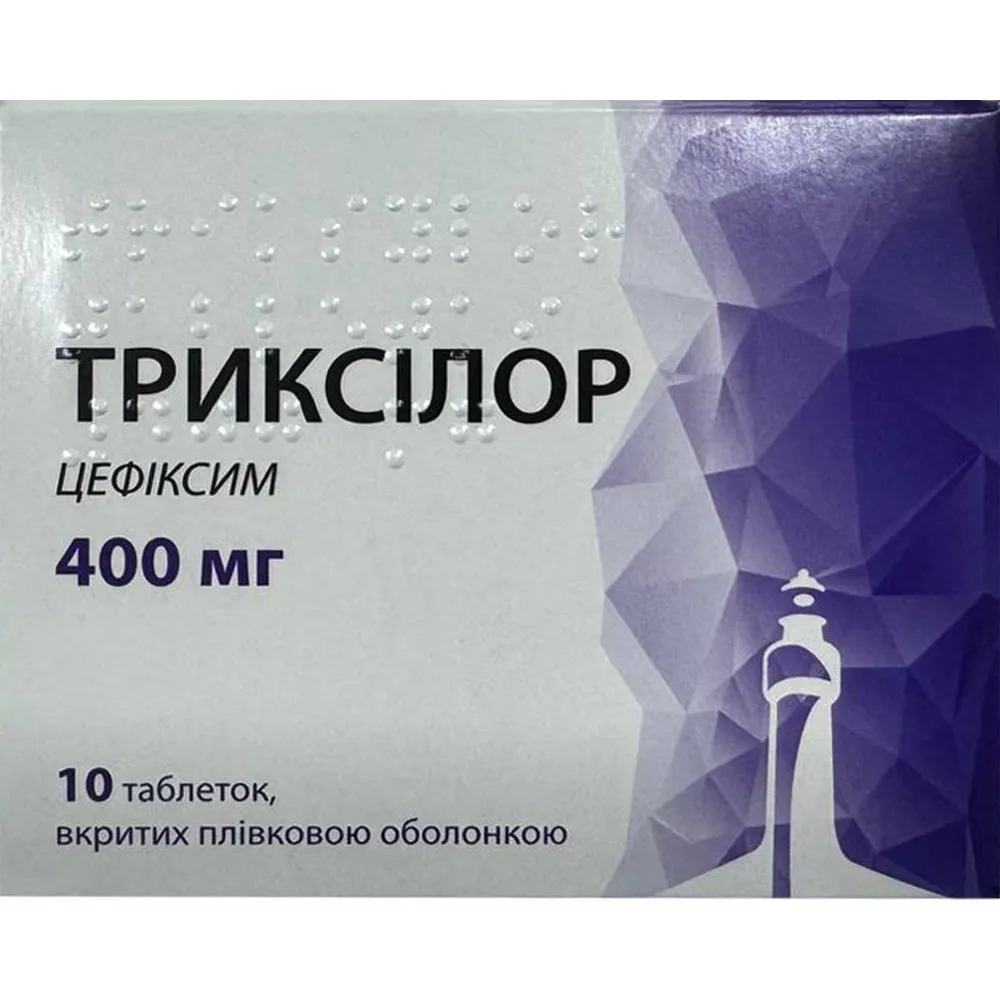
Table of Contents
INSTRUCTIONS FOR MEDICAL USE OF THE MEDICINAL PRODUCT TRIXILOR (TRIXILOR)
Composition:
Active substance: cefixime;
One film-coated tablet contains 400 mg of cefixime (as cefixime trihydrate);
Excipients: microcrystalline cellulose; pregelatinized starch; calcium hydrogen phosphate, dihydrate, unmilled; calcium hydrogen phosphate, dihydrate, powder; magnesium stearate;
Film coating: "Opadry AMB White OY-B-28920" or equivalent amount, polyvinyl alcohol, titanium dioxide (E 171), talc, lecithin, xanthan gum.
Pharmaceutical form. Film-coated tablets.
Main physicochemical properties: elongated film-coated tablets, white in color, with a break line on both sides and embossing "F" on one side and "P1" on the other.
Pharmacotherapeutic group. Third-generation cephalosporin antibiotic. ATC code J01D D08.
Pharmacological Properties
Pharmacodynamics
Cefixime is a new oral cephalosporin characterized by a broad spectrum of bactericidal activity and high stability against the hydrolytic activity of beta-lactamases. The bactericidal effect of cefixime is due to inhibition of bacterial cell wall synthesis. It is active in vitro against a wide range of clinically significant gram-positive and gram-negative pathogens.
Cefixime is particularly active against the following bacteria: Streptococcus (except enterococci), Haemophilus, Branhamella, Neisseria, Escherichia, Klebsiella, Proteus, Enterobacter, Pasteurella, Providencia, Salmonella, Shigella, Citrobacter, Serratia. However, the following bacteria are predominantly resistant to cefixime: Pseudomonas sp., Streptococcus sp., Listeria monocytogenes, Bacteroides fragilis, and Clostridia.
Pharmacokinetics
Absorption. After a single oral dose of 200 mg, the maximum serum concentration of cefixime is 3 mcg/mL, achieved within 3–4 hours. After a single oral dose of 400 mg, the maximum serum concentration is higher (ranging from 3.5 to 4 mcg/mL), even though there is no direct proportionality to the administered dose. After repeated oral administration of 400 mg/day (one or two doses per day) for 15 days, serum levels and bioavailability remain unchanged, indicating no accumulation of cefixime in the body. After administration of 8 mg/kg of cefixime as a suspension in pediatric patients, serum concentrations are similar to those achieved in adults after a 400 mg dose.
Distribution. The absolute bioavailability of cefixime is approximately 50% and is not altered by food intake. In this case, the time to reach maximum concentration is delayed by approximately 1 hour. The apparent volume of distribution is 17 liters. In animals, after distribution, tissue concentrations of cefixime exceed the minimum inhibitory concentration for sensitive strains (0.20 mcg/mL) in most tissues (except brain).
Elimination. The elimination kinetics of cefixime are characterized by a half-life of 3 to 4 hours. Cefixime is excreted unchanged by the kidneys (16–25%). Non-renal elimination occurs predominantly via bile.
No metabolites have been detected in serum or urine in humans or animals.
In elderly patients, pharmacokinetic parameters are slightly altered. A slight increase in serum concentration, bioavailability, and amount of excreted cefixime (by 15 to 25%) does not require adjustment of the daily dose in this population. In severe renal impairment (creatinine clearance < 20 mL/min), prolonged plasma elimination, prolonged half-life, and increased peak serum concentration necessitate dose reduction from 400 mg to 200 mg/day.
In hepatic insufficiency, elimination is slowed (T1/2 = 6.4 hours), but no adjustment of the daily dose is required.
Protein binding is approximately 70%, primarily to albumin, and is independent of concentration (when therapeutic doses are administered).
Clinical characteristics
Indications. The medicinal product is indicated for use in adults and children aged 12 years and older with body weight above 50 kg for the treatment of infections caused by microorganisms sensitive to cefixime, including:
- upper respiratory tract infections (pharyngitis);
- infections of the ear, nose, and throat (ENT) organs (otitis media, tonsillitis); lower respiratory tract infections (pneumonia, bronchitis);
- kidney and urinary tract infections.
Contraindications. Confirmed hypersensitivity to cephalosporin antibiotics or to any other components of the medicinal product; increased sensitivity to penicillins; porphyria.
Interaction with other medicinal products and other types of interactions
Probenecid (and other tubular secretion blockers) increases the maximum blood concentration of cefixime by slowing renal excretion of cefixime, which may lead to symptoms of overdose.
Salicylic acid increases the concentration of free cefixime by 50% due to displacement of cefixime from protein-binding sites; this effect is concentration-dependent.
Carbamazepine may cause an increase in cefixime plasma concentration; therefore, monitoring of plasma levels of cefixime is advisable.
Nifedipine, a calcium channel blocker, may increase the bioavailability of cefixime by up to 70%.
Coumarin-type anticoagulants. Cefixime should be used with caution in patients receiving anticoagulant therapy, such as warfarin. Since cefixime may potentiate the effect of anticoagulants, prolongation of prothrombin time is possible, with or without clinical signs of bleeding.
Other forms of interactions: the use of cephalosporins may cause false-positive reactions when testing for glucose in urine using Benedict's or Fehling's solutions, or with Clinistix tablets. During cefixime administration, the direct Coombs test may yield false-positive results.
Special precautions for use
Encephalopathy. Beta-lactam antibiotics, including cefixime, may increase the risk of encephalopathy (which may manifest as seizures, confusion, impaired consciousness, and motor disturbances), particularly in cases of overdose or in patients with impaired renal function.
Severe skin reactions. Serious skin reactions, such as toxic epidermal necrolysis, Stevens–Johnson syndrome, and drug reaction with eosinophilia and systemic symptoms (DRESS syndrome), have been observed in some patients receiving cefixime. If serious skin adverse reactions occur, cefixime should be discontinued and appropriate treatment and/or preventive measures should be initiated.
Hypersensitivity reactions. Before administering cefixime, the patient’s history of hypersensitivity reactions to penicillins and cephalosporins, or to other drugs, should be carefully evaluated.
Cefixime should be used with caution in patients with allergic reactions to penicillins. Evidence from both in vivo (in the human body) and in vitro studies indicates the existence of cross-allergic reactions between penicillins and cephalosporins, although such cases are rare. Reactions may occur via an anaphylactic mechanism, especially after parenteral administration.
Antibiotics should be used cautiously in patients with a history of any type of hypersensitivity reaction, particularly following drug administration. If an allergic reaction occurs, the drug should be discontinued immediately.
Antimicrobial resistance. Treatment with cefixime may increase the risk of bacterial resistance, with or without clinically evident superinfection. Superinfection. Prolonged use of antibiotics may occasionally lead to overgrowth of non-susceptible organisms. If superinfection occurs, appropriate therapy should be initiated.
Anemia. Cases of hemolytic anemia, including severe cases with fatal outcomes, have been reported following the use of cephalosporins. Recurrent episodes of hemolytic anemia after cephalosporin administration, including cefixime, have also been reported in patients with a prior history of hemolytic anemia following initial cephalosporin exposure.
Acute renal failure. Like other cephalosporins, cefixime may cause acute renal failure, with tubulointerstitial nephritis being the primary pathological condition. If acute renal failure occurs, cefixime should be discontinued and appropriate therapy and/or interventions should be initiated.
Renal impairment. The dose of cefixime should be appropriately reduced in patients with severe renal impairment and in patients undergoing hemodialysis or peritoneal dialysis (see section "Dosage and administration").
Alterations in intestinal microflora. Prolonged use of antibacterial agents may lead to overgrowth of non-susceptible microorganisms and disruption of normal intestinal microflora, potentially resulting in overgrowth of Clostridium difficile and development of pseudomembranous colitis. In mild cases of antibiotic-associated pseudomembranous colitis, discontinuation of the drug may be sufficient. If colitis symptoms do not improve after discontinuation, oral vancomycin, the antibiotic of choice for pseudomembranous colitis, should be administered.
For moderate to severe colitis requiring treatment, electrolyte and protein solutions should be added. Concomitant use of drugs that reduce intestinal peristalsis should be avoided. Antibiotics with broad-spectrum activity should be used with caution in patients with a history of gastrointestinal disorders, particularly colitis.
Laboratory test data. Reversible changes in liver and kidney function tests and in blood parameters (thrombocytopenia, leukopenia, and eosinophilia) may occur during cefixime therapy.
Cephalosporins enhance the toxicity of alcohol; therefore, consumption of alcoholic beverages during cefixime treatment is not recommended.
Use during pregnancy or breastfeeding
The use of this medicinal product during pregnancy and breastfeeding should be considered only if the expected benefit to the mother outweighs the potential risk to the fetus or infant.
Pregnancy. No embryotoxic effects of cefixime have been observed. However, the use of the drug should be avoided during the first trimester of pregnancy.
Breastfeeding. There are no data on the passage of cefixime into breast milk.
Ability to affect reaction speed when driving or operating machinery. Cefixime does not affect reaction speed when driving or operating machinery. However, if dizziness occurs, driving or operating machinery should be avoided.
Dosage and Administration
The medicinal product can be taken independently of food intake.
The break line on both sides of the tablet is not intended for dividing into equal doses.
The daily dose for adults and children aged 12 years and older with a body weight over 50 kg is a single dose of 400 mg.
The duration of treatment depends on the nature of the disease course and the type of infection. After the disappearance of infection symptoms and/or fever, it is advisable to continue taking the medicinal product for at least 48–72 hours.
To prevent complications, treatment of upper respiratory tract or urinary tract infections with cefixime usually lasts 5–10 days, while lower respiratory tract infections require treatment for 10–14 days.
Treatment of otitis media typically lasts 10–14 days.
For infections caused by group A beta-hemolytic streptococci, to prevent late complications (acute rheumatic fever, glomerulonephritis), treatment should last at least 10 days.
For uncomplicated lower urinary tract infections in women, the medicinal product may be administered for 1–3 days.
The medicinal product should be prescribed with caution to patients with renal impairment; when creatinine clearance is ≤ 20 mL/min, the daily dose should be reduced to 200 mg. There are no age-related dosage restrictions for elderly patients.
Children. The medicinal product is indicated for children aged 12 years and older with a body weight over 50 kg.
Overdose
When using beta-lactam antibiotics, including cefixime, there is a risk of encephalopathy, particularly in cases of overdose or in patients with impaired renal function.
No cases of overdose have been reported. Adverse reactions observed with doses up to 2 g in healthy study participants did not differ from those seen in patients receiving the recommended doses.
Symptoms: intensification of adverse reactions.
Treatment: gastric lavage, symptomatic and supportive therapy. There is no specific antidote. Hemodialysis or peritoneal dialysis only slightly enhances the elimination of cefixime from the body.
Adverse Reactions
Listed below are adverse reactions observed during clinical studies and in the post-marketing period.
| Blood and lymphatic system disorders |
Eosinophilia, hyper-eosinophilia, agranulocytosis, leukopenia, neutropenia, granulocytopenia, hemolytic anemia, thrombocytopenia, thrombocytosis. |
| Gastrointestinal disorders |
Stomach cramps, abdominal pain, diarrhea*, dyspepsia, nausea, vomiting, flatulence, dysbacteriosis, candidiasis of mucous membranes of the mouth, stomatitis, glossitis. |
| Hepatobiliary disorders |
Jaundice, hepatitis, cholestasis. |
| Infections and infestations |
Pseudomembranous colitis, vaginitis. |
| Laboratory findings |
Increased aspartate aminotransferase, increased alanine aminotransferase levels, elevated blood bilirubin, increased blood urea, elevated blood creatinine. |
| Nervous system disorders |
Dizziness, headache. Seizures have been reported during treatment with cephalosporins, including cefixime (frequency unknown)**. Beta-lactams, including cefixime, may increase the patient's susceptibility to encephalopathy (which may include seizures, confusion, impaired consciousness, movement disorders), particularly in cases of overdose or impaired renal function (frequency unknown)**. |
| Respiratory, thoracic and mediastinal disorders |
Dyspnea |
| Renal and urinary system disorders |
Acute renal failure with tubulointerstitial nephritis (see section "Special precautions"). |
| Immune system disorders |
Anaphylactic reaction, angioneurotic edema, serum sickness-like reaction. |
| Skin and subcutaneous tissue disorders |
Drug reaction with eosinophilia and systemic symptoms (DRESS syndrome), erythema multiforme, Stevens-Johnson syndrome, toxic epidermal necrolysis, urticaria, rash, pruritus, genital pruritus, acute generalized exanthematous pustulosis (see section "Special precautions"). |
| General disorders and administration site conditions |
Drug fever, arthralgia, fever, facial swelling, anorexia, candidal vaginitis. |
* Diarrhea is more frequently associated with higher doses of cefixime. Some cases of moderate to severe diarrhea have been reported; sometimes this required discontinuation of therapy. If severe diarrhea occurs, cefixime administration should be discontinued.
** Cannot be evaluated based on available data.
Reporting suspected adverse reactions. Reporting suspected adverse reactions after drug registration is of great importance. It allows continuous monitoring of the benefit-risk balance of the drug. Medical and pharmaceutical professionals, as well as patients or their legal representatives, should report all suspected adverse reactions and lack of drug efficacy through the Automated Information System for Pharmacovigilance at the following link: https://aisf.dec.gov.ua
Shelf life. 2 years.
Storage conditions. Store in the original packaging at a temperature not exceeding 25 °C. Keep out of reach and sight of children.
Packaging. 5 tablets per blister; 1 or 2 blisters per cardboard box.
Prescription status. Prescription only.
Manufacturer. ACS DOBFAR S.P.A.
Manufacturer's address and location of business operations
V. LAURENTINA KM 24,730, POLENCIA (RM), 00071, Italy