Tricard
Ukraine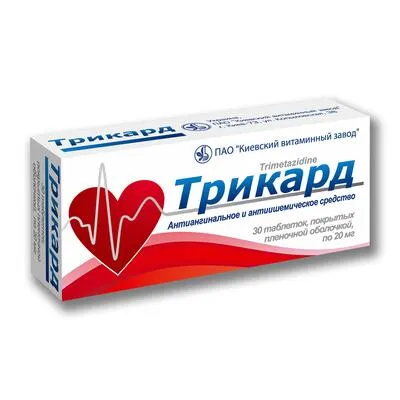
Table of Contents
INSTRUCTIONS FOR MEDICAL USE OF THE MEDICINAL PRODUCT TRICARD (TRICARD)
Composition:
Active substance: 1 tablet contains 20 mg of trimetazidine dihydrochloride;
Excipients: maize starch, mannite (E 421), povidone, magnesium stearate, talc;
Coating: film-coating mixture Opadry II Red (polyethylene glycol, polyvinyl alcohol, titanium dioxide (E 171), yellow lake FCF (E 110), ponceau 4R (E 124), talc).
Pharmaceutical form. Film-coated tablets.
Main physicochemical properties: round, biconvex film-coated tablets of red color.
Pharmacotherapeutic group. Cardiology agents. Trimetazidine. ATC code C01EB15.
Pharmacological Properties.
Pharmacodynamics.
An antianginal and anti-ischemic agent.
Mechanism of action. By preserving cellular energy metabolism in cells suffering from hypoxia or ischemia, trimetazidine prevents a decrease in intracellular ATP levels, thereby ensuring proper functioning of ion pumps and transmembrane sodium-potassium flux while maintaining cellular homeostasis.
Trimetazidine inhibits β-oxidation of fatty acids by blocking long-chain 3-ketoacyl-CoA thiolase (3-KAT), thus enhancing glucose oxidation. In ischemic cells, energy production via glucose oxidation requires less oxygen compared to energy production via β-oxidation of fatty acids. Enhanced glucose oxidation optimizes cellular energy metabolism and consequently supports adequate energy metabolism under ischemic conditions.
Simultaneously, trimetazidine increases phospholipid metabolism and their incorporation into the membrane, thereby providing protection against membrane damage.
In angina pectoris, it reduces the frequency of angina attacks, decreases the need for nitroglycerin, improves exercise tolerance, and does not affect arterial blood pressure or heart rate.
Pharmacodynamic effects. In patients with ischemic heart disease, trimetazidine acts as a metabolic agent, preserving intracellular levels of high-energy phosphates in the myocardium. These effects are achieved without concomitant hemodynamic effects.
Pharmacokinetics.
After oral administration, trimetazidine is rapidly and almost completely absorbed through the intestinal mucosa; food intake does not affect drug absorption. Maximum plasma concentration is reached within 2–3 hours and is directly proportional to the dose. Plasma protein binding is low – 16–21%. Trimetazidine undergoes biotransformation, forming three major and several minor metabolites. It is well distributed in tissues, with a volume of distribution of approximately 4.8 L/kg. Elimination half-life is 6–7 hours. It is excreted predominantly by the kidneys (85%), with a small amount eliminated via the intestine (6%). Data on the passage of trimetazidine into breast milk are lacking.
Clinical characteristics.
Indications.
In adults, trimetazidine is indicated for symptomatic treatment of stable angina pectoris when first-line antianginal therapies are insufficiently effective or not tolerated.
Contraindications.
Hypersensitivity to the active substance or to any of the excipients. Parkinson's disease, symptoms of parkinsonism, tremor, restless legs syndrome, and other related movement disorders. Severe renal impairment (creatinine clearance < 30 mL/min).
Interaction with other medicinal products and other forms of interaction.
No cases of interaction with other medicinal products have been reported. In particular, trimetazidine may be administered in combination with heparin, calciparine, vitamin K antagonists, oral lipid-lowering agents, aspirin, β-blockers, calcium antagonists, and digitalis preparations (trimetazidine does not affect plasma digoxin levels).
Special precautions for use
The medicinal product should be used for the baseline treatment of angina pectoris, but not for the relief of acute angina attacks. It should not be prescribed for unstable angina or myocardial infarction as primary therapy at the pre-hospital stage or during the first days of hospitalization. If an episode of unstable angina occurs during ongoing treatment, the therapy should be reassessed and appropriate medical treatment initiated, and revascularization considered depending on the severity of the condition.
Trimetazidine may induce or worsen symptoms of parkinsonism (tremor, akinesia, muscle hypertonia), which should be regularly monitored, especially in elderly patients. In doubtful cases, patients should be referred to a neurologist for appropriate evaluation. If movement disorders occur, such as parkinsonism symptoms, restless legs syndrome, tremor, or gait instability, trimetazidine should be discontinued. These events are rare and usually resolve after treatment withdrawal; in most patients, resolution occurs within 4 months after stopping trimetazidine. If parkinsonism symptoms persist beyond 4 months after discontinuation of the drug, patients should be referred to a neurologist.
Falls related to gait instability or arterial hypotension may occur, particularly in patients receiving antihypertensive therapy (see section "Adverse reactions").
Trimetazidine should be prescribed with caution:
- in patients with moderate renal impairment;
- in patients aged 75 years and older.
In renal impairment, monitoring of functional parameters is recommended and the dose may be reduced if necessary.
Severe cutaneous adverse reactions. Severe skin adverse reactions have been reported during treatment with trimetazidine, including drug reaction with eosinophilia and systemic symptoms (DRESS syndrome) and acute generalized exanthematous pustulosis, which may be life-threatening or lead to fatal outcomes. When prescribing the medicinal product, patients should be informed about the signs and symptoms of severe skin reactions, and careful monitoring of patients should be performed during treatment. If signs or symptoms suggestive of these reactions occur, trimetazidine should be immediately discontinued and alternative therapy considered (if necessary).
Use during pregnancy or breastfeeding.
Due to the lack of clinical data on the use of the medicinal product, its use is not recommended during pregnancy or breastfeeding.
Ability to affect reaction speed when driving or operating machinery.
Trimetazidine has no effect on hemodynamics; however, cases of dizziness and somnolence have been reported (see section "Adverse reactions"), which may affect the ability to drive or operate machinery.
Dosage and Administration
The medicinal product should be administered to adults at a dose of 1 tablet three times daily during meals, with sufficient amount of water. The duration of treatment is determined individually, depending on the severity and course of the disease.
Patients with renal impairment. For patients with moderate renal function impairment (creatinine clearance 30–60 mL/min) (see section "Special Warnings and Precautions for Use"), the recommended dose is 1 tablet twice daily, i.e. once in the morning and once in the evening during meals.
Elderly patients. Elderly patients are more sensitive to the effects of trimetazidine due to age-related decline in renal function. For patients with moderate renal function impairment (creatinine clearance 30–60 mL/min), the recommended dose is 1 tablet twice daily, i.e. once in the morning and once in the evening during meals.
Careful dose titration is required for elderly patients.
Children. Safety and efficacy of trimetazidine in children have not been established. Data are lacking.
Overdose.
Data regarding trimetazidine overdose are limited.
Treatment is symptomatic.
Adverse reactions.
Gastrointestinal disorders: epigastric pain, diarrhea, dyspepsia, nausea and vomiting, constipation.
General disorders: asthenia.
Nervous system disorders: headache, dizziness; infrequently – paresthesia; symptoms of parkinsonism (tremor, akinesia, muscle hypertonia, gait instability, restless legs syndrome, and other movement disorders related to the above), which usually resolve after discontinuation of treatment; sleep disorders (insomnia, somnolence).
Skin and subcutaneous tissue disorders: rash, pruritus, urticaria; frequency not known – drug reaction with eosinophilia and systemic symptoms (DRESS syndrome), acute generalized exanthematous pustulosis (see section "Special precautions"), angioneurotic edema.
Cardiovascular system disorders: arterial hypotension, orthostatic hypotension (which may be associated with malaise, dizziness or falls, particularly in patients receiving antihypertensive agents), facial flushing, palpitations, extrasystole, tachycardia.
Blood and lymphatic system disorders: agranulocytosis, thrombocytopenia, thrombocytopenic purpura.
Hepatobiliary disorders: hepatitis.
Due to the presence of colorants yellow sunset FCF (E 110) and ponceau 4R (E 124) in the composition of the medicinal product, allergic reactions may occur, including bronchial asthma, especially in patients with allergy to acetylsalicylic acid.
Shelf life. 3 years.
Storage conditions.
Store in the original packaging at a temperature not exceeding 25 °C.
Keep out of reach of children.
Packaging. 10 tablets in a blister; 3 blisters in a carton.
Prescription status. Prescription only.
Manufacturer. JSC "KYIV VITAMIN PLANT".
Manufacturer's address and location of business activity.
38 Kopilivska Street, Kyiv, 04073, Ukraine.
Web-site: www.vitamin.com.ua.