Triactan®
Ukraine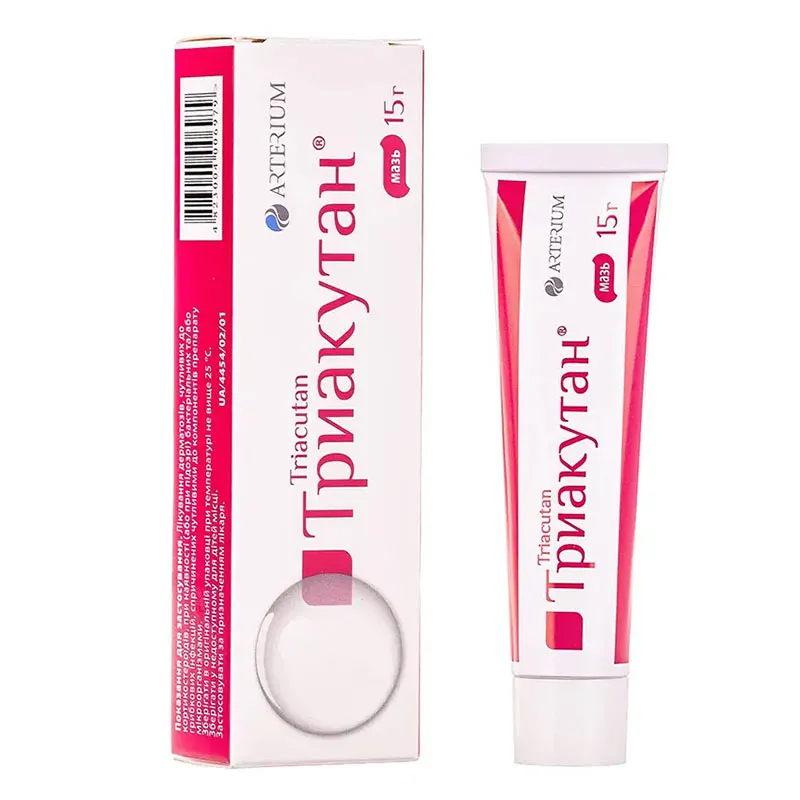
Table of Contents
INSTRUCTIONS FOR MEDICAL USE OF THE MEDICINAL PRODUCT TRIACUTAN® (TRIACUTAN)
Composition:
Active substances: 1 g of cream contains: betamethasone dipropionate* – 0.64 mg; gentamicin sulfate, calculated as gentamicin** – 1.0 mg; clotrimazole*** – 10 mg;
Excipients: methylparaben (methyl p-hydroxybenzoate) (E 218) – 2.0 mg; propylene glycol; disodium edetate (EDTA disodium); mineral oil; white soft paraffin; cetyl stearyl alcohol; polyethylene glycol (macrogol) cetyl stearyl ether; sodium dihydrogen phosphate monohydrate; sodium hydrogen phosphate dodecahydrate; purified water.
* – betamethasone dipropionate, calculated as 100 % substance;
** – gentamicin sulfate, calculated as gentamicin (calculated as anhydrous gentamicin);
*** – clotrimazole, calculated as 100 % substance.
Pharmaceutical form. Cream.
Main physicochemical characteristics: white or almost white cream.
Pharmacotherapeutic group.
Corticosteroids for dermatological use. Corticosteroids in combination with antibiotics. Betamethasone and antibiotics.
ATC code D07CC01.
Pharmacological properties.
Pharmacodynamics.
The medicinal product combines the anti-inflammatory effect of betamethasone dipropionate, the antibacterial activity of gentamicin sulfate, and the antifungal effect of clotrimazole.
Betamethasone dipropionate is a potent (class III) corticosteroid with anti-inflammatory, antiallergic, and antipruritic effects.
Gentamicin is an antibiotic from the aminoglycoside group with bactericidal activity. Its mechanism of action involves inhibition of protein synthesis in microorganisms sensitive to the antibiotic. Gentamicin is active against many aerobic gram-negative bacteria and a few gram-positive bacteria. In vitro, gentamicin at concentrations of 1–8 mcg/mL inhibits most susceptible strains of Escherichia coli, Haemophilus influenzae, Moraxella lacunata, Neisseria, indole-positive and indole-negative Proteus strains, Pseudomonas (including most strains of Pseudomonas aeruginosa), Staphylococcus aureus, Staphylococcus epidermidis, and Serratia. Different species and even strains of the same species may show significant differences in in vitro sensitivity. Moreover, in vitro sensitivity does not always correlate with in vivo sensitivity. Gentamicin is ineffective against most anaerobic bacteria, fungi, and viruses. Gentamicin has only minimal efficacy against streptococci.
Resistance to gentamicin may develop in both gram-negative and gram-positive bacteria.
Clotrimazole is a synthetic antifungal agent belonging to the imidazole derivatives group. Its spectrum of activity includes various fungi pathogenic for humans and animals. Clotrimazole is effective against dermatophytes, yeasts, and molds. In vitro studies have demonstrated the efficacy of clotrimazole against Trichophyton rubrum, Trichophyton mentagrophytes, Epidermophyton floccosum, Microsporum canis, and Candida species (including Candida albicans). The antifungal action of clotrimazole is known to result from inhibition of ergosterol synthesis, which is an essential component of the fungal cell membrane.
Pharmacokinetics.
Pharmacokinetic studies of the medicinal product have not been conducted.
Betamethasone. Under normal conditions, only a portion of topically applied betamethasone becomes systemically available. The extent of penetration depends on the site of application, skin condition, pharmaceutical formulation, patient's age, and method of application.
Gentamicin. Gentamicin is not absorbed through intact skin after topical application. However, when applied to damaged or inflamed skin or under occlusive dressings over small skin areas, systemic absorption of gentamicin may occur.
Clotrimazole. After application to the skin, systemic absorption is low, with most of the clotrimazole remaining in the stratum corneum. Such concentrations were observed 6 hours after application of 1% radiolabeled clotrimazole to intact skin and skin with acute inflammation: stratum corneum = 100 mcg/cm³, reticular layer = 0.5–1 mcg/cm³, subcutaneous layer = 0.1 mcg/cm³.
Clinical characteristics.
Indications.
Treatment of dermatoses sensitive to corticosteroids, when (or suspected) bacterial and/or fungal infections caused by microorganisms sensitive to the components of the drug are present.
Contraindications.
The product is contraindicated in patients with hypersensitivity to the active substances or to any other component of the product, to other aminoglycoside antibiotics (cross-allergic reactions to gentamicin), or to imidazole derivatives (cross-allergic reactions to clotrimazole). The medicinal product is also contraindicated in skin tuberculosis, cutaneous manifestations of syphilis, skin reactions following vaccination, skin ulcers, acne, widespread plaque psoriasis, viral skin infections (e.g., herpes simplex, herpes zoster), varicose veins, perioral dermatitis, rosacea, chickenpox, and other bacterial and fungal skin infections without appropriate antibacterial and antifungal therapy.
Triakutan® is not indicated for use under occlusive dressings. The product should not be applied to mucous membranes, eyes, or the area around the eyes.
Do not use the cream for the treatment of nails or scalp skin infections.
Interaction with other medicinal products and other forms of interaction.
When the cream is applied to the genital area or the anal opening, the presence of soft paraffin (an excipient in the formulation) may reduce the tensile strength of latex condoms, thereby decreasing their reliability during use. When applied topically, clotrimazole may act as an antagonist to amphotericin and other polyene antibiotics.
Special precautions for use.
The cream is particularly suitable for the treatment of disorders in the exudative stage. The medicinal product is not intended for ophthalmological use.
If skin irritation or signs of hypersensitivity occur, treatment with the cream should be discontinued and appropriate therapy should be initiated.
With topical application, systemic absorption of active substances may be higher when the medicinal product is applied to large areas of skin, especially during prolonged use or on damaged skin. In such cases, adverse reactions typical of systemic administration of the active substances may occur.
When aminoglycoside antibiotics are administered systemically concurrently, the possibility of cumulative toxic effects (ototoxicity/nephrotoxicity) should be considered in case of increased absorption.
Particular attention should be paid to possible cross-allergic reactions with other aminoglycoside antibiotics.
Prolonged topical use of antibiotics may occasionally lead to the growth of resistant microflora. In such cases, as well as in the event of superinfection, appropriate treatment should be initiated.
The medicinal product should be used in high doses, over large body areas, or with potent or very potent corticosteroids only under regular medical supervision, particularly regarding suppression of the hypothalamic-pituitary-adrenal system (HPA) and possible metabolic effects. If HPA suppression occurs, the medicinal product should be discontinued or the frequency of application reduced, or the patient should be switched to a less potent corticosteroid. HPA function usually recovers after discontinuation of the medicinal product. In some cases, withdrawal symptoms may develop, requiring administration of systemic corticosteroids.
Application of the medicinal product on open wounds or damaged skin should be avoided.
Continuous treatment for more than 2–3 weeks is not recommended.
Potent, very potent, and moderately potent corticosteroids should be used with caution when applied to facial or genital skin. In such cases, the treatment course should not exceed 1 week.
In general, only low-potency corticosteroids should be used around the eyes (due to the risk of glaucoma).
Corticosteroids may mask symptoms of an allergic reaction to one of the components of the medicinal product.
Patients should be advised to use the medicinal product only for personal treatment of their diagnosed skin condition and not to pass it on to others.
When using systemic and topical corticosteroids (including intranasal, inhaled, and intraocular administration), visual disturbances may occur. If symptoms such as blurred vision or other visual disturbances occur, the patient should undergo an ophthalmological examination to evaluate possible causes of visual impairment, which may include cataract, glaucoma, or rare conditions such as central serous chorioretinopathy, which has been reported after systemic and topical corticosteroid use.
Children.
Pediatric patients may be more susceptible to hypothalamic-pituitary-adrenal system (HPA) suppression and Cushing's syndrome caused by topical corticosteroids than adult patients, due to a higher skin surface area to body weight ratio.
In children treated with topical corticosteroids, suppression of HPA function, Cushing's syndrome, growth retardation, inadequate weight gain, and increased intracranial pressure have been reported.
Signs of adrenal cortex function suppression include low plasma cortisol levels and lack of response to ACTH stimulation tests. Increased intracranial pressure may present as bulging fontanelle, headache, and bilateral optic disc swelling.
Propylene glycol, present in the medicinal product, may cause skin irritation.
Methylparaben contained in the cream may cause allergic reactions (possibly delayed).
Cetostearyl alcohol, an ingredient of the medicinal product, may cause local skin reactions (e.g., contact dermatitis).
Use during pregnancy or breastfeeding.
Pregnancy
Experimental studies have demonstrated teratogenic effects of topical corticosteroids. There are no data on their use in pregnant women.
Aminoglycosides cross the placental barrier and may harm the fetus when administered during pregnancy. Cases of complete, irreversible, bilateral congenital deafness in children whose mothers received aminoglycosides (including gentamicin) during pregnancy have been reported. There is insufficient data on the topical use of gentamicin during pregnancy. There is also insufficient data on the use of clotrimazole in pregnant women.
Animal studies have not demonstrated any risk of adverse effects of the drug on the fetus.
The medicinal product Triakutan® should be used during pregnancy only if clearly needed. Triakutan® should not be used in high doses, over large skin areas, or for prolonged periods.
Lactation
It is unknown whether gentamicin, clotrimazole, and corticosteroids, when applied topically, are excreted in breast milk. However, systemic corticosteroids are excreted in breast milk; therefore, breastfeeding should be discontinued during treatment.
Triakutan® should not be applied to the mammary glands during breastfeeding.
The drug should not be used during the first trimester of pregnancy. The medicinal product may be prescribed only if absolutely necessary at later stages, when the expected benefit to the mother outweighs the potential risk to the fetus.
Ability to influence reaction rate while driving or operating machinery.
The effect on the ability to drive vehicles or operate other automated systems has not been studied.
Method of Administration and Dosage.
Apply a thin layer of the preparation to the entire affected area and the adjacent area of intact skin twice daily, in the morning and evening. The duration of treatment depends on the patient's clinical response as well as clinical and microbiological findings.
In case of fungal athlete's foot infection, a longer treatment course may be required (2–4 weeks).
Children. The use of the preparation is not recommended in children due to lack of experience with the drug in this age group.
Overdose. Prolonged or excessive use of topical glucocorticosteroids may lead to suppression of the hypothalamic-pituitary-adrenal system, resulting in secondary adrenal insufficiency and symptoms of hypercorticism, including Cushing's syndrome.
It cannot be ruled out that a single overdose of gentamicin may lead to symptoms of overdose.
Excessive and prolonged topical use of gentamicin may result in overgrowth of antibiotic-resistant microorganisms.
Treatment. Appropriate symptomatic therapy should be administered. Symptoms of acute hypercorticism are usually reversible. If necessary, correction of electrolyte imbalance should be performed. In cases of chronic toxic effects, discontinuation of corticosteroids should be gradual.
In case of overgrowth of resistant microorganisms, treatment with the drug should be discontinued and appropriate antifungal or antibacterial therapy should be initiated.
Side effects.
Start of treatment
Skin
Rare: skin irritation, burning sensation, itching, dry skin, hypersensitivity reactions to one of the components of the medicinal product, and changes in skin color.
With application to large areas of skin and/or for prolonged periods, local skin changes may occur. When applied to large areas of skin, systemic reactions may occur (adrenal suppression, fainting, arterial hypotension, shortness of breath, discomfort/pain, malaise).
One should bear in mind the increased risk of secondary infections due to reduced local resistance to infection.
Skin
Localized skin changes such as skin atrophy (particularly on the face), telangiectasia, exudation, blistering, swelling, urticaria, maceration of the skin, miliaria, pigmentary disturbances (hypopigmentation), hypochromia, striae, focal desquamation, skin pricking, lamellar desquamation, skin induration, skin fissures, sensation of warmth, follicular rash, erythema, stretch marks, subcutaneous hemorrhages, purpura, steroid-induced acneiform eruptions, rosacea-like/perioral dermatitis, hypertrichosis, and changes in skin color. It is unknown whether these skin color changes are reversible.
Uncommon: contact sensitization to gentamicin.
Photosensitization has been observed in some patients; however, this effect is not reproduced upon repeated application of gentamicin followed by exposure to ultraviolet radiation.
Endocrine system
Suppression of endogenous corticosteroid synthesis, adrenal hyperactivity with edema. Any adverse effects observed with systemic use of glucocorticoids, including suppression of the adrenal cortex, may also occur with topical application.
Metabolism
Emergence of latent diabetes mellitus.
Eye disorders
Blurred vision.
Ear, inner ear/kidney disorders
With concomitant systemic use of aminoglycoside antibiotics, cumulative ototoxicity/nephrotoxicity may occur when applying Triakutan® cream to large body areas or areas of damaged skin.
Musculoskeletal system
Osteoporosis, growth retardation (in children).
Shelf life. 3 years.
Storage conditions.
Store in the original packaging at a temperature not exceeding 25 °C. Do not freeze.
Keep out of reach of children.
Packaging. 15 g in a tube; 1 tube in a carton.
Prescription status. Prescription only.
Manufacturer. JSC "Kyivmedpreparat".
Manufacturer's address and place of business.
139 Saksaganskogo Street, Kyiv, 01032, Ukraine.