Tranexa
Ukraine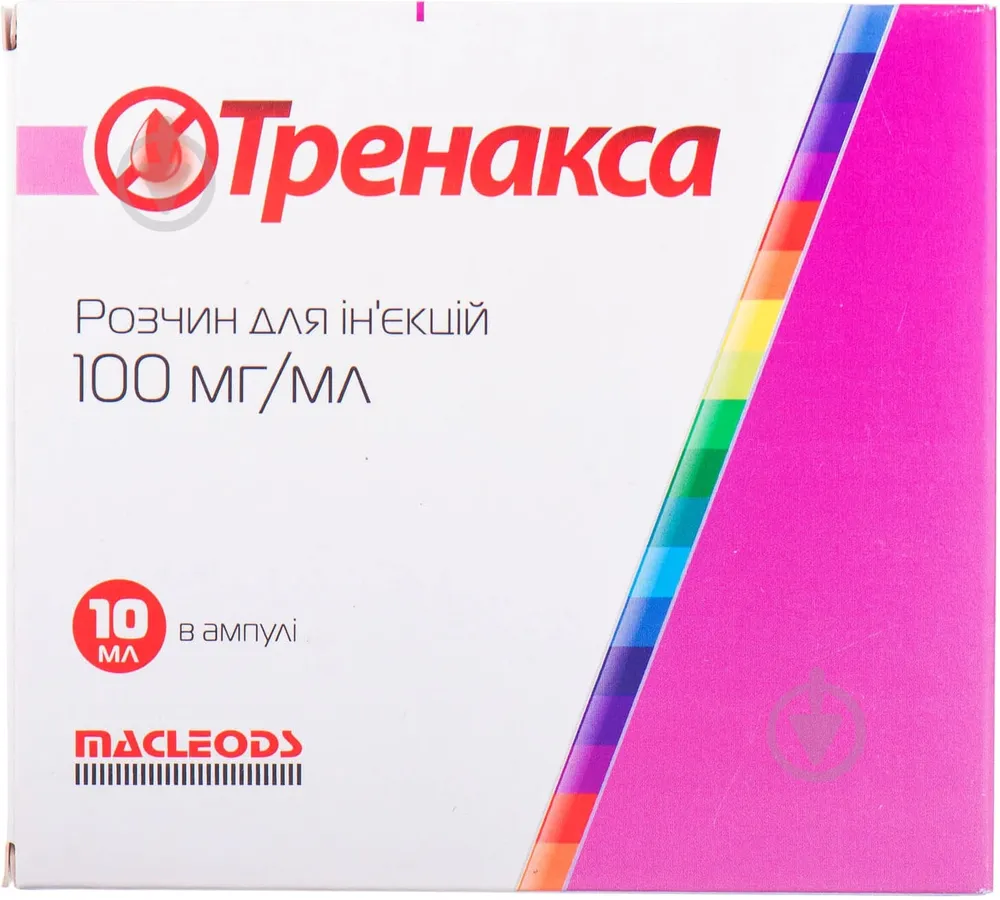
Table of Contents
INSTRUCTIONS FOR MEDICAL USE OF THE MEDICINAL PRODUCT TRENAXA (TRENAXA)
Composition:
active substance: tranexamic acid;
1 ml of solution contains 100 mg of tranexamic acid;
excipients: water for injections, hydrochloric acid or sodium hydroxide (for pH adjustment).
Pharmaceutical form. Injection solution.
Main physicochemical characteristics: clear solution, free from visible particles.
Pharmacotherapeutic group.
Antihemorrhagic agents. Fibrinolysis inhibitors. ATC code B02A A02.
Pharmacological properties.
Pharmacodynamics.
Tranexamic acid exerts an antihemorrhagic effect by inhibiting the fibrinolytic activity of plasmin. A complex forms involving tranexamic acid and plasminogen; tranexamic acid binds to plasminogen during conversion involving plasmin. The activity of the tranexamic acid–plasmin complex on fibrin is lower than that of plasmin alone. In vitro studies have shown that high doses of tranexamic acid reduce the activity of this complex.
Pediatric population (children aged 1 year and older)
Twelve studies on efficacy in pediatric cardiac surgery have been described in the scientific literature, involving 1073 children, of whom 631 patients received tranexamic acid. Most of these were evaluated in comparison with a placebo control group. The study population was heterogeneous with respect to age, type of surgical intervention, and dosing. Study results on the use of tranexamic acid indicate reduced blood loss and decreased need for blood product transfusions in pediatric cardiac surgery involving cardiopulmonary bypass (CPB), particularly in high-bleeding-risk procedures, especially in "cyanotic" (with significant circulatory impairment) patients or patients undergoing reoperation. The most appropriate dosing regimen identified may be as follows:
- Initial dose (loading dose) – bolus infusion of 10 mg/kg administered after induction of anesthesia and prior to skin incision;
- continuous infusion at 10 mg/kg/h or injection into the cardiopulmonary bypass pump adapter at a dose adjusted for the specific surgical procedure or calculated according to patient body weight – 10 mg/kg, or injection into the cardiopulmonary bypass pump adapter and a final bolus injection of 10 mg/kg at the end of the surgical procedure involving CPB.
Some data suggest that continuous infusion may be preferable, as it maintains therapeutic plasma concentrations throughout the surgery. No specific dose-response or pharmacokinetic studies have been conducted in children.
Pharmacokinetics.
Absorption. Peak plasma concentration of tranexamic acid is rapidly achieved after short-term intravenous infusion, after which plasma concentrations decline in a multiexponential manner.
Distribution. At therapeutic plasma levels, the protein binding of tranexamic acid to plasma proteins is approximately 3%; this binding is believed to be entirely attributable to binding with plasminogen. Tranexamic acid does not bind to serum albumin. The initial volume of distribution is approximately 9 to 12 liters.
Tranexamic acid crosses the placenta. After intravenous administration of 10 mg/kg in pregnant women, the concentration of tranexamic acid in maternal serum ranges from 10–53 mcg/mL, while the concentration in umbilical cord blood ranges from 4–31 mcg/mL. Tranexamic acid rapidly penetrates into joint fluid and synovial membrane tissues. After intravenous administration of 10 mg/kg in patients undergoing knee surgery, concentrations in joint fluid were similar to those in serum. Concentrations of tranexamic acid in various other tissues and fluids are proportional to those observed in blood (in breast milk – one hundredth, in cerebrospinal fluid – one tenth, in aqueous humor of the eye – one tenth). Tranexamic acid has been detected in semen, where it inhibits fibrinolytic activity but has virtually no effect on sperm migration (motility).
Elimination. The drug is primarily excreted in urine as unchanged compound. Renal excretion via glomerular filtration is the main elimination pathway. Renal clearance is practically equivalent to plasma clearance (110–116 mL/min). Approximately 90% of tranexamic acid is excreted within the first 24 hours after intravenous administration of a 10 mg/kg dose. The elimination half-life of tranexamic acid is approximately 3 hours.
Special patient groups. Plasma concentrations increase in patients with renal impairment. No specific pharmacokinetic studies have been conducted in children.
Clinical characteristics.
Indications.
Bleeding or risk of bleeding due to enhanced fibrinolysis, either generalized or local, in adults and children aged 1 year and older.
Specific indications include:
- Bleeding caused by increased systemic or local fibrinolysis, such as:
- menorrhagia and metrorrhagia;
- gastrointestinal bleeding;
- hemorrhagic disorders of the urinary tract occurring in connection with surgical intervention on the prostate or as a result of surgery or procedures on the urinary tract;
- Otolaryngological (adenoidectomy, tonsillectomy) and dental (tooth extraction) surgical procedures;
- Gynecological surgeries or complications in obstetric practice;
- Thoracic, abdominal, and other major surgical procedures, e.g., cardiovascular surgery;
- Control of bleeding associated with administration of a fibrinolytic medicinal product.
Contraindications.
- Hypersensitivity to the active substance or to any of the excipients of the medicinal product.
- Acute venous or arterial thrombosis.
- Fibrinolytic states with acute severe bleeding due to administration of coagulopathic agents (anticoagulants), except for those agents that predominantly activate the fibrinolytic system.
- Severe renal insufficiency (risk of drug accumulation).
- History of seizures.
- Intrathecal and intraventricular injection, intracerebral administration (risk of cerebral edema with subsequent development of seizures).
Interaction with other medicinal products and other forms of interaction.
Drug interaction studies have not been conducted. Concomitant (simultaneous) use of anticoagulants should be carried out under strict supervision of a physician experienced in this area of therapy. Medicinal products affecting hemostasis should be used with caution in patients who have received treatment with tranexamic acid. In such cases, there is a risk of thrombosis, e.g., when estrogens are used. In addition, the antifibrinolytic effect of the drug may be antagonized by thrombolytics.
Heparins may be added during intravenous infusion.
Combined therapy with chlorpromazine and tranexamic acid in patients with subarachnoid hemorrhage may lead to cerebral vasospasm and cerebral ischemia, as well as possible reduction in cerebral blood flow.
The drug is incompatible with urokinase, norepinephrine bitartrate, desoxyepinephrine hydrochloride, dipyridamole, and diazepam.
Use with caution in patients receiving antifibrinolytic therapy.
The simultaneous use with estrogens increases the risk of thrombus formation.
Special precautions for use.
The specified indications and method of administration must be strictly observed:
- Intravenous injections should be administered very slowly;
- tranexamic acid must not be administered intramuscularly.
Seizures. Cases of seizures associated with tranexamic acid treatment have been reported in patients. During coronary artery bypass graft (CABG) surgery, most of these cases occurred after intravenous administration of high doses of tranexamic acid. When recommended low doses of tranexamic acid are used, the incidence of postoperative seizures is the same as in patients who did not receive this medication.
Visual disturbances. The possibility of ophthalmological complications, including visual disturbances and color vision abnormalities, should be considered. In such cases, treatment should be discontinued. With continuous long-term use of tranexamic acid (injections), regular ophthalmological examinations (including visual acuity, color vision, fundus, and visual field testing) should be scheduled. In the presence of, or if new ophthalmological abnormalities develop—particularly those related to retinal disorders—the physician, after appropriate specialist consultation, must individually assess the necessity and safety of long-term tranexamic acid (injections) use in each specific case.
Hematuria. In cases of hematuria involving the upper urinary tract, there is a risk of urethral obstruction.
Thromboembolic complications. Risk factors for thromboembolic complications should be evaluated before prescribing tranexamic acid. Tranexamic acid (injection solution) should be administered to patients with a history of thromboembolic disorders or to those with a family history indicating a risk of thromboembolic complications (patients at high risk of thrombophilia) only when there are clear, life-threatening indications. In such cases, treatment should be initiated only after consultation with a specialist experienced in hemostasis and must be conducted under strict medical supervision.
Due to the increased risk of thrombosis, tranexamic acid should be used cautiously in patients taking oral contraceptives.
Disseminated intravascular coagulation (DIC). Tranexamic acid is generally not administered to patients with DIC syndrome. If use of tranexamic acid is necessary, it should be prescribed only when there is predominant activation of the fibrinolytic system accompanied by acute, severe bleeding. The characteristic hematological profile in such conditions includes: shortened euglobulin clot lysis time; prolonged prothrombin time; decreased plasma levels of fibrinogen, factors V and VIII, plasminogen, fibrinolysin, and alpha-2-macroglobulin; normal plasma levels of P and P-complex (i.e., factors II [prothrombin], VIII, and X); elevated plasma levels of fibrinogen degradation products; and normal platelet count. The above profile implies that the various components of this profile cannot be independently altered by the underlying disease alone. In such acute cases, a single dose of 1 g of tranexamic acid is often sufficient to control bleeding. The use of tranexamic acid in patients with DIC syndrome should only be considered when appropriate hematological laboratory facilities and clinical experience are available.
Use during pregnancy or breastfeeding.
There are no adequate and well-controlled clinical studies on the safety of tranexamic acid use during pregnancy. However, there is evidence of absence of teratogenic and embryotoxic effects. Tranexamic acid has been used for hemostatic therapy during the first and second trimesters of pregnancy in cases of threatened miscarriage, effectively preventing pregnancy loss and supporting successful pregnancy continuation. Nevertheless, tranexamic acid should be prescribed to pregnant women only if the expected benefit to the mother outweighs the potential risk to the fetus.
The drug may be used during labor and cesarean section at usual doses.
Tranexamic acid passes into breast milk in small amounts. If tranexamic acid administration is necessary, a decision should be made regarding discontinuation of breastfeeding.
Ability to affect reaction speed when driving or operating machinery.
During treatment with the medicinal product Tranexa at usual doses, dizziness and arterial hypotension may occur, as well as impaired color vision and visual acuity. Therefore, during treatment, patients should avoid driving vehicles or operating complex machinery requiring high concentration and rapid reaction times.
Method of administration and dosage.
Administer intravenously (by infusion or bolus injection).
Adults
In generalized fibrinolysis, administer tranexamic acid intravenously, slowly, at a dose of 1 g (2 vials of 5 ml) or 15 mg/kg body weight every 6–8 hours, at an infusion rate of 1 ml/min.
In local fibrinolysis, it is recommended to administer the drug starting from a dose of 500 mg (1 vial of 5 ml) up to 1 g (2 vials of 5 ml) intravenously, slowly (approximately 1 ml/min), 2–3 times daily.
Dosing for patients with renal impairment. In patients with renal insufficiency, the use of tranexamic acid is contraindicated in cases of severe renal impairment. For patients with mild or moderate renal impairment, the dosage of tranexamic acid should be reduced according to serum creatinine levels:
Table 1
| Serum creatinine |
Dose (intravenous) |
Administration |
|
| μmol/L |
mg/100 mL |
||
| 120–249 |
1.35–2.82 |
10 mg/kg |
every 12 hours |
| 250–500 |
2.82–5.65 |
10 mg/kg |
every 24 hours |
| > 500 |
> 5.65 |
5 mg/kg |
every 24 hours |
Dosing in patients with hepatic impairment
Dose adjustment is not required in patients with hepatic impairment.
Children
For children aged 1 year and older, the drug is indicated as per the indications (see section "Indications"), with a dosage of approximately 20 mg/kg/day. However, data on efficacy, safety, and dosing specifics in children for the indicated conditions are limited.
The efficacy, dosing characteristics, and safety of tranexamic acid in children who have undergone cardiac surgery have not been fully investigated.
Elderly patients
Dose adjustment is generally not required unless there are signs of renal impairment.
Administration method
Administration must strictly follow a specific regimen – slow intravenous administration (injection/infusion).
Tranexamic acid should not be administered intramuscularly.
Intravenous injection: tranexamic acid should be administered by slow bolus injection over at least 5 minutes.
Intravenous infusion: tranexamic acid must be mixed directly with the following injection/infusion solutions:
sodium chloride 0.9%, injection solution; Ringer's injection solution; dextrose, 5% injection solution; dextrin-40 in dextrose 5% injection solution, and dextrin-40 in 0.9% sodium chloride injection solution; amino acid solution.
Children
The maximum single dose for children aged 1 year and older is 10 mg/kg body weight. The maximum daily dose is 20 mg/kg body weight.
Overdose
Cases of overdose have not been reported.
Symptoms of overdose may include dizziness, headache, hypotension, and seizures (convulsions). Seizures have been shown to typically occur with higher infusion rates and are characteristic when the dose is increased.
Treatment of overdose is symptomatic.
Adverse reactions.
The adverse reactions listed below are systematized according to the MedDRA classifier (primary system organ classes). Within each organ system class, adverse reactions are ranked by frequency. Within each frequency group, adverse reactions are listed in order of decreasing severity. Frequency was defined as follows: very common (> 1/10); common (>1/100, <1/10); uncommon (>1/1000, <1/100); frequency unknown (cannot be estimated from available data).
Table 2
| MedDRA system class (organs) |
Frequency |
Adverse reactions |
| Immune system disorders |
frequency unknown |
Hypersensitivity reactions, including anaphylactic-type reactions |
| Nervous system disorders |
frequency unknown |
Seizures, particularly in case of incorrect administration |
| Eye disorders |
frequency unknown |
Visual disturbances, including color vision defects |
| Blood and lymphatic system disorders |
frequency unknown |
Malaise due to hypotension, with or without loss of consciousness (usually after too rapid intravenous injection, exceptionally after oral administration). Arterial or venous thromboembolism at any site |
| Gastrointestinal disorders |
common |
Diarrhea, vomiting, nausea |
| Skin and subcutaneous tissue disorders |
uncommon |
Allergic dermatitis |
Shelf life. 3 years.
Storage conditions.
Store at a temperature not exceeding 25 °C in the original packaging.
Keep out of reach and sight of children.
Packaging.
5 ml or 10 ml in ampoules, 1, 5 or 10 ampoules in a blister pack; 1 blister pack in a cardboard box.
Prescription status. By prescription only.
Manufacturer.
Labiana Pharmaceuticals, S.L.U.
Manufacturer's address and address of the place of business.
Casanova, 27-31 Corbera de Llobregat, 08757 (Barcelona), Spain.