Trifemol n
Ukraine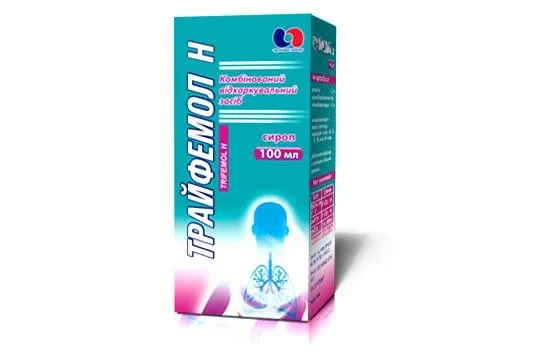
Table of Contents
INSTRUCTIONS FOR MEDICAL USE OF THE MEDICINAL PRODUCT TRIFEMOL H (TRIFEMOL H)
Composition:
Active ingredients: 5 ml of syrup contains guaifenesin 33.34 mg, pseudoephedrine hydrochloride 10.0 mg, triprolidine hydrochloride 0.417 mg;
Excipients: ammonium glycyrrhizinate, sorbitol (E 420), sucrose (sucrose), sodium benzoate (E 211), sodium saccharin, sodium citrate, glycerin, "Raspberry" flavor (aromatic substance, purified water, propylene glycol (E 1520), ethanol 96%, alpha-tocopherol (E 307), ascorbic acid (E 300), maltol (E 636)), yellow FCF (E 110), purified water.
Pharmaceutical form. Syrup.
Main physicochemical properties: clear, viscous, orange-colored liquid with a characteristic fruity odor. A slight sediment may form, which disappears after keeping the preparation at +25 °C.
Pharmacotherapeutic group.
Medicinal products used in cough and colds. Expectorants, excluding combination preparations containing antitussives. ATC code R05C A10.
Pharmacological properties.
Triafemol N is a combination medicinal product, whose therapeutic effect is determined by the pharmacologically active substances contained in its composition.
Pharmacodynamics. Tripolidine is an H1-receptor antagonist, providing symptomatic treatment of allergic conditions caused by the release of excessive amounts of histamine. Pseudoephedrine is a decongestant that exhibits direct and indirect sympathomimetic activity.
Guaifenesin is an expectorant that facilitates the expulsion of mucus.
Pharmacokinetics. The drug is rapidly and almost completely absorbed from the gastrointestinal tract. It is excreted in the form of metabolites through the intestine. The half-life ranges from 4 to 6 hours.
Clinical characteristics.
Indications.
Symptomatic treatment of upper and lower respiratory tract diseases associated with productive cough.
Contraindications.
Hypersensitivity to any of the ingredients of the medicinal product.
Severe hypertension or uncontrolled hypertension, severe ischemic heart disease; severe acute or chronic kidney diseases/kidney failure, severe hepatic impairment, bronchial asthma, bronchitis and bronchiectasis accompanied by excessive secretion, pheochromocytoma.
Concomitant use of other sympathomimetics (decongestants, appetite suppressants, and amphetamine-like psychostimulants).
Concomitant use with monoamine oxidase inhibitors (MAOIs), as well as use within two weeks after discontinuation of MAOI therapy (including the antibacterial agent furazolidone). Use in combination with other symptomatic therapies containing pseudoephedrine or triprolidine. Children under 12 years of age. Pregnancy, breastfeeding.
Interaction with other medicinal products and other forms of interactions.
This medicinal product should not be used concomitantly with MAO inhibitors and within two weeks after discontinuation of MAOI therapy. Concurrent use with MAO inhibitors may cause severe hypertensive crisis, headache, marked increase in body temperature, and severe cardiac arrhythmia. As a sympathomimetic, pseudoephedrine stimulates the release of norepinephrine through direct action, while MAO inhibitors increase norepinephrine levels in adrenergic neurons by inhibiting the breakdown of catecholamines. Concurrent use significantly increases norepinephrine levels and enhances sympathetic nervous system activity.
Concomitant use of pseudoephedrine and methyldopa may lead to impaired blood pressure regulation with possible development of hypertensive crisis.
Concomitant use of dihydroergotamine and pseudoephedrine may result in a significant increase in blood pressure.
Concomitant use of pseudoephedrine and substances that alkalinize urine (e.g., sodium bicarbonate) markedly reduces the excretion of pseudoephedrine.
When used concomitantly with antihypertensive agents (e.g., beta-blockers, reserpine, debrisoquine, guanethidine), the effect of the latter is reduced.
Use of the drug in patients taking cardiac glycosides, quinidine, or tricyclic antidepressants may lead to the development of arrhythmias.
Concomitant use with sympathomimetics (decongestants, appetite suppressants, amphetamine psychostimulants) affecting the catabolism of sympathomimetic amines may cause increased blood pressure.
Concomitant use with hypnotics, sedatives, or tranquilizers may enhance drowsiness.
Guaifenesin enhances the analgesic effect of paracetamol and acetylsalicylic acid and potentiates the effects of alcohol and other substances that depress the central nervous system.
The central nervous action of muscle relaxants may increase the adverse effects of guaifenesin, particularly muscle weakness.
Effect on laboratory test results.
Guaifenesin may cause false-positive results in diagnostic tests measuring 5-hydroxyindoleacetic acid (photometric method using nitrosonaphthol as reagent) and vanillylmandelic acid in urine. Therefore, treatment with the drug should be discontinued 48 hours before urine collection for testing.
Special precautions for use.
Do not exceed the recommended doses. Patients should not take other medicines containing pseudoephedrine or triprolidine simultaneously with this product.
Posterior reversible encephalopathy syndrome (PRES) and reversible cerebral vasoconstriction syndrome (RCVS). Cases of PRES and RCVS have been reported with the use of medicinal products containing pseudoephedrine (see section "Adverse reactions"). The risk is increased in patients with severe or uncontrolled hypertension or with severe acute or chronic kidney disease/renal insufficiency (see section "Contraindications").
Discontinue pseudoephedrine and seek immediate medical attention if symptoms such as sudden severe or thunderclap headache, nausea, vomiting, confusion, seizures, and/or visual disturbances occur. Most reported cases of PRES and RCVS resolved after discontinuation of the medicinal product and appropriate treatment.
Use with caution and under physician supervision:
in patients with impaired liver or kidney function, urinary retention, prostatic hypertrophy, gastrointestinal disorders, hyperthyroidism, cardiovascular diseases (mild or moderate ischemic heart disease, arrhythmias, tachycardia), arterial hypertension, occlusive vascular diseases including atherosclerosis, aneurysm, myasthenia gravis, diabetes mellitus, glaucoma, increased intraocular pressure, elderly patients, patients with epilepsy, and when used in combination with antitussive agents.
Do not use concomitantly with furazolidone, as this may lead to an increase in blood pressure.
Use with caution in patients receiving beta-blockers and other antihypertensive agents.
The use of this medicinal product may cause drowsiness, dizziness, blurred vision, and impaired psychomotor performance, which may seriously affect the patient's ability to drive or operate machinery. If these symptoms occur, driving and operating machinery should be avoided.
Avoid concomitant use with other products containing antihistamine components, including cold and cough remedies.
When used in children and elderly patients, neurological and anticholinergic complications and paradoxical excitation are more likely to occur.
Concomitant use with anticholinergic agents such as atropine, and certain psychotropic agents, may lead to tachycardia, dry mouth, urinary retention, and gastrointestinal disturbances (spasmodic abdominal pain).
Since this product may suppress allergic skin test responses, its use should be discontinued several days before skin testing.
Severe skin reactions, such as acute generalized exanthematous pustulosis, may occur with medicinal products containing pseudoephedrine. Rash may appear within the first two days of treatment and be accompanied by fever, as well as numerous small non-follicular pustules appearing on large erythematous and edematous areas in skin folds, trunk, and upper limbs. Patients should be alert for symptoms such as elevated body temperature, erythema, or numerous small pustules. If these occur, the medicinal product should be discontinued and medical advice sought.
Guaifenesin should be used with caution in the treatment of cough with excessive mucus production, persistent or chronic cough due to smoking, asthma, chronic bronchitis, or emphysema.
Opioids should be used with particular caution in patients with a history of psychiatric disorders, including severe depression, anxiety, alcohol or drug abuse, among others.
Concomitant use of Triphemol N with alcohol or other central nervous system depressants is not permitted.
If a patient has known sugar intolerance, medical advice should be sought before taking this medicinal product.
This medicinal product contains 12.9 g of sucrose per dose. Use with caution in patients with diabetes mellitus. May be harmful to teeth.
This medicinal product contains a small amount of ethanol (alcohol), less than 100 mg per dose.
The colouring agent "Yellow FCF" (E 110) may cause allergic reactions.
Use during pregnancy or breastfeeding.
This medicinal product is contraindicated during pregnancy or breastfeeding.
Ability to affect reaction speed when driving or operating machinery.
Triphemol N may cause drowsiness, which may impair the ability to drive or perform other potentially hazardous tasks requiring rapid psychomotor reactions.
Dosage and Administration.
For adults and children aged 12 years and older: 30 ml of syrup three times daily.
The duration of treatment depends on the severity and course of the disease and is determined individually by a physician. If symptoms persist for more than 7 days or if there is worsening of condition (fever, erythema, or skin rash), the use of the medicinal product should be discontinued and medical advice should be sought.
Children.
The drug is indicated for children aged 12 years and older.
Overdose.
Symptoms.
Overdose may lead to an intensification of the drug's adverse effects.
Mild or moderate overdose of guaifenesin may cause dizziness or vertigo, gastrointestinal disturbances, nausea, vomiting, or decreased muscle tone. Very high doses may lead to symptoms such as excitement, confusion, and respiratory depression. Rare cases of bladder or kidney stones have been reported in patients who chronically ingested large amounts of guaifenesin.
Overdose of pseudoephedrine may cause reactions related to stimulation of the central nervous and cardiovascular systems (e.g., excitement, restlessness, hallucinations, arterial hypertension and arrhythmias, tachycardia, urinary retention, nausea, vomiting, thirst). In severe cases, psychosis, seizures, coma, and hypertensive crisis may occur.
Serum potassium levels may decrease due to intracellular shift from the extracellular environment.
Overdose of triprolidine is likely to cause reactions similar to those described in the section "Adverse Reactions." Additional symptoms may include ataxia, weakness, respiratory depression, dry skin and mucous membranes, hyperpyrexia, tremor, psychosis, seizures, tachycardia, and arrhythmia.
Treatment: symptomatic and supportive therapy.
In acute poisoning, gastric lavage via a tube and administration of activated charcoal are required. Particular attention should be paid to restoring proper respiratory gas exchange by ensuring airway patency and establishing assisted or artificial ventilation of the lungs. Catheterization of the urinary bladder may be performed. Forced acid diuresis or dialysis enhances the elimination of pseudoephedrine. Seizures and associated central nervous system stimulation are treated by parenteral administration of diazepam.
Adverse Reactions
Guaifenesin
Gastrointestinal system: gastrointestinal disturbances, particularly nausea, vomiting, or diarrhea.
Immune system: hypersensitivity reactions such as difficulty swallowing, swelling of the face, lips, tongue, or throat, severe itching with rash or skin swelling, coma, confusion, bradycardia, bronchospasm, dyspnea, granulocytopenia, and anaphylactic shock. These reactions may be preceded by fever, dizziness, nausea, vomiting, stomach cramps, heartburn, or pain.
Pseudoephedrine
Psychiatric disorders
Common: nervousness, insomnia.
Uncommon: agitation, restlessness, tremor.
Rare: hallucinations (especially in children).
Nervous system
Common: dizziness.
Uncommon: headache.
Unknown frequency: posterior reversible encephalopathy syndrome, reversible cerebral vasoconstriction syndrome (see section "Special precautions").
Cardiovascular system
Rare: tachycardia, palpitations, increased blood pressure, arrhythmia.
An increase in systolic blood pressure has been observed; however, the effect of pseudoephedrine on blood pressure at therapeutic doses is not clinically significant.
Gastrointestinal system
Common: dry mouth, nausea, vomiting.
Uncommon: decreased appetite.
Skin and subcutaneous tissue
Rare: rash, allergic dermatitis, increased sweating.
Various allergic skin reactions, including systemic manifestations such as bronchospasm and angioedema, have been observed after pseudoephedrine administration.
Renal and urinary system
Uncommon: dysuria, urinary retention.
Urinary retention is mainly observed in patients with urinary tract obstruction, e.g., due to prostate hypertrophy.
Triprolidine
Psychiatric disorders
Frequency unknown: paradoxical excitation (particularly in children and elderly patients: increased energy, restlessness, nervousness), confusion (particularly in elderly patients), night hallucinations, hallucinations (mainly in children).
Nervous system
Very common: sedative effect, drowsiness.
Common: inattention, coordination disturbances, dizziness.
Uncommon: headache.
Cardiovascular system
Uncommon: orthostatic hypotension, palpitations, tachycardia, weakness.
Eye disorders
Frequency unknown: blurred vision.
Chest and ENT organs
Frequency unknown: thickening of bronchial secretions, nasal congestion.
Gastrointestinal system
Common: dryness in mouth, nose, and throat.
Frequency unknown: gastrointestinal discomfort including nausea and vomiting, anorexia, diarrhea, constipation, increased appetite, weight gain, heartburn.
Skin and subcutaneous tissue
Frequency unknown: rash and urticaria, photosensitivity reactions.
Renal and urinary system
Frequency unknown: urinary retention, dysuria, polyuria.
Reporting suspected adverse reactions. Reporting of suspected adverse reactions after marketing authorization of the medicinal product is important. It allows continuous monitoring of the benefit-risk balance of the medicinal product. Medical and pharmaceutical professionals, as well as patients or their legal representatives, should report all suspected adverse reactions and lack of efficacy through the Automated Pharmacovigilance Information System at the following link: https://aisf.dec.gov.ua.
**Shelf life. ** 3 years.
After opening the bottle, do not store for more than 28 days.
Storage conditions.
Store in the original packaging at a temperature not exceeding 25 °C.
Keep out of reach of children.
Packaging.
100 or 200 ml in a bottle; 1 bottle with a dosing device in a cardboard box.
Prescription status.
Prescription only.
Manufacturer.
Limited liability company "Kharkiv Pharmaceutical Enterprise "Zdorov'ya Narodu".
Manufacturer's location and address of business activity.
Ukraine, 61002, Kharkiv region, city of Kharkiv, Kuilikivska Street, 41.