Tos-may
Ukraine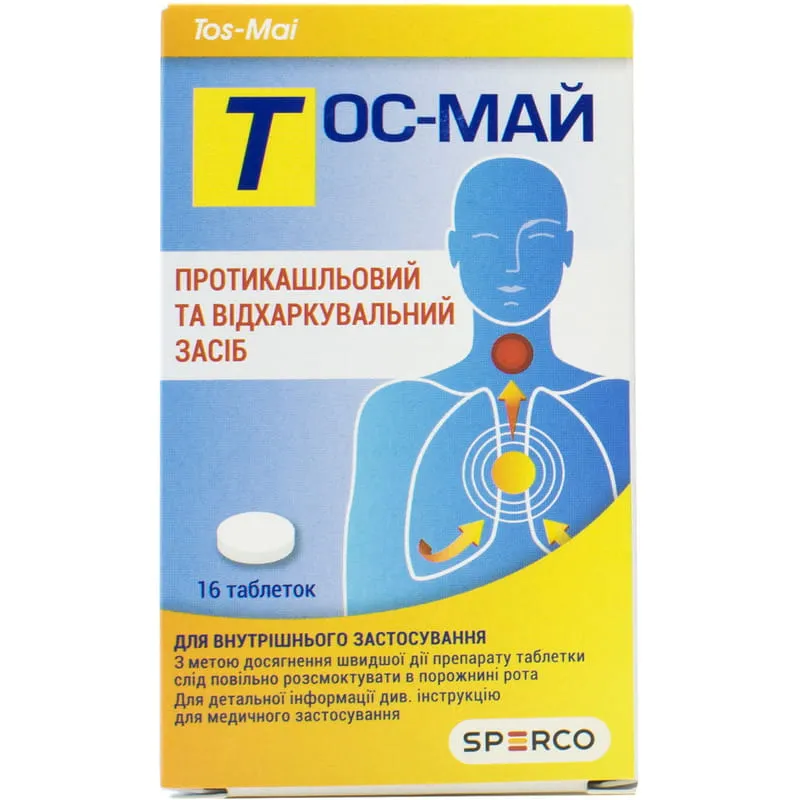
Table of Contents
INSTRUCTION FOR MEDICAL USE OF THE MEDICINAL PRODUCT TOS-MAI (TOS-MAI)
Composition:
Active substances: dextromethorphan hydrobromide, benzocaine, potassium guaiacolsulfonate, sodium benzoate;
1 tablet contains 2 mg of dextromethorphan hydrobromide, 0.2 mg of benzocaine, 15 mg of sodium benzoate, 35 mg of potassium guaiacolsulfonate;
Excipients: mannite (E 421), povidone, talc, magnesium stearate, anise essence, menthol, sodium saccharin.
Pharmaceutical form. Tablets.
Main physicochemical properties: white tablets with speckles, 13 mm in diameter.
Pharmacotherapeutic group. Antitussives and expectorants.
ATC code: R05FB.
Pharmacological Properties.
Pharmacodynamics.
A combination medicinal product that has antitussive, mucolytic, expectorant, and local anesthetic effects, thereby reducing cough, pain, and throat irritation. The action of the drug is due to the pharmacological properties of its constituent components.
Dextromethorphan – an antitussive agent, is the D-stereoisomer of levorphanol. In terms of its mechanism of action, dextromethorphan is an NMDA receptor antagonist in the medulla oblongata. It affects the central component of the cough reflex, thereby reducing dry, non-productive cough associated with irritation of the respiratory mucosa in cold-related illnesses. Dextromethorphan has also been shown to affect the peripheral component of the cough reflex by suppressing impulses arising from the mucosa of the upper respiratory tract. In terms of antitussive potency, dextromethorphan is comparable to codeine; however, unlike codeine, it does not cause dependence, does not suppress the respiratory center or ciliary activity of the respiratory epithelium, and lacks analgesic effects.
Benzocaine – a highly active topical local anesthetic agent, a derivative of para-aminobenzoic acid. It does not exert systemic effects. Its mechanism of action is associated with reduced ionic permeability of nerve endings. In combination antitussive preparations, benzocaine reduces pain and throat irritation.
Potassium guaiacolsulfonate belongs to expectorant agents. It promotes reduction of bronchial mucus viscosity, depolymerizes mucopolysaccharides, and enhances the activity of ciliated respiratory epithelium. It reduces surface tension and adhesive properties of sputum, decreases its viscosity, facilitates its clearance from the respiratory tract, and transforms non-productive cough into productive cough. It also has weak antiseptic and anesthetic properties.
Sodium benzoate belongs to directly acting expectorants. When administered orally, it increases bronchial gland secretion, liquefies sputum, and facilitates its removal from the respiratory tract. It has mild antibacterial and antifungal properties.
Pharmacokinetics.
After oral administration, dextromethorphan is rapidly absorbed in the gastrointestinal tract and has high bioavailability. The antitussive effect develops within 15–30 minutes after administration and lasts for 5–6 hours. Maximum plasma concentration is reached within 2 hours. It is actively metabolized in the liver via N- and O-demethylation. The elimination half-life is 6.5 hours. It is excreted primarily by the kidneys as metabolites, with only a small amount excreted unchanged.
Potassium guaiacolsulfonate is rapidly absorbed from the gastrointestinal tract. Maximum blood concentration is achieved within 1–2 hours. Therapeutic concentration persists for up to 6 hours. The elimination half-life is 1–2 hours. It is excreted with sputum and eliminated by the kidneys as metabolites and in unchanged form.
Clinical characteristics.
Indications.
Symptomatic treatment of dry irritating cough associated with acute viral respiratory infections and infectious-inflammatory diseases of the upper and lower respiratory tracts. Preparation of patients for bronchoscopy.
Contraindications.
Hypersensitivity to dextromethorphan, amide anesthetics, or other components of the medicinal product. Respiratory insufficiency, bronchial asthma, pulmonary emphysema.
Must not be used concomitantly with monoamine oxidase inhibitors (MAOIs) or antidepressants of the selective serotonin reuptake inhibitor (SSRI) class (fluoxetine, paroxetine), as well as within 2 weeks after discontinuation of these agents.
Interaction with other medicinal products and other forms of interaction.
Concomitant use of this drug with antidepressants – MAO inhibitors, furazolidone, procarbazine, selegiline, linezolid – should be avoided due to increased risk of central nervous system (CNS) stimulation, arterial hypertension, and hyperthermia (serotonin syndrome). CNS depressants, including psychotropic agents, antihistamines, and antiparkinsonian drugs, as well as alcohol, enhance the sedative effect of the drug when used concomitantly. Dextromethorphan is metabolized via the cytochrome P450 isoenzymes CYP2D6 and undergoes pronounced presystemic metabolism. Concomitant use with CYP2D6 enzyme inhibitors may increase dextromethorphan concentrations in the body to levels significantly exceeding therapeutic concentrations. This increases the risk of toxic effects of dextromethorphan on the patient and may cause CNS excitation, confusion, tremor, insomnia, diarrhea, and respiratory insufficiency, as well as increase the risk of serotonin syndrome. Potent CYP2D6 enzyme inhibitors include fluoxetine, paroxetine, quinidine, and terbinafine. When used concomitantly with quinidine, dextromethorphan plasma concentrations increase 20-fold. Amiodarone, flecainide, propafenone, sertraline, bupropion, methadone, cinacalcet, haloperidol, perphenazine, and thioridazine also have a similar effect on dextromethorphan metabolism. When concomitant use of CYP2D6 inhibitors and dextromethorphan is necessary, careful monitoring of the patient is required, with timely dose adjustments if needed. Concomitant use of dextromethorphan with MAO inhibitors, Parkinson’s disease medications, selective serotonin reuptake inhibitors, and other antidepressants significantly enhances their effects; therefore, such combinations should be avoided. Cyclooxygenase-2 (COX-2) inhibitors (coxibs), specifically celecoxib, parecoxib, and valdecoxib, may increase blood concentrations of dextromethorphan by inhibiting its hepatic metabolism. This medicinal product should not be taken with grapefruit or grapefruit juice due to inhibition of CYP2D6 and CYP3A4 enzymes and subsequent elevation of dextromethorphan blood levels.
Benzocaine, a component of this medicinal product, interacts with cholinesterase inhibitors, which suppress the metabolism of local anesthetics, thereby increasing the risk of systemic toxicity. Benzocaine reduces the antibacterial effect of sulfonamide drugs. Interference may occur with diagnostic tests assessing pancreatic function that use bentiromide. It is recommended to discontinue treatment at least 3 days prior to such testing.
Special precautions for use.
Do not exceed the maximum daily doses of the drug, combine the use of the drug with alcohol consumption, or use the drug in cases of chronic cough associated with bronchial asthma and pulmonary emphysema. Exercise caution when prescribing the drug to patients with liver disease, as the metabolism of dextromethorphan may be altered, which should be taken into account when determining the dosage.
Patients suffering from chronic cough caused by smoking or accompanied by excessive sputum production should consult a physician before using the drug.
If cough persists for more than 7 days or is accompanied by fever, rash, or headache, the patient should be examined to determine the underlying cause of illness.
There have been reports of dextromethorphan abuse. Although the dose of dextromethorphan in this medicinal product is low, this should be considered when prescribing the drug to adolescents, young adults, and patients with a history of substance or psychotropic drug abuse.
Dextromethorphan may cause histamine release; therefore, it should be used with caution in patients with atopic dermatitis.
Dextromethorphan is metabolized in the liver by cytochrome P450 isoenzymes CYP2D6, the activity of which is genetically determined. Approximately 10% of the world's population has low activity of this enzyme ("poor metabolizers"). In such individuals, as well as in patients taking drugs that inhibit CYP2D6 (see section "Interaction with other medicinal products and other types of interactions"), symptoms of overdose and/or prolonged effects of dextromethorphan may occur.
There is a risk of methemoglobinemia when using medicinal products containing benzocaine, primarily in patients with congenital defects such as glucose-6-phosphate dehydrogenase deficiency, NADH-hemoglobin reductase deficiency, pyruvate kinase deficiency, or presence of hemoglobin-M. The appearance of skin, lips, and nail bed cyanosis, headache, dizziness, difficulty breathing, weakness, or tachycardia may indicate potentially life-threatening methemoglobinemia requiring immediate medical intervention.
When using local anesthetics, including benzocaine, there is an increased risk of systemic toxicity in acute illnesses. Patients with hypersensitivity to systemic anesthetics of the ester type, particularly para-aminobenzoic acid (PABA) derivatives, parabens, or paraphenylenediamine (hair dyes), may also exhibit increased sensitivity to benzocaine.
The use of benzocaine may result in a positive doping test result in athletes.
The medicinal product contains mannitol, which may cause a mild laxative effect.
Use during pregnancy or breastfeeding.
No teratogenic or embryotoxic effects of the drug have been reported. However, due to the lack of adequate clinical studies, Toss-Mai should be used during pregnancy only on a physician's prescription when the expected benefit to the mother outweighs the potential risk to the fetus.
Due to the lack of information regarding the use of the drug during breastfeeding, it should not be used in women during this period.
Ability to influence reaction rate while driving or operating machinery.
In some patients, drowsiness and reduced reaction time may occur after using the drug, which should be taken into account when driving or operating machinery.
Dosage and Administration
For children aged 12 years and older, and adults: usually 1–2 tablets 4–6 times daily (maximum daily dose is 16 tablets). For children aged 6 to 12 years: 1 tablet 4 times daily (maximum daily dose for this age group is 8 tablets).
The duration of treatment depends on the severity and course of the disease and is determined individually by a physician. This medicinal product should not be used for longer than 7 days without consulting a doctor.
To achieve faster onset of action, the tablets should be slowly dissolved in the mouth.
Children.
Tos-May is indicated for children aged 6 years and older.
Overdose.
In cases of significant overdose, symptoms may occur due to:
Dextromethorphan – drowsiness, dizziness, ataxia, irritability, hyperactivity, confusion, blurred vision, nystagmus, respiratory depression, nausea, vomiting, central nervous system (CNS) depression, excitation, psychotic disorders (psychosis), dysarthria, myoclonus, tremor;
Potassium guaiacolsulfonate – drowsiness, nausea, vomiting; nephrolithiasis;
Benzocaine – dizziness, double vision, excitation, seizures, lethargy; methemoglobinemia leading to cyanosis of the skin, lips, and nail beds, headache, dizziness, difficulty breathing, weakness, tachycardia.
Treatment.
In case of overdose, immediate medical attention is required! Treatment is symptomatic. In the event of seizures, benzodiazepines should be administered; in case of respiratory depression, respiratory support and naloxone should be used. If methemoglobinemia develops, methylene blue should be administered.
Side effects
Gastrointestinal disorders: nausea, vomiting, abdominal pain, diarrhea, constipation, gastrointestinal disturbances.
Central nervous system disorders: general weakness, drowsiness, headache, impaired consciousness.
Immune system disorders: allergic reactions, including skin rash, itching, facial skin hyperemia, angioneurotic edema, anaphylactic reactions.
Blood and lymphatic system disorders: methemoglobinemia.
Reporting of suspected adverse reactions
Reporting of suspected adverse reactions after authorization of the medicinal product is of great importance. It enables ongoing monitoring of the benefit-risk balance of the medicinal product. Healthcare and pharmaceutical professionals, as well as patients or their legal representatives, are encouraged to report all suspected adverse reactions and lack of efficacy through the Automated Pharmacovigilance Information System at the following link: https://aisf.dec.gov.ua.
Shelf life
2 years. Do not use the medicinal product after the expiry date stated on the packaging.
Storage conditions
Store at a temperature not exceeding 25 °C. Keep out of reach and sight of children.
Packaging
8 tablets in a blister made of aluminum foil coated with PVDC and laminated with PVC/PVDC. 2 blisters with patient information leaflet in a cardboard carton.
Availability category
Over-the-counter (without prescription).
Manufacturer
Laboratorios Alcala Farma, S.L.
Manufacturer's address
Avenida Madrid, 82, Alcala de Henares, 28802 Madrid, Spain.
Marketing Authorization Holder
SPERCO INTERNATIONAL LIMITED.
Address of the Marketing Authorization Holder
Spyrou Kyprianou, 57, BIBLOSERV BUSINESS CENTER, 2nd floor, 6051, Larnaca, Cyprus.