Tonzyrin
Ukraine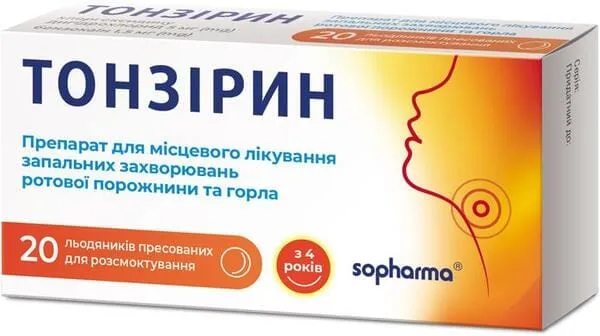
Table of Contents
INSTRUCTIONS FOR MEDICAL USE OF THE MEDICINAL PRODUCT TONZIRYN (TONZIRYN)
Composition:
Active substances: chlorhexidine dihydrochloride, benzocaine;
One compressed lozenge contains: chlorhexidine dihydrochloride 5 mg, benzocaine 1.5 mg.
Excipients: isomalt, polyethylene glycol 6000, peppermint flavor 87B668 (menthol, menthone, peppermint essential oil, corn maltodextrin, sodium starch octenylsuccinate), aspartame (E 951), magnesium stearate.
Pharmaceutical form. Compressed lozenges.
Main physical and chemical properties: white or almost white, round, flat compressed lozenges with a score line on one side and a minty odor.
Pharmacotherapeutic group.
Preparations for treatment of the throat. Antiseptics.
ATC Code R02A A05.
Pharmacological Properties.
Chlorhexidine
Mechanism of action
The antimicrobial activity of chlorhexidine is associated with its effect on the cell membrane, particularly by disrupting the inner cytoplasmic membrane. Its antimicrobial action is primarily explained by the fact that the cell membrane carries a negative electric charge. Upon contact, the cationic molecule of chlorhexidine alters the surface charge of the cell by enhancing the uptake of phosphate-containing components.
This process disrupts the integrity of the outer membrane, facilitating the penetration of chlorhexidine into the inner cell membrane, where it binds to phospholipids present within. As a result, membrane permeability increases, especially for small molecules such as potassium ions, which leave the cell.
Benzocaine
Mechanism of action
Benzocaine is a well-known local anesthetic that provides immediate and prolonged relief from pain in the oral cavity and throat. Benzocaine penetrates lipid layers and affects terminal pain receptors in the mucous membranes and skin.
The primary mechanism of action involves inhibition of predominantly sodium-specific ion channels in the neuronal cell membrane—so-called voltage-gated sodium channels.
When sodium influx is interrupted, the action potential cannot be generated, thereby blocking signal transmission.
Pharmacodynamics.
Chlorhexidine
Among antiseptic agents, chlorhexidine is a biocide that is probably the most widely used, particularly in hand-washing and oral hygiene products, as well as a disinfectant and preservative. This is largely due to its efficacy and broad spectrum of activity, its ability to adsorb onto skin and mucous membranes, and its low irritancy. Despite the advantages of chlorhexidine, its activity is pH-dependent and significantly reduced in the presence of organic compounds.
Clinical efficacy and safety
Chlorhexidine exerts bactericidal and bacteriostatic effects against a broad spectrum of vegetative gram-positive and gram-negative bacteria, some fungi, and viruses. It acts by disrupting the cytoplasmic membrane of bacterial cells. Its activity against yeasts, dermatophytes, mycobacteria, and certain species of Pseudomonas and Proteus is low.
Chlorhexidine exhibits the greatest activity at neutral or slightly alkaline pH.
Its use in the form of lozenges leads to a significant reduction in the number of bacteria in the oral cavity and saliva.
With prolonged use over several months, its effect diminishes due to changes in the oral flora.
Its antimicrobial activity varies with different concentrations of the substance: at low concentrations, it is predominantly bacteriostatic, whereas bactericidal action is associated with high concentrations.
Chlorhexidine is effective against a large number of gram-negative and gram-positive bacteria and fungi, many of which are key pathogens in the oral cavity.
Microorganisms showing high sensitivity to chlorhexidine include: Staphylococcus aureus, Staphylococcus epidermidis, Streptococcus mutans, Streptococcus salivarius, Streptococcus sobrinus, and Streptococcus sanguis; Enterococcus faecalis, Micrococcus luteus, Pseudomonas aeruginosa, Escherichia coli, Klebsiella, Salmonella, and many strains of these and other gram-negative bacteria.
Chlorhexidine exhibits fungicidal activity, even at very low concentrations, with MIC values reaching 0.001%.
Benzocaine
Benzocaine is the ethyl ester of para-aminobenzoic acid, containing in its molecule an ester linkage -CO-O-. It has a short duration of action because it is rapidly hydrolyzed by plasma pseudocholinesterase and has a short plasma half-life. Benzocaine is weakly toxic, provides prolonged local anesthetic effect, and is used in clinical practice only for superficial local anesthesia.
Clinical efficacy and safety
Local application of benzocaine leads to a reduction in pain sensations. Its anesthetic effect begins 15–30 seconds after application and lasts 5–10 minutes after dilution by saliva in the oral cavity.
Benzocaine in the form of lozenges has demonstrated superior efficacy compared to placebo and is a useful and well-tolerated agent for relieving painful discomfort in the throat associated with sore throat.
Pharmacokinetics.
Chlorhexidine
Absorption
After oral administration, chlorhexidine is poorly absorbed from the gastrointestinal tract. It is very well adsorbed onto the mucosal surface and, due to reverse release, can be recovered in saliva for up to 8 hours after administration. There are no data on absorption through the oral mucosa.
Biotransformation and elimination
Chlorhexidine is excreted in feces (90%) and in urine (less than 1%).
In human studies, the elimination half-life has been determined to be 4 days.
Benzocaine
Absorption
Benzocaine is poorly absorbed through the mucous membrane.
Biotransformation and elimination
Ester-type anesthetics undergo biotransformation in the liver and plasma by esterases, resulting in metabolites para-aminobenzoic acid and ethanol, which are metabolized to acetyl coenzyme A. Para-aminobenzoic acid is either conjugated with glycine or excreted unchanged in urine. Degradation is pH-dependent.
Clinical characteristics.
Indications.
For local treatment of inflammatory diseases of the oral cavity (stomatitis, gingivitis, aphthae) and throat (tonsillitis, pharyngitis, laryngitis).
Contraindications.
- Hypersensitivity to the active substances or to any of the excipients;
- presence of wounds and ulcers in the oral cavity and throat;
- low cholinesterase levels;
- children under 4 years of age.
Interaction with other medicinal products and other forms of interaction.
Benzocaine weakens the effect of sulfonamides and aminosalicylates due to its metabolite, 4-aminobenzoate.
Chlorhexidine is incompatible with anionic compounds, as it precipitates with them due to its cationic detergent properties. Such compounds are present in most toothpastes; therefore, a 30-minute interval should be maintained between tooth brushing and the use of lozenges.
Special precautions for use.
Tonzirin, compressed lozenges, should be used with caution and under medical supervision only for erosive-desquamative changes of the oral mucosa.
Prolonged use (more than one week) of medicinal products containing chlorhexidine may lead to reversible discoloration of the tongue and teeth.
Due to the presence of aspartame, this medicinal product should not be used by patients with phenylketonuria.
Use during pregnancy or breastfeeding.
There are no reports of toxicity during pregnancy and breastfeeding, which is most likely related to poor absorption of the drug and low systemic bioavailability.
There are no contraindications for the use of this medicinal product during pregnancy and breastfeeding.
Ability to influence reaction rate while driving or operating machinery.
There is no data regarding the effect on the ability to drive or operate machinery.
Method of Administration and Dosage
Adults and children aged 12 years and older
One lozenge several times a day. If necessary, one lozenge every 1–2 hours, up to a maximum daily dose of 8 lozenges.
Children aged 4 to 12 years
Up to 4 lozenges per day, to be taken every few hours.
Children under 4 years of age
This medicinal product should not be used in this age group.
Treatment should be initiated as early as possible at the first signs of symptoms and continued for 1–2 days after symptom resolution.
Method of Administration
For oromucosal use.
Lozenges should be held in the mouth until completely dissolved. Do not swallow them!
It is advisable to avoid eating or drinking for 30 minutes after taking a lozenge. Take the last lozenge before bedtime and at least 30 minutes after tooth brushing.
Children
This medicinal product is contraindicated in children under 4 years of age.
Overdose
Chlorhexidine
When used as recommended, only a small amount of chlorhexidine is absorbed and is eliminated from the body without causing symptoms of intoxication due to low systemic absorption. Systemic intoxication is rare with poorly soluble chlorhexidine hydrochloride but may occur with the more soluble chlorhexidine gluconate salt. In such cases, direct contact with chlorhexidine gluconate may cause mucosal damage, and systemic effects may include reversible elevation of liver enzymes. There is no specific antidote.
Benzocaine
Intoxication is possible only with improper use.
Symptoms: Initially, symptoms of central nervous system (CNS) excitation may occur (nausea, tremor, convulsions), followed later by CNS depression, including possible respiratory depression and coma. With regard to cardiac effects, toxic concentrations may lead to bradycardia, AV block, and cardiac arrest.
In young children, benzocaine may particularly cause methemoglobinemia, resulting in dyspnea and cyanosis.
Treatment: Initial management should include general measures to enhance elimination (induce vomiting, gastric lavage, administration of activated charcoal). In case of hypoxia or anoxia, oxygen ventilation is required; in case of cardiac arrest, cardiac massage should be performed. In the event of convulsions, diazepam or fast-acting barbiturates should be administered (contraindicated in anoxic convulsions). In severe cases, succinylcholine may be used after intubation and artificial ventilation of the lungs. Cardiovascular disturbances may be managed with infusions and correction of fluid and electrolyte balance. Methemoglobinuria may be treated with intravenous administration of up to 50 mL of a 1% solution of methylene blue.
Side effects.
With prolonged use, temporary taste disturbances, burning sensation, and tingling of the tongue may occur.
Prolonged use of medicinal products (more than one week) containing chlorhexidine may lead to tooth discoloration, which can be removed using toothpaste. Reversible tongue discoloration is also possible.
Local irritation and contact allergy are rarely observed.
In very rare cases, systemic hypersensitivity reactions up to anaphylactic shock may occur.
When using benzocaine, methemoglobinemia has been observed in young children.
Reporting of suspected adverse reactions
Reporting of suspected adverse reactions after marketing authorization of the medicinal product is of great importance. It allows continuous monitoring of the benefit-risk balance of the medicinal product. Medical and pharmaceutical professionals, as well as patients or their legal representatives, are encouraged to report all suspected adverse reactions and lack of efficacy of the medicinal product via the Automated Pharmacovigilance Information System at the following link: https://aisf.dec.gov.ua.
Shelf life. 2 years.
Storage conditions.
Keep out of reach and sight of children.
Store at a temperature not exceeding 25 °C.
Packaging.
10 compressed lozenges in a blister pack made of PVC film and aluminum foil.
1 or 2 blisters per cardboard box.
12 compressed lozenges in a blister pack made of PVC film and aluminum foil.
2 blisters per cardboard box.
Supply classification. Over-the-counter.
Manufacturer.
Adipharm EAD.
Manufacturer's address and place of business.
Boulevard Simeonovo Shose 130, Sofia, 1700, Bulgaria.