Tobrinext
Ukraine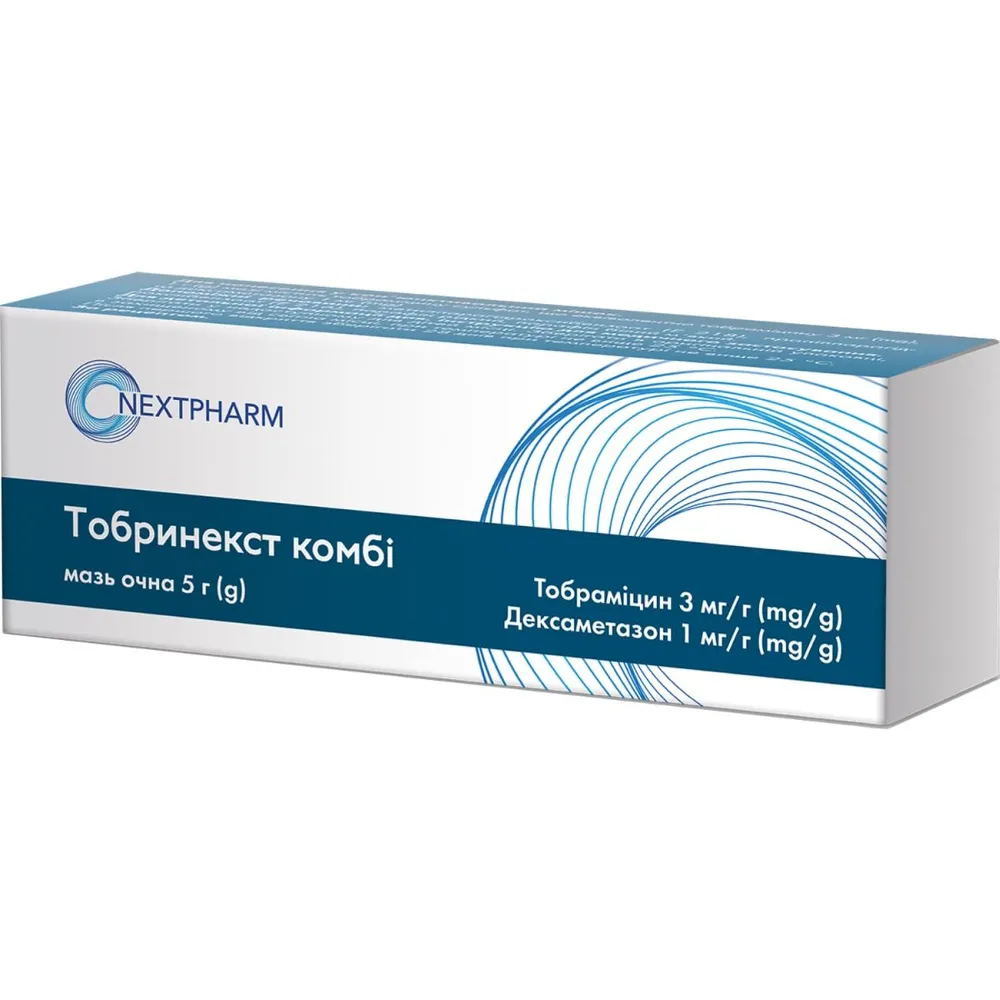
Table of Contents
INSTRUCTIONS for medical use of the medicinal product Tobrinext (Tobrinext)
Composition:
Active substance: tobramycin;
1 g of ointment contains tobramycin sulfate equivalent to 3 mg of tobramycin;
Excipients: methylparahydroxybenzoate (E 218), propylparahydroxybenzoate (E 216), liquid paraffin, white soft paraffin.
Pharmaceutical form. Eye ointment.
Main physicochemical properties: ointment with a uniform consistency, from white to pale yellow in color.
Pharmacotherapeutic group.
Medicinal products used in ophthalmology. Antimicrobial agents. Antibiotics.
ATC code S01A A12.
Pharmacological properties.
Pharmacodynamics.
Tobramycin is a rapidly-acting bactericidal antibiotic from the aminoglycoside group. It acts on bacterial cells by inhibiting the complex of polypeptides and protein synthesis in ribosomes.
Resistance to tobramycin develops through several different mechanisms, including alterations in ribosomal subunits within the bacterial cell, impaired transport of tobramycin into the cell, and inactivation of tobramycin by a group of adenylating, phosphorylating, and acetylating enzymes. Genetic information responsible for the production of inactivating enzymes may be transferred via bacterial chromosomes or plasmids. Cross-resistance to other aminoglycosides may occur.
The following in vitro breakpoints and activity spectrum are based on systemic administration. These values may not be applicable when the medicinal product is applied locally to the eye, as higher concentrations are achieved with local application and local physical/chemical conditions may influence the drug's activity at the site of administration. The European Committee on Antimicrobial Susceptibility Testing (EUCAST) has established the following breakpoints for tobramycin:
Enterobacteriaceae: S ≤ 2 mg/L, R > 4 mg/L;
Pseudomonas spp.: S ≤ 4 mg/L, R > 4 mg/L;
Acinetobacter spp.: S ≤ 4 mg/L, R > 4 mg/L;
Staphylococcus spp.: S ≤ 1 mg/L, R > 1 mg/L;
non-species specific: S ≤ 2 mg/L, R > 4 mg/L.
The information provided below gives approximate data regarding whether microorganisms will be susceptible to tobramycin in the form of ophthalmic ointment. Only bacterial species commonly causing external eye infections, such as conjunctivitis, are listed in this instruction.
The prevalence of acquired resistance in specific microbial species may vary geographically and over time; therefore, local information on microbial resistance patterns is desirable, especially when treating severe infections. Advice from a specialist should be sought if local resistance prevalence renders the activity of tobramycin at least questionable against certain types of infections.
| Susceptible species: Aerobic gram-positive microorganisms Bacillus megaterium; Bacillus pumilus; Corynebacterium accolens; Corynebacterium bovis; Corynebacterium macginleyi; Corynebacterium pseudodiphtheriticum; Kocuria kristinae; Staphylococcus aureus (methicillin-susceptible); Staphylococcus haemolyticus (methicillin-susceptible). Aerobic gram-negative microorganisms Acinetobacter junii; Acinetobacter ursingii; Citrobacter koseri; Escherichia coli; Klebsiella oxytoca; Klebsiella pneumoniae; Moraxella catarrhalis; Moraxella oslonensis; Morganella morganii; Neisseria perflava; Proteus mirabilis; Pseudomonas aeruginosa; Serratia liquifaciens. |
| Conditionally resistant species: Acinetobacter baumannii; Bacillus cereus; Bacillus thuringiensis; Kocuria rhizophila; Staphylococcus epidermidis; Staphylococcus haemolyticus (methicillin-resistant)*; Staphylococcus; other coagulase-negative species Serratia marcescens. |
| Resistant microorganisms: Aerobic gram-positive microorganisms Enterococcus faecalis; Staphylococcus aureus (methicillin-resistant); Streptococcus mitis; Streptococcus pneumoniae; Streptococcus pyogenes; Streptococcus sanguis. Aerobic gram-negative microorganisms Chryseobacterium indologenes; Haemophilus influenzae; Stenotrophomonas maltophilia. Anaerobic microorganisms Propionibacterium acnes. |
* Resistance exceeds 50%.
Children
Analysis of clinical trial data on the use of eye drops or ointments containing tobramycin for the treatment of bacterial conjunctivitis, blepharitis, or blepharoconjunctivitis in children aged 1 to 18 years showed that the overall safety profile in children was similar to that in adult patients. The use of the medicinal product is not recommended in children under 1 year of age due to insufficient data.
Pharmacokinetics.
Absorption of tobramycin through corneal and conjunctival tissues is quite low; therefore, only a minimal amount of tobramycin is absorbed into the eye following topical ophthalmic administration. Tobramycin is rapidly and extensively excreted in urine via glomerular filtration, primarily in unchanged form. The plasma half-life is approximately 2 hours, with a clearance of 0.04 L/h/kg and a volume of distribution of 0.26 L/kg. Plasma protein binding of tobramycin is negligible (less than 10%). Oral bioavailability of tobramycin is low (< 1%).
Clinical characteristics.
Indications.
Treatment of external ocular infections and adjacent tissues caused by pathogenic microorganisms sensitive to tobramycin.
Contraindications.
Hypersensitivity to the active substance or to any of the excipients of the medicinal product.
Interaction with other medicinal products and other forms of interaction.
Clinically significant interactions with topical ophthalmic tobramycin have not been described.
No specific studies on potential interactions have been conducted. There are reports of interactions with other medicinal products following systemic administration of tobramycin. However, systemic absorption of tobramycin after topical application is so low that the risk of any interaction is minimal.
When applying multiple ophthalmic medicinal products locally at the same time, an interval of at least 5 minutes between applications should be observed.
Ophthalmic ointments should be applied last.
Special precautions for use.
The medicinal product is intended for ophthalmic use only.
Some patients may develop hypersensitivity to topically applied aminoglycosides. The severity of hypersensitivity reactions may vary from local effects to generalized reactions such as erythema, pruritus, urticaria, skin rashes, anaphylaxis, anaphylactoid reactions, or bullous reactions. If hypersensitivity occurs during treatment, administration of this medicinal product, as well as other medicinal products, should be discontinued.
Cross-hypersensitivity to other aminoglycosides may occur. Patients who are sensitive to topically applied tobramycin may also be sensitive to other aminoglycosides administered topically and/or systemically.
Serious adverse reactions, including neurotoxicity, ototoxicity, and nephrotoxicity, have occurred in patients receiving tobramycin as systemic therapy. Caution is advised when tobramycin is used concomitantly with topical and systemic aminoglycosides.
As with other antibiotics, prolonged use of Tobrinext may result in overgrowth of non-susceptible microorganisms, including fungi. If superinfection occurs, appropriate therapy should be instituted.
The use of contact lenses is not recommended during treatment of ocular infections.
The use of ophthalmic ointment may delay corneal wound healing.
This medicinal product contains methylparaben (E 218) and propylparaben (E 216), which may cause allergic reactions (possibly delayed).
Use during pregnancy or breastfeeding.
Reproductive function
No studies have been conducted to evaluate the effect of tobramycin on human reproductive function following topical ophthalmic administration.
Pregnancy
There are no or very limited data on the use of tobramycin administered topically to the eye in pregnant women.
Animal studies have shown toxic effects on reproductive function.
Tobrinext is not recommended during pregnancy.
Breastfeeding
It is unknown whether tobramycin passes into human breast milk following topical ophthalmic administration. Following systemic administration, tobramycin is excreted in breast milk. It is unlikely that tobramycin will be present in breast milk or cause clinical effects in the newborn following topical ophthalmic use. However, a risk to the breastfed infant cannot be excluded. Consideration should be given to temporarily discontinuing breastfeeding during treatment with tobramycin or to discontinuing/abstaining from the therapy, taking into account the benefit-risk ratio.
Ability to affect reaction speed when driving or operating machinery.
The effect of Tobrinext on the ability to drive or operate machinery is none or negligible. However, transient blurred vision or other visual disturbances may affect the ability to drive or operate machinery. If blurred vision occurs after application of the ointment, patients should wait until vision clears before driving or operating machinery.
Dosage and Administration
Dosage
For mild to moderate severity of the disease, it is recommended to apply a small amount of the medicinal product (a strip approximately 1.5 cm long) into the conjunctival sac (sacs) of the affected eye(s) 2 or 3 times daily.
For severe disease, it is recommended to apply a small amount of the medicinal product (a strip approximately 1.5 cm long) into the conjunctival sac (sacs) of the affected eye(s) every 3–4 hours during the first 2 days, followed by 2–3 times daily until complete recovery.
As with other antibiotics, appropriate monitoring of bacterial sensitivity to the drug should be performed.
Treatment typically lasts 7–10 days.
It is recommended to gently close the eyelids and lightly press on the area of the nasolacrimal duct—this reduces systemic absorption of drugs administered into the eye and decreases the likelihood of systemic adverse effects.
Patients with hepatic or renal impairment
There are no data on the use of ophthalmic preparations containing tobramycin in these patient groups. However, due to the low systemic absorption of tobramycin following topical administration, dosage adjustment is not necessary.
Administration method
The medicinal product is intended for topical use only—application into the conjunctival sac.
To prevent contamination of the tube tip and its contents, care should be taken to avoid touching the eyelids, surrounding areas, or other surfaces with the tube tip. The tube should be closed immediately after use.
How to apply the ointment
- Tilt your head backward.
- Place a finger under the eye on the cheek and gently pull the skin downward to create a V-shaped pouch between the eyeball and the lower eyelid.
- Apply a small amount (approximately the size of a pea) of ointment into the V-shaped pouch. Avoid contact between the tube tip and the eye or eyelid.
- Look downward before closing the eye.
Children
Tobrex can be used in children aged 1 year and older at the same dosage as adults. However, information on the use of the medicinal product in pediatric patients is limited (see section "Pharmacodynamics"). Safety and efficacy in children under 1 year of age have not been established.
Overdose
In case of overdose during topical administration, flush the excess ointment from the eye(s) with warm water.
Due to the characteristics of this drug, serious toxic reactions are not expected following overdose after ocular (ocular) application or accidental ingestion of the tube contents.
Clinical manifestations of overdose resemble adverse effects observed in some patients: punctate keratitis, erythema, increased lacrimation, eyelid swelling, and itching.
Adverse reactions.
The most common adverse reactions associated with the use of the medicinal product were ocular hyperemia and sensation of eye discomfort, occurring in approximately 1.4% and 1.2% of patients, respectively.
The frequency of adverse reactions was defined according to the following categories: very common (≥ 1/10), common (≥ 1/100, < 1/10), uncommon (≥ 1/1000, < 1/100), rare (≥ 1/10000, < 1/1000), very rare (< 1/10000).
Within each frequency grouping, adverse reactions are listed in order of decreasing severity.
| Organ systems |
Adverse reactions according to MedDRA [Medical Dictionary for Regulatory Activities] terms |
| Immune system disorders |
Uncommon: hypersensitivity. |
| Nervous system disorders |
Uncommon: headache. |
| Eye disorders |
Common: eye discomfort, eye hyperemia. Uncommon: keratitis, corneal abrasion, visual disturbance, blurred vision, eyelid erythema, eyelid edema, conjunctival edema, eye irritation, eye pain, dry eyes, eye discharge, eye pruritus, increased lacrimation. |
| Skin and subcutaneous tissue disorders |
Uncommon: urticaria, dermatitis, dry skin, leukoderma, pruritus, purpura. |
Additional adverse reactions have been identified during the post-marketing surveillance period, as listed below. Based on the available data, it is not possible to estimate the frequency of their occurrence.
| Organ systems |
Adverse reactions according to MedDRA terms |
| Immune system |
Anaphylactic reaction |
| Eye disorders |
Ocular allergy, itchy eyelids, eye irritation. |
| Skin and subcutaneous tissue |
Rash, Stevens-Johnson syndrome, erythema multiforme. |
Description of some adverse reactions
- Hypersensitivity to topically applied aminoglycosides may occur in some patients (see section "Special precautions").
- Serious adverse reactions, including neurotoxicity, ototoxicity, and nephrotoxicity, have been observed in patients who received systemic tobramycin therapy (see section "Special precautions").
Reporting of suspected adverse reactions
Reporting of suspected adverse reactions after drug registration is important. It allows continuous monitoring of the benefit-risk balance of the medicinal product. Medical and pharmaceutical professionals, as well as patients or their legal representatives, should report all suspected adverse reactions and lack of drug efficacy via the Automated Pharmacovigilance Information System at the following link: https://aisf.dec.gov.ua.
Shelf life. 3 years.
After first opening, store for up to 28 days at a temperature not exceeding 25 °C.
Storage conditions.
Store in the original packaging, protected from light, at a temperature not exceeding 25 °C. Keep out of reach of children.
Packaging.
5 g of ointment in an aluminum foil tube with a nozzle and a screw plastic cap; 1 tube per cardboard box.
Prescription status. Prescription only.
Manufacturer.
BALKAНPHARMA-RAZGRAD AD / BALKANPHARMA-RAZGRAD AD.
Manufacturer's address and place of business.
68 Aprilsko Vastanie Blvd., Razgrad 7200, Bulgaria / 68 Aprilsko Vastanie Blvd., Razgrad 7200, Bulgaria.