Tobramycin-pharmex
Ukraine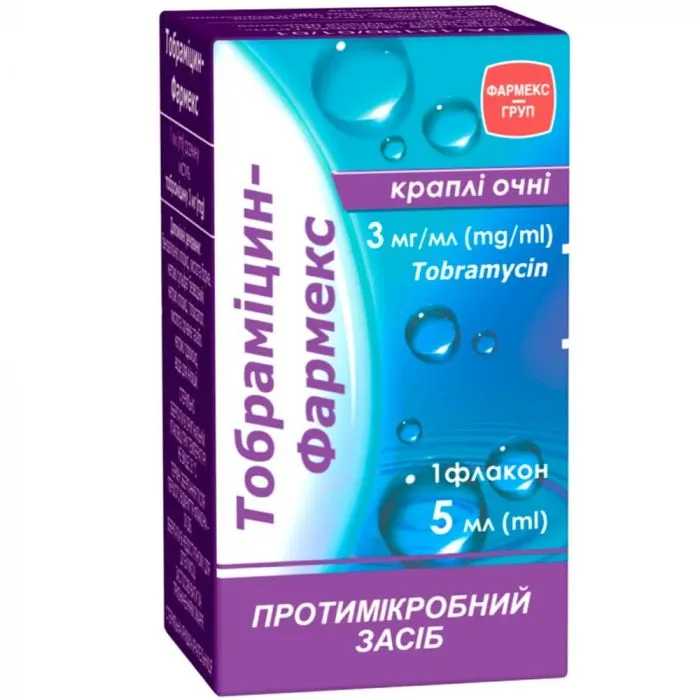
Table of Contents
INSTRUCTIONS FOR MEDICAL USE OF THE MEDICINAL PRODUCT TOBRAMYCIN-PHARMEKS
Composition:
Active substance: tobramycin;
1 ml of solution contains 3 mg of tobramycin;
Excipients: benzalkonium chloride, boric acid, anhydrous sodium sulfate, sodium chloride, tyloxapol, sulfuric acid and/or sodium hydroxide, water for injections.
Pharmaceutical form. Eye drops.
Main physico-chemical properties: clear solution, colorless to slightly brownish or yellowish.
Pharmacotherapeutic group.
Medicinal products used in ophthalmology. Antimicrobial agents. Antibiotics.
ATC code S01A A12.
Pharmacological properties.
Pharmacodynamics.
Tobramycin is a rapidly acting bactericidal antibiotic of the aminoglycoside group. Its primary action targets bacterial cells by inhibiting the complex of polypeptides and protein synthesis in ribosomes.
Resistance to tobramycin develops through several different mechanisms, including alterations in ribosomal subunits within the bacterial cell, impaired transport of tobramycin into the cell, and inactivation of tobramycin by a group of adenylating, phosphorylating, and acetylating enzymes. The genetic information responsible for production of these inactivating enzymes may be transferred via bacterial chromosomes or plasmids. Cross-resistance to other aminoglycosides may occur.
The following in vitro breakpoints and activity spectrum are based on systemic administration. These values may not be applicable when the medicinal product is administered topically to the eye, as higher concentrations are achieved locally and local physical/chemical conditions may influence the drug's activity at the site of application. According to the European Committee on Antimicrobial Susceptibility Testing (EUCAST), the following breakpoints have been defined for tobramycin:
Enterobacteriaceae S ≤ 2 mg/L, R > 4 mg/L
Pseudomonas spp. S ≤ 4 mg/L, R > 4 mg/L
Acinetobacter spp. S ≤ 4 mg/L, R > 4 mg/L
Staphylococcus spp. S ≤ 1 mg/L, R > 1 mg/L
Non-species-specific S ≤ 2 mg/L, R > 4 mg/L.
The information provided below gives approximate data on whether microorganisms will be susceptible to tobramycin in the TOBRAMYCIN-PHARMEKS formulation. Only bacterial species commonly causing external eye infections, such as conjunctivitis, are listed in this instruction.
The prevalence of acquired resistance may vary geographically and over time for relevant microorganism species; therefore, local information on microbial resistance patterns is desirable, especially when treating severe infections. If necessary, expert advice should be sought when local resistance prevalence renders the efficacy of tobramycin at least questionable against certain types of infections.
| Susceptible species |
| Aerobic gram-positive microorganisms |
| Bacillus megaterium |
| Bacillus pumilus |
| Corynebacterium accolens |
| Corynebacterium bovis |
| Corynebacterium macginleyi |
| Corynebacterium pseudodiphtheriticum |
| Kocuria kristinae |
| Staphylococcus aureus (methicillin-susceptible) |
| Staphylococcus haemolyticus (methicillin-susceptible). |
| Aerobic gram-negative microorganisms |
| Acinetobacter junii |
| Acinetobacter ursingii |
| Citrobacter koseri |
| Escherichia coli |
| Klebsiella oxytoca |
| Klebsiella pneumoniae |
| Moraxella catarrhalis |
| Moraxella oslonensis |
| Morganella morganii |
| Neisseria perflava |
| Proteus mirabilis |
| Pseudomonas aeruginosa |
| Serratia liquifaciens. |
| Conditionally resistant species |
| Acinetobacter baumannii |
| Bacillus cereus |
| Bacillus thuringiensis |
| Kocuria rhizophila |
| Staphylococcus aureus (methicillin-resistant) |
| Staphylococcus epidermidis |
| Staphylococcus haemolyticus (methicillin-resistant)* |
| Staphylococcus, other coagulase-negative species |
| Serratia marcescens. |
| Resistant microorganisms |
| Aerobic gram-positive microorganisms |
| Enterococcus faecalis |
| Streptococcus mitis |
| Streptococcus pneumoniae |
| Streptococcus pyogenes |
| Streptococcus sanguis. |
| Aerobic gram-negative microorganisms |
| Chryseobacterium indologenes |
| Haemophilus influenzae |
| Stenotrophomonas maltophilia. |
| Anaerobic bacteria |
| Propionibacterium acnes. |
* Resistance is greater than 50%.
Preclinical safety data
Systemic toxicity data are well characterized. Systemic effects of tobramycin at toxic doses, which greatly exceed the dose used for local ocular application, may be associated with nephrotoxicity and ototoxicity.
In vitro and in vivo studies of tobramycin did not reveal mutagenic effects.
Tobramycin crosses the placenta into fetal circulation and amniotic fluid. Animal studies with high systemic doses of tobramycin administered to pregnant animals during organogenesis revealed fetal kidney toxicity and ototoxicity. Other studies conducted in rats and rabbits using tobramycin doses exceeding 100 mg/kg/day administered parenterally (>400 times the maximum clinical dose) showed no evidence of impaired fertility or adverse effects on the fetus.
No studies have been conducted to evaluate the carcinogenic potential of tobramycin.
Children
Over 600 children were included in 10 clinical trials of tobramycin ophthalmic drops or ointment for the treatment of bacterial conjunctivitis, blepharitis, or blepharoconjunctivitis. Patient ages ranged from 1 to 18 years. Overall, the safety profile in children was comparable to that in adult patients. No recommendations can be made for children under 1 year of age due to insufficient data.
Pharmacokinetics
Systemic exposure to tobramycin following topical ophthalmic administration of TOBRAMYCIN-PHARMEKS eye drops is low. Tobramycin plasma concentrations could not be quantified in 9 out of 12 patients who received an ophthalmic suspension containing 0.3% tobramycin and 0.1% dexamethasone in each eye four times daily for two consecutive days. The highest measured concentration was 0.25 mcg/mL, which is 8 times lower than the 2 mcg/mL concentration known to be below the threshold for risk of nephrotoxicity.
Tobramycin is rapidly and extensively excreted in urine by glomerular filtration, primarily in unchanged form. The plasma elimination half-life is approximately 2 hours, with a clearance of 0.04 L/h/kg and a volume of distribution of 0.26 L/kg. Plasma protein binding of tobramycin is negligible, less than 10%. Oral bioavailability of tobramycin is low (<1%).
Children
The medicinal product can be used in children (from 1 year of age) at the same dose as in adults. Information for children under 1 year of age is limited.
Clinical characteristics.
Indications.
Treatment of external infections of the eye and adjacent tissues caused by pathogenic microorganisms sensitive to tobramycin.
Contraindications.
Hypersensitivity to the active substance or to any of the excipients of the medicinal product.
Interaction with other medicinal products and other forms of interaction.
When topical corticosteroids and tobramycin at a concentration of 3 mg/mL are used concomitantly, clinical signs of bacterial, fungal, or viral infection may be masked, and hypersensitivity reactions may be suppressed.
There have been reports of interactions with other medicinal products following systemic administration of tobramycin. However, systemic absorption of tobramycin after topical application is so low that the risk of any interaction is minimal.
If several topical ophthalmic medicinal products are used simultaneously, an interval of at least 10–15 minutes between applications is required. Ophthalmic ointments should be administered last.
Special precautions for use.
- For topical ophthalmic use only. Not intended for injection or oral administration.
- After the first opening of the bottle, remove the tamper-evident ring designed to indicate first opening.
- Local hypersensitivity to topically applied aminoglycosides may occur in some patients. The severity of hypersensitivity reactions may vary from local effects to generalized reactions such as erythema, itching, urticaria, skin rashes, anaphylaxis, anaphylactoid reactions, or bullous reactions. If hypersensitivity occurs during treatment with this medicinal product, its use should be discontinued, as well as the use of other concurrently administered medicinal products (see section "Adverse reactions").
- Cross-sensitivity to other aminoglycosides may occur. It should be noted that patients who become sensitive to topically applied tobramycin may also become sensitive to other aminoglycosides administered topically and/or systemically.
- Serious adverse reactions, including neurotoxicity, ototoxicity, and nephrotoxicity, have occurred in patients receiving systemic tobramycin therapy. Caution is advised when tobramycin is used concomitantly with topical and systemic aminoglycosides; monitoring of total serum aminoglycoside concentrations is recommended (see section "Adverse reactions").
- The medicinal product should be used with caution in patients with known or suspected neuromuscular disorders such as myasthenia gravis or Parkinson's disease. Aminoglycosides may exacerbate muscle weakness due to their potential effect on neuromuscular function.
- As with other antibiotics, prolonged use of TOBRAMYCIN-PHARMEKS may lead to overgrowth of non-susceptible microorganisms, including fungi. If superinfection occurs, appropriate therapy should be initiated.
- The use of contact lenses during treatment of ocular infections is not recommended. Therefore, patients should be advised not to wear contact lenses during treatment with this medicinal product.
- TOBRAMYCIN-PHARMEKS contains benzalkonium chloride, which may cause irritation and is known to discolor soft contact lenses. Contact with soft contact lenses should be avoided. If patients are permitted to use contact lenses, they should be instructed to remove their contact lenses before administering the drops and to wait 15 minutes after instillation before reinserting them.
- To prevent contamination of the dropper tip and solution, care should be taken not to touch the eyelids, adjacent areas, or any other surfaces with the tip of the dropper bottle.
Use during pregnancy or breastfeeding.
Reproductive function
Studies evaluating the effect of tobramycin on human or animal reproductive function following topical administration have not been conducted (see section "Pharmacological properties").
Pregnancy
Data on the use of tobramycin administered topically to the eye in pregnant women are lacking or very limited. Clinical studies in volunteers have not shown an association between tobramycin use and developmental abnormalities. Following intravenous administration to pregnant women, tobramycin crosses the placenta and reaches the fetus. In utero exposure to tobramycin does not cause ototoxicity.
Animal studies have demonstrated toxic effects on reproductive function at doses exceeding the maximum recommended human dose; therefore, these data have limited clinical relevance (see section "Pharmacological properties").
Despite the expected minimal systemic effect of tobramycin following topical administration, as a precautionary measure, it is preferable to avoid the use of tobramycin during pregnancy. TOBRAMYCIN-PHARMEKS may be used in women planning pregnancy. The medicinal product is not recommended during pregnancy.
Breastfeeding
Minimal exposure of tobramycin in breast milk has been reported in women following intravenous or intramuscular administration of up to 150 mg tobramycin three times daily. Despite the lack of specific data on systemic exposure to tobramycin following ophthalmic administration, due to the much lower doses administered topically to the eye compared to the systemic doses mentioned above, minimal transfer into breast milk is expected, and no adverse effects are anticipated in breastfed newborns/infants. Ophthalmic topical use of tobramycin may be considered during breastfeeding if the benefit to the mother outweighs the potential risk to the breastfed newborn/infant.
Ability to influence the reaction rate when driving or operating machinery.
There is no or negligible influence on the ability to drive or operate machinery during treatment with TOBRAMYCIN-PHARMEKS. Transient blurred vision or other visual disturbances may affect the ability to drive or operate machinery. If blurred vision occurs after instillation, patients should wait until vision clears before driving or operating machinery.
Dosage and Administration
As with other antibiotics, appropriate monitoring of bacterial sensitivity to the drug should be carried out.
Use in children, adolescents, adults, including elderly patients
For mild to moderate severity of the disease, instill 1–2 drops into the conjunctival sac(s) of the affected eye(s) every 4 hours.
For severe disease, instill 1–2 drops into the conjunctival sac(s) of the affected eye(s) every hour until improvement occurs; the frequency of administration should then be gradually reduced until treatment is discontinued.
Treatment usually lasts 7–10 days.
After instillation, it is recommended to gently close the eyelid or apply pressure at the lacrimal sac area. This reduces systemic absorption of ophthalmic drugs, thereby decreasing the likelihood of systemic adverse reactions.
If concomitant therapy with other topical ophthalmic agents is required, an interval of 10–15 minutes should be maintained between administrations.
Patients with hepatic and/or renal impairment
There are no study data available on the use of TOBRAMYCIN-PHARMEKS in these patient populations. However, due to the low systemic absorption of tobramycin following topical ocular administration, dosage adjustment is not required.
Children
Eye drops can be used in children aged 1 year and older at the same dose as in adults. Current data are described in the section "Pharmacological Properties". Safety and efficacy of the eye drops in children under 1 year of age have not been established.
Overdose
No toxic effects are expected in case of overdose following topical administration or accidental ingestion of the contents of one bottle, considering the characteristics of this drug.
Possible clinical signs and symptoms of overdose with TOBRAMYCIN-PHARMEKS (punctate keratitis, erythema, increased lacrimation, eyelid swelling and itching) may resemble adverse reactions observed in some patients.
Any excess of TOBRAMYCIN-PHARMEKS following topical overdose should be rinsed from the eye(s) with warm water.
Adverse reactions.
During clinical studies, the most commonly reported adverse reactions were ocular hyperemia and eye discomfort, occurring in approximately 1.4% and 2% of patients, respectively. The adverse reactions listed below were observed during clinical studies of the drug and were classified as follows: very common (≥1/10), common (≥1/100, <1/10), uncommon (≥1/1000, <1/100), rare (≥1/10000, <1/1000), and very rare (<1/10000). Within each frequency grouping, adverse reactions are listed in order of decreasing severity.
| Organ system |
Adverse reactions[According to MedDRA (version 15.1)] |
| Immune system disorders |
Uncommon: hypersensitivity. |
| Nervous system disorders |
Uncommon: headache. |
| Eye disorders |
Common: eye discomfort, eye hyperemia. Uncommon: keratitis, corneal abrasion, visual disturbance, blurred vision, eyelid erythema, eyelid edema, conjunctival edema, eye irritation, eye pain, dry eyes, eye discharge, eyelid disorders, eye pruritus, increased lacrimation. |
| Skin and subcutaneous tissue disorders |
Uncommon: urticaria, dermatitis, madarosis, leukoderma, pruritus, dry skin. |
During the post-marketing surveillance period, the following additional adverse reactions have been identified. Based on the available data, it is not possible to estimate their frequency of occurrence.
| Organ system classification |
Adverse reactions[According to MedDRA (version 15.1)] |
| Immune system disorders |
Anaphylactic reaction |
| Eye disorders |
Ocular allergy, eyelid pruritus |
| Skin and subcutaneous tissue disorders |
Rash, erythema, Stevens-Johnson syndrome, erythema multiforme. |
Description of some adverse reactions
- Hypersensitivity to topically applied aminoglycosides may occur in some patients (see section "Special precautions").
- Serious adverse reactions, including neurotoxicity, ototoxicity, and nephrotoxicity, have been observed in patients receiving systemic tobramycin therapy. However, such reactions have not been reported following topical ocular administration of tobramycin (see section "Special precautions").
- Eye drops may be used in children aged 1 year and older at the same dose as in adults. Currently available data are described in the section "Pharmacological properties". Safety and efficacy of the eye drops in children under 1 year of age have not been established (see section "Dosage and administration").
Reporting suspected adverse reactions
Reporting of suspected adverse reactions after authorization of the medicinal product is important. It allows continued monitoring of the benefit-risk balance of the medicinal product. Healthcare professionals and patients, as well as their legal representatives, are encouraged to report any suspected adverse reactions and lack of efficacy through the Automated Pharmacovigilance Information System at the following link: https://aisf.dec.gov.ua.
Shelf life. 2 years.
Storage period after first opening of the container – 28 days.
Storage conditions.
Store in the original packaging at a temperature not exceeding 25 °C. Keep out of reach of children.
Packaging.
5 ml in a bottle, 1 bottle with a dropper cap in a cardboard box.
Prescription status.
Prescription only.
Manufacturer.
LLC "FARMEKS GROUP".
Manufacturer's address and place of business.
100, Shevchenka Street, Boryspil, Kyiv Oblast, 08301, Ukraine.