Tivorel aspartate
Ukraine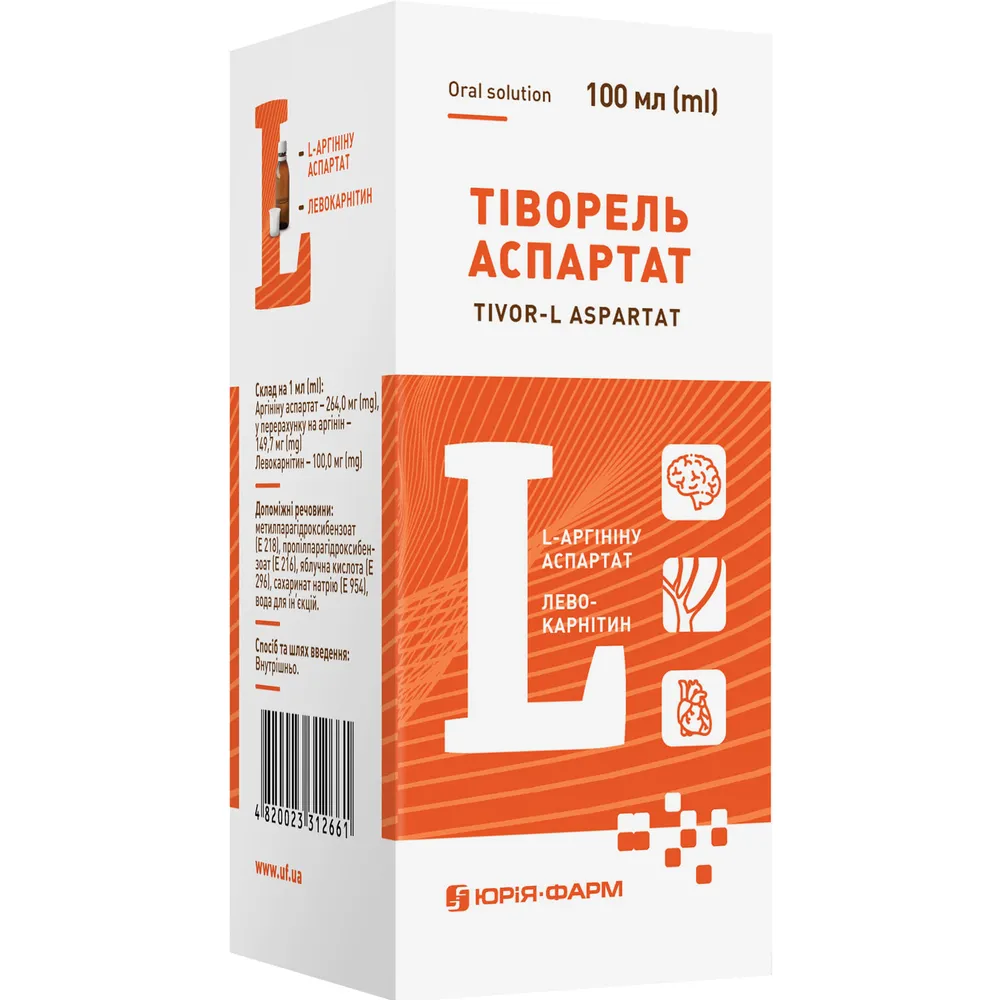
Table of Contents
INSTRUCTIONS FOR MEDICAL USE OF THE MEDICINAL PRODUCT TIVOREL ASPARTATE (TIVOREL ASPARTATE)
Composition:
Active substances: arginine aspartate (L-arginine L-aspartate), levocarnitine;
1 ml of solution contains 264 mg of arginine aspartate (L-arginine L-aspartate), equivalent to 149.7 mg of arginine, and 100 mg of levocarnitine;
Excipients: methylparahydroxybenzoate (E 218) – 0.8 mg; propylparahydroxybenzoate (E 216) – 0.2 mg; malic acid (E 296); sodium saccharin (E 954); water for injections.
Pharmaceutical form. Oral solution.
Main physicochemical properties: clear, colorless or slightly yellowish viscous liquid.
Pharmacotherapeutic group. Medicinal products affecting the cardiovascular system. Other combined cardiovascular medicinal products.
ATC code: C01EX.
Pharmacological properties.
Pharmacodynamics.
The therapeutic effect of the medicinal product Tivorel aspartate is due to the synergistic action of its components – arginine and levocarnitine.
Arginine (α-amino-δ-guanidinovaleric acid) belongs to the class of conditionally essential amino acids. It acts as an active cellular regulator of numerous vital functions in the body and exerts protective effects under critical conditions.
Arginine exerts anti-hypoxic, membrane-stabilizing, cytoprotective, antioxidant, free radical-scavenging, and detoxifying effects. It acts as an active regulator of intermediate metabolism and energy supply processes, plays a role in maintaining hormonal balance, improves placental blood flow, and reduces the risk of fetal oxidative stress. It is known that arginine enhances peripheral tissue sensitivity to insulin and glucagon, increases blood levels of growth hormone and prolactin, regulates blood glucose levels during physical exertion, participates in the synthesis of proline, polyamines, and agmatine, is involved in fibrinogenolysis and spermatogenesis, and exerts membrane-stabilizing effects.
Arginine is the primary source of nitric oxide (NO), thereby influencing hemodynamics in the body. The pronounced cationic properties of the guanidine group of arginine promote improved metabolic processes in tissues by reducing the concentration of products of lipid peroxidation of membranes, enhancing the activity of the antioxidant defense system, and improving mitochondrial energy supply through activation of the mitochondrial redox system.
The anti-hypoxic effect of arginine is achieved not only through increased production of nitric oxide (NO) by endothelial NO-synthase but also via an indirect antioxidant effect induced by arginine, combined with a reduction in the concentration of superoxide anion radicals released from the endothelium.
Arginine activates guanylate cyclase and increases the level of cyclic guanosine monophosphate (cGMP) in vascular endothelium. It reduces activation and adhesion of leukocytes and platelets to the vascular endothelium, suppresses the synthesis of adhesion proteins, thereby preventing the formation and progression of atherosclerotic plaques. It inhibits the synthesis of endothelin-1, a potent vasoconstrictor and stimulator of vascular smooth muscle cell proliferation and migration. Arginine also suppresses the synthesis of asymmetric dimethylarginine – a powerful endogenous inducer of oxidative stress.
Nitric oxide (NO) molecules inhibit mononuclear cell adhesion, platelet aggregation, vascular smooth muscle proliferation, and reactive oxygen species generation. Under physiological conditions, NO participates in vascular system adaptation to increased metabolic demands caused by physical exertion.
Arginine directly participates in the regulation of vascular processes, including placental circulation, through its effects on the endothelium.
Arginine plays an important role in ammonia detoxification in the ornithine cycle of urea synthesis, as well as in binding this neurotoxin into non-toxic glutamine and stimulating the removal of ammonia from the central nervous system (CNS) and the body as a whole. Thus, the drug exerts a hypoammonemic effect.
Arginine stimulates thymus gland activity, which produces T-cells. It exerts an acid-forming effect and promotes correction of acid-base balance.
Levocarnitine is a natural substance involved in most energy-producing processes. Its presence is essential for the metabolism of fatty acids, amino acids, carbohydrates, and ketone bodies. Only the L-isomer of carnitine is biologically active. The highest concentrations of levocarnitine are found in muscle tissue, myocardium, and liver.
Levocarnitine is necessary for the transport of long-chain fatty acids into mitochondria for subsequent beta-oxidation and energy production. Fatty acids are used as an energy substrate by all tissues except the brain. In skeletal muscles and myocardium, fatty acids are the primary energy substrate.
Levocarnitine plays a crucial role in cardiac metabolism, as fatty acid oxidation depends on the availability of sufficient amounts of this substance. ATP production from fatty acids is energetically more favorable than glucose oxidation. Modulation of the glycolytic ATP production pathway by levocarnitine is optimal for cardioprotection, as it optimizes ATP production via glycolysis in ischemic cells without affecting the use of fatty acids as the main ATP source in non-ischemic cells.
Experimental studies have also shown that stress, acute ischemia, and myocarditis can lead to decreased levels of levocarnitine in myocardial tissue. Numerous animal studies have confirmed the beneficial effects of levocarnitine in various experimentally induced cardiac disorders: acute and chronic ischemia, cardiac decompensation, heart failure due to myocarditis, and drug-induced cardiotoxicity (e.g., taxanes, adriamycin, etc.).
By facilitating the use of fatty acids as an energy substrate, levocarnitine enhances endurance during physical exertion.
By releasing coenzyme A from complex thioesters, levocarnitine also enhances carbohydrate oxidation in the Krebs cycle of tricarboxylic acids, stimulates the activity of the key glycolysis enzyme pyruvate dehydrogenase, and in skeletal muscles, promotes the oxidation of branched-chain amino acids. Thus, levocarnitine directly or indirectly participates in most energy-producing processes, and its presence is essential for the oxidation of fatty acids, amino acids, carbohydrates, and ketone bodies.
By reducing plasma concentrations of free fatty acids, levocarnitine helps decrease tissue insulin resistance.
Results from a Phase III clinical trial involving 137 patients demonstrate that the use of the medicinal product Tivorel aspartate as part of combination therapy for ischemic heart disease is superior in efficacy to standard therapy, leading to increased duration of physical exercise performed, increased threshold workload power, and improved quality of life assessment (based on the HeartQoL questionnaire).
Results from another Phase III clinical trial involving 106 patients show that the use of Tivorel aspartate as part of combination therapy for acute ischemic-type cerebrovascular events in the carotid artery territory is effective and has a favorable safety profile.
Clinical experience with the combined use of L-arginine aspartate and levocarnitine indicates that their combination increases general and specific physical performance and improves the psychophysiological state of athletes in various sports.
Pharmacokinetics.
Not studied.
Clinical characteristics.
Indications.
- Tivorel aspartate is used as part of complex therapy for:
- chronic ischemic heart disease;
- atherosclerosis of coronary, cerebral, and peripheral vessels;
- acute ischemic-type cerebrovascular disorders.
- Tivorel aspartate is used to increase tolerance to physical exertion, including in sports.
Contraindications.
- Hypersensitivity to the active substances or to any of the excipients.
- History of allergic reactions.
- Severe renal function impairment.
- Use of potassium-sparing diuretics, as well as spironolactone.
- Myocardial infarction (including history of).
Interaction with other medicinal products and other types of interactions.
When using the medicinal product Tivorel aspartate, it should be considered that the drug may cause pronounced and persistent hyperkalemia against a background of renal insufficiency in patients who are taking or have taken spironolactone. Prior use of potassium-sparing diuretics may also contribute to increased blood potassium concentration.
Concomitant use with aminophylline may increase insulin levels in the blood.
Simultaneous use with glucocorticoids leads to accumulation of levocarnitine in body tissues (except liver). Other anabolic agents enhance the drug's effect.
In patients who received levocarnitine concomitantly with coumarin-derived anticoagulants (see sections "Special precautions", "Adverse reactions"), very rare cases of increased international normalized ratio (INR) have been observed. INR or another appropriate coagulation test should be performed weekly until values stabilize, and monthly thereafter in patients taking such anticoagulants together with levocarnitine.
Concomitant use of levocarnitine with agents that induce hypocarnitinemia by enhancing renal carnitine excretion (e.g., valproic acid, prodrugs containing pivalic acid, cephalosporins, cisplatin, carboplatin, ifosfamide) may reduce its levels.
The medicinal product is incompatible with thiopental.
Special precautions for use
The drug should be used with caution in patients with electrolyte imbalances, particularly plasma potassium levels, as the medication may promote hyperkalemia in patients with kidney disease. Therefore, electrolyte balance should be monitored during prolonged treatment.
Arginine and levocarnitine enhance glucose metabolism; hence, when using Tivorel aspartate in diabetic patients receiving antidiabetic therapy, blood glucose levels should be monitored regularly to allow timely adjustment of therapy.
Alcohol, nicotine, and psychostimulants should be avoided during treatment with this medication.
If symptoms of asthenia worsen during treatment, therapy should be discontinued.
The drug should be used cautiously in patients with angina pectoris.
Very rare cases of increased INR have been observed in patients concurrently taking levocarnitine and coumarin-derived anticoagulants (see sections "Interaction with other medicinal products and other forms of interaction", "Adverse reactions"). Appropriate monitoring is required when coumarin anticoagulants are used concomitantly.
Seizures have been reported in patients with a history of seizure activity. However, it has not been fully established whether levocarnitine increases the frequency and/or severity of seizures. If seizures are associated with levocarnitine administration, discontinuation of the drug should be considered.
Long-term oral administration of high doses of levocarnitine in patients with severe renal dysfunction or end-stage chronic kidney disease (CKD) is contraindicated (see section "Contraindications") because it may lead to accumulation in the blood of potentially toxic metabolites—trimethylamine (TMA) and trimethylamine-N-oxide (TMAO)—due to insufficient renal excretion. This accumulation leads to increased TMA excretion in urine.
Recommended doses of the drug should not be exceeded. The drug should be discontinued if adverse effects occur. Sensitivity to the drug should be carefully assessed during the first week of treatment and after each dose increase.
The medicinal product contains excipients methylparahydroxybenzoate (E 218) and propylparahydroxybenzoate (E 216), which may cause allergic reactions (possibly delayed).
Tivorel aspartate contains:
0.0039 mmol (or less than 0.09 mg) of sodium per 1 ml of medicinal product;
0.078 mmol (or 1.79 mg) of sodium in 20 ml of medicinal product, i.e., practically sodium-free.
Use during pregnancy or breastfeeding
There are no data on the use of Tivorel aspartate in pregnant women. Data regarding excretion of the drug in breast milk and its effects on the fetus are unknown. Therefore, the drug should be administered during pregnancy or breastfeeding only if the expected benefit to the mother outweighs the potential risk to the fetus/infant.
Effect on ability to drive and operate machinery
In individual cases, certain adverse reactions affecting the central nervous system may impair the ability to drive or operate complex machinery.
Method of administration and dosage.
Take orally before meals.
Single dose is 10–20 ml. Maximum daily dose – 40 ml. The daily dose may be divided into 2–4 administrations.
| Indications |
Dosage |
Duration of treatment |
| In complex therapy: |
||
| chronic ischemic heart disease |
20 ml twice daily |
21 days |
| acute ischemic-type cerebral circulation disorders |
20 ml twice daily |
21 days |
| atherosclerosis of coronary, cerebral and peripheral vessels |
10 ml 3–4 times daily |
21 days |
| to increase tolerance to physical exertion, including in sports |
15 ml twice daily |
21 days |
The duration of treatment with the drug may be prolonged if necessary, as prescribed by a physician.
Children.
There is no data regarding the use of the drug in children.
Overdose.
Symptoms
Renal failure, hypoglycemia; large doses of the drug may cause diarrhea.
Treatment
If the above symptoms occur, administration of the drug must be discontinued. Physiological responses should be monitored and vital functions supported. Gastric lavage and administration of sorbents are indicated. If necessary, alkalizing agents and diuretics (saluretics), electrolyte solutions (0.9% sodium chloride solution), and 5% glucose solution should be administered. Symptomatic and supportive therapy should be carried out. There is no antidote.
Adverse reactions.
The adverse reactions listed below are classified by organs and systems and by frequency of occurrence. Frequency of occurrence is classified as very common (≥ 1/10), common (≥ 1/100 – < 1/10), uncommon (≥ 1/1000 – < 1/100), rare (≥ 1/10000 – < 1/1000), very rare (< 1/10000), frequency not known (cannot be estimated from the available data).
| Organ systems |
Frequency |
Adverse reactions |
| Immune system disorders |
Frequency unknown |
Anaphylactic shock, hypersensitivity reactions including rash, urticaria, bronchospasm, angioedema |
| Nervous system disorders |
Frequency unknown |
Headache, dizziness, fear sensation, weakness, tremor, seizures* |
| Cardiac disorders |
Frequency unknown |
Fluctuations in blood pressure, changes in heart rate, chest pain |
| Respiratory, thoracic and mediastinal disorders |
Frequency unknown |
Dyspnea |
| Gastrointestinal disorders |
Uncommon |
Mild gastrointestinal discomfort, nausea immediately after administration of the medicinal product, which resolve spontaneously; vomiting, diarrhea |
| Frequency unknown |
Dry mouth, abdominal pain |
|
| Musculoskeletal and connective tissue disorders |
Frequency unknown |
Joint pain |
| General disorders |
Frequency unknown |
Hyperthermia, feeling of warmth, malaise |
| Investigations |
Very rare |
Increased INR, hyperkalemia |
| Other |
Very rare |
Specific body odor |
* Seizures have been reported in patients both with and without prior seizure activity. In patients with a history of seizures, an increase in the frequency and/or severity of seizures has been observed.
Reporting of Adverse Reactions
Reporting of adverse reactions following marketing authorization of the medicinal product is of significant importance. It enables continuous monitoring of the benefit-risk balance of the medicinal product. Healthcare professionals and patients or their legal representatives are encouraged to report all suspected adverse reactions and lack of therapeutic efficacy via the Automated Information System for Pharmacovigilance at the following link: https://aisf.dec.gov.ua.
Shelf life. 2 years.
Shelf life after first opening of the bottle – 14 days.
Storage conditions.
Store at temperatures not exceeding 30 °C in the original packaging. Keep out of reach and sight of children.
Incompatibilities.
The medicinal product is incompatible with thiopental.
Packaging.
100 ml or 200 ml in a brown polymer bottle with a tamper-evident cap, 1 bottle with a measuring cup in a cardboard box.
Prescription status. Prescription only.
Manufacturer.
LLC "Yuria-Pharm".
Manufacturer's address and location of operations.
108, Kobzarska St., Cherkasy, Cherkasy region, Ukraine. Tel.: (044) 281-01-01.