Thionex
Ukraine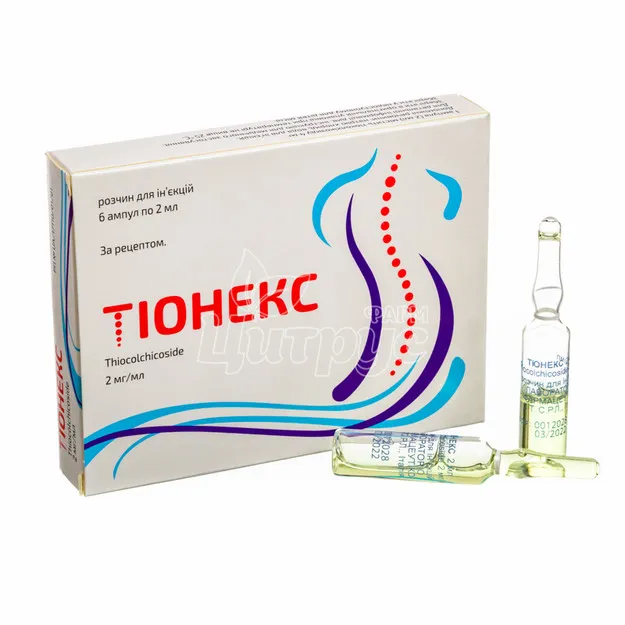
Table of Contents
INSTRUCTIONS FOR MEDICAL USE OF THE MEDICINAL PRODUCT THIONEX (THIONEX)
Composition:
Active substance: thiocolchicoside;
1 ampoule (2 ml) contains 4.0 mg of thiocolchicoside;
Excipients: sodium chloride, water for injections.
Pharmaceutical form. Injection solution.
Main physicochemical properties: clear, slightly yellowish solution.
Pharmacotherapeutic group. Muscle relaxants with central mechanism of action. Thiocolchicoside. ATC code M03BX05.
Pharmacological properties.
Pharmacodynamics.
Thiocolchicoside is a semi-synthetic sulfide derivative of colchicoside, a natural glycoside of Colchicum, which exerts a myorelaxant effect but does not exhibit curare-like effects. Some studies have shown a selective agonistic effect on GABAergic and glycinergic receptors. This mechanism may explain the efficacy of thiocolchicoside in both reflex, rheumatic, and traumatic contractures, as well as in spastic contractures of central origin. Thiocolchicoside does not affect voluntary movements and has no effect on respiratory muscles. It does not influence the cardiovascular system.
Pharmacokinetics.
Absorption
After intramuscular administration, the maximum plasma concentration (Cmax) of thiocolchicoside is reached within 30 minutes, with levels of 113 ng/mL achieved after a 4 mg dose and 175 ng/mL after an 8 mg dose. Corresponding values for the area under the plasma concentration–time curve (AUC) are 283 ng·h/mL and 417 ng·h/mL, respectively.
The pharmacologically active metabolite SL18.0740 is also observed at lower concentrations, with a Cmax of 11.7 ng/mL reached 5 hours after administration, and an AUC of 83 ng·h/mL.
Data on the inactive metabolite SL59.0955 are not available.
Distribution
The apparent volume of distribution of thiocolchicoside has been estimated at 42.7 L following intramuscular administration of 8 mg. Data on both metabolites are lacking.
Elimination
After intramuscular administration, the expected elimination half-life of thiocolchicoside is 1.5 hours, and plasma clearance is 19.2 L/h.
Preclinical safety data
The metabolite aglycone (3-demethylthiocolchicine-SL59.0955), formed predominantly after oral administration, induces chromosomal damage in vitro (micronucleus test in human lymphocytes) and chromosomal damage in vivo (micronucleus test in rat bone marrow after oral administration). Micronuclei arose primarily due to chromosome loss (centromere-positive micronuclei after FISH centromere staining or CREST), indicating aneugenic properties. The aneugenic effect of SL59.0955 was observed in vitro and in vivo at concentrations and exposure levels close to those observed in human plasma at therapeutic doses of 8 mg twice daily orally. The aneugenic effect in dividing cells may lead to cellular aneuploidy. Aneuploidy—alteration in chromosome number and loss of heterozygosity—is recognized as a risk factor for teratogenicity, embryotoxicity/spontaneous abortions, and impaired male fertility (if germ cells are affected), as well as a potential risk factor for carcinogenesis (if somatic cells are affected). The presence of the aglycone metabolite (3-demethylthiocolchicine-SL59.0955) after intramuscular administration has not been investigated; therefore, its formation following this route of administration cannot be excluded. Thiocolchicoside and its metabolites exhibit aneugenic activity at various concentration levels, which is considered a risk factor for altered human fertility.
Carcinogenic potential has not been evaluated.
Clinical characteristics.
Indications.
Adjuvant therapy for painful muscular contractures in acute spinal disorders in adults and adolescents aged 16 years and older.
Contraindications.
Thiocolchicoside should not be used:
- in patients with hypersensitivity to the active substance or to any of the excipients of the medicinal product;
- throughout the entire pregnancy period;
- during breastfeeding;
- in women of childbearing potential who are not using appropriate contraceptive measures during treatment with the medicinal product Thionex and for one month after discontinuation of treatment (see sections "Special precautions" and "Use during pregnancy or breastfeeding");
- in men who are not using appropriate contraceptive measures during treatment with the medicinal product Thionex and for three months after discontinuation of treatment (see sections "Special precautions" and "Use during pregnancy or breastfeeding");
- in patients suffering from flaccid paralysis or muscle hypotonia.
Interaction with other medicinal products and other forms of interaction.
Information on interactions is lacking.
Special precautions for use
Thiocolchicoside may trigger seizures, particularly in patients with epilepsy or in patients at risk of seizures (see section "Adverse reactions").
Episodes of vasovagal syncope have been observed after intramuscular administration; therefore, patients should remain under medical supervision following injections (see section "Adverse reactions").
Genotoxic potential
According to preclinical data, one of the metabolites of thiocolchicoside, SL59.0955, induces aneuploidy (alteration in the number of chromosomes in dividing cells) at concentrations close to the exposure level observed in humans at oral doses of 8 mg twice daily (see section "Pharmacological properties").
Aneuploidy is considered a risk factor for teratogenicity, embryotoxicity/foetotoxicity, miscarriage, altered male fertility, and potential carcinogenic risk. To prevent these risks, exceeding the recommended dose or prolonged use of the medicinal product should be avoided (see section "Dosage and administration").
Patients must be adequately informed about the potential risks for possible pregnancy and the need to use effective contraception methods (see sections "Contraindications" and "Use during pregnancy or breastfeeding").
Post-marketing reports have documented cases of liver injury associated with the use of thiocolchicoside. Severe cases (e.g., fulminant hepatitis) of liver injury have been reported in patients who concurrently used non-steroidal anti-inflammatory drugs (NSAIDs) or paracetamol. Patients should be advised to discontinue treatment and consult a physician immediately if signs of liver injury occur (see section "Adverse reactions").
The maximum daily dose must not exceed 8 mg, which should be divided into two administrations with a 12-hour interval. If a dose is missed, the next dose should be administered at the usual time.
Injection site reactions
Following intramuscular administration of thiocolchicoside, injection site reactions have been reported, including injection site necrosis and cutaneous medication embolism, also known as Nicolau syndrome, and livedoid dermatitis (see section "Adverse reactions"). Proper injection technique must be followed when administering thiocolchicoside intramuscularly.
This medicinal product contains less than 1 mmol (23 mg)/dose of sodium, i.e., essentially "sodium-free".
Use during pregnancy or breastfeeding
Contraception in women and men
Thionex is contraindicated in women of reproductive potential and in men who do not use effective contraception (see section "Contraindications").
Due to the aneugenic potential of thiocolchicoside and its metabolites, women of reproductive potential must use effective contraception during treatment with thiocolchicoside and for 1 month after completion of treatment (see section "Preclinical safety data").
Men must use effective contraception during treatment with thiocolchicoside and for 3 months after treatment ends (see section "Contraindications").
Pregnancy
Information on the use of thiocolchicoside in pregnant women is limited.
Animal studies have shown teratogenic effects of this drug (see section "Pharmacological properties").
The medicinal product Thionex is contraindicated during pregnancy and in women of reproductive potential who do not use appropriate contraceptive measures (see section "Contraindications").
Breastfeeding period
The use of thiocolchicoside is contraindicated during breastfeeding, as it is excreted in breast milk (see section "Contraindications").
Fertility
Thiocolchicoside and its metabolites have aneugenic effects at various concentration levels, representing a risk factor for human fertility (see section "Pharmacological properties").
Ability to influence the speed of reactions when driving or operating machinery
Studies on the effect of thiocolchicoside on the ability to drive or operate machinery have not been conducted.
Since somnolence is a common adverse reaction, this should be taken into account when driving vehicles or operating machinery.
Administration and dosage
The medicinal product Thionex is administered intramuscularly.
The recommended maximum daily dose is 4 mg every 12 hours (8 mg per day). Treatment should not exceed 5 consecutive days.
Exceeding the recommended dose or duration of administration should be avoided (see section "Special precautions for use").
Children
The drug is contraindicated in children under 16 years of age.
Overdose
Cases of overdose are unknown or reported only in specialized literature.
In the event of overdose, careful medical monitoring and symptomatic measures are recommended.
Adverse Reactions
The adverse reactions listed below are systematized according to MedDRA system organ classes and frequency: very common (≥1/10), common (≥1/100, <1/10), uncommon (≥1/1000, <1/100), rare (≥1/10000, <1/1000), very rare (<1/10000), unknown (frequency cannot be estimated from available data).
Immune system disorders
Uncommon: itching.
Rare: urticaria.
Very rare: hypotension.
Frequency unknown: angioedema and anaphylactic reactions, including anaphylactic shock.
Nervous system disorders
Common: somnolence (see section "Ability to influence reaction rate when driving or operating machinery").
Rare: excitement or brief confusion.
Frequency unknown: malaise, with or without vasovagal syncope within the first few minutes after intramuscular injection; seizures (see section "Special precautions for use").
Gastrointestinal disorders
Common: diarrhea, stomach pain.
Uncommon: nausea, vomiting.
Rare: heartburn.
Hepatobiliary disorders
Frequency unknown: drug-induced liver injury (see section "Special precautions for use").
Skin and subcutaneous tissue disorders
Uncommon: allergic skin reactions.
General disorders and administration site conditions
Frequency unknown: injection site reactions, including pain, erythema, swelling around the injection site; cutaneous drug embolism (Nicolau syndrome).
Reporting of suspected adverse reactions
Reporting suspected adverse reactions after medicinal product registration is important. It allows continuous monitoring of the benefit-risk balance of the medicinal product. Healthcare professionals and patients or their legal representatives should report all suspected adverse reactions and lack of efficacy via the Automated Pharmacovigilance Information System at the following link: https://aisf.dec.gov.ua.
Shelf life. 3 years.
Storage conditions. Store in the original packaging at a temperature not exceeding 25 °C. Keep out of reach of children.
Incompatibilities.
No data available.
Packaging.
2 ml in ampoules; 6 ampoules in a blister pack. 1 blister pack in a carton.
Prescription status. Prescription only.
Manufacturer.
LABORATORIO FARMACEUTICO S.T. S.R.L., Italy.
Manufacturer's address and location.
VIA DANTE ALIGHIERI, 71 –18038 Sanremo (Imperia), Italy.
Marketing authorization holder.
JSC "FarmLiga" / UAB "Farmlyga".
Address of the marketing authorization holder.
Antakalnio str. 48A-304, Vilnius, Republic of Lithuania / Antakalnio g. 48A-304, Vilnius, Republic of Lithuania.