Thiokton
Ukraine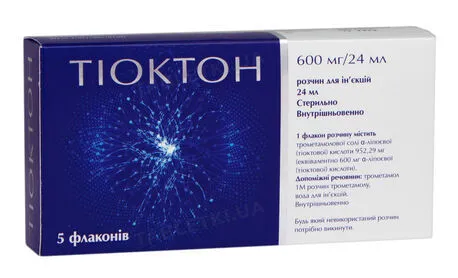
Table of Contents
INSTRUCTIONS for medical use of the medicinal product THIOCTON
Composition:
Active substance: thioctic (α-lipoic) acid;
1 vial of solution contains tromethamine thioctate 952.2876 mg (equivalent to 600 mg of thioctic (α-lipoic) acid);
Excipients: tromethamine, 1 M solution of tromethamine, water for injections.
Pharmaceutical form. Solution for injection.
Main physicochemical properties: clear yellowish solution, practically free from visible particles.
Pharmacotherapeutic group. Agents affecting the digestive system and metabolic processes. Thioctic acid. ATC code A16AX01.
Pharmacological Properties
Pharmacodynamics
Thioctic acid (α-lipoic acid) is an endogenous vitamin-like substance that functions as a coenzyme in the oxidative decarboxylation of α-keto acids.
Hyperglycemia caused by diabetes mellitus leads to the accumulation of advanced glycation end-products (AGEs). This process results in reduced endoneurial blood flow and endoneurial hypoxia and ischemia, accompanied by increased formation of reactive oxygen species (ROS), which in turn damage peripheral nerves. Additionally, a decreased level of antioxidants (such as glutathione) is observed in peripheral nerves.
α-Lipoic acid intervenes in these processes by reducing the formation of advanced glycation end-products, improving endoneurial blood flow, and restoring physiological levels of antioxidants such as glutathione, which acts as a scavenger of reactive oxygen species in the diabetic nerve.
These effects, observed in experimental studies, support the theory that peripheral nerve function may be improved by α-lipoic acid. This particularly applies to sensory disturbances in diabetic polyneuropathy, manifested by dysesthesia and paresthesia, such as burning sensations, pain, numbness, and "pins and needles."
Pharmacokinetics
Primary metabolism of α-lipoic acid occurs in the liver. There are no significant differences in systemic availability of α-lipoic acid among different patients. α-Lipoic acid undergoes biotransformation via side-chain oxidation and conjugation, and is primarily excreted by the kidneys.
The elimination half-life of α-lipoic acid in human plasma is approximately 25 minutes, and the total plasma clearance is 9–13 mL/min per kg body weight. At the end of a 12-minute infusion of 600 mg, the plasma concentration reaches approximately 47 μg/mL. Animal studies (in rats and dogs) using radiolabeled α-lipoic acid have demonstrated that 80–90% is predominantly excreted via the kidneys in the form of metabolites. Similarly, in humans, only a small fraction is excreted unchanged in urine. Biotransformation mainly occurs through side-chain oxidation (beta-oxidation) and/or
S-methylation of the corresponding thiol groups.
Clinical characteristics.
Indications.
Treatment of symptoms of peripheral (sensorimotor) diabetic polyneuropathy.
Contraindications.
Tioctone is absolutely contraindicated in patients with known hypersensitivity to thioctic acid or to other components of the medicinal product.
Interaction with other medicinal products and other forms of interaction.
When treating simultaneously with Tioctone and cisplatin, the effectiveness of the latter is reduced.
Concomitant treatment with Tioctone may enhance the blood glucose-lowering effect of insulin and/or other antidiabetic agents. Therefore, regular monitoring of blood glucose levels is recommended, especially at the beginning of treatment with thioctic acid. In order to prevent symptoms of hypoglycemia, in some cases it may be necessary to reduce the dose of insulin and/or oral antidiabetic agent.
Caution
Regular alcohol consumption is a significant risk factor for the development and progression of the clinical picture of neuropathy, and thus may negatively affect the treatment process with Tioctone. Therefore, patients with diabetic polyneuropathy are generally advised, if possible, to abstain from alcohol consumption. This restriction also applies to intervals between treatment courses.
Special precautions for use.
Hypersensitivity reactions of varying severity, up to anaphylactic shock, have been observed during parenteral administration of Thiocid (see section "Adverse reactions"). Therefore, patients should be under close medical supervision during treatment with this drug. If the first signs (such as itching, nausea, weakness) appear, treatment must be discontinued immediately and appropriate medical assistance provided if necessary.
An unusual odor of urine may occur after administration of Thiocid; however, this phenomenon is clinically insignificant.
Cases of Insulin Autoimmune Syndrome (IAS) have been reported during treatment with thioctic acid. Patients with human leukocyte antigen genotypes such as HLA-DRB1*04:06 and HLA-DRB1*04:03 alleles are more susceptible to development of IAS during treatment with thioctic acid. The HLA-DRB1*04:03 allele (susceptibility to IAS: 1.6) has been particularly noted in Caucasians, with higher prevalence in Southern than in Northern Europe, while the HLA-DRB1*04:06 allele (susceptibility to IAS: 56.6) has been particularly observed in Japanese and Korean patients. Insulin Autoimmune Syndrome should be considered in the differential diagnosis of spontaneous hypoglycemia in patients receiving thioctic acid therapy (see section "Adverse reactions").
Use during pregnancy or breastfeeding.
Use of thioctic acid during pregnancy is not recommended due to lack of adequate clinical data.
There are no data on the passage of thioctic acid into breast milk; therefore, its use during breastfeeding is not recommended.
Ability to influence reaction rate when driving or operating machinery.
Thiocid has no effect or only a negligible effect on the ability to drive or operate machinery.
Dosage and Administration
The cornerstone of treatment for diabetic polyneuropathy is optimal glycemic control.
Dosage and duration of treatment are determined individually by a physician.
For symptomatic peripheral (sensorimotor) diabetic polyneuropathy, the recommended daily dose for adults is 24 ml of injectable solution (corresponding to 600 mg of thioctic acid per day) administered intravenously.
The intravenous injection may be given undiluted using a syringe over a period of not less than 12 minutes.
During the initial treatment period, the injectable solution should be administered intravenously for 2–4 weeks.
Infusion Instructions
Only 0.9% sodium chloride solution should be used for preparing the infusion solution!
The drug should be administered intravenously by drip infusion over 30 minutes, after dissolving the contents of the Thiokton vial in 250 ml of 0.9% sodium chloride solution.
Since the active ingredient is light-sensitive, the infusion solution should be prepared immediately before use. The infusion solution should be protected from light (e.g., by wrapping in aluminum foil). When protected from light, the infusion solution remains stable for approximately 6 hours.
Care must be taken to ensure that the infusion time lasts no less than 12 minutes.
Continuation of treatment with α-lipoic acid in oral form at a daily dose of 600 mg is recommended.
Children
Not recommended for use in children.
Overdose
In cases of overdose, symptoms such as nausea, vomiting, and headache may occur.
Following accidental or intentional administration of thioctic acid in doses of 10–40 g in combination with alcohol intoxication, isolated cases with severe signs of intoxication have been observed, including fatal outcomes. Clinical manifestations of intoxication included psychomotor disturbances or dizziness, followed by generalized seizures and development of lactic acidosis. Consequences of thioctic acid intoxication may include hypoglycemia, shock, rhabdomyolysis, hemolysis, disseminated intravascular coagulation (DIC), bone marrow suppression, and multiorgan failure.
Treatment Measures in Case of Intoxication
Even with suspicion of significant Thiokton intoxication (e.g., more than 10 tablets of 600 mg in adults or more than 50 mg/kg body weight in children), the patient should be immediately hospitalized and standard detoxification procedures initiated (such as induction of emesis, gastric lavage, activated charcoal administration). Treatment of generalized seizures, lactic acidosis, and other life-threatening consequences of intoxication should follow principles of modern intensive care and be symptom-oriented.
Currently, no advantage of hemodialysis, hemoperfusion, or filtration methods in forced elimination of thioctic acid has been demonstrated.
Adverse Reactions
Adverse effects that may occur during the use of this medicinal product are classified according to the following frequency: very common (≥ 1/10), common (≥ 1/100 to < 1/10), uncommon (≥ 1/1000 to < 1/100), rare (≥ 1/10,000 to < 1/1000), very rare (< 1/10,000), not known (cannot be estimated from the available data).
Blood and lymphatic system disorders: very rare – thrombopathy.
Immune system disorders: not known – allergic reactions such as skin rash, urticaria, eczema, and pruritus; anaphylactic reactions.
Frequency not known: insulin autoimmune syndrome (see section: "Special precautions for use").
Metabolism and nutrition disorders: very rare – hypoglycaemia*.
Nervous system disorders: uncommon – dysgeusia; very rare – stroke, convulsions, headache*, dizziness*, sweating*.
Eye disorders: very rare – diplopia, visual disturbances.
Gastrointestinal disorders: uncommon – nausea and vomiting.
Skin and subcutaneous tissue disorders: very rare – purpura.
General disorders and administration site conditions: very rare – reactions at the injection site.
Following rapid intravenous injection, a sensation of pressure in the head and difficulty breathing may occur, which resolve spontaneously.
*Due to improved glucose excretion, a very rare decrease in blood glucose levels may be observed. As a result, symptoms of hypoglycaemia such as dizziness, sweating, headache, and blurred vision may occur.
Reporting of suspected adverse reactions.
Reporting of suspected adverse reactions after medicinal product registration is important. It allows continued monitoring of the benefit-risk balance of the medicinal product. Medical and pharmaceutical professionals, as well as patients or their legal representatives, should report all suspected adverse reactions and lack of efficacy through the automated pharmacovigilance information system (https://aisf.dec.gov.ua).
Shelf life. 3 years.
The product should be used immediately.
The solution for infusion, protected from light and diluted in physiological saline, remains stable for 6 hours.
Storage conditions.
Store in the original packaging to protect from light at a temperature not exceeding 25 °C. Do not freeze. Keep out of reach of children.
Incompatibilities.
Thioctic acid reacts in vitro with metal ion complexes (e.g., cisplatin). Thioctic acid forms complexes with sugar molecules (e.g., levulose solution). Thioton is incompatible with glucose solution, Ringer's solution, and other solutions known to react with SH groups or disulfide bonds.
As a diluent for Thioton infusions, only 0.9% sodium chloride solution should be used.
Packaging.
24 ml in a vial, 5 vials in a blister pack, in a cardboard box.
Prescription status.
Prescription only.
Manufacturer.
K.T. Rompharm Company S.R.L. /
S.C. Rompharm Company S.R.L.
Manufacturer's address and location of operations.
Str. Eroilor No 1A, Otopeni, 075100, Ilfov County, Romania – Building Rompharm 1 and Rompharm 2 /
Eroilor str. No 1A, Otopeni city, 075100, county Ilfov, Romania – building Rompharm 1 and Rompharm 2.
Marketing Authorisation Holder.
FORC-PHARMA DISTRIBUTION LLC.
Address of the Marketing Authorisation Holder.
132, Holosiivskyi Ave., Kyiv, 03127, Ukraine