Ticolin®
Ukraine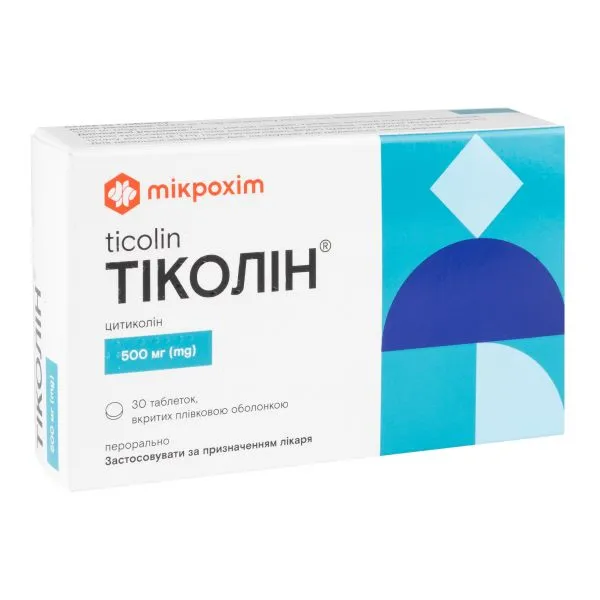
Table of Contents
INSTRUCTION for medical use of the medicinal product Ticolin® (Ticolin)
Composition:
Active substance: citicoline;
One tablet contains sodium citicolline equivalent to 500 mg of citicoline;
Excipients: talc, magnesium stearate, colloidal anhydrous silicon dioxide, sodium croscarmellose, hydrogenated castor oil, microcrystalline cellulose, titanium dioxide (E 171), polyethylene glycol 6000 (macrogol 6000), hypromellose.
Pharmaceutical form. Film-coated tablets.
Main physicochemical characteristics: oval, biconvex film-coated tablets of white to almost white color.
Pharmacotherapeutic group.
Psychostimulants. Medicinal products used in attention deficit hyperactivity disorder (ADHD), nootropic agents. Other psychostimulant and nootropic agents.
ATC code N06BX06.
Pharmacological Properties.
Pharmacodynamics.
Citicoline stimulates the biosynthesis of structural phospholipids in neuronal membranes, as confirmed by magnetic resonance spectroscopy data. Citicoline improves the function of membrane mechanisms such as ion pumps and receptors, without which normal nerve impulse conduction is impossible. Due to its stabilizing effect on neuronal membranes, citicoline exhibits anti-edematous properties that promote reabsorption of cerebral edema.
Clinical studies have shown that citicoline inhibits the activation of certain phospholipases (A1, A2, C, and D), reducing the formation of free radicals, preventing the destruction of membrane systems, and preserving antioxidant defense systems such as glutathione.
Citicoline preserves neuronal energy reserves and inhibits apoptosis, thereby enhancing cholinergic transmission.
Experimental evidence has demonstrated that citicoline also exerts a preventive neuroprotective effect in focal cerebral ischemia.
Clinical studies have shown that citicoline significantly increases functional recovery rates in patients with acute cerebrovascular disorders, which correlates with a slowed progression of cerebral ischemic lesions as observed in neuroimaging. In patients with traumatic brain injury, citicoline accelerates recovery and reduces the duration and severity of post-traumatic syndrome.
Citicoline improves levels of attention and consciousness and helps reduce symptoms of amnesia, cognitive deficits, and other neurological disorders associated with cerebral ischemia.
Pharmacokinetics.
Citicoline is well absorbed after oral, intramuscular, and intravenous administration. Plasma choline levels increase significantly following administration by these routes. Absorption after oral administration is nearly complete, and bioavailability is almost equivalent to that achieved with intravenous administration.
Depending on the route of administration, the drug is metabolized in the intestine and liver into choline and cytidine. After administration, citicoline is widely distributed into brain structures, with rapid incorporation of the choline fraction into structural phospholipids and the cytidine fraction into cytidine nucleotides and nucleic acids. Upon reaching the brain, citicoline integrates into cellular, cytoplasmic, and mitochondrial membranes, participating in the formation of phospholipid fractions.
Only a small amount of the dose is excreted in urine and feces (less than 3%). Approximately 12% of the dose is excreted as exhaled CO₂. The excretion of the drug in urine occurs in two phases: the first phase lasts approximately 36 hours, during which the excretion rate rapidly decreases, and a second phase, during which the excretion rate declines much more slowly. A similar biphasic pattern is observed in excretion as exhaled CO₂, with the rate of CO₂ excretion rapidly decreasing after approximately 15 hours, followed by a much slower decline.
Clinical characteristics.
Indications.
- Stroke, acute phase of cerebral circulation disorders and treatment of complications and consequences of cerebral circulation disorders;
- traumatic brain injury and its neurological consequences;
- cognitive disorders and behavioral disorders due to chronic vascular and degenerative cerebral disorders.
Contraindications.
- Hypersensitivity to any component of the drug;
- increased parasympathetic nervous system tone.
Interaction with other medicinal products and other forms of interactions.
The medicinal product Ticolin® should not be used simultaneously with drugs containing meclofenoxate. The drug enhances the effect of levodopa.
Special precautions for use.
Tikolin® contains 1.2 mmol (26 mg) of sodium per tablet. Caution should be exercised when administering the drug to patients on a sodium-restricted diet.
Use during pregnancy or breastfeeding.
There are insufficient data on the use of the medicinal product Tikolin® in pregnant women. Data on the excretion of citicoline in breast milk and its effects on the fetus are lacking. Therefore, during pregnancy or breastfeeding, the drug should be prescribed only when the expected benefit to the mother outweighs the potential risk to the fetus.
Ability to affect reaction speed when driving or operating machinery.
In individual cases, certain adverse reactions from the central nervous system may affect the ability to drive or operate complex machinery.
Method of administration and dosage.
The recommended dose for adults is 500 to 2000 mg (1–4 tablets) per day.
Dosage and duration of treatment depend on the severity of brain damage and are determined by a physician.
Elderly patients do not require dose adjustment.
Children.
Experience with use of the drug in children is limited.
Overdose.
Cases of overdose have not been reported.
Side effects.
Side effects occur very rarely (< 1/10,000) (including patient reports).
Central and peripheral nervous system disorders: severe headache, vertigo, hallucinations.
Cardiovascular disorders: arterial hypertension, arterial hypotension, tachycardia.
Respiratory, thoracic and mediastinal disorders: dyspnea.
Gastrointestinal disorders: nausea, vomiting, diarrhea.
Immune system disorders: allergic reactions, including rash, hyperemia, exanthema, urticaria, purpura, pruritus, angioedema, anaphylactic shock.
General disorders: chills.
Shelf life.
2 years.
Storage conditions.
Store at a temperature not exceeding 30 °C in the original packaging.
Keep out of reach of children.
Packaging.
7 tablets in a blister. 4 blisters with the instruction for medical use in a cardboard box.
10 tablets in a blister. 3 blisters with the instruction for medical use in a cardboard box.
Prescription status.
Prescription only.
Manufacturer.
MICROCHEM LTD (responsible for batch release, excluding control/testing of the batch).
JSC "KIEV MEDPREPARAT" (responsible for manufacturing and control/testing of the batch, excluding batch release).
Manufacturer's address and place of business.
Ukraine, 01013, Kyiv, Budynstustrii St., 5.
Ukraine, 01032, Kyiv, Saksaganskoho St., 139.
Marketing authorization holder.
MICROCHEM LTD.
Address of the marketing authorization holder.
Ukraine, 01013, Kyiv, Budynstustrii St., 5.
You can report an adverse event associated with this medicinal product by calling +38 (050) 309-83-54 (24/7).