Typhim vi® / typhim vi vaccine for prevention of typhoid fever polysaccharide liquid
Ukraine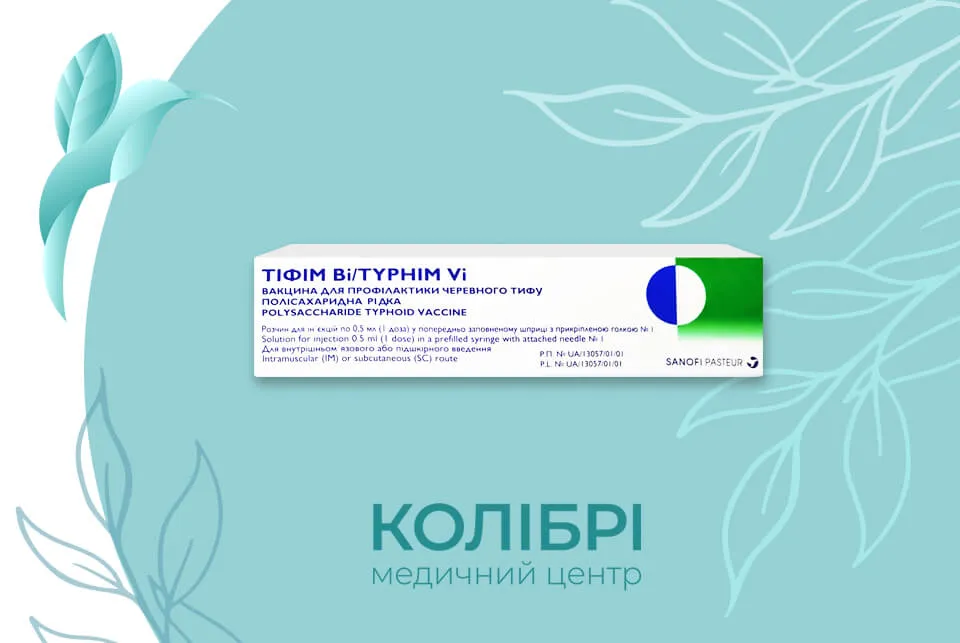
Table of Contents
INSTRUCTIONS for medical use of the medicinal product TYPHIM Vi®/TYPHIM Vi Typhoid vaccine polysaccharide liquid
Composition:
One immunizing dose of vaccine (0.5 mL) contains:
Active substance:
Purified Vi capsular polysaccharide of Salmonella typhi (Ty2 strain) 25 mcg
Excipients:
| phenol sodium chloride sodium hydrogen phosphate, dihydrate sodium dihydrogen phosphate, dihydrate water for injections |
≤ 1.250 mg 4.150 mg 0.065 mg 0.023 mg up to 0.5 ml |
The Tifivm Vi® product may contain formaldehyde or casein in trace amounts used during the manufacturing process (see section "Contraindications").
Pharmaceutical form.
Injection solution, 25 mcg/dose, 0.5 ml (1 dose) in a pre-filled syringe with attached needle.
Main physico-chemical properties:
The vaccine is a clear, colorless liquid free from visible particles, consisting of purified Vi-capsular polysaccharide of Salmonella typhi in a buffered phenolic solution.
Pharmacotherapeutic group. Bacterial vaccines. Vaccines for typhoid fever prevention. Purified polysaccharide antigen.
ATC code: J07AP03.
Immunological and biological properties.
Pharmacodynamics.
The vaccine contains purified Vi-capsular polysaccharide of Salmonella typhi (strain Ty2) and provides immunity against typhoid fever within 1–3 weeks after vaccination. The duration of immunity is at least 3 years.
A double-blind, randomized, controlled clinical study was conducted to evaluate efficacy in a highly endemic region of Nepal, involving both children and adult patients aged 5 to 44 years. Overall, 3,457 patients received vaccination with Tifivm Vi®. Compared to the control group (23-valent pneumococcal polysaccharide vaccine), the efficacy achieved after administration of a single dose of Tifivm Vi® was 74% (95% CI: 49; 87) against blood culture-confirmed typhoid fever cases during 20 months of active surveillance.
Data on seroconversion rates (defined as a 4-fold increase in antibody levels against the Vi antigen of Salmonella typhi) were obtained from 19 clinical studies. These studies were conducted in both endemic and non-endemic regions involving children aged 2 years and older and adults, totaling 2,137 evaluable patients. In the adult population, seroconversion rates ranged from 62.5% to 100% within 3–4 weeks after a single injection, with a similar magnitude of immune response in terms of antibody production against the Vi antigen of Salmonella typhi observed in non-endemic regions compared to endemic regions.
Persistence of antibodies against the Vi antigen of Salmonella typhi depends on endemicity and tends to be higher in endemic regions (documented up to 10 years in 83 children with levels equal to or exceeding 1 mcg/ml, i.e., serological correlates of protection against typhoid fever). In non-endemic regions, antibodies against the Vi antigen of Salmonella typhi persist for 2–3 years at levels above 1 mcg/ml, with frequencies of approximately 41% at 2 years and 35.6% at 3 years after vaccination with Tifivm Vi®. Revaccination should be performed at intervals not exceeding 3 years if the patient remains at risk.
Pediatric population.
In a double-blind, randomized, controlled clinical study evaluating efficacy conducted in a highly endemic region of the Republic of South Africa, a total of 5,692 patients aged 5 to 15 years received Tifivm Vi®. Compared to the control group (bivalent meningococcal polysaccharide vaccine groups A and C), the efficacy achieved after administration of a single dose of Tifivm Vi® was 55% (95% CI: 30; 71) against blood culture-confirmed typhoid fever cases during a 3-year observation period.
Immunogenicity was evaluated in both endemic and non-endemic regions in children aged 2 to 17 years. In 9 clinical studies involving a total of 733 evaluable children, seroconversion rates ranged from 67% to 100% within 3–4 weeks after a single injection of Tifivm Vi®, indicating an immune response magnitude in terms of antibody production against the Vi antigen of Salmonella typhi similar to that documented in adult participants.
Pharmacokinetics.
Not studied.
Clinical characteristics.
Indications.
For active immunization to prevent typhoid fever in children aged 2 years and older and adults (particularly individuals traveling to endemic regions, immigrants, medical personnel, and military personnel).
Contraindications.
- Hypersensitivity to any component of the vaccine, to formaldehyde or casein (which may be present in trace amounts in each dose of the product due to their use during the manufacturing process), or reaction after previous administration of the vaccine or a product of similar composition;
- fever. Vaccination should be postponed until full recovery.
Interaction with other medicinal products and other forms of interaction.
The product can be administered together with other vaccines provided that different syringes are used and injections are given at different body sites.
The product may be used simultaneously with vaccines for prevention of (yellow fever, diphtheria, tetanus, poliomyelitis, meningitis A+C, hepatitis A, hepatitis B) and with rabies vaccine produced on Vero cell culture.
Special precautions for use.
Before administration, the vaccine should be allowed to reach room temperature for several minutes.
Waste must be destroyed according to current regulations for disposal of biological waste.
The vaccine protects against typhoid fever caused by Salmonella typhi, but does not provide protection against Salmonella paratyphi A or B or non-typhoidal Salmonellae.
Like any other immunobiological product, Typhim Vi® vaccine cannot protect 100% of vaccinated individuals.
The immunogenicity of the vaccine may be reduced in patients with immunodeficiency or those receiving immunosuppressive therapy. In such cases, vaccination should be postponed until immunosuppressive therapy has ended.
Vaccination is recommended for individuals with chronic immunodeficiency, such as HIV-infected individuals, despite a potentially reduced immune response.
Vaccination should be performed at least 2 weeks prior to potential exposure to Salmonella typhi-induced typhoid fever.
Strictly contraindicated for intravascular injection: ensure that the needle has not entered a blood vessel.
Due to the risk of hematoma formation, administer with caution to individuals with thrombocytopenia or any coagulation disorders.
Prior to administration, the patient's health status should be evaluated, and a thorough vaccination history obtained, including possible hypersensitivity to this or similar vaccines, and any adverse events occurring within 48 hours after previous vaccinations with this or a compositionally similar vaccine.
The need for vaccination should be properly justified.
Syncope (fainting) may occur following any vaccination, or even before vaccination, as a psychogenic response to needle injection, particularly in adolescents. This may be accompanied by a range of neurological symptoms such as transient visual disturbances, paresthesia, and tonic-clonic limb movements during the recovery phase. It is important that procedures are conducted in settings allowing prevention of injuries due to syncope.
As with any parenterally administered vaccine, immediate availability of emergency medical treatment must be ensured in case of anaphylactic reactions. Individuals receiving vaccination should remain under medical supervision for 30 minutes after vaccination.
This medicinal product contains less than 1 mmol (23 mg)/dose of sodium, i.e., it is practically sodium-free.
Traceability:
To improve traceability of biological medicinal products, the name and batch number of the administered product should be clearly documented.
Use during pregnancy or breastfeeding.
Animal studies have not been conducted.
Data on the use of the vaccine in pregnant women are limited; therefore, vaccination during pregnancy is not recommended. The vaccine should be administered during pregnancy only if absolutely necessary and after careful risk/benefit assessment.
The effect of the vaccine administered during lactation has not been studied. Administer with caution to women during lactation.
Ability to affect the speed of reactions when driving vehicles or operating machinery.
Studies on the ability of the vaccine to affect reaction speed during driving or operating machinery have not been conducted. Fatigue has been observed as a very rare adverse reaction following vaccine administration (see section "Adverse reactions").
Administration and Dosage.
For adults and children aged 2 years and older only.
Vaccination is performed as a single dose of 0.5 ml.
Revaccination is recommended every 2–3 years if there is a risk of disease, depending on the level of such risk.
The vaccination dose is the same for adults and children.
The vaccine is administered subcutaneously or intramuscularly.
The recommended injection site is the thickest part of the deltoid muscle.
When conducting immunization in Ukraine, administration schedules, contraindications, and interactions with other medicinal products should be in accordance with current orders issued by the Ministry of Health of Ukraine regarding preventive vaccinations.
Vaccination must be administered by medical personnel in vaccination rooms of healthcare facilities.
Children.
Children under 2 years of age should not be vaccinated due to the high risk of inadequate antibody response.
Adverse reactions.
Summary of safety profile data
During clinical studies, more than 15,000 individuals received Typhim Vi® vaccine (as a single injection or two injections).
The most frequently reported adverse reaction in patients of all age groups was injection site pain. In adults (aged 18 years and older), the most frequently reported systemic reactions were myalgia and increased fatigue. In children and adolescents (aged 2 to 17 years), the most frequently reported systemic reactions were myalgia and headache.
Most adverse reactions occurred within 3 days after vaccination. The majority of reactions resolved spontaneously within 1–3 days after onset.
Tabulated list of adverse reactions
The adverse reactions listed below were identified from clinical trials (pooled analysis) and post-marketing experience in various countries worldwide. The pooled analysis was based on data from 6 recent studies using the same safety assessment standard, involving 1,532 participants (97 children and adolescents aged 2 to 17 years and 1,435 adults).
Frequency of adverse reactions was categorized as follows:
very common: ≥ 10 %;
common: ≥ 1% and < 10%;
uncommon: ≥ 0.1% and < 1%;
rare: ≥ 0.01% and < 0.1%;
very rare: < 0.01%;
frequency not known: frequency cannot be estimated from the available data.
The table below summarizes the adverse reactions reported after administration of any dose of Typhim Vi® vaccine in children and adolescents aged 2 to 17 years, grouped by frequency.
| Adverse reactions |
Children and adolescents aged 2–17 years (N = 97) |
Adults (N = 1435) |
| Frequency |
Frequency |
|
| Immune system disorders |
||
| Anaphylactic, anaphylactoid reactions, including shock |
Frequency unknown* |
|
| Serum sickness |
Frequency unknown* |
|
| Nervous system disorders |
||
| Vasovagal syncope as a reaction to injection |
Frequency unknown* |
|
| Headache |
Very common |
Common |
| Respiratory, thoracic and mediastinal disorders |
||
| Bronchial asthma |
Frequency unknown* |
|
| Gastrointestinal disorders |
||
| Nausea |
Frequency unknown* |
|
| Vomiting |
Frequency unknown* |
|
| Diarrhea |
Frequency unknown* |
|
| Abdominal pain |
Frequency unknown* |
|
| Skin and subcutaneous tissue disorders |
||
| Allergic-type reactions such as itching, skin rash, urticaria |
Frequency unknown* |
|
| Musculoskeletal and connective tissue disorders |
||
| Arthralgia |
Frequency unknown* |
|
| Myalgia |
Very common |
Very common |
| General disorders and administration site conditions |
||
| Pain at injection site |
Very common |
|
| Erythema at injection site |
Very common |
Common |
| Itching at injection site |
|
Uncommon |
| Swelling / edema / induration at injection site |
Very common |
Common |
| Malaise |
Common |
Very common |
| Increased body temperature |
Common |
|
| Increased fatigue / general weakness |
Common |
Very common |
* Reported during post-marketing surveillance.
The most frequently reported adverse reactions in children and adolescents (aged 2 to 17 years) were injection site reactions: pain (52.6%), swelling / edema / induration (16.5%), and erythema (14.4%). The most common systemic reactions were myalgia (14.6%) and headache (13.5%).
In adults (aged 18 years and older), the most frequently reported adverse reactions were injection site pain (75.6%), myalgia (47.1%), and increased fatigue / general malaise (25.0%).
Shelf life.
3 years.
Storage conditions.
The vaccine should be stored at 2 to 8 °C (in a refrigerator). Do not freeze. If the vaccine has been frozen, it must be discarded. Protect from light; keep the syringe in the cardboard box. Transport must be carried out under cold chain conditions.
Keep out of reach of children.
Incompatibilities.
This vaccine must not be mixed with other vaccines or medicinal products.
Packaging.
1 dose in a syringe.
0.5 mL (1 dose) of injectable solution in a pre-filled syringe with attached needle.
1 syringe per cardboard box.
1 syringe in a standard export pack contained within a cardboard box with the instructions for medical use.
Prescription category.
Prescription only.
Manufacturers.
Sanofi Pasteur, France
Sanofi-Aventis Zrt., Hungary
Manufacturers' locations and addresses of places of business.
1541 Avenue Marcel Mérieux, 69280 Marcy l’Étoile, France
Parc Industriel d’Incarville, 27100 Val-de-Reuil, France
Building 5, Kampona Utca 1, Budapest XXII, 1225, Hungary
Marketing Authorization Holder.
Sanofi Pasteur, France
Address of the Marketing Authorization Holder.
14 Espace Henry Wallon, 69007 Lyon, France