Thiaprilan®
Ukraine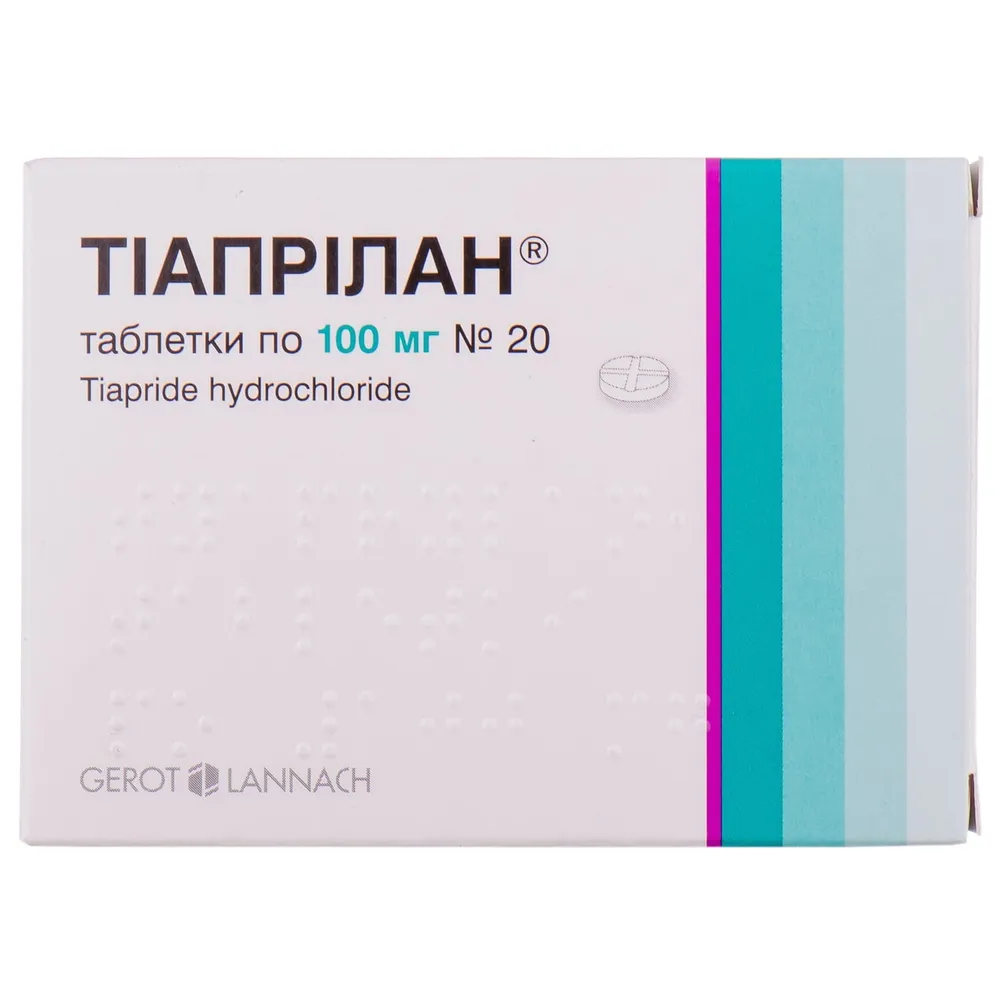
Table of Contents
INSTRUCTIONS FOR MEDICAL USE OF THE MEDICINAL PRODUCT TIAPIRILAN® (TIAPRILAN®)
Composition:
Active substance: tiapride hydrochloride;
One tablet contains 111.1 mg of tiapride hydrochloride, equivalent to 100 mg of tiapride;
Excipients: mannitol (E 421), microcrystalline cellulose, magnesium stearate, povidone, colloidal anhydrous silicon dioxide.
Dosage form. Tablets.
Main physicochemical characteristics: white, round tablets with bevelled edges and a cross-score line on both sides.
Pharmacotherapeutic group.
Antipsychotic agents. ATC code N05A L03.
Pharmacological properties.
Pharmacodynamics.
Tiapride belongs to the group of ortho-methoxy substituted benzamides (orthopramides), a class of substances with central action.
Tiapride is characterized by high affinity for central dopaminergic receptors, especially when these receptors are previously sensitized by dopamine. Tiapride exerts an antidopaminergic effect, predominantly on dopamine D2-receptors, which results in the antikinetic activity of the drug.
In contrast to conventional antipsychotic agents, tiapride produces minimal cataleptic effect. Due to these properties, tiapride is suitable for the treatment of movement disorders of central origin.
Pharmacological and clinical studies have shown that tiapride has antiemetic properties.
Pharmacokinetics.
After oral administration of 200 mg tiapride, the maximum plasma concentration of 1.3 \µg/mL is reached within 1 hour. The absolute bioavailability of tiapride is 75%. When taken simultaneously with food, the maximum plasma concentration increases by 40%. In elderly subjects, absorption of the drug is slowed.
Tiapride rapidly distributes throughout the body. It penetrates the blood-brain barrier and placental barrier without accumulation. Tiapride does not bind to plasma proteins, but binds slightly to erythrocytes. The elimination half-life from plasma is 5.3 hours.
Metabolism of tiapride is weakly expressed. 70% of the administered dose is excreted unchanged in urine; renal clearance is 330 mL/min; excretion correlates with creatinine clearance.
In patients with impaired renal function, the dose of the drug should be adjusted according to the degree of impairment.
Clinical characteristics.
Indications.
- Dyskinesia and movement disorders, such as Huntington's disease, early dyskinesia, late dyskinesia.
- Psychomotor disorders in elderly individuals.
- Psychomotor disorders in chronic alcoholism.
Contraindications.
Hypersensitivity to the active substance or to any other component of the medicinal product; prolactin-dependent tumor (e.g., pituitary prolactinoma), epithelial breast cancer; pheochromocytoma. Concomitant use of levodopa or other dopaminergic drugs. Existing central nervous system (CNS) depression or coma, bone marrow depression.
Interaction with other medicinal products and other forms of interaction.
Contraindicated combinations.
Concomitant use with dopaminergic agonists, except in patients with Parkinson’s disease (e.g., cabergoline, quinagolide), should be avoided due to the opposing antagonism between dopaminergic agonists and neuroleptics.
Tiapride should not be combined with medicinal products that may prolong the QT interval and with medicinal products that may cause serious arrhythmias (ventricular fibrillation-torsades de pointes).
Thus, concomitant use of tiapride with the following medicinal products is not recommended:
- medicinal products that may cause marked bradycardia (heart rate <55 bpm), such as beta-blockers, bradycardia-inducing calcium channel blockers (diltiazem, verapamil), clonidine, guanfacine, and digitalis;
- medicinal products that may cause electrolyte imbalance, especially hypokalemia, such as diuretics causing hypokalemia, stimulant laxatives, intravenous administration of amphotericin B, glucocorticoids, and adrenocorticotropic hormone. Hypokalemia should be taken into account;
- class Ia (e.g., quinidine, hydroquinidine, disopyramide) and class III (e.g., amiodarone, sotalol, dofetilide, ibutilide) antiarrhythmics;
- certain neuroleptics, such as sultopride, pipothiazide, sertindole, veralipide, chlorpromazine, levomepromazine, trifluoperazine, cyamemazine, sulpiride, pimozide, haloperidol, droperidol, fluphenazine, pipotiazine, flupentixol, zuclopentixol;
- certain antiparasitic agents (halofantrine, lumefantrine, pentamidine);
- other medicinal products such as thioridazine, tricyclic antidepressants, lithium, bepridil, cizapride, intravenous erythromycin, intravenous vincamycin, intravenous spiramycin, sparfloxacin, moxifloxacin, diphemanil, mizolastine.
Due to the increased risk of ventricular arrhythmias, particularly ventricular fibrillation-torsades de pointes, if possible, treatment with antibacterial agents capable of inducing ventricular fibrillation-torsades de pointes should be discontinued. If combination therapy cannot be avoided, QT interval should be monitored by ECG before initiation of treatment.
Dopaminergic agonists, except levodopa.
(Amantadine, apomorphine, bromocriptine, entacapone, lisuride, pergolide, piribedil, pramipexole, ropinirole, selegiline).
In patients with Parkinson’s disease, due to the mutual antagonism between the effects of dopaminergic agonists and neuroleptics, dopaminergic agents may induce or exacerbate psychotic disorders. When neuroleptic therapy cannot be avoided in patients with Parkinson’s disease who have been receiving dopaminergic agonists, these agents should be gradually reduced and discontinued (abrupt withdrawal of dopaminergic agonists may precipitate neuroleptic malignant syndrome).
Methadone.
Due to the increased risk of ventricular arrhythmia, particularly ventricular fibrillation-torsades de pointes, concomitant use of these agents should not be combined.
During treatment with the medicinal product, concomitant consumption of alcoholic beverages should be avoided, as this may lead to enhanced sedative effects.
Concomitant use of tiapride with levodopa should be avoided, since levodopa and antipsychotic agents may mutually reduce each other's effects.
When antipsychotic agents are used in patients with Parkinson’s disease, a drug causing less pronounced extrapyramidal side effects should be selected (e.g., chlorpromazine, levomepromazine).
Concomitant use of tiapride with antihypertensive agents may increase their effects (postural hypotension).
Concomitant use of other medicinal products that depress the central nervous system (e.g., analgesics and morphine derivatives with cough-suppressant effects, most antihistamines, barbiturates, benzodiazepines and other tranquilizers, clonidine) leads to enhanced CNS depression.
Special precautions for use.
Particular caution should be exercised when using the drug:
-
in elderly patients: like other antipsychotic agents, tiapride may increase the frequency of sedative effects and arterial hypotension due to increased sensitivity;
-
in patients with severe cardiovascular disorders (due to possible hemodynamic adverse effects, particularly arterial hypotension);
-
in patients with respiratory disorders, cerebrovascular disorders, or risk factors for cerebrovascular diseases;
-
in patients with closed-angle glaucoma;
-
in patients with renal impairment (in such cases, the risk of relative overdose should be considered);
-
in patients with Parkinson's disease: except in exceptional cases, tiapride should not be used in patients with Parkinson's disease;
-
in patients with a history of epilepsy: antipsychotic medicinal products may reduce the seizure threshold. Although this phenomenon has not been sufficiently studied with tiapride, close monitoring of patients is recommended;
-
in patients with a history of jaundice, diabetes, hypothyroidism, myasthenia gravis, paralytic ileus, benign prostatic hyperplasia, or urinary retention;
-
in acute infection or leukopenia;
-
in patients with QT interval prolongation on ECG and in the presence of risk factors for QT prolongation;
-
tiapride should be used with caution in patients with cardiovascular disorders, as it may cause QT interval prolongation. This effect of tiapride is known to increase the risk of serious ventricular arrhythmias, such as ventricular fibrillation or flutter. Prior to any administration, and if possible according to the patient's clinical condition, it is recommended to monitor factors that may contribute to the development of this rhythm disorder, such as:
- heart rate less than 55 beats per minute,
- electrolyte imbalance, particularly hypokalemia,
- congenital QT interval prolongation (chronic treatment with appropriate medications may correct pronounced bradycardia (<55 bpm), electrolyte imbalances, decreased intracardiac conduction, or QT interval prolongation).
Close monitoring of patients is recommended, as tiapride lowers the seizure threshold.
The drug is contraindicated in patients with pheochromocytoma, as severe hypertensive crises have been reported with substances of similar chemical structure.
Patients undergoing long-term treatment should have regular ophthalmological examinations and should avoid exposure to direct sunlight.
Neuroleptic Malignant Syndrome.
In the event of unexplained hyperthermia, treatment with tiapride should be discontinued immediately. Hyperthermia may be a manifestation of "neuroleptic malignant syndrome" (akathisia, chills, hyperthermia, impaired consciousness, autonomic disturbances), which may rarely occur as a result of antipsychotic therapy. This is particularly possible when treating with high doses (e.g., in chronic alcoholism).
Use during pregnancy or breastfeeding.
There is no experience with the use of tiapride in pregnant women; therefore, the drug should be prescribed to pregnant women only if strictly indicated. If therapy is necessary, the drug should be continued at an effective dose throughout pregnancy. If possible, the dose of the antipsychotic agent, as well as that of any antiparkinsonian agent (if used), should be reduced towards the end of pregnancy due to the anticholinergic properties of the latter.
Tiapride, if used in late pregnancy, may theoretically cause, particularly at high doses, anticholinergic-like effects, which may be enhanced by concomitant use of antiparkinsonian drugs and may manifest as tachycardia, increased excitability, abdominal distension, meconium retention, and sedative effects.
Monitoring of the newborn's neurological status, and in case of concomitant use of an antiparkinsonian agent — gastrointestinal function, is recommended.
Tiapride passes into breast milk; therefore, the use of the drug during breastfeeding should be avoided.
Fetuses and newborns exposed to antipsychotic drugs during the third trimester of pregnancy are at risk of adverse reactions, including extrapyramidal and/or withdrawal symptoms, which may vary in severity and duration after delivery or postnatal development. Reports include agitation, hypertension, hypotonia, tremor, somnolence, respiratory distress, or feeding disorders in newborns. Therefore, newborns should be closely monitored.
Ability to affect reaction speed when driving or operating machinery.
Tiapride affects reaction speed; therefore, patients should refrain from driving or operating machinery during treatment.
Method of administration and dosage.
Tablets should be taken without chewing, with sufficient liquid, preferably during meals.
The dosage should be individually adjusted. The daily dose should be divided into 3 doses.
Motor disorders and movement disorders.
- Early dyskinesia: 150–400 mg/day.
- Late dyskinesia: 300–800 mg/day.
- Huntington's disease: 300–1200 mg/day.
Psychomotor disorders in elderly patients – 200–400 mg/day.
Psychomotor disorders in chronic alcoholism – 300–400 mg/day.
Impaired liver or kidney function. In patients with severe renal insufficiency, the dose should be reduced depending on creatinine clearance, namely:
| Creatinine clearance |
Recommended dose |
| 50-80 mL/min |
75% of standard daily dose |
| 10-50 mL/min |
50% of standard daily dose |
| less than 10 mL/min |
25% of standard daily dose |
In patients with impaired liver function, dose adjustment is not required.
The duration of treatment depends on the clinical symptoms. In patients with creatinine clearance less than 10 ml/min, a quarter of the standard dose is recommended (the tablet can be divided).
Children.
Since experience with the use of tiapride in this age group is still insufficient, the drug should not be used in children.
Overdose.
Symptoms. Experience with tiapride overdose is limited. Drowsiness and sedation, coma, arterial hypotension, and extrapyramidal symptoms may occur. Gastric lavage and symptomatic treatment are recommended.
In cases of acute overdose, the possibility of concomitant intake of other medicinal products should be considered. Since tiapride is poorly dialyzed, hemodialysis is ineffective for elimination of this substance.
Treatment. There is no specific antidote. Therefore, symptomatic intensive therapy is required, along with careful continuous monitoring of cardiac function (risk of QT interval prolongation with subsequent ventricular arrhythmia) until complete resolution of overdose symptoms, as well as close monitoring of respiratory function.
In cases of severe extrapyramidal symptoms, anticholinergic agents should be administered.
Adverse Reactions
Adverse effects are classified by their severity and frequency: very common (>1/10); common (>1/100, <1/10); uncommon (>1/1000, <1/100); rare (>1/10,000, <1/1000); very rare (<1/10,000), including isolated cases.
Within each frequency group, adverse reactions are listed in order of decreasing occurrence.
It should be noted that in some cases, adverse reactions may be difficult to distinguish from symptoms of the underlying disease.
Central Nervous System:
Common: dizziness, vertigo, headache, parkinsonism and parkinsonism-like symptoms such as tremor, hypokinesia, increased salivation;
Uncommon: akathisia, dystonia (spasms, torticollis, oculogyric crisis, trismus);
Very rare: acute dyskinesia. As with all other antipsychotic agents, tardive dyskinesia (characterized by rhythmic involuntary movements, especially of the tongue and/or face) may develop after prolonged treatment with tiapride, requiring close monitoring of the patient. Cases have been reported after treatment lasting more than 3 months. In such cases, treatment with anticholinergic or antiparkinsonian agents is not recommended, as they are either ineffective or may even worsen the patient's condition.
Development of neuroleptic malignant syndrome — a potentially life-threatening complication that may occur during treatment with antipsychotic agents.
All of these symptoms can be completely reversed by using antiparkinsonian medications.
Psychiatric Disorders:
Common: fatigue, somnolence, insomnia, sedative effect, anxiety, agitation, apathy.
Endocrine System:
Uncommon: tiapride causes hyperprolactinemia, which is reversible upon discontinuation of treatment. The following adverse reactions may occur: galactorrhea, amenorrhea, breast enlargement, breast tenderness, frigidity in women, as well as gynecomastia and impotence in men.
General Disorders and Administration Site Conditions:
General: asthenia/fatigue, nasal congestion, dry mouth, constipation, jaundice, mild liver function abnormalities, photosensitivity reactions, miosis, blurred vision, pupil dilation, tachycardia, ECG changes, arrhythmia, delirium, catatonia-like states, nightmares, depression, seizures, urinary retention, ejaculation inhibition, priapism, hypo-/hyperthermia, hypercholesterolemia, hypersensitivity reactions including urticaria, exfoliative dermatitis, erythema, contact sensitivity. Prolonged therapy may lead to pigment deposition in the skin and eyes; corneal and lens opacities may occur. Hematological disorders, including hemolytic anemia, aplastic anemia, thrombocytopenic purpura, eosinophilia, agranulocytosis, leukopenia.
Uncommon: weight gain, allergic reactions in isolated cases.
In addition, orthostatic hypotension has been reported. There have been reports of sudden fatal outcomes (possible causes include cardiac arrhythmias, asphyxia).
Tiapride may cause QT interval prolongation; it increases the risk of serious ventricular arrhythmias such as ventricular flutter and fibrillation.
Neonatal Disorders: neonatal withdrawal syndrome.
Shelf Life: 60 months.
Storage Conditions: Store in the original packaging at a temperature not exceeding 25°C, in a place inaccessible to children.
Packaging: 20 tablets per blister; 1 or 3 blisters per cardboard box.
Prescription Category: Prescription only.
Manufacturer:
H. L. Pharma GmbH, Austria.
Manufacturer's Address and Location of Business Operations:
Schlossplatz 1, 8502 Lannach, Austria.