Tevalor-teva
Ukraine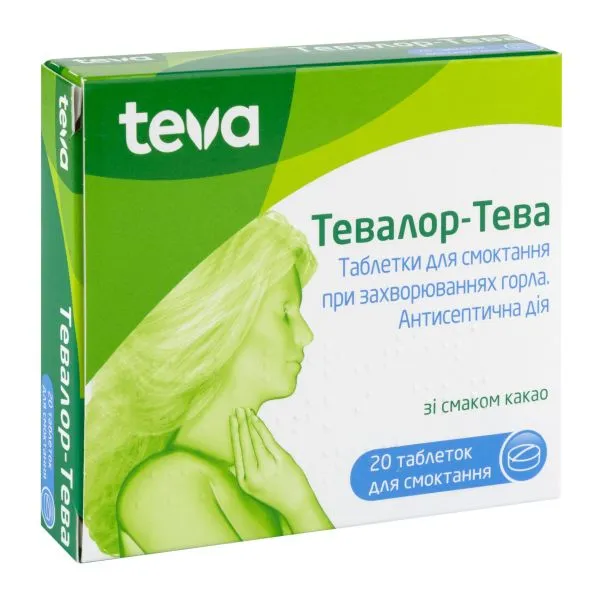
Table of Contents
INSTRUCTIONS FOR MEDICAL USE OF THE MEDICINAL PRODUCT TEVALOR-TEVA (TEVALOR-TEVA)
Composition:
Active substances: 1 tablet contains 0.25 mg of dequalinium chloride; 30 mg of ascorbic acid;
Excipients: glucose monohydrate, sodium saccharin, pectin, vanillin, sucrose, cocoa powder, lactose monohydrate, magnesium stearate.
Pharmaceutical form. Lozenges.
Main physico-chemical properties: round, flat lozenges with beveled edges and a score line on one side, 13 mm in diameter; brown, mottled in appearance.
Pharmacotherapeutic group.
Preparations used in throat diseases. Various antiseptics.
ATC code R02A A20.
Pharmacological Properties
Pharmacodynamics
Tevabor-Teva is a combination medication with pronounced local antiseptic, antibacterial, and antifungal effects. It is used in throat inflammations. The drug exhibits primarily bacteriostatic (according to some data, bactericidal) activity against a range of Gram-positive and Gram-negative microorganisms, including strains resistant to antibiotics. The preparation is most effective at alkaline pH values (such as the environment in the oral cavity). Dequalinium chloride is a local antiseptic belonging to the quinoline group. It is a bis-quaternary quinoline with antiseptic and bacteriostatic properties.
Dequalinium chloride exerts local antiseptic action, primarily; antibacterial activity—mainly against Gram-negative and Gram-positive microorganisms, particularly against pyogenic pathogens and antibiotic-resistant strains (pyogenic streptococci, Borrelia, etc.); antifungal activity—primarily against Candida albicans, some species of Trichophyton, and dermatophytes. It is not active against Mycobacterium. The antibacterial effect is due to denaturation of microbial proteins and enzymes through solubilization and depolymerization, as well as glycolysis and inactivation of dehydrogenases—initially reversible, but prolonged contact leads to irreversible inactivation; inhibition of protein synthesis at the ribosomal level; and cytolysis of the cell membrane. The surface-active cationic effect underlies its bacteriostatic activity, which is stronger against Gram-positive than against Gram-negative microorganisms.
Ascorbic acid, included in the formulation, affects intracellular oxidation and reduction processes; enhances the synthesis of specific antibacterial antitoxins and improves reticuloendothelial function; reduces cellular membrane permeability; improves the condition of capillary vessel walls; and limits exudative, inflammatory, and allergic reactions.
Microbial resistance to the medicinal product Tevalor-Teva develops slowly during prolonged use (over 15–20 days). Development of resistance is minimal for Gram-positive microorganisms and certain fungi. The drug remains effective against microorganisms resistant to penicillin, streptomycin, and sulfonamides.
Pharmacokinetics
The drug exerts local antiseptic action in the oral cavity. It is rapidly absorbed from the gastrointestinal tract. Distributed via diffusion through the liver, lungs, and kidneys. Elimination is prolonged, occurring via urine and feces.
Clinical characteristics.
Indications.
- Local antiseptic treatment of inflammatory conditions of the oral cavity and throat caused by pathogens sensitive to the drug (catarrhal, ulcerative, fibrous gingivitis, aphthous stomatitis, candidiasis, pharyngitis, tonsillitis, laryngitis, and glossitis).
- As part of combination therapy for more severe throat infections, used together with antibiotics and sulfonamides.
- Prevention of infections before and after surgical procedures in the oral cavity and throat.
Contraindications.
Hypersensitivity to the active substances or to any of the excipients. Thrombosis, predisposition to thrombosis, thrombophlebitis, severe kidney disease, diabetes mellitus, fructose intolerance, Lapp lactase deficiency, or glucose-galactose malabsorption syndrome. Allergy to quaternary ammonium compounds (e.g., benzalkonium chloride).
Interaction with other medicinal products and other forms of interaction.
The antibacterial activity of dequalinium chloride is reduced when used concomitantly with detergents, such as toothpaste. The medicinal product should not be used in combination with cholinesterase inhibitors.
The absorption of ascorbic acid is reduced when taken simultaneously with oral contraceptives, fruit or vegetable juices, or alkaline drinks. Orally administered ascorbic acid enhances the absorption of penicillin, tetracycline, iron, and also promotes intestinal absorption of aluminum, which should be considered when treating concomitantly with aluminum-containing antacids.
Ascorbic acid reduces the effectiveness of heparin and indirect anticoagulants and increases the risk of crystalluria during salicylate therapy. Concurrent use of ascorbic acid and deferoxamine increases tissue iron toxicity, especially in cardiac muscle, potentially leading to circulatory decompensation. Ascorbic acid may be taken only 2 hours after deferoxamine injection.
Prolonged intake of high doses of ascorbic acid by patients undergoing disulfiram treatment inhibits the disulfiram-alcohol reaction. High doses of ascorbic acid reduce the effectiveness of tricyclic antidepressants, neuroleptics—phenothiazine derivatives—and tubular reabsorption of amphetamine, and interfere with renal excretion of mexiletine.
Ascorbic acid increases the total clearance of ethanol. Quinolone derivatives, calcium chloride, salicylates, and corticosteroids, when used long-term, reduce the body's ascorbic acid reserves.
When taken simultaneously with polystyrene sulfonate (kayexalate), a medication used to treat hyperkalemia, there is a risk of developing severe necrotic lesions of the skin and mucous membranes, particularly of the gastrointestinal tract.
Special precautions for use
Due to the absence of an analgesic component in the medicinal product, it is not advisable to use it for inflammatory conditions accompanied by severe throat pain. If the main clinical signs of infection generalization are present, a physician should be consulted to prescribe systemic antibacterial therapy. If any adverse effects occur, administration of Tivalore-Teva should be discontinued. Concurrent use with other locally acting medicinal products should be performed cautiously and under medical supervision.
Absorption of ascorbic acid may be impaired in intestinal dyskinesia, enteritis, and achylia. Use with caution in patients with glucose-6-phosphate dehydrogenase deficiency.
As a reducing agent, ascorbic acid may interfere with laboratory test results, for example, when measuring blood glucose and bilirubin levels, as well as transaminase and lactate dehydrogenase activities.
When taking ascorbic acid in doses exceeding 1 g per day and with prolonged use exceeding the recommended daily dose and treatment duration of Tivalore-Teva by more than threefold, kidney function, arterial blood pressure, and pancreatic function should be monitored. The medicinal product should be used cautiously in patients with a history of kidney disease and in patients with progressive malignant disease, as the course of the disease may worsen.
In patients with urolithiasis, the daily dose of ascorbic acid should not exceed 1 g, as high doses of ascorbic acid may increase the risk of calcium oxalate stone formation in patients predisposed to kidney stone formation. The product should be used with caution in patients with galactosemia. Since ascorbic acid enhances iron absorption, its use in high doses (over 1 g) may be hazardous in patients with hemochromatosis, thalassemia, polycythemia, leukemia, or sideroblastic anemia. Patients with high iron levels in the body should use the product only at the recommended doses.
High doses of the drug should not be prescribed to patients with increased blood coagulability.
The medicinal product contains glucose, lactose, and sucrose. If you have been diagnosed with intolerance to certain sugars, consult your physician before taking this medicinal product (see section "Contraindications").
Use during pregnancy or breastfeeding
During pregnancy or breastfeeding, use with caution, under medical supervision, strictly adhering to the recommended doses.
Ability to affect reaction rate when driving or operating machinery
The medicinal product Tivalore-Teva does not affect the patient's ability to perform tasks requiring increased attention (such as driving vehicles or operating moving machinery).
Dosage and Administration.
For adults and children aged 4 years and older: take 1 tablet for sucking every 2–3 hours (no more than 8–10 tablets per day).
Do not chew the tablets. After taking the medication, patients are advised not to eat or drink for 30 minutes.
Treatment should be continued for an additional 1–2 days after the symptoms of the disease have disappeared. The total duration of treatment should not exceed 5–7 days (to avoid the risk of disrupting the development of normal bacterial flora in the oral cavity and throat).
Children.
The medication should not be administered to children under 4 years of age in this pharmaceutical form due to the risk of developing aspiration.
Overdose.
Exacerbation of adverse reactions.
Ascorbic acid is well tolerated. It is a water-soluble vitamin, and any excess is excreted in urine. However, prolonged use of high doses of vitamin C may suppress the function of the islet apparatus of the pancreas, requiring monitoring of its condition. Overdose may lead to changes in renal excretion of ascorbic and uric acids during urine acidification, with a risk of precipitation of oxalate calculi.
Administration of high doses of the drug may lead to vomiting, nausea, or diarrhea, which resolve after discontinuation of the drug. In rare cases, esophageal ulcers and necrosis may occur. Treatment is symptomatic.
Adverse reactions.
The medicinal product is usually well tolerated, does not irritate tissues at the site of application, and no reports of serious adverse effects have been received. However, the following undesirable drug reactions related to dequalinium chloride may occur:
Gastrointestinal tract: nausea, vomiting, burning sensation and irritation in the throat, dryness in the oral cavity, oral dysbiosis (with prolonged use at high doses);
Other: very rarely – allergic reactions;
Local reactions: in rare cases, particularly with abuse – development of ulceration and necrosis.
The following undesirable reactions related to ascorbic acid may occur:
Immune system: allergic reactions, including rash, itching, angioneurotic edema, urticaria; occasionally – anaphylactic shock in the presence of sensitization;
Skin and subcutaneous tissue: eczema;
Cardiovascular system: arterial hypertension;
Nervous system: increased excitability, sleep disturbances, headache, sensation of warmth, fatigue;
With prolonged use at high doses (over 1 g of ascorbic acid per day): damage to the islet apparatus of the pancreas (hyperglycemia, glucosuria) and impaired glycogen synthesis up to the development of diabetes mellitus; myocardial dystrophy; thrombocytosis, hyperprothrombinemia, erythrocytopenia, neutrophilic leukocytosis; in patients with glucose-6-phosphate dehydrogenase deficiency in erythrocytes, hemolysis is possible; oral dysbiosis; irritation of the gastrointestinal mucosa, heartburn, vomiting, diarrhea; damage to the glomerular apparatus of the kidneys, crystalluria, formation of urate, cystine and/or oxalate concretions in the kidneys and urinary tract, renal failure; disturbances in zinc and copper metabolism.
Shelf life. 3 years.
Storage conditions.
Store in the original packaging at a temperature not exceeding 25 °C.
Keep out of reach of children!
Packaging. 20 tablets per blister, 1 or 2 blisters per cardboard pack.
Dispensing category. Over-the-counter.
| Manufacturer. |
Balkanpharma-Razgrad AD.
Balkanpharma-Dupnitsa AD.
Manufacturer's location and address of its place of business.
68 Aprilsko Vastanie Boulevard, Razgrad 7200, Bulgaria.
3 Samokovsko Shose Street, Dupnitsa, 2600, Bulgaria.