Tempalgin
Ukraine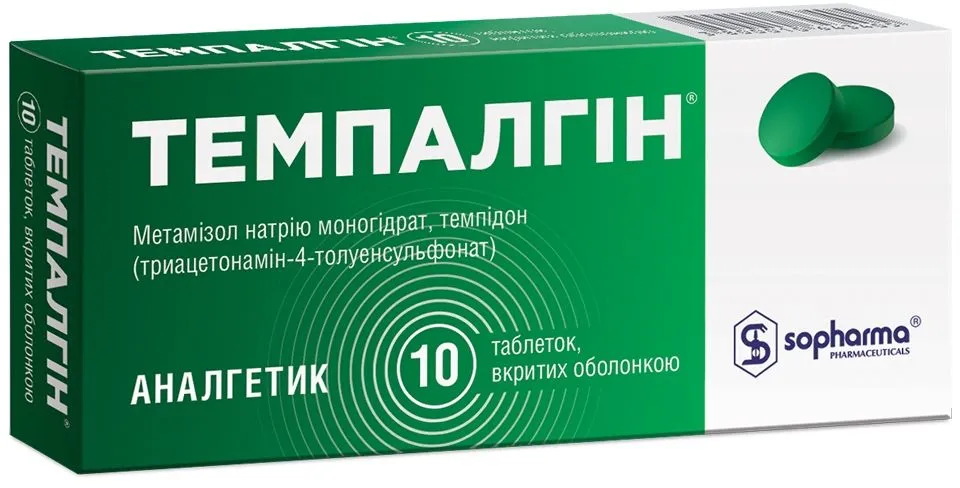
Table of Contents
INSTRUCTION FOR MEDICAL USE OF THE MEDICINAL PRODUCT TEMPALGIN® (TEMPALGIN®)
Composition:
Active substances: sodium metamizole monohydrate, temponidone (triacetoneamine-4-toluenesulfonate);
One coated tablet contains: sodium metamizole monohydrate 500 mg, temponidone (triacetoneamine-4-toluenesulfonate) 20 mg;
Excipients: wheat starch, microcrystalline cellulose (type 101), povidone K 25, talc, magnesium stearate;
Film coating: Opadry II 85 F21526 green (partially hydrolyzed polyvinyl alcohol, polyethylene glycol 3350, talc, titanium dioxide (E 171), quinoline yellow (E 104), indigo carmine FCF (E 133)).
Pharmaceutical form. Coated tablets.
Main physicochemical properties: round, biconvex, coated tablets, 13 mm in diameter, green in color, odorless.
Pharmacotherapeutic group.
Analgesics. Pyrazolones. Metamizole sodium, combinations with psychotropic agents.
ATC code N02B B72.
Pharmacological Properties
Pharmacodynamics
Sodium metamizole has analgesic and anti-inflammatory effects. It inhibits the synthesis of prostaglandins by suppressing cyclooxygenase, has membrane-stabilizing action, and inhibits the formation of endogenous pyrogens.
Temphenone has pronounced anxiolytic activity and relieves states of anxiety, fear, and tension. It reduces motor excitability and exhibits central N-cholinolytic action. It enhances and prolongs the analgesic effect of metamizole. Temphenone favorably influences the emotional component of pain.
The combination of sodium metamizole and temphenone enhances the analgesic effect of metamizole and increases the duration of its action.
Pharmacokinetics
Absorption: After oral administration, metamizole is hydrolyzed in the gastrointestinal tract. The active metabolites are 4-methyl-aminoantipyrine (MAA) and 4-aminoantipyrine (AA). MAA is characterized by rapid and complete absorption. Maximum plasma concentration is reached within 1–2 hours. The bioavailability of MAA is approximately 90%. Food does not affect the pharmacokinetics of metamizole.
Temphenone is absorbed in the upper gastrointestinal tract. Therapeutic plasma concentrations are achieved within 30 minutes after administration. Maximum plasma concentration of 0.8 mcg/mL is reached within 60 minutes.
Distribution: Sodium metamizole is partially bound to plasma proteins.
Data from experimental animal studies indicate that tissue distribution of temphenone is extensive.
Metabolism: Sodium metamizole undergoes extensive hepatic metabolism. Its main metabolites, 4-methyl-aminoantipyrine and 4-aminoantipyrine, are pharmacologically active.
Excretion: It is excreted in urine in the form of metabolites, with only 3% of the excreted amount of metamizole being in unchanged form. Metamizole metabolites penetrate into breast milk.
Temphenone is excreted unchanged in urine, at a quantity of 2/3 of the administered dose.
Patients with hepatic impairment: The elimination half-life of the active metabolite MAA is prolonged approximately threefold in patients with impaired liver function. These patients should be treated with lower doses of metamizole.
Patients with renal impairment: In patients with impaired renal function, decreased excretion of certain metabolites is observed. These patients should be treated with lower doses of metamizole.
Clinical characteristics.
Indications.
For short-term symptomatic treatment of mild to moderate pain associated with the following conditions: headache, toothache and dental procedures, myalgia, neuralgia, arthralgia.
Contraindications.
- Hypersensitivity to active or excipients;
- Hypersensitivity to other pyrazolone derivatives;
- Agranulocytosis caused by metamizole, other pyrazolones or pyrazolidines in medical history;
- Acute hepatic porphyria;
- Congenital glucose-6-phosphate dehydrogenase deficiency (risk of hemolysis);
- Severe renal and/or hepatic impairment;
- Bone marrow dysfunction (e.g., following cytostatic therapy) or blood disorders (aplastic anemia, leukopenia), changes in peripheral blood composition;
- Anemia of any etiology, cytostatic or infectious neutropenia;
- Arterial hypotension with blood pressure values below 100 mmHg;
- Suspicion of acute surgical pathology.
Interaction with other medicinal products and other types of interactions.
The effects of tricyclic antidepressants (psychoforin, amitriptyline), oral contraceptives, analgesics, allopurinol, and alcohol are potentiated when used concomitantly with the medicinal product Temalgine®.
Concomitant use with other analgesics and NSAIDs increases the risk of hypersensitivity reactions and other adverse effects.
Barbiturates, glutethimide, and phenylbutazone reduce the intensity and shorten the duration of metamizole's pharmacodynamic effects due to induction of liver enzymes.
Metamizole decreases the activity of coumarin anticoagulants when used concomitantly due to induction of hepatic enzymes.
Analgesic effect of the drug is enhanced by sedatives and tranquilizers (diazepam, trioxazine, valocordin, codeine, etc.).
Metamizole reduces the plasma concentration of cyclosporine.
Concomitant use with chlorpromazine may result in hypothermia.
Cytoplastic agents (sacrolizine, methotrexate), gold preparations, mercaptazole (thiamazole), chloramphenicol, and other drugs that suppress hematopoiesis enhance the myelotoxic effect of metamizole.
Caution is required when used concomitantly with diuretics (furosemide).
Radiopaque contrast agents, colloidal plasma substitutes, and penicillin should not be used during treatment with sodium metamizole.
Tempidone potentiates the sedative effect of hypnotics, general anesthetics, and narcotic and non-narcotic analgesics.
Sulfonamide oral hypoglycemic agents may enhance their hypoglycemic effect when used together with NSAIDs, including sodium metamizole.
Since metamizole may reduce the efficacy of certain drugs, Temalgine® should be used with caution in combination with the following medicinal products:
- Bupropion – used for treatment of depression or as an aid to smoking cessation;
- Efavirenz – used for treatment of HIV/AIDS;
- Methadone – used for treatment of addiction to controlled substances (so-called opioids);
- Valproate – used for treatment of epilepsy or bipolar disorder;
- Tacrolimus – used to prevent organ rejection in transplant patients;
- Sertraline – used for treatment of depression.
Special precautions for use.
| Agranulocytosis Metamizole treatment may cause agranulocytosis, including fatal cases. This condition may occur even if previous use of metamizole had no adverse effects. Metamizole-induced agranulocytosis is an idiosyncratic adverse reaction unrelated to the dose of the drug and may occur at any time during treatment, as well as shortly after its discontinuation. Patients should be informed of the necessity to discontinue treatment and immediately seek medical attention if any symptoms suggestive of agranulocytosis occur (e.g., fever, chills, sore throat, and painful mucosal lesions, particularly in the mouth, nose, and throat, as well as in the genital or anal areas). If metamizole is used for fever, some symptoms of developing agranulocytosis may remain unnoticed. Similarly, these symptoms may go unrecognized in patients receiving antibiotic therapy. If signs or symptoms suggestive of agranulocytosis appear, treatment must be discontinued immediately and a complete blood count should be performed. If the diagnosis is confirmed, treatment must not be resumed. |
Treatment with the medicinal product Tempan (due to the content of metamizole) should be prescribed only for a short period, when no other alternative treatment methods are available.
Before starting treatment, patients must be warned that if bleeding of the gums, pallor of the skin, asthenia, or skin and mucosal rashes occur, the drug must be discontinued immediately and medical advice sought without delay.
The recommended doses of the medicinal product should not be exceeded. Since metamizole has anti-inflammatory and analgesic properties, it may mask signs of infection, symptoms of non-infectious diseases, and complications associated with pain syndrome, which could complicate their diagnosis.
Use in children should be carried out under constant medical supervision.
Caution is required when administering the drug to patients with allergic diseases, patients with hypersensitivity to analgesics and anti-rheumatic medicinal products (analgesic intolerance), or to other drugs or food products, due to an increased risk of developing allergic reactions and asthmatic attacks.
Severe skin reactions, including Stevens-Johnson syndrome, toxic epidermal necrolysis, and drug-induced eosinophilia with systemic symptoms (DRESS syndrome), which may be life-threatening or fatal, have been reported during treatment with metamizole. Patients should be informed about the signs and symptoms of skin reactions and closely monitored. If signs or symptoms indicating such reactions appear, treatment with metamizole should be discontinued and must never be restarted (see section "Contraindications").
The following patient groups require cautious use:
- Elderly patients – may lead to an increased frequency of adverse reactions, especially those affecting the gastrointestinal tract;
- Patients with impaired kidney function or a history of kidney disease (pyelonephritis, glomerulonephritis);
- Patients with inflammatory bowel diseases, including ulcerative colitis and Crohn's disease;
- Patients with cardiac or circulatory insufficiency;
- Patients with chronic alcoholism.
Metamizole may provoke hypotensive reactions. Treatment with Tempan should be administered with particular caution in patients with hypotension, volume depletion, dehydration, or unstable hemodynamics.
The risk of adverse effects increases when used concomitantly with alcohol.
Caution is required in patients with moderate impairment of liver function or impaired kidney function.
Hepatitis has been observed in patients treated with metamizole, with symptoms developing from several days to several months after initiation of treatment.
If a patient develops symptoms suggestive of liver injury, such as nausea or vomiting, fever, fatigue, loss of appetite, dark urine, pale stools, jaundice of the skin or sclera, pruritus, rash, or upper abdominal pain, treatment with Tempan must be discontinued and medical advice sought. The physician should assess the patient's liver function.
Tempan should not be used if the patient has previously experienced liver injury during treatment with metamizole.
Red discoloration of urine may occur during treatment due to excretion of sodium metamizole metabolites.
The drug should not be used for longer than the recommended duration without consulting a physician! If symptoms of illness do not begin to resolve, or conversely, if health deteriorates or adverse effects appear, treatment should be discontinued and medical advice sought regarding further management.
Wheat starch, an ingredient of the drug, may contain only insignificant traces of gluten and is considered safe for individuals with celiac disease.
The recommended doses of the drug should not be exceeded. Use in children should be carried out under constant medical supervision.
Use during pregnancy or breastfeeding.
Pregnancy.
Controlled clinical studies in pregnant women have not been conducted, and observational data on the use of the drug in this group are lacking. Although metamizole is a weak inhibitor of prostaglandin synthesis, there is a potential risk of premature closure of the ductus arteriosus and perinatal complications due to reduced platelet aggregation in both the fetus and mother. Treatment with the drug is contraindicated during pregnancy.
Breastfeeding.
Metamizole metabolites penetrate into breast milk. If treatment with Tempan is necessary, breastfeeding must be discontinued.
Ability to influence reaction rate while driving or operating machinery.
Tempan reduces the ability to concentrate and slows conditioned reflexes; therefore, it should not be prescribed to drivers of vehicles or to individuals whose work requires high speed of mental and physical reactions.
Method of Administration and Dosage
Tablets should be taken orally with water, preferably after meals.
The treatment course should not exceed 3 days. Prolonged use or use in higher doses is possible only after consultation with a physician.
The dosage depends on the intensity of pain and individual sensitivity to the drug.
Adults.
Usual dose: 1 tablet 1–2 times daily, depending on the severity of clinical symptoms. The maximum single dose should not exceed 1 tablet. The maximum daily dose is 2 tablets.
For dental procedures: 1 tablet 30 minutes before intervention.
Children aged 15 years and older.
1 tablet daily. The maximum daily dose is 1 tablet.
Patients aged 65 years and older.
Dosage reduction is usually not required. In patients with age-related renal or hepatic impairment, treatment should be short-term. The maximum daily dose should not exceed 2 tablets.
Patients with hepatic impairment.
In these patients, the elimination half-life of metamizole metabolites may be prolonged. In patients with moderate to severe hepatic impairment, treatment is recommended at ½ the standard adult dose (maximum daily dose – 1 tablet).
Patients with renal impairment.
Metamizole and its metabolites are excreted by the kidneys. In patients with impaired renal function, treatment with Temalgine® should be administered at ½ the standard adult dose (maximum daily dose – 1 tablet).
Children. Do not use in children under 15 years of age.
Overdose.
Symptoms:
- Gastrointestinal syndrome (nausea, vomiting, stomach pain; with large doses – hematemesis and melena);
- Cerebral syndrome (Menière-like symptoms, tinnitus, weakness, ataxia, drowsiness, apnea, impaired consciousness, delirium, coma with arterial hypotension and tonic-clonic seizures);
- Hematological syndrome (agranulocytosis, aplastic anemia or hemolytic anemia, hemorrhagic diathesis);
- Metabolic syndrome (metabolic alkalosis);
- Renal syndrome (from oliguria to anuria);
- Acute hepatic and renal failure;
- Toxic-allergic syndrome (bullous-urticarial and petechial rashes, sometimes resembling typhus or measles; in some patients, toxic-allergic shock may develop);
- Hypothermia, palpitations, marked decrease in blood pressure, tachycardia, dysphagia, dyspnea, gastralgia/gastritis, respiratory muscle paralysis.
At the first signs of overdose, immediate medical attention is required.
Treatment: symptomatic management – gastric lavage, monitoring of respiratory and cardiac functions, fluid administration, forced diuresis, and, if necessary, hemodialysis.
Adverse Reactions.
Adverse reactions may occur during the use of the medicinal product Tempalgin®; these are more commonly associated with sodium metamizole.
Adverse reactions are classified by organ systems.
Blood and lymphatic system disorders: agranulocytosis, leukopenia, aplastic anemia, thrombocytopenia, hemolytic anemia.
Immune system disorders: fixed drug eruption, maculopapular rash, anaphylactic or anaphylactoid reactions. Milder effects manifest as typical skin and mucous membrane reactions – itching, burning, redness, urticaria, swelling (generalized or localized), dyspnea, and rarely gastrointestinal complaints. Such milder reactions may progress to more severe forms with generalized urticaria, severe angioneurotic edema (including laryngeal edema), severe bronchospasm, cardiac arrhythmias, decreased arterial pressure (sometimes preceded by increased arterial pressure), asthmatic attack (in patients with aspirin-induced asthma), Lyell’s syndrome, circulatory shock.
Skin and subcutaneous tissue disorders: severe skin reactions have been reported, including Stevens-Johnson syndrome, toxic epidermal necrolysis, and (with unknown frequency) drug-induced eosinophilia with systemic symptoms (DRESS) associated with the use of metamizole (see section "Special precautions for use").
Metabolism and nutrition disorders: decreased appetite.
Nervous system disorders: headache, dizziness.
Cardiovascular system disorders: palpitations, tachycardia, cyanosis, hypotension.
Gastrointestinal disorders: nausea, vomiting, abdominal pain and discomfort; in isolated cases – ulceration and hemorrhage.
Hepatobiliary disorders: drug-induced liver injury, including acute hepatitis, jaundice, elevated liver enzyme levels, cholestasis, hyperbilirubinemia.
Renal and urinary disorders: polyuria, oliguria, anuria, proteinuria, interstitial nephritis. With high-dose use – impaired kidney function.
Shelf life. 4 years.
Storage conditions. Store out of reach of children.
Store in the original packaging at a temperature not exceeding 25 °C.
Packaging. 10 film-coated tablets in a blister made of PVC film and aluminum foil. 1 or 2 blisters per cardboard box.
Pharmaceutical category. Over-the-counter (without prescription).
Manufacturers:
JSC "Sofarma".
JSC "VITAMINS".
Manufacturers' addresses and places of business.
JSC "Sofarma"
16 Iliensko Shose Str., Sofia, 1220, Bulgaria.
JSC "VITAMINS"
31 Uspenska Str., Uman, Cherkasy Oblast, 20300, Ukraine.