Telmisartan-teva
Ukraine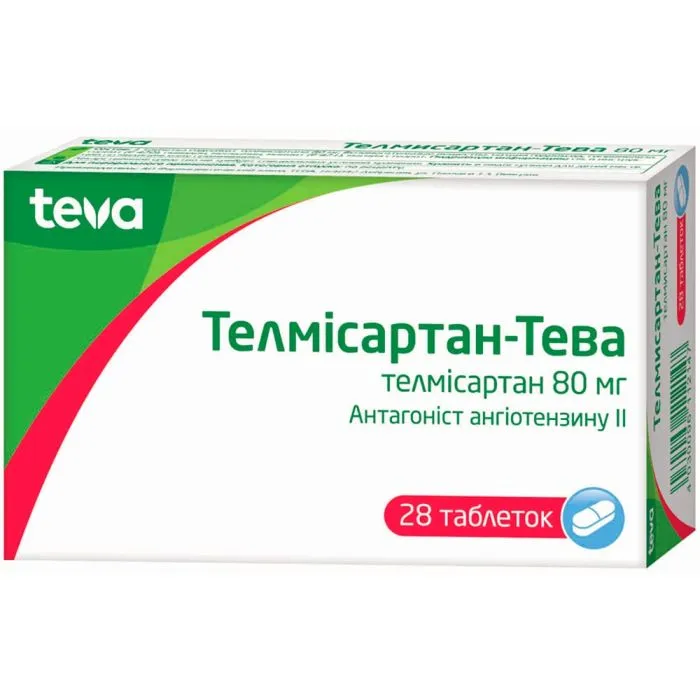
Table of Contents
INSTRUCTION FOR MEDICAL USE OF THE MEDICINAL PRODUCT TELMISARTAN-TEVA (TELMISARTAN-TEVA)
Composition:
Active substance: telmisartan;
1 tablet contains 80 mg of telmisartan;
Excipients: sodium hydroxide, hypromellose, sorbitol (E 420), povidone, meglumine, mannitol (E 421), magnesium stearate.
Pharmaceutical form. Tablets.
Main physicochemical properties: white or almost white elongated tablets with a break line on one side.
Pharmacotherapeutic group. Simple preparations of angiotensin II antagonists.
ATC code: C09CA07.
Pharmacological Properties
Pharmacodynamics
Telmisartan is an oral specific antagonist of angiotensin II receptors (AT1 subtype). With high affinity, telmisartan displaces angiotensin II from its binding sites on AT1-receptors, through which angiotensin II mediates its effects. Telmisartan does not exhibit any partial agonistic activity at the AT1-receptor.
Telmisartan selectively binds to AT1-receptors without even partial agonistic effect on them. The binding is long-lasting.
Telmisartan has no affinity for other receptors, including AT2-receptors and other AT-receptors. The functional role of these receptors is not fully understood, nor is the effect of their possible stimulation by angiotensin II, whose levels increase under the influence of telmisartan. Telmisartan reduces plasma aldosterone levels, does not block ion channels, and does not reduce plasma renin levels. It does not inhibit angiotensin-converting enzyme (kininase II), the enzyme also responsible for bradykinin breakdown. Therefore, potentiation of bradykinin-mediated adverse effects is not expected.
In humans, a dose of 80 mg of telmisartan almost completely inhibits the increase in arterial blood pressure induced by angiotensin II. The inhibitory effect lasts over 24 hours and is detectable up to 48 hours.
Pharmacokinetics
Absorption
Telmisartan is rapidly absorbed, but the amount absorbed is variable. The mean absolute bioavailability of telmisartan is approximately 50%.
When telmisartan is administered with food, the area under the concentration-time curve (AUC0–∞) for telmisartan decreases by approximately 6% (40 mg dose) to approximately 19% (160 mg dose). Three hours after administration, plasma concentrations become equivalent to those observed when telmisartan is taken without food.
Linearity/Non-linearity
The slight reduction in AUC is not considered to reduce the therapeutic efficacy of the drug. There is no linear relationship between dose and plasma levels. Cmax, and to a lesser extent AUC, increase disproportionately at doses above 40 mg.
Distribution
Telmisartan is highly bound to plasma proteins (more than 99.5%), primarily to albumin and alpha-1-acid glycoprotein. The mean volume of distribution at steady state (Vss) is approximately 500 L.
Metabolism
Telmisartan is metabolized via conjugation to the glucuronide of the parent compound. The pharmacological activity of the conjugate has not been established.
Elimination
Telmisartan exhibits a biexponential pharmacokinetic profile with a terminal elimination half-life of more than 20 hours. Maximum plasma concentration (Cmax) and, to a lesser extent, the area under the concentration-time curve (AUC) increase disproportionately with dose. With telmisartan administered at recommended doses, no clinically significant accumulation has been observed. Plasma concentrations were higher in women than in men, without corresponding impact on efficacy.
After oral (and intravenous) administration, telmisartan is almost completely excreted in feces, primarily in unchanged form.
Cumulative urinary excretion accounts for less than 1% of the administered dose. Total plasma clearance (CLtot) is high (approximately 1000 mL/min), compared to hepatic blood flow (approximately 1500 mL/min).
Special patient populations
Children. The pharmacokinetics of two doses of telmisartan were evaluated as a secondary objective in hypertensive patients (n = 57) aged 6 to <18 years after administration of telmisartan at doses of 1 mg/kg or 2 mg/kg for 4 weeks of treatment. Pharmacokinetic objectives included determination of steady-state telmisartan levels in children and adolescents and investigation of age-related differences. Although the study was too small to reliably assess pharmacokinetics in children under 12 years of age, the results generally correspond to data obtained in adults and confirm the non-linearity of telmisartan, particularly for Cmax.
Gender. Plasma Cmax and AUC concentrations in women are approximately 3 and 2 times higher, respectively, than in men.
Elderly patients. The pharmacokinetics of telmisartan do not differ between elderly patients and patients under 65 years of age.
Patients with renal impairment. In patients with mild to moderate and severe renal impairment, plasma concentrations increased approximately two-fold. However, in patients with renal impairment undergoing dialysis, lower plasma concentrations were observed. Telmisartan has high plasma protein binding in patients with renal impairment and cannot be removed by dialysis. The elimination half-life is not altered in patients with renal impairment.
Patients with hepatic impairment. Pharmacokinetic studies in patients with hepatic impairment showed an increase in absolute bioavailability to approximately 100%. The elimination half-life is not altered in patients with hepatic impairment.
Clinical characteristics.
Indications.
Hypertension.
Treatment of essential hypertension in adults.
Cardiovascular disease prevention.
Reduction of cardiovascular morbidity in patients with:
- established atherothrombotic cardiovascular disease (ischemic heart disease, stroke or peripheral arterial disease in medical history);
- type 2 diabetes mellitus with diagnosed target organ damage.
Contraindications.
Hypersensitivity to the active substance or to any of the excipients of the drug (see section "Composition").
Pregnancy or planned pregnancy (see sections "Special precautions", "Use during pregnancy or breastfeeding").
Obstructive biliary disorders.
Severe hepatic impairment.
Paediatric population (under 18 years of age).
Concomitant use of telmisartan and aliskiren-containing medicinal products is contraindicated in patients with diabetes mellitus or renal impairment (GFR < 60 mL/min/1.73 m²) (see sections "Interaction with other medicinal products and other forms of interaction" and "Pharmacological properties").
Interaction with other medicinal products and other forms of interaction.
Digoxin
When telmisartan was co-administered with digoxin, median increases in peak plasma concentrations of digoxin (by 49%) and trough concentrations (by 20%) were observed. Monitoring of digoxin levels should be initiated at the beginning of telmisartan treatment, during dose adjustments, and upon discontinuation to maintain levels within the therapeutic range.
Like other medicinal products affecting the renin-angiotensin-aldosterone system (RAAS), telmisartan may cause hyperkalaemia (see section "Special precautions"). This risk may increase when combined with other medicinal products that may also provoke hyperkalaemia (potassium-containing salt substitutes, potassium-sparing diuretics, ACE inhibitors, angiotensin II receptor antagonists, NSAIDs (including selective COX-2 inhibitors), heparin, immunosuppressants (cyclosporine or tacrolimus), and trimethoprim).
The frequency of hyperkalaemia episodes depends on associated risk factors. The risk increases with the use of the above-mentioned therapeutic combinations. This risk is particularly high when combined with potassium-sparing diuretics and potassium-containing salt substitutes. Combinations, for example, with ACE inhibitors or NSAIDs, pose a lower risk provided warnings for use are strictly observed.
Concomitant use not recommended
Potassium-sparing diuretics or potassium supplements
Angiotensin II receptor antagonists such as telmisartan reduce potassium loss caused by diuretics. Potassium-sparing diuretics such as spironolactone, eplerenone, triamterene or amiloride, potassium-containing dietary supplements, or potassium-containing salt substitutes may lead to a significant increase in serum potassium levels. If concomitant use is indicated due to documented hypokalaemia, these agents should be used with caution and with frequent monitoring of serum potassium levels.
Lithium
When lithium is used concomitantly with ACE inhibitors and angiotensin II receptor antagonists, including telmisartan, reversible increases in serum lithium concentrations and lithium toxicity have been reported. If use of such a combination is necessary, careful monitoring of serum lithium levels is recommended.
Concomitant use requiring caution
Non-steroidal anti-inflammatory drugs (NSAIDs)
NSAIDs (e.g. acetylsalicylic acid at doses used for treatment of inflammatory conditions, COX-2 inhibitors, and non-selective NSAIDs) may reduce the antihypertensive effect of angiotensin II receptor antagonists.
In some patients with impaired renal function (e.g. dehydrated patients or elderly patients with impaired renal function), concomitant use of angiotensin II receptor antagonists and agents that inhibit cyclooxygenase may lead to further deterioration of renal function, including possible acute renal failure, which is usually reversible. Therefore, such combinations should be used with caution, particularly in elderly patients. Adequate hydration should be ensured; consideration should be given to monitoring renal function after initiation of concomitant therapy and periodically thereafter.
In one study, concomitant administration of telmisartan and ramipril resulted in a 2.5-fold increase in AUC0–24 and Cmax of ramipril and ramiprilat. The clinical significance of this finding is unknown.
Diuretics (thiazide or loop diuretics)
Prior treatment with high doses of diuretics such as furosemide (a loop diuretic) or hydrochlorothiazide (a thiazide diuretic) may lead to dehydration and risk of hypotension at the start of telmisartan therapy.
Concomitant use requiring attention
Other antihypertensive agents
The antihypertensive effect of telmisartan may be enhanced when used concomitantly with other antihypertensive agents.
Clinical data have shown that dual blockade of the renin-angiotensin-aldosterone system (RAAS) with concomitant use of ACE inhibitors, angiotensin II receptor antagonists, or aliskiren is associated with a higher incidence of adverse reactions such as arterial hypotension, hyperkalaemia, and impaired renal function (including acute renal failure), compared to monotherapy with a drug acting on the RAAS (see sections "Special precautions", "Contraindications", and "Pharmacodynamics").
Due to their pharmacological properties, drugs such as baclofen and amifostine may enhance the hypotensive effect of all antihypertensive agents, including telmisartan. Orthostatic hypotension may also be exacerbated by alcohol consumption, barbiturates, narcotics, or antidepressants.
Corticosteroids (systemic use)
Reduction of antihypertensive effect.
Special precautions for use.
Pregnancy
Angiotensin II receptor antagonists must not be initiated during pregnancy. If continuation of therapy is considered essential for a patient planning pregnancy, she should be switched to an alternative antihypertensive treatment with an established safety profile during pregnancy. Angiotensin II receptor antagonists must be discontinued as soon as pregnancy is confirmed, and alternative therapy should be initiated if necessary (see sections "Contraindications" and "Use during pregnancy or breastfeeding").
Hepatic impairment
Telmisartan-Teva should not be used in patients with cholestasis, obstructive biliary disorders, or severe hepatic impairment, as telmisartan is primarily excreted via bile. In such patients, hepatic clearance of telmisartan is reduced. Telmisartan-Teva should be used with caution in patients with mild to moderate hepatic impairment.
Renovascular hypertension
There is a risk of severe hypotension and renal failure in patients with bilateral renal artery stenosis or stenosis of the artery to a single functioning kidney when treated with drugs affecting the renin-angiotensin-aldosterone system.
Renal impairment and kidney transplantation
In patients with impaired renal function, periodic monitoring of serum potassium and creatinine levels is recommended during treatment. There is no experience with the use of the drug in patients who have recently undergone kidney transplantation.
Reduced intravascular fluid volume
Symptomatic hypotension, particularly after the first dose, may occur in patients with reduced circulating blood volume or hyponatremia resulting from intensive diuretic therapy, salt-restricted diet, or diarrhea and vomiting. Such conditions should be corrected prior to administration of the drug. Sodium levels and intravascular fluid volume should be normalized before initiating treatment.
Dual blockade of the renin-angiotensin-aldosterone system
Evidence indicates that concomitant use of angiotensin-converting enzyme (ACE) inhibitors, angiotensin II receptor blockers, or aliskiren increases the risk of hypotension, hyperkalemia, and impaired renal function (up to acute renal failure).
Therefore, dual blockade of the renin-angiotensin-aldosterone system by concomitant use of ACE inhibitors, angiotensin II receptor blockers, or aliskiren is not recommended (see section "Interaction with other medicinal products and other forms of interaction"). If dual blockade is considered absolutely necessary, it should be performed only under specialist supervision and with continuous, careful monitoring of renal function, electrolytes, and blood pressure.
ACE inhibitors and angiotensin II receptor blockers should not be used concomitantly in patients with diabetic nephropathy.
Other conditions associated with activation of the renin-angiotensin-aldosterone system
In patients whose vascular tone and renal function are highly dependent on the activity of the renin-angiotensin-aldosterone system (e.g., patients with severe congestive heart failure or significant renal disease, including renal artery stenosis), treatment with drugs affecting this system, such as telmisartan, may cause acute hypotension, hyperazotemia, oliguria, or, less frequently, acute renal failure (see section "Adverse reactions").
Primary hyperaldosteronism
Patients with primary hyperaldosteronism usually do not respond to antihypertensive agents that suppress the renin-angiotensin system; therefore, telmisartan is not recommended for such patients.
Stenosis of mitral and aortic valves, obstructive hypertrophic cardiomyopathy
As with other vasodilators, the drug should be used with caution in patients with mitral or aortic stenosis or obstructive hypertrophic cardiomyopathy.
Diabetic patients treated with insulin or antidiabetic medicinal products
Hypoglycemia may occur in such patients during telmisartan treatment. Blood glucose levels should be monitored in these patients, and dose adjustments of insulin or antidiabetic agents may be required.
In patients with diabetes mellitus and cardiovascular risk (patients with diabetes and concomitant coronary artery disease), the risk of fatal myocardial infarction and sudden cardiovascular death may be higher when treated with antihypertensive agents such as angiotensin II receptor antagonists and ACE inhibitors. Coronary artery disease in diabetic patients may be asymptomatic and therefore undiagnosed. Diabetic patients should be carefully evaluated, for example by stress testing, to detect and treat concomitant coronary artery disease before initiating treatment with the drug.
Hyperkalemia
Use of drugs affecting the renin-angiotensin-aldosterone system may lead to hyperkalemia.
In elderly patients, patients with renal impairment, patients with diabetes mellitus, patients receiving other drugs that may increase potassium levels, and/or patients with intercurrent illnesses, hyperkalemia may lead to fatal outcomes.
The benefit-risk ratio should be assessed before concomitant use of drugs affecting the renin-angiotensin-aldosterone system.
Key risk factors for hyperkalemia to consider include:
- diabetes mellitus, renal impairment, age (>70 years);
- combination with one or more drugs affecting the renin-angiotensin-aldosterone system and/or potassium-containing dietary supplements. Medicinal products or therapeutic classes of drugs that may provoke hyperkalemia include potassium-containing salt substitutes, potassium-sparing diuretics, ACE inhibitors, angiotensin II receptor antagonists, non-steroidal anti-inflammatory drugs (NSAIDs, including selective COX-2 inhibitors), heparin, immunosuppressants (cyclosporine or tacrolimus), and trimethoprim;
- intercurrent conditions such as dehydration, acute heart decompensation, metabolic acidosis, worsening renal function, sudden deterioration of kidney function (e.g., due to infections), and cell lysis (e.g., acute limb ischemia, rhabdomyolysis, severe trauma).
Close monitoring of serum potassium is recommended in patients at risk.
Ethnic differences
As observed with ACE inhibitors, telmisartan and other angiotensin II receptor antagonists are clearly less effective in lowering blood pressure in black patients compared to patients of other races. This may be explained by the lower renin levels observed in black patients with arterial hypertension compared to other racial groups.
Others
As with other antihypertensive agents, excessive reduction of blood pressure in patients with ischemic heart disease and ischemic cardiomyopathy may lead to myocardial infarction or stroke.
Sorbitol
The medicinal product contains 38.4 mg of sorbitol in each tablet. This medicinal product should not be used by patients with rare hereditary fructose intolerance.
Sodium
This medicinal product contains less than 1 mmol sodium (23 mg) per tablet, i.e., essentially sodium-free.
Use during pregnancy or breastfeeding.
Pregnancy
| The medicinal product is contraindicated in pregnant women or women who are planning to become pregnant. If pregnancy is confirmed during treatment with this medicinal product, its use must be discontinued and replaced with another medicinal product permitted for use (see sections «Contraindications» and «Special precautions»). |
There are insufficient data on the use of telmisartan in pregnant women.
Epidemiological evidence of teratogenic risk associated with the use of angiotensin-converting enzyme (ACE) inhibitors during the first trimester of pregnancy has not been conclusive, but a small increased risk cannot be excluded. Although there are no controlled epidemiological data on the teratogenic risk of angiotensin II receptor antagonists, similar risks may exist for this class of medicinal products. When pregnancy is planned, the drug should be replaced in advance with another antihypertensive agent with an established safety profile during pregnancy. Upon confirmation of pregnancy, treatment with angiotensin II receptor antagonists must be urgently discontinued and, if necessary, alternative therapy should be initiated.
It is known that the use of angiotensin II receptor antagonists during the second and third trimesters of pregnancy causes fetal toxicity in humans (renal dysfunction, oligohydramnios, delayed skull ossification) and neonatal toxicity (renal failure, hypotension, hyperkalemia). If angiotensin II receptor antagonists are administered starting from the second trimester of pregnancy, ultrasound monitoring of fetal renal function and skull ossification is recommended. Neonates exposed in utero to angiotensin II receptor antagonists must be closely monitored for signs of hypotension (see sections "Contraindications" and "Special precautions for use").
Breast-feeding
As there is no information regarding the use of telmisartan during breast-feeding, its use is not recommended. Alternative treatments with established safety profiles during lactation should be used, especially when breast-feeding newborns or preterm infants.
Fertility
Preclinical studies have not shown any effect of telmisartan on fertility in males or females.
Ability to affect reaction speed when driving or operating machinery
When using antihypertensive therapy, dizziness or somnolence may occasionally occur. This should be taken into account when driving or operating machinery.
Dosage and Administration
Telmisartan-Teva should be administered once daily orally with a sufficient amount of liquid, independently of food intake.
Management of arterial hypertension
The usual effective dose is 40 mg once daily. For some patients, a dose of 20 mg once daily may be sufficient. If blood pressure is not adequately controlled, the dose may be increased up to a maximum of 80 mg once daily. Telmisartan-Teva can also be prescribed in combination with thiazide diuretics, such as hydrochlorothiazide, which provide an additional antihypertensive effect when used concomitantly with telmisartan. When considering dose escalation, it should be noted that the maximum antihypertensive effect is achieved within 4–8 weeks after initiation of treatment.
Prevention of cardiovascular disease
The recommended dose is 80 mg once daily. It is not known whether telmisartan doses lower than 80 mg are effective in reducing cardiovascular morbidity.
At the beginning of telmisartan treatment for the purpose of reducing cardiovascular risk, careful monitoring of blood pressure is recommended. Dose adjustments of concomitant antihypertensive medications may be necessary.
Elderly patients
Dose adjustment is not required.
Renal impairment
Experience with use in patients with renal insufficiency or undergoing hemodialysis is limited. For these patients, the lowest starting dose of 20 mg is recommended (see section "Special precautions"). Dose adjustment is not required in patients with mild to moderate renal impairment.
Hepatic impairment
Telmisartan is contraindicated in patients with severe hepatic impairment.
For patients with mild to moderate hepatic impairment, the daily dose of telmisartan should not exceed 40 mg once daily (see section "Special precautions").
Children
The efficacy and safety of telmisartan in children (under 18 years of age) have not been established.
Current available data are provided in the "Pharmacokinetics" section, but no dose recommendations can be made.
Overdose.
Information regarding telmisartan overdose is limited.
Symptoms: The most prominent symptoms of overdose were hypotension and tachycardia; bradycardia, dizziness, elevated serum creatinine, and acute renal failure have also been reported.
Treatment: Telmisartan is not removed from the body by hemodialysis. The patient should be under close medical supervision and receive symptomatic and supportive treatment. Management depends on the time elapsed since overdose and the severity of symptoms. Induction of emesis and/or gastric lavage is recommended. Activated charcoal may be used in managing overdose. Frequent monitoring of serum electrolytes and creatinine levels should be performed. In case of hypotension, the patient should be placed in a supine position and treated with rapid volume and salt repletion.
Adverse Reactions
Serious adverse reactions, including anaphylactic reaction and angioneurotic edema, are possible in isolated cases (from ≥1/10,000 to <1/1,000). Acute renal failure has also been observed.
The overall incidence of adverse reactions in patients with arterial hypertension during controlled clinical trials receiving telmisartan was generally comparable to that with placebo (41.4% vs. 43.9%). The incidence of adverse reactions was dose-independent and not related to patient sex, age, or race. The safety profile of telmisartan in patients who received the drug for cardiovascular disease prevention was consistent with the safety profile observed in patients with arterial hypertension.
The adverse reactions listed below are based on results from controlled clinical studies in hypertensive patients and post-marketing reports. This list also includes serious adverse reactions and those leading to discontinuation of the drug during three long-term clinical trials involving 21,642 patients who received telmisartan for cardiovascular disease prevention over a period of up to 6 years.
Adverse reactions are listed according to their frequency: very common (≥1/10); common (from 1/100 to <1/10); uncommon (from 1/1,000 to <1/100); rare (from 1/10,000 to <1/1,000); very rare (<1/10,000).
Within each category, adverse reactions are listed in order of decreasing severity.
Infections and infestations:
uncommon – urinary tract infections (including cystitis), upper respiratory tract infections (including pharyngitis and sinusitis);
rare – sepsis, including cases with fatal outcome1.
Blood and lymphatic system disorders:
uncommon – anemia;
rare – eosinophilia, thrombocytopenia.
Immune system disorders:
rare – anaphylactic reaction, hypersensitivity.
Metabolism and nutrition disorders:
uncommon – hyperkalemia;
rare – hypoglycemia (in patients with diabetes mellitus).
Psychiatric disorders:
uncommon – insomnia, depression;
rare – anxiety.
Nervous system disorders:
uncommon – syncope;
rare – somnolence.
Eye disorders:
rare – visual disturbance.
Ear and labyrinth disorders:
uncommon – vertigo.
Cardiac disorders:
uncommon – bradycardia;
rare – tachycardia.
Vascular disorders:
uncommon – arterial hypotension2, orthostatic hypotension.
Respiratory, thoracic and mediastinal disorders:
uncommon – dyspnea, cough;
very rare – interstitial lung disease4.
Gastrointestinal disorders:
uncommon – abdominal pain, diarrhea, dyspepsia, flatulence, vomiting;
rare – dry mouth, gastric discomfort, dysgeusia.
Hepatobiliary disorders:
rare – liver function abnormalities/liver disorders3.
Skin and subcutaneous tissue disorders:
uncommon – pruritus, increased sweating, rash;
rare – angioneurotic edema (including fatal cases), eczema, erythema, urticaria, drug eruption, toxic dermatitis.
Musculoskeletal and connective tissue disorders:
uncommon – back pain (e.g., sciatica), muscle cramps, myalgia;
rare – arthralgia, limb pain, tendon pain (symptoms similar to tendinitis).
Renal and urinary disorders:
uncommon – renal function impairment, including acute renal failure.
General disorders and administration site conditions:
uncommon – chest pain, asthenia (weakness);
rare – influenza-like symptoms.
Investigations:
uncommon – increased blood creatinine levels;
rare – decreased hemoglobin levels, increased blood uric acid levels, increased liver enzyme levels, increased blood creatine phosphokinase levels.
1, 2, 3, 4 See section «Adverse Reactions. Description of Selected Adverse Reactions» for detailed information.
Description of Selected Adverse Reactions
Sepsis. In the PRoFESS study, a higher incidence of sepsis was observed in patients receiving telmisartan compared to those receiving placebo. This may be due to chance or may reflect a process not yet understood.
Hypotension. This adverse reaction was commonly observed in patients with controlled blood pressure who received telmisartan for cardiovascular risk reduction in addition to standard therapy.
Liver function abnormalities/Liver disorders. According to post-marketing data, most cases of liver function abnormalities/liver disorders occurred in patients of Japanese nationality. Patients of Japanese nationality appear to be more susceptible to these adverse reactions.
Interstitial lung disease. Cases of interstitial lung disease temporally associated with telmisartan use have been reported during post-marketing surveillance. However, a causal relationship has not been established.
Reporting suspected adverse reactions. Reporting of adverse reactions after drug registration is important. It allows continuous monitoring of the benefit-risk balance of the medicinal product. Healthcare professionals are requested to report any suspected adverse reactions via the national reporting system.
Shelf life. 3 years.
Storage conditions.
The medicinal product does not require special storage conditions. Keep out of reach and sight of children.
Packaging.
7 tablets per blister; 4 blisters per carton.
Prescription status.
Prescription only.
Manufacturer.
Teva Pharmaceutical Works Private Limited Company.
Actavis Ltd.
Manufacturer's address and site of operation.
Division 1; H-4042 Debrecen, Pallagi Street 13, Hungary.
BLB015, BLB 016 Bulebel Industrial Building, M. Zeitun ZTN 3000, Malta.