Tebocan
Ukraine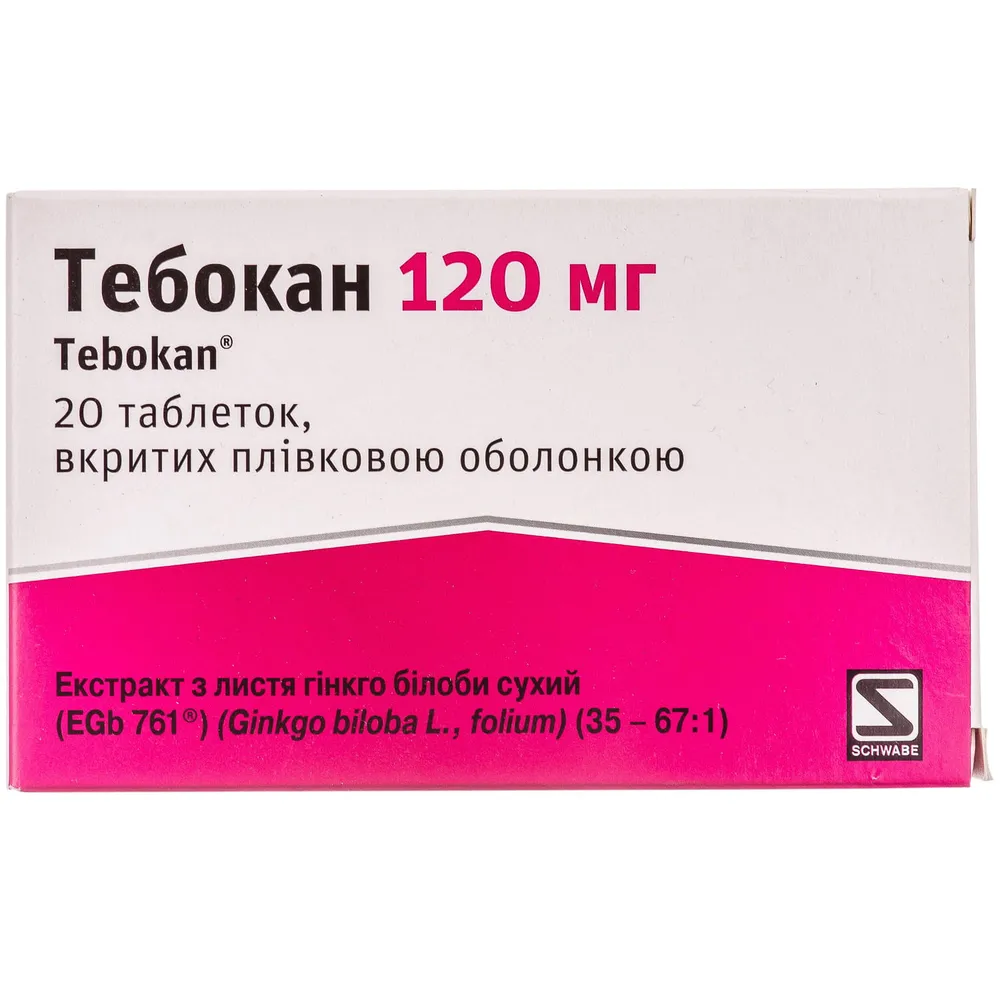
Table of Contents
INSTRUCTION FOR MEDICAL USE OF THE MEDICINAL PRODUCT TEBOKAN
Composition:
Active substance: dry extract of Ginkgo biloba leaves (EGb 761®) (Ginkgo biloba L., folium);
One film-coated tablet contains dry extract of Ginkgo biloba leaves (EGb 761®) (Ginkgo biloba L., folium) (35–67:1), extractant: acetone 60% (m/m) 120 mg, standardized to 26.4–32.4 mg flavonoids as flavonoid glycosides; 6.48–7.92 mg terpene lactones, of which 3.36–4.08 mg are ginkgolides A, B, and C and 3.12–3.84 mg bilobalide, and not more than 0.6 μg ginkgolic acids;
Excipients: lactose monohydrate, microcrystalline cellulose, corn starch, colloidal anhydrous silicon dioxide, sodium croscarmellose, magnesium stearate, hypromellose, macrogol 1500, titanium dioxide (E 171), iron oxide red (E 172), talc, anti-adherent emulsion SE 2: dimethicone, colloidal anhydrous silicon dioxide, α-octadecyl-ω-hydroxypoly(ethylene oxide)-5, sorbic acid.
Pharmaceutical form. Film-coated tablets.
Main physicochemical characteristics: red-colored, round, smooth, film-coated tablets.
Pharmacotherapeutic group.
Drugs used in dementia. ATC code N06DX02.
Pharmacological Properties.
Pharmacodynamics.
Pharmacological studies have demonstrated that the standardized extract of Ginkgo biloba (EGb 761®), contained in Tebokan, enhances tolerance to hypoxia, particularly in brain tissues; inhibits the development and accelerates the regression of brain edema caused by trauma or intoxication; reduces retinal edema and corneal damage; inhibits age-related decline in muscarinic cholinergic and alpha-2-adrenergic receptors, as well as age-related increase in hippocampal choline uptake; improves memory and learning ability; enhances compensation of balance disorders; increases blood flow, especially in the microcirculation area; improves blood rheological properties; inactivates toxic oxygen radicals (due to flavonoids); exhibits antagonism (due to ginkgolides) toward platelet-activating factor and exerts neuroprotective effects (due to ginkgolides A and B, and bilobalide).
Pharmacokinetics.
The cerebral bioavailability of the standardized Ginkgo biloba extract (EGb 761®) contained in the medicinal product Tebokan has been demonstrated in humans using pharmacologically based EEG, based on dose-dependent effects on brain electrical activity. After oral administration of 80 mg of the standardized Ginkgo biloba extract, the terpene lactones—ginkgolide A, ginkgolide B, and bilobalide—demonstrated absolute bioavailability in humans of 98% for ginkgolide A, 79% for ginkgolide B, and 72% for bilobalide. Maximum plasma concentrations were 15 ng/mL for ginkgolide A, 4 ng/mL for ginkgolide B, and approximately 12 ng/mL for bilobalide. Elimination half-lives were 3.9 hours (ginkgolide A), 7 hours (ginkgolide B), and 3.2 hours (bilobalide). Plasma protein binding is 43% for ginkgolide A, 47% for ginkgolide B, and 67% for bilobalide. The drug is excreted by the kidneys.
Clinical characteristics.
Indications.
- For the treatment of cognitive disorders due to cerebral dysfunction, including primary degenerative dementia, vascular dementia, and mixed forms, with the main symptoms such as memory impairment, reduced attention, depressive mood, dizziness, tinnitus, and headache;
- To increase the walking distance without pain during physical therapy procedures, specifically in walking exercises for patients with stage II peripheral arterial circulation disorders according to Fontaine (painful cramps, intermittent claudication, paresthesia of lower limbs, etc.);
- Dizziness and tinnitus of vascular and involutional origin.
Contraindications.
Hypersensitivity to Ginkgo biloba extract or to any of the excipients listed in the section "Composition".
Pregnancy (see section "Use during pregnancy or breast-feeding").
Interaction with other medicinal products and other forms of interaction.
When administered concomitantly with anticoagulants (e.g., phenprocoumon, warfarin) or antiplatelet agents (e.g., clopidogrel, acetylsalicylic acid, and other nonsteroidal anti-inflammatory drugs), the effect of these agents may be enhanced.
Research data on concomitant use with warfarin do not indicate a significant interaction; however, appropriate monitoring is recommended at the beginning of therapy, when changing dosage, discontinuing, or replacing the medication.
Special precautions for use.
The first signs of improvement appear one month after starting treatment.
Before initiating treatment with Tebonin, it is necessary to determine whether the observed pathological symptoms are not consequences of an underlying disease requiring specific treatment.
If dizziness and tinnitus occur frequently, medical advice should always be sought. In case of sudden hearing impairment or hearing loss, immediate medical consultation is required.
In patients with a pathological tendency to bleeding (hemorrhagic diathesis), as well as when the drug is used concomitantly with anticoagulants, Tebonin should be administered only after consultation with a physician.
Medicinal products containing Ginkgo biloba extract may increase the risk of bleeding; therefore, their use should be discontinued 3–4 days prior to surgical interventions.
In patients with epilepsy, an increase in epileptic seizures caused by taking medicinal products containing Ginkgo biloba leaf extract cannot be excluded.
Since this medicinal product contains lactose, it is contraindicated in patients with congenital galactosemia, glucose-galactose malabsorption syndrome, or lactase deficiency.
Use during pregnancy or breastfeeding.
Pregnancy. This medicinal product is contraindicated during pregnancy.
Breastfeeding. There is no evidence that Ginkgo metabolites are excreted in breast milk. However, risk to newborns and infants cannot be excluded. Due to the lack of clinical data, the drug is not recommended during breastfeeding.
Fertility. Animal studies have not revealed any harmful effects of Tebonin on fertility.
Ability to influence reaction speed when driving or operating machinery.
There have been no reports regarding the ability of the medicinal product to affect reaction speed when driving or operating machinery.
Dosage and Administration
For dementia, take 1 tablet (corresponding to 120 mg of ginkgo extract) twice daily.
For peripheral arterial circulation disorders and to increase the distance the patient can walk without pain, take 1 tablet 1–2 times daily.
For vertigo and vascular or involutional tinnitus, take 1 tablet 1–2 times daily.
Film-coated tablets should be taken orally, without chewing, with a small amount of liquid, in the morning and evening (twice daily). Tablet intake is independent of food intake.
For dementia, treatment duration depends on symptom severity and should last at least 8 weeks. After 3 months of treatment, the need for continued therapy should be reassessed.
For peripheral arterial circulation disorders, the minimum treatment period is 6 weeks.
For vertigo, further symptom improvement is generally not expected after 6–8 weeks of treatment.
For tinnitus, treatment duration should last at least 12 weeks. If no improvement occurs within 6 months, further symptom relief is unlikely.
Children
The drug is not recommended for children.
Overdose
Cases of overdose have not been reported.
Side effects.
Possible side effects:
- Blood and lymphatic system disorders: bleeding in individual organs (frequency unknown);
- Gastrointestinal disorders: mild gastrointestinal disturbances such as abdominal pain, diarrhea, dyspeptic symptoms, nausea, vomiting (frequency unknown);
- Nervous system disorders: headache (frequency unknown);
- Immune system disorders: hypersensitivity reactions, urticaria, dyspnea (frequency unknown);
- Skin disorders: allergic skin reactions such as redness, swelling, itching, rash, eczema (frequency unknown).
If any side effects occur, discontinue use of the medication and consult a physician.
Shelf life.
5 years.
Do not use the medicinal product after the expiry date stated on the packaging.
Storage conditions.
No special storage conditions required. Keep out of reach and sight of children.
Packaging.
20 film-coated tablets in a blister; 1, 2 or 3 blisters per pack.
Availability.
Over-the-counter.
Manufacturer.
Dr. Willmar Schwabe GmbH & Co. KG.
Manufacturer's address and place of business:
Willmar-Schwabe-Strasse 4, 76227 Karlsruhe, Germany.