Tyverb
Ukraine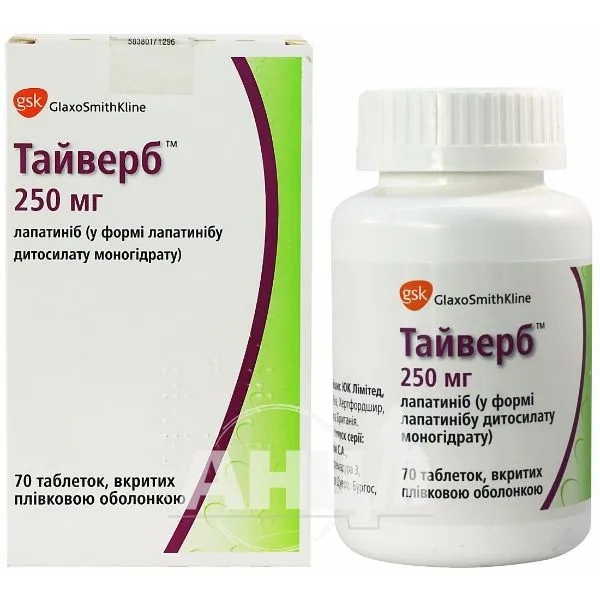
Table of Contents
INSTRUCTION FOR MEDICAL USE OF THE MEDICINAL PRODUCT TAIYVERB (TYVERB)
Composition:
Active substance: lapatinib;
One tablet contains 250 mg of lapatinib in the form of lapatinib ditosylate monohydrate;
Excipients: microcrystalline cellulose, povidone K30, sodium starch glycolate (type A), magnesium stearate, Opadry® Yellow YS-1-12524-A (hypromellose, titanium dioxide (E 171), polyethylene glycol 400, polysorbate 80, yellow iron oxide (E 172), red iron oxide (E 172)).
Pharmaceutical form. Film-coated tablets.
Main physicochemical characteristics: film-coated, oval, biconvex yellow tablets, flat on one side and marked with GS XJG on the other side.
Pharmacotherapeutic group. Antineoplastic agents. Inhibitors of human epidermal growth factor receptor 2 (HER2) tyrosine kinase. ATC code L01EH01.
Pharmacological properties.
Pharmacodynamics.
Mechanism of action. Lapatinib, a 4-anilinoquinazoline, is an inhibitor of the intracellular domains of tyrosine kinase receptors EGFR (ErbB1) and HER2 (ErbB2) (calculated Kiapp values of 3 nM and 13 nM, respectively) with slow dissociation from these receptors (elimination half-life ≥ 300 min). Lapatinib inhibits ErbB-driven tumor cell growth in vitro and in various animal models.
The combination of lapatinib and trastuzumab may demonstrate complementary mechanisms of action, as well as potentially different resistance mechanisms. The ability of lapatinib to inhibit growth has been studied in cell lines exposed to trastuzumab. Lapatinib retained significant activity against HER2-amplified breast cancer cell lines selected for prolonged growth in trastuzumab-containing medium in vitro, and demonstrated additive effects when combined with trastuzumab in these cell lines.
Pharmacokinetics.
Absorption. After oral administration, lapatinib is incompletely and variably absorbed (coefficient of variation of AUC approximately 70%). Serum concentrations appear after a median lag time of 0.25 hours (range 0 to 1.5 hours). Peak plasma concentrations (Cmax) of lapatinib are reached approximately 4 hours after administration. Daily administration of a 1250 mg dose results in geometric mean Cmax values at steady state (coefficient of variation) of 2.43 (76%) µg/mL, and AUC values of 36.2 (79%) µg*h/mL.
Systemic exposure to lapatinib increases when administered with food. AUC increases by 3- and 4-fold (Cmax by approximately 2.5- and 3-fold, respectively) when administered with a low-fat meal (5% fat [500 calories]) or a high-fat meal (50% fat [1000 calories]), compared to fasting conditions. The timing of food intake also affects systemic exposure to lapatinib. Compared to administration 1 hour before a low-fat breakfast, mean AUC values increased approximately 2- and 3-fold when lapatinib was taken 1 hour after a low-fat or high-fat meal, respectively.
Distribution. Lapatinib is highly bound (>99%) to albumin and alpha-1 acid glycoprotein. In vitro studies have shown that lapatinib is a substrate for the efflux transporters BCRP (breast cancer resistance protein) and Pgp (ABCB1). Additionally, in vitro, lapatinib inhibits these efflux transporters as well as the hepatic uptake transporter OATP1B1 at clinically relevant concentrations (IC50 values equal to 2.3 µg/mL). The clinical significance of these effects on the pharmacokinetics of other drugs, as well as on the pharmacological activity of other anticancer agents, is unknown.
Biological transformation. Lapatinib undergoes extensive metabolism, primarily via CYP3A4 and CYP3A5, and to a lesser extent via CYP2C19 and CYP2C8, resulting in various oxidized metabolites, none of which exceeds 14% of the dose excreted in feces or 10% of lapatinib plasma concentrations.
Lapatinib inhibits CYP3A and CYP2C8 in vitro at clinically relevant concentrations. Lapatinib weakly inhibits hepatic microsomal enzymes CYP1A2, CYP2C9, CYP2C19, and CYP2D6, or UGT enzymes (in vitro IC50 values ≥ 6.9 µg/mL).
Elimination. Elimination half-life increases in a dose-dependent manner after single doses. Steady state is achieved within 6–7 days of dosing. The elimination half-life at steady state is 24 hours. Lapatinib is eliminated primarily via metabolism mediated by CYP3A4/5. Biliary excretion also contributes to elimination. Lapatinib and its metabolites are excreted predominantly in feces. Unchanged lapatinib accounts for a mean of 27% (range 3 to 67%) of the oral dose excreted in feces. Less than 2% of the administered oral dose (as lapatinib and metabolites) is excreted in urine.
Renal impairment. Specific pharmacokinetic studies of lapatinib in patients with renal impairment or in patients undergoing hemodialysis have not been conducted. Available data suggest that patients with mild to moderate renal impairment do not require dose adjustment.
Hepatic impairment. The pharmacokinetics of lapatinib were studied in patients with moderate (n = 8) and severe (n = 4) hepatic impairment compared to those with normal hepatic function (n = 8) in healthy volunteers. Systemic exposure (AUC) to lapatinib after a single 100 mg dose increased by 56% and 85% in patients with moderate and severe hepatic impairment, respectively. Lapatinib should be used with caution in patients with impaired liver function.
Clinical characteristics.
Indications.
Treatment of adult female patients with HER2-overexpressing (ErbB2) breast cancer:
- in combination with capecitabine for patients with advanced or metastatic disease whose disease has progressed on prior trastuzumab therapy in combination with anthracyclines and taxanes for metastatic disease;
- in combination with trastuzumab for patients with metastatic, hormone receptor-negative breast cancer whose disease has progressed after trastuzumab-containing chemotherapy;
- in combination with an aromatase inhibitor for postmenopausal women with metastatic, hormone receptor-positive breast cancer who have not received chemotherapy; patients in the registration trial had not been previously treated with trastuzumab or aromatase inhibitors; there are no data on the efficacy of this combination compared to trastuzumab in combination with an aromatase inhibitor in this patient group.
Contraindications.
Hypersensitivity to any component of the medicinal product.
Interaction with other medicinal products and other forms of interaction.
Effect of other medicinal products on lapatinib
Lapatinib is primarily metabolized by CYP3A (see section "Pharmacokinetics").
Concomitant administration with the strong CYP3A4 inhibitor ketoconazole (200 mg twice daily for 7 days) in healthy volunteers increased systemic exposure to lapatinib (100 mg once daily) by approximately 3.6-fold, and the elimination half-life increased by 1.7-fold. Concomitant use of Tyverb with strong CYP3A4 inhibitors (such as ritonavir, saquinavir, telithromycin, ketoconazole, itraconazole, voriconazole, posaconazole, nefazodone) should be avoided. Caution should be exercised and careful monitoring of the patient's clinical status and possible adverse reactions is recommended when Tyverb is used concomitantly with moderate CYP3A4 inhibitors.
Concomitant administration with the CYP3A4 inducer carbamazepine (100 mg twice daily for 3 days and 200 mg twice daily for 17 days) in healthy volunteers decreased systemic exposure to lapatinib by approximately 72%. Concomitant use of Tyverb with known CYP3A4 inducers (e.g., rifampicin, rifabutin, carbamazepine, phenytoin, or St John's wort) should be avoided.
Lapatinib is a substrate for the transporter proteins Pgp and BCRP (breast cancer resistance protein). Inhibitors (ketoconazole, itraconazole, quinidine, verapamil, cyclosporine, erythromycin) and inducers (rifampicin, St John's wort) of these proteins may alter the exposure and/or distribution of lapatinib (see section "Pharmacokinetics").
The solubility of lapatinib is pH-dependent. Concomitant use with agents that increase gastric pH should be avoided, as the solubility and absorption of lapatinib may be reduced. Prior treatment with a proton pump inhibitor (esomeprazole) reduces lapatinib exposure by an average of 27% (ranging from 6 to 49%). This effect diminishes with increasing patient age from 40 to 60 years.
Effect of lapatinib on other medicinal products
Lapatinib inhibits CYP3A4 in vitro at clinically relevant concentrations. Concomitant administration of Tyverb with oral midazolam increases the AUC of midazolam by approximately 45%. When midazolam is administered intravenously, no clinically significant increase in midazolam AUC is observed. Concomitant use of lapatinib with orally administered medicinal products with a narrow therapeutic index that are CYP3A4 substrates, such as cisapride, pimozide, or quinidine, should be avoided (see sections "Special warnings and precautions for use" and "Pharmacokinetics").
Lapatinib inhibits CYP2C8 in vitro at clinically relevant concentrations. Concomitant use of Tyverb with medicinal products with a narrow therapeutic index that are CYP2C8 substrates (e.g., repaglinide) should be avoided (see sections "Special warnings and precautions for use" and "Pharmacokinetics").
Concomitant administration of lapatinib with intravenous paclitaxel increases paclitaxel exposure by 23%, due to inhibition of CYP2C8 and/or P-glycoproteins (Pgp) by lapatinib. Clinical studies have shown that this combination increases the frequency and severity of diarrhea and neutropenia. Lapatinib in combination with paclitaxel should be used with caution.
Concomitant administration of lapatinib with intravenous docetaxel does not significantly affect the AUC or Cmax of either active substance. However, the frequency of docetaxel-induced neutropenia increases.
Concomitant administration of Tyverb with irinotecan (when used as part of the FOLFIRI regimen) increases the AUC of SN-38, the active metabolite of irinotecan, by approximately 40%. The exact mechanism of this interaction is unknown, but it is presumed to be related to inhibition of one or more transporter proteins by lapatinib. Tyverb should be used with caution when combined with irinotecan, with close monitoring of adverse reactions and consideration of the need to reduce the dose of irinotecan.
Lapatinib inhibits the Pgp transporter protein in vitro at clinically relevant concentrations. Concomitant administration of lapatinib with oral digoxin increases the AUC of digoxin by approximately 80%. Tyverb should be used with caution when combined with medicinal products with a narrow therapeutic index that are substrates of Pgp transporter proteins.
Lapatinib inhibits the BCRP and OATP1B1 transporter proteins in vitro. The clinical significance of these effects has not been studied. It cannot be excluded that lapatinib may affect the pharmacokinetics of BCRP substrates (e.g., topotecan) and OATP1B1 substrates (e.g., rosuvastatin) (see section "Pharmacokinetics").
Concomitant administration of Tyverb with capecitabine, letrozole, or trastuzumab does not significantly affect the pharmacokinetic parameters of these medicinal products (or metabolites of capecitabine) or lapatinib.
Interactions with food and beverages
The bioavailability of lapatinib increases up to 4-fold when administered with food, depending on the fat content of the meal. Moreover, depending on the type of food, the bioavailability of lapatinib is approximately 2–3 times higher when the drug is taken 1 hour after a meal compared to when it is taken 1 hour before the first meal of the day (see sections "Posology and method of administration" and "Pharmacokinetics").
Grapefruit juice may inhibit CYP3A4 in the intestinal wall and increase the bioavailability of lapatinib; therefore, its consumption should be avoided during treatment with Tyverb.
Special precautions for use.
Data indicate that the combination of Tyverb with chemotherapy is less effective than the combination of trastuzumab with chemotherapy.
Cardiotoxicity
Left ventricular ejection fraction (LVEF) reduction has been reported with lapatinib use (see section "Adverse reactions"). Lapatinib has not been evaluated in patients with symptomatic heart failure. Lapatinib should be used with caution in patients with left ventricular dysfunction (including concomitant use with potentially cardiotoxic medicinal products). Prior to initiating treatment with Tyverb, LVEF should be assessed in all patients to confirm that baseline levels are within normal limits. Monitoring of LVEF should continue during treatment with Tyverb to prevent a decline below acceptable limits (see section "Dosage and administration"). In some cases, reduction in LVEF may be severe and may lead to heart failure. Fatal events have been reported, although the cause remains unclear. In clinical trials of lapatinib, cardiac adverse reactions, including reduction in LVEF, were observed in approximately 1% of patients receiving lapatinib. Symptomatic reductions in LVEF occurred in approximately 0.3% of patients receiving lapatinib. However, in a pilot clinical trial evaluating lapatinib in combination with trastuzumab in patients with metastatic disease, the incidence of cardiac adverse reactions, including reduction in LVEF, was higher (7%) compared to lapatinib monotherapy (2%). The nature and severity of cardiac adverse reactions in this study were similar to those previously observed with lapatinib use.
Concentration-dependent QTc interval prolongation has been demonstrated in a dedicated placebo-controlled crossover study in patients with advanced solid tumors.
Therefore, Tyverb should be used with caution in patients with conditions that may predispose to QT prolongation (such as hypokalemia, hypomagnesemia, and congenital long QT syndrome), when used concomitantly with other medicinal products that may prolong the QT interval or increase lapatinib exposure, such as strong CYP3A4 inhibitors.
Hypokalemia and hypomagnesemia should be corrected prior to starting treatment. Electrocardiography (ECG) with QT interval measurement should be performed before starting treatment and 1–2 weeks after initiation of Tyverb therapy.
ECG monitoring should be performed as clinically indicated, for example, after initiating concomitant medications that may affect the QT interval or interact with lapatinib.
Interstitial lung disease and pneumonitis
Lapatinib use has been associated with pulmonary toxicity, including interstitial lung disease and pneumonitis (see section "Adverse reactions"). Patients should be monitored for symptoms of pulmonary toxicity (dyspnea, cough, fever), and treatment should be discontinued in patients who develop Grade 3 or higher symptoms (according to the National Cancer Institute Adverse Event Classification). Pulmonary toxicity may be severe and may lead to respiratory failure. Fatal cases have been reported, although the causes remain unclear.
Hepatotoxicity
Hepatotoxicity has been reported during treatment with Tyverb, which in rare cases may lead to fatal outcomes. Hepatotoxicity may occur from several days after initiation of treatment up to several months. At the start of therapy, patients should be informed about the potential for hepatotoxicity. Liver function (transaminases, bilirubin, and alkaline phosphatase levels) should be assessed prior to starting treatment, monthly during treatment, and as clinically indicated. If liver function abnormalities are severe, treatment with Tyverb should be discontinued and not resumed. Patients who are carriers of the HLA alleles DQA1*02:01 and DRB1*07:01 have an increased risk of hepatotoxicity associated with Tyverb use. In a large randomized clinical trial of Tyverb monotherapy (1194 patients), the overall risk of severe hepatic injury (ALT >5 times the upper limit of normal, Grade 3 severity according to the National Cancer Institute classification) was 2.8% after 1 year of treatment. The overall incidence in carriers of DQA1*02:01 and DRB1*07:01 alleles was 10.3%, compared to 0.5% in patients without these alleles. HLA allele carriage is common (15–25%) among Europeans, Asians, African Americans, and Latin Americans, but lower (1%) in Japanese.
Tyverb should be used with caution in patients with moderate or severe hepatic impairment and in patients with severe renal impairment (see sections "Dosage and administration" and "Pharmacokinetics").
Diarrhea
Diarrhea, including severe cases, has been reported with Tyverb use (see section "Adverse reactions"). Diarrhea may be potentially life-threatening if associated with dehydration, renal failure, neutropenia, and/or electrolyte imbalance. Fatal cases have been reported. Diarrhea typically occurs early during Tyverb treatment, with nearly half of affected patients experiencing onset within 6 days. Diarrhea usually lasts 4–5 days. Diarrhea associated with Tyverb is generally mild in severity; severe diarrhea (Grade 3 and Grade 4 according to the National Cancer Institute classification) occurred in <10% and <1% of patients, respectively. At the start of treatment, patients' baseline bowel patterns and any other symptoms (fever, cramping pain, nausea, vomiting, dizziness, and thirst) should be assessed to allow monitoring for changes during treatment and identification of patients at increased risk of diarrhea. Patients should be advised to promptly report any changes in bowel habits. In potentially severe cases of diarrhea, neutrophil count and body temperature should be assessed. Prompt treatment of diarrhea with antidiarrheal agents is important. In severe cases, oral or intravenous electrolyte and fluid replacement, use of antibiotics such as fluoroquinolones (especially if diarrhea persists for more than 24 hours, or if fever or Grade 3–4 neutropenia is present), and discontinuation or interruption of Tyverb may be required (see section "Dosage and administration" – "Discontinuation or dose reduction" – "Diarrhea").
Severe skin reactions
There have been reports of severe skin reactions with Tyverb use. If Stevens-Johnson syndrome or life-threatening reactions such as toxic epidermal necrolysis (e.g., progressive skin rash often with blistering or mucosal involvement) or erythema multiforme are suspected, treatment with Tyverb should be discontinued.
Concomitant use with CYP3A4 inhibitors and inducers
Concomitant use of lapatinib with CYP3A4 inhibitors or inducers should be done with caution due to increased or decreased lapatinib concentrations, respectively (see section "Interaction with other medicinal products and other forms of interaction").
Grapefruit juice should be avoided during lapatinib treatment (see section "Interaction with other medicinal products and other forms of interaction").
Concomitant use of Tyverb with other medicinal products that have a narrow therapeutic index and are substrates of CYP3A4 and/or CYP2C8 should be avoided (see section "Interaction with other medicinal products and other forms of interaction").
Concomitant use with agents that increase gastric pH should be avoided, as the solubility and absorption of lapatinib may be reduced (see section "Interaction with other medicinal products and other forms of interaction").
Sodium content
This medicinal product contains less than 1 mmol sodium (23 mg) per tablet, i.e., essentially "sodium-free".
Use during pregnancy or breastfeeding.
Women of childbearing potential
Women of childbearing potential should be advised to use appropriate contraceptive measures and to avoid pregnancy during treatment with Tyverb and for at least 5 days after the last dose.
Pregnancy
There are no data on the use of Tyverb in pregnant women. Reproductive toxicity was observed in animal studies (see section "Pharmacological properties"). The potential risk to humans is unknown.
Tyverb should not be used during pregnancy unless absolutely necessary.
Breastfeeding
The safety of Tyverb during breastfeeding has not been established. It is unknown whether lapatinib is excreted in human milk. In rats, impaired growth of pups was observed when exposed to lapatinib via breast milk. Women receiving Tyverb should discontinue breastfeeding during treatment and for at least 5 days after the last dose.
Fertility
There are no data on the use of Tyverb in women of reproductive potential.
Effect on ability to drive and use machines
Tyverb has no influence on the ability to drive or operate machinery. Given the pharmacological profile of lapatinib, a detrimental effect on such activities is unlikely. However, when assessing a patient's ability to perform tasks requiring high attention and psychomotor speed, the patient's clinical condition and the nature of adverse reactions should be considered.
Method of Administration and Dosage
Treatment with Tyverb must be prescribed only by a physician experienced in the use of anticancer agents.
The HER2 (ErbB2) overexpression status must be established by the presence of IHC 3+ or IHC 2+ with gene amplification, or by gene amplification alone. The HER2 status must be determined using accurate and validated methods.
Dosage
Tyverb in combination with capecitabine
The recommended dose of Tyverb is 1250 mg (5 tablets) once daily.
The recommended dose of capecitabine is 2000 mg/m²/day administered in two divided doses (every 12 hours) each day from day 1 to day 14 of a 21-day treatment cycle. Capecitabine should be taken with food or within 30 minutes after a meal (see the capecitabine product information for medical use).
Tyverb in combination with trastuzumab
The recommended dose of Tyverb is 1000 mg (4 tablets) once daily.
The recommended dose of trastuzumab is 4 mg/kg body weight as an intravenous loading dose, followed by 2 mg/kg body weight intravenously once weekly (see the trastuzumab product information for medical use).
Tyverb in combination with an aromatase inhibitor
The recommended dose of Tyverb is 1500 mg (6 tablets) once daily.
When Tyverb is used in combination with an alternative aromatase inhibitor, refer to the product information for medical use of that specific aromatase inhibitor.
Discontinuation or dose reduction
Cardiovascular disorders
Treatment with Tyverb should be discontinued in the event of symptoms associated with a decline in left ventricular ejection fraction to Grade 3 or higher (according to the National Cancer Institute classification) or if the ejection fraction falls below the lower limit of normal (see section "Special Warnings and Precautions"). Resumption of Tyverb treatment may be considered at a reduced dose (1000 mg/day when used with capecitabine, 750 mg/day when used with trastuzumab, or 1250 mg/day when used with an aromatase inhibitor) no sooner than 2 weeks after discontinuation and only if the left ventricular ejection fraction has returned to normal and the patient is asymptomatic.
Interstitial lung disease/Pneumonitis
Treatment with Tyverb should be discontinued in the event of pulmonary symptoms indicative of interstitial lung disease or pneumonitis of Grade 3 or higher (according to the National Cancer Institute toxicity classification) (see section "Special Warnings and Precautions").
Diarrhea
Treatment with Tyverb should be interrupted in the event of Grade 3 diarrhea or Grade 1 or 2 diarrhea (according to the National Cancer Institute toxicity classification) with signs of complications (moderate to severe abdominal cramping, nausea or vomiting of Grade 2 or higher severity, reduced performance status, fever, sepsis, neutropenia, overt bleeding, or dehydration) (see sections "Special Warnings and Precautions" and "Adverse Reactions"). Treatment with Tyverb may be resumed at a reduced dose (from 1000 mg/day to 750 mg/day, from 1250 mg/day to 1000 mg/day, or from 1500 mg/day to 1250 mg/day) once diarrhea resolves to Grade 1 or lower. Treatment with Tyverb should be permanently discontinued in the event of Grade 4 diarrhea (according to the National Cancer Institute toxicity classification).
Other toxicities
A decision to discontinue or interrupt treatment may be made if the level of toxicity in the patient is greater than or equal to Grade 2 according to the National Cancer Institute toxicity classification. Treatment may be resumed at the standard dose of 1250 mg/day when used with capecitabine, 1000 mg/day when used with trastuzumab, or 1500 mg/day when used with an aromatase inhibitor, once toxicity resolves to Grade 1 or lower. In the event of recurrence of toxicities, the dose of Tyverb may be reduced to 1000 mg/day when used with capecitabine, 750 mg/day when used with trastuzumab, or 1250 mg/day when used with an aromatase inhibitor.
Renal impairment
No dose adjustment is required in patients with mild to moderate renal impairment. Tyverb should be used with caution in patients with severe renal impairment due to lack of experience in this patient population.
Hepatic impairment
Tyverb should be discontinued and never reinitiated in patients with severe hepatic impairment (see section "Special Warnings and Precautions").
Due to increased drug exposure, Tyverb should be used with caution in patients with moderate or severe hepatic impairment. Currently, there are insufficient data to provide dose adjustment recommendations for patients with hepatic impairment.
Elderly patients
Data on the use of Tyverb in combination with capecitabine and Tyverb in combination with trastuzumab in patients aged 65 years and older are limited.
In a Phase III clinical trial of Tyverb in combination with letrozole in patients with hormone receptor-positive metastatic breast cancer (all randomized patients in the as-treated population, N = 642), 44% of participants were aged 65 years or older. Overall, no differences in efficacy and safety were observed between these patients and those under 65 years of age.
Method of administration
Tyverb is intended for oral administration.
The daily dose of Tyverb should not be split. Tyverb should be taken at least one hour before or at least one hour after a meal. To minimize individual variability, administration of Tyverb should be standardized relative to food intake for each patient—for example, always taken one hour before a meal (see sections "Interaction with Other Medicinal Products and Other Forms of Interaction" and "Pharmacokinetics" for information on absorption).
Missed doses should not be made up; the next dose should be taken according to the regular schedule (see section "Overdose").
When co-administering with other medicinal products, refer to the product information for medical use of those products for dosing instructions, including dose reductions, contraindications, and safety information.
Children
The safety and efficacy of Tyverb in children (under 18 years of age) have not been established. No data are available.
Overdose
There is no specific antidote for inhibition of EGFR (ErbB1) and/or HER2 (ErbB2) tyrosine phosphorylation. The maximum daily dose used in clinical studies was 1800 mg.
Cases of overdose, both asymptomatic and symptomatic, have been reported in patients treated with Tyverb. In patients who received up to 5000 mg of lapatinib, symptoms included known adverse reactions associated with Tyverb (see section "Adverse Reactions"), and in some cases, scalp hair changes and/or mucosal inflammation, sinus tachycardia (with normal ECG), and/or mucositis. In one case, a patient who ingested 9000 mg of Tyverb also developed sinus tachycardia (with normal ECG).
Renal excretion is not a major route of elimination of Tyverb, and the drug is highly protein-bound; therefore, hemodialysis is unlikely to be an effective method of drug elimination. Symptomatic treatment should be administered according to the patient's clinical condition or in accordance with national guidelines for the management of poisoning.
Adverse reactions
The safety of Tyverb (lapatinib) has been evaluated both as monotherapy and in combination with other chemotherapeutic agents for the treatment of various types of cancer in more than 20,000 patients, including 198 patients who received lapatinib in combination with capecitabine, 149 patients who received lapatinib in combination with trastuzumab, and 654 patients who received lapatinib in combination with letrozole (see section "Pharmacological properties").
The most commonly reported adverse reactions (> 25%) during treatment with lapatinib were gastrointestinal disorders (such as diarrhea, nausea, and vomiting) and rash. Palmar-plantar erythrodysesthesia [PPE] was also frequently observed when lapatinib was administered in combination with capecitabine (> 25%). The incidence of PPE was similar in the groups receiving lapatinib plus capecitabine and capecitabine as monotherapy. Diarrhea was the most common adverse reaction leading to treatment discontinuation when lapatinib was used in combination with capecitabine or with letrozole.
When lapatinib was administered in combination with trastuzumab, no additional adverse reactions were reported. An increased frequency of cardiac toxicity was observed; however, these events were similar in nature and severity to those observed in the lapatinib clinical trial program (see section "Special warnings and precautions for use". Cardiotoxicity). These data are based on exposure to this combination in 149 patients in the main clinical trial.
List of adverse reactions in tabular form
The adverse reactions listed below have been reported and are considered causally related to the administration of lapatinib as monotherapy or in combination with capecitabine, trastuzumab, or letrozole.
The following classification of adverse reaction frequencies is applied: very common (≥ 1/10); common (≥ 1/100 to < 1/10); uncommon (≥ 1/1,000 to < 1/100); rare (≥ 1/10,000 to < 1/1,000); very rare (< 1/10,000); frequency not known (frequency cannot be estimated from the available data).
Within each frequency category, adverse reactions are listed in order of decreasing severity.
| Immune system disorders |
|
| Isolated |
Hypersensitivity reactions, including anaphylaxis (see section "Contraindications") |
| Metabolism and nutrition disorders |
|
| Very common |
Anorexia |
| Psychiatric disorders |
|
| Very common |
Insomnia* |
| Nervous system disorders |
|
| Very common |
Headache† |
| Common |
Headache* |
| Cardiovascular system |
|
| Common |
Decreased left ventricular ejection fraction (see section "Dosage and administration" – "Discontinuation or dose reduction" – "Cardiovascular disorders" and section "Special precautions") |
| Frequency unknown |
Ventricular arrhythmias/torsades de pointes, QT interval prolongation on ECG** |
| Vascular disorders |
|
| Very common |
Hot flushes† |
| Respiratory system |
|
| Very common |
Nosebleed†, cough†, dyspnea† |
| Uncommon |
Interstitial lung disease/pneumonitis |
| Frequency unknown |
Pulmonary arterial hypertension** |
| Gastrointestinal system |
|
| Very common |
Diarrhea, which may lead to dehydration (see section "Dosage and administration" – "Discontinuation or dose reduction" – "Other manifestations of drug toxicity" and section "Special precautions"), nausea, vomiting, dyspepsia*, stomatitis*, constipation*, abdominal pain* |
| Common |
Constipation† |
| Hepatobiliary system |
|
| Common |
Hyperbilirubinemia, hepatotoxicity (see section "Special precautions") |
| Skin and subcutaneous tissue |
|
| Very common |
Rash (including acneiform dermatitis) (see section "Dosage and administration" – "Discontinuation or dose reduction" – "Other manifestations of drug toxicity"), dry skin*†, palmar-plantar erythrodysesthesia*, alopecia†, pruritus† |
| Common |
Nail disorders, including paronychia; skin fissures |
| Frequency unknown |
Severe skin reactions, including Stevens-Johnson syndrome (SJS) and toxic epidermal necrolysis (TEN)** |
| Musculoskeletal and connective tissue disorders |
|
| Very common |
Limb pain*†, back pain*†, arthralgia† |
| General disorders |
|
| Very common |
Weakness, mucosal inflammation (mucositis)*, asthenia† |
* These adverse reactions were observed during the use of lapatinib in combination with capecitabine.
† These adverse reactions were observed during the use of lapatinib in combination with letrozole.
** Adverse reactions obtained from spontaneous reports and publications.
Description of selected adverse reactions
Decreased left ventricular ejection fraction and QT interval prolongation
Decreased left ventricular ejection fraction (LVEF) was observed in approximately 1% of patients receiving lapatinib, with over 70% of cases being asymptomatic. Condition improved or recovered in over 70% of cases, of which nearly 60% continued receiving lapatinib and approximately 40% had lapatinib treatment continued. Symptomatic reduction in LVEF occurred in 0.3% of patients receiving lapatinib as monotherapy or in combination with other anticancer medicinal products. Symptoms included dyspnea, heart failure, and palpitations. Overall, 58% of patients who remained asymptomatic recovered. Decreased LVEF was observed in 2.5% of patients receiving lapatinib in combination with capecitabine, compared to 1.0% of patients receiving capecitabine as monotherapy. Decreased LVEF occurred in 3.1% of patients receiving lapatinib in combination with letrozole, compared to 1.3% of patients receiving letrozole plus placebo. Decreased LVEF was observed in 6.7% of patients receiving lapatinib in combination with trastuzumab, compared to 2.1% of patients receiving lapatinib as monotherapy.
Concentration-dependent QT interval prolongation (maximum mean ΔΔQTcF 8.75 s; 90% CI 4.08, 13.42) was observed in a dedicated study in patients with advanced solid tumors (see section "Special precautions for use").
Diarrhea
Diarrhea was observed in approximately 65% of patients receiving lapatinib in combination with capecitabine, in 64% of patients receiving lapatinib in combination with letrozole, and in 62% of patients receiving lapatinib in combination with trastuzumab. Most cases of diarrhea were of mild to moderate severity and did not lead to discontinuation of lapatinib treatment. Diarrhea responded well to prophylactic treatment (see section "Special precautions for use"). However, there have been reports of several cases of acute renal failure secondary to severe dehydration due to diarrhea.
Rash
Rash was observed in approximately 28% of patients receiving lapatinib in combination with capecitabine, in 45% of patients receiving lapatinib in combination with letrozole, and in 23% of patients receiving lapatinib in combination with trastuzumab. Rash was usually mild in severity and did not lead to discontinuation of lapatinib treatment. Physicians prescribing the medicinal product are advised to perform a skin examination before treatment initiation and regularly during treatment. Patients experiencing skin reactions should be advised to avoid exposure to sunlight and to use sunscreen with SPF ≥ 30. In the event of a skin reaction, a full-body examination should be performed at each visit until one month after resolution of the reaction. Patients with severe or persistent skin reactions should be referred to a dermatologist.
Hepatotoxicity
The risk of lapatinib-induced hepatotoxicity has been associated with carriage of HLA alleles DQA1*02:01 and DRB1*07:01 (see section "Special precautions for use").
Reporting of suspected adverse reactions.
Reporting suspected adverse reactions after medicinal product authorization is important. It allows continued monitoring of the benefit-risk balance of the medicinal product. Healthcare and pharmaceutical professionals, as well as patients or their legal representatives, should report all suspected adverse reactions and lack of efficacy via the Automated Pharmacovigilance Information System at the following link: https://aisf.dec.gov.ua
Shelf life.
Vial: 3 years.
Blister: 2 years.
Storage conditions.
Store at temperatures not exceeding 30 °C. Keep out of reach of children.
Packaging.
10 or 12 tablets per blister; 7 blisters per cardboard box.
70 or 84 tablets per vial; 1 vial per cardboard box.
Prescription status. Prescription only.
Manufacturer.
Sandoz S.R.L.
Manufacturer's address and location of its operations.
Str. Livezeni No. 7A, 540472, Tirgu Mures, Mures County, Romania.